Ripple Calls XRPL Permissioned Domains A ‘Gamechanger’ As Go-Live Nears

bitcoinist2026-01-14 tarihinde yayınlandı2026-01-14 tarihinde güncellendi

Özet

RippleX announces that the XRP Ledger's "Permissioned Domains" amendment is nearing activation, requiring an 80% validator consensus. Currently at 76.47%, this feature introduces institutional-grade access controls on the public blockchain, enabling regulated entities to use permissioned trading and lending protocols without private infrastructure. It paves the way for a Permissioned DEX, limiting market interactions to approved participants, and supports future applications like on-chain foreign exchange and lending. The community highlights the need for more stablecoins and real-world assets to boost liquidity. XRP price is noted at $2.15.

Ripple’s developer arm RippleX says the XRP Ledger’s “Permissioned Domains” amendment is nearing its activation threshold, positioning the network to roll out institution-friendly access controls that could underpin a permissioned version of XRPL’s native decentralized exchange.

In a series of posts on X late Tuesday, RippleX framed Permissioned Domains as a “gamechanger” enabling layer for “permissioned flows” on a public blockchain, an approach aimed squarely at regulated firms that want on-chain settlement and trading without adopting fully private infrastructure.

Ripple’s Next ‘Gamechanger’ For The XPR Ledger

Via X, RippleX said: “The amendment for Permissioned Domains is nearing the threshold for activation.Ripple supports this feature, as well as the Permissioned DEX which this will ultimately enable. “

Under XRPL’s governance process, amendments become active after maintaining a 80% validator supermajority for a sustained period. According to xrpl.org, the PermissionedDEX is currently open for voting and has reached 50.00% thus far, while the PermissionedDomains amendment stands at 76.47%.

RippleX describes the feature as a “game-changer for XRPL because they bring institutional-grade controls to a public network, without sacrificing the trade-offs of a private chain.”

The company further writes: “While the Permissioned Domains amendment is an enabling feature, it sets the stage for financial institutions to engage in permissioned flows on a fast, scalable, and resilient blockchain network, the XRPL. The Permissioned DEX will enable permissioned trading flows, and the upcoming lending protocol may apply Permissioned Domains for controlled lending and borrowing flows.”

On XRPL’s documentation, permissioned domains are described as controlled environments that “do nothing on their own,” but can be used by higher-level features, such as permissioned DEX functionality and lending protocols,to restrict and manage access for compliance-driven deployments. Permissioned DEXes are the practical endpoint: regulated entities participating in XRPL’s native order books while enforcing who can interact with specific markets.

“Traditionally, any XRPL DEX offer can be matched by anyone. A permissioned DEX changes that,” Ripple wrote, describing permissioned trading as rules-based matching limited to approved participants.

RippleX also points to adjacent roadmap items, including an upcoming lending protocol that could apply the same domain-based controls to borrowing and lending flows, suggesting the design pattern is intended to extend beyond trading into broader onchain finance primitives.

The announcement drew immediate interest from XRP community voices. Popular community member Krippenreiter highlighted “on-chain FX” as a headline application, while Anodos Finance CEO Panos Mekras responded that “the only thing left is to bring the actual assets and liquidity to flow.” Krippenreiter agreed, calling for “more stablecoins, RWAs, and more market making.”

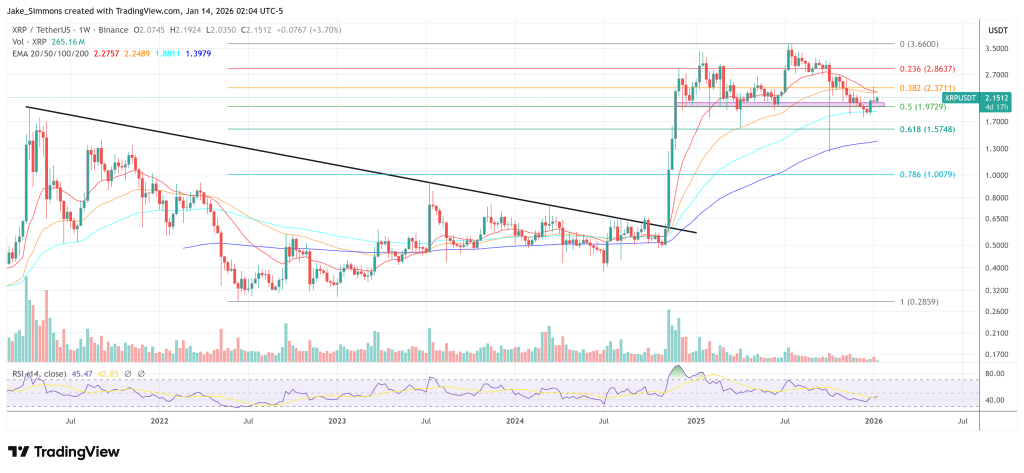
At press time, XRP traded at $2.15.

XRP needs to reclaim the 0.382 Fib, 1-week chart | Source: XRPUSDT on TradingView.com

İlgili Sorular

QWhat is the 'Permissioned Domains' amendment on the XRP Ledger and why is it significant?

AThe 'Permissioned Domains' amendment is an enabling feature that introduces institution-grade access controls to the public XRP Ledger network. It is significant because it allows for 'permissioned flows' on a public blockchain, enabling regulated firms to use on-chain settlement and trading without having to adopt fully private infrastructure, thus combining the benefits of a public network with the controls of a private chain.

QWhat is the governance process for activating an amendment on the XRPL, and what is the current status of the PermissionedDomains vote?

AUnder XRPL's governance process, an amendment becomes active after it maintains an 80% validator supermajority for a sustained period. At the time of the article, the PermissionedDomains amendment had reached 76.47% of the vote.

QHow does a Permissioned DEX differ from the traditional XRPL DEX?

ATraditionally, any offer on the XRPL DEX can be matched by any participant. A Permissioned DEX changes this by enabling rules-based matching that is limited to only approved, vetted participants, which is crucial for compliance-driven deployments by regulated entities.

QBeyond trading, what other potential use cases for Permissioned Domains does RippleX mention?

ARippleX mentions that the upcoming lending protocol could apply the same Permissioned Domains feature to control borrowing and lending flows, suggesting the design pattern is intended to extend into broader on-chain finance primitives beyond just trading.

QWhat was the price of XRP at the time the article was published?

AAt press time, the price of XRP was $2.15.

İlgili Okumalar

Frenzy Surrounding Unitree's Humanoid Robots Exceeds Hyperliquid Traders' Expectations

The Chinese robotics company Unitree Robotics made a highly anticipated debut on the Shanghai Stock Exchange on August 19, 2026. Its shares soared 629% above their IPO price, valuing the company at approximately $66 billion at the start of trading. This represents one of the most significant investor frenzies around physical AI—systems combining AI with robots. Prior to the listing, crypto traders on the Hyperliquid platform had already been speculating on the company's value through a perpetual futures contract, pegging its valuation at around $38 billion. The actual debut massively exceeded these crypto market predictions by about 75%. The contract's trading volume reached $64 million. Unitree, specializing in humanoid and quadruped robots, is now mainland China's first publicly listed humanoid robot company. It shipped over 5,500 humanoid units in 2025, leading global sales. The company's 2025 revenue surged to 1.7 billion yuan from 393 million yuan a year earlier, with a net profit of 278 million yuan and gross margins exceeding 60%. The IPO, which raised about 6.1 billion yuan ($905 million), reflects intense investor interest in the physical AI sector. JPMorgan estimates the humanoid robot market could grow from $2 billion in 2025 to $300 billion by 2035, with China holding about 75% of the global market share due to lower production costs. However, analysts warn of potential overvaluation, noting the stock's price far exceeds traditional financial metrics and is driven by retail speculation. The company faces the challenge of translating pilot projects and demonstrations into widespread commercial adoption. Strategic investors in the IPO included AI firm DeepSeek, Tencent, and units of major state-owned companies.

cryptonews.ru4 dk önce

Frenzy Surrounding Unitree's Humanoid Robots Exceeds Hyperliquid Traders' Expectations

cryptonews.ru4 dk önce

Why Didn't Oil Prices Stabilize Above $100 as Traffic Through the Strait of Hormuz Plunged Again?

Despite a significant drop in daily oil tanker traffic through the critical Strait of Hormuz in August, Brent crude oil prices have failed to stabilize above $100 per barrel, instead hovering around $90. This contrasts with traditional market logic, where a threat to a chokepoint handling roughly 20 million barrels per day (27% of global seaborne oil) should trigger a sustained supply risk premium. The article explains that the market is pricing in increased transit costs rather than an imminent, complete supply cutoff. Investors currently believe multiple buffers can absorb the shock: strategic and commercial inventories, the potential for coordinated stock releases, available OPEC+ spare capacity, and alternative export routes from the Gulf. Furthermore, workarounds like ship-to-ship transfers outside the Strait and route adjustments by buyers and shippers add resilience, though at a higher cost for insurance, financing, and longer voyages. The underlying U.S.-Iran tensions frame this reassessment as a problem of cost allocation across the supply chain. The price action suggests traders are awaiting clearer signals—such as a military escalation, sustained Iranian attacks, or stricter enforcement of secondary sanctions on buyers—before pricing in a worst-case, long-term disruption scenario. In the longer term, the episode is accelerating investments to reduce dependency on the Strait, such as expanded storage and pipeline infrastructure, which will embed higher costs into the energy system. While Brent may remain range-bound for now, the real-time impact of the Hormuz risk is likely appearing first in freight rates, insurance premiums, and regional product spreads like diesel crack margins. The stability of current prices depends on how much longer these existing buffers can effectively absorb the mounting transit costs and logistical friction.

marsbit54 dk önce

Why Didn't Oil Prices Stabilize Above $100 as Traffic Through the Strait of Hormuz Plunged Again?

marsbit54 dk önce

BONK Crypto Treasury Company Has Only $2.14 Million Cash Left, 70% of Revenue Comes from Founder's Own Platform

BONK Inc. (BNKK), the NASDAQ-listed company associated with the Solana meme coin BONK, reported stark financials for the first half of the year. While revenue skyrocketed 6,218% year-over-year to $5.5 million, the company posted a net loss of $7.88 million and its cash reserves plummeted to just $214,000. Its auditors issued a "going concern" warning, citing cumulative losses of $191.4 million, negative operating cash flow, and critically low liquidity. A critical detail is that $3.92 million, or 71%, of its revenue came from an "affiliate revenue share" with LetsBonk.fun, a meme coin launchpad. This platform is linked to founder Mitchell Rudy, whose entity, Lucky Dog Holdings, beneficially owns approximately 40.2% of common stock and all C Series preferred shares. These preferred shares grant the holder the right to elect half of the company's board. The company's financial structure is further intertwined with Rudy; it sold $50 million worth of stock to his entities, accepting payment in BONK tokens. Fluctuations in the value of these and other held digital assets led to an $8.17 million unrealized loss, the primary driver of the net loss. With operating cash outflows of $4.17 million for the half-year, the remaining cash covers roughly nine days of operations at the current burn rate, highlighting severe financial strain despite top-line growth.

marsbit1 saat önce

BONK Crypto Treasury Company Has Only $2.14 Million Cash Left, 70% of Revenue Comes from Founder's Own Platform

marsbit1 saat önce

İşlemler

Spot
活动图片