Rhythm Interview with OpenMind: From x402 Payments to Building the 'Android for Robots'

marsbit2026-01-22 tarihinde yayınlandı2026-01-22 tarihinde güncellendi

Özet

In a 2025 interview, OpenMind founder and Stanford professor Jan Liphardt discusses his vision for building the "brain" for humanoid robots, positioning it as a potential "Android for robots." Following a $20 million funding round, OpenMind has accelerated its product roadmap, launching a suite of offerings from an underlying operating system to a payment protocol. A core of OpenMind’s strategy is enabling the emerging "Machine Economy," where robots act as independent economic agents. A key development is its partnership with Circle and the implementation of the x402 protocol, allowing robots to autonomously conduct transactions using USDC stablecoins—exemplified by robots independently paying for charging at stations in San Francisco. Beyond payments, OpenMind is creating a modular operating system (OM1) and a dedicated app store where users can download skills and applications for their robots. The company aims to address critical challenges in robotics, including value exchange, identity authentication, data privacy, and collaborative governance through its FABRIC protocol and blockchain technology, envisioning a future of seamless human-robot collaboration.

In 2025, humanoid robots are transitioning from science fiction to reality. From Tesla's Optimus to Figure AI's Figure 01, the capabilities of general-purpose humanoid robots are rapidly expanding with the support of large language models. According to Goldman Sachs predictions, the humanoid robot market could reach $154 billion by 2035. A trillion-dollar market is attracting the world's top tech companies and brightest minds to dive in.

However, as robots' "limbs" become increasingly advanced, a more core question arises: how to build an intelligent, open, and secure enough "brain"? When thousands of robots enter homes, hospitals, and cities, how will they collaborate, exchange value, and seamlessly integrate with human society?

Stanford professor and OpenMind founder Jan Liphardt provides his answer. After securing $20 million in funding led by Pantera Capital in August 2025, OpenMind hit the fast-forward button, releasing a series of products from the underlying operating system to upper-layer payment protocols, gradually outlining the complete blueprint for its "robot brain."
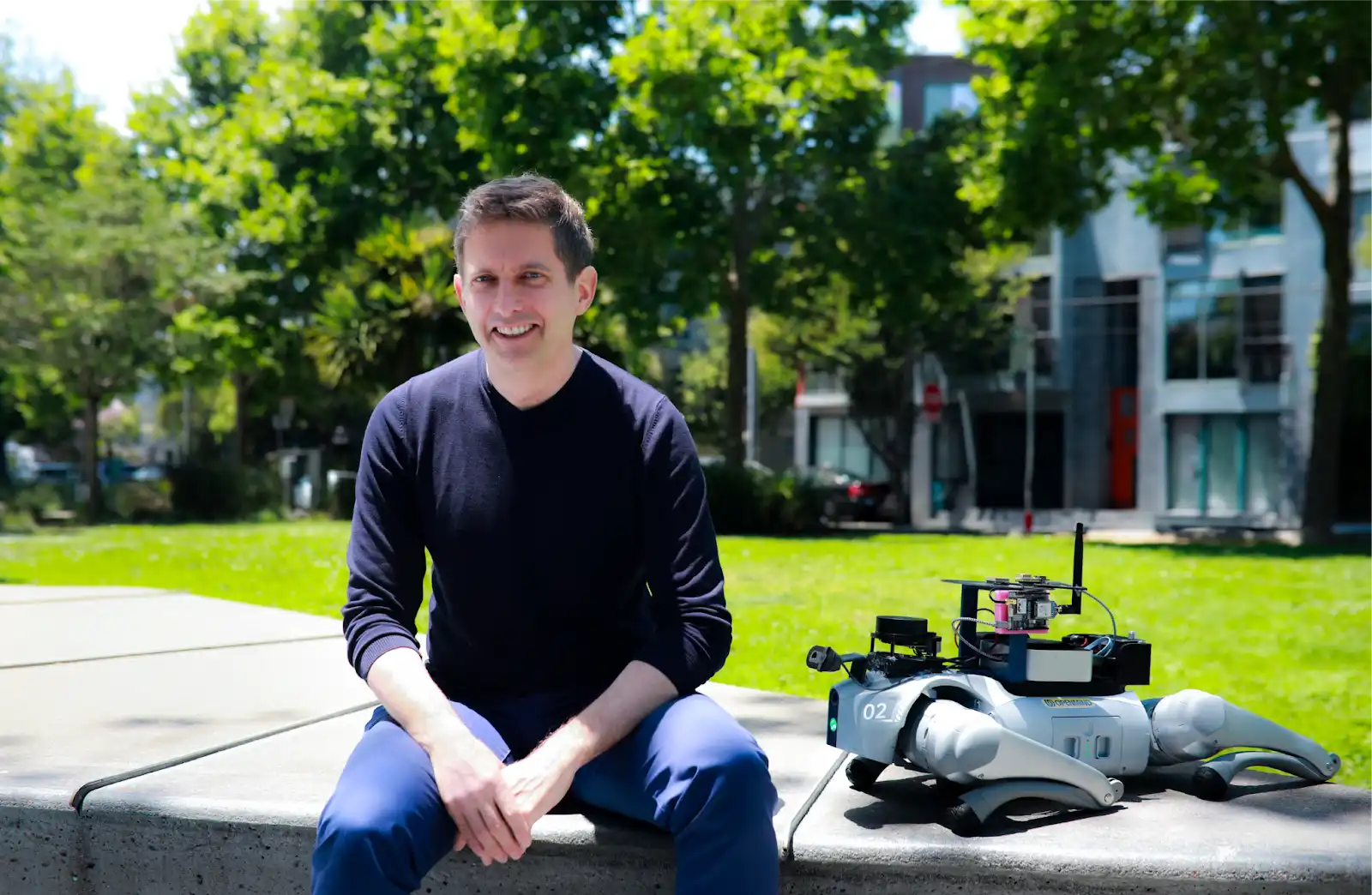
OpenMind's core business is providing SaaS-based cloud cognitive services to enterprises. But they keenly observed that as robots become independent economic participants, blockchain will play a crucial role in payment systems, identity authentication, data privacy, and collaborative governance.

Recently, OpenMind's collaboration with stablecoin issuer Circle and the deployment of robot charging stations on the streets of San Francisco are initial implementations of this vision. Robots can independently complete charging payments using USDC, which may mark the dawn of the "Machine Economy" era.

Simultaneously, OpenMind is building a dedicated app store for robots, allowing users to download applications and skills to their robots in one place, much like customizing phone apps on the Apple App Store or Google Play Store. The app was launched last week on the OpenMind App Store.

In this exclusive interview, we delved into the philosophy behind building the robot "brain," the design理念 of the modular operating system OM1, and how the FABRIC protocol and blockchain technology can构建 a future where machines and humans collaborate efficiently. He shared OpenMind's technical roadmap and offered profound insights on key issues such as developer ecosystems, remote operation, and data privacy.

Below is the interview content:

Establishing a "Bank Account" for Robots

In December 2025, OpenMind and stablecoin issuer Circle jointly announced the launch of a robot autonomous payment system based on the x402 protocol. As robots' capabilities improve, they will no longer be mere tools for executing tasks but will start to act as autonomous economic entities. They will need to purchase computing power, data, skills, and even hire other robots or humans to complete complex tasks.

To achieve this, a financial system designed specifically for machines, requiring no human intervention, becomes indispensable. The traditional banking system is clearly not prepared for this, and cryptocurrency and blockchain technology, with their native digital and decentralized characteristics, have become the most natural choice.


İlgili Sorular

QWhat is the core business of OpenMind as mentioned in the article?

AOpenMind's core business is providing SaaS-based cloud cognitive services for enterprises.

QWhich company led the $20 million funding round for OpenMind in August 2025?

APantera Capital led the $20 million funding round for OpenMind in August 2025.

QWhat specific payment protocol did OpenMind collaborate with Circle to implement for robots?

AOpenMind collaborated with Circle to implement a robot autonomous payment system based on the x402 protocol.

QWhat is the name of the modular operating system that OpenMind is developing for robots?

AOpenMind is developing a modular operating system called OM1 for robots.

QWhat recent development did OpenMind announce for customizing robot capabilities, similar to smartphone app stores?

AOpenMind announced a dedicated app store for robots, allowing users to download applications and skills to their robots, similar to smartphone app stores.

İlgili Okumalar

Bitcoin Withdrawals Continue: 8 Years of Storage in a Coldcard Cold Wallet Ended in Zero

Coldcard Hardware Wallet Hacked: Losses Mount Due to Vulnerable Seed Generation A critical vulnerability in Coldcard hardware wallets has led to a continued wave of fund thefts. According to Galaxy Research, the total stolen has reached 1,367.05 BTC (approx. $88.6 million) from 4,585 addresses, a significant increase from the initial 594.5 BTC reported on July 30, 2026. Most of the stolen funds remain on the attackers' addresses. The issue is not with the current firmware, which Coinkite has updated, but with seed phrases generated on vulnerable devices between March 2021 and the release of fixed firmware versions. Due to a programmer error, devices switched from using a hardware random number generator to the software-based Yasmarang generator, which was initialized with publicly accessible data like the chip's serial number. This made the seed phrases predictable through offline brute-force attacks, meaning wallets remain at risk until funds are moved to a new wallet generated with the patched firmware. Affected devices include Mk2/Mk3 with firmware 4.0.1–4.1.9 (and up to 5.0.3), Mk4/Mk5 up to version 5.6.0, and Q models up to 1.5.0Q. The only exceptions are seeds created with a high-entropy method like at least 50 independent dice rolls or a strong unique BIP-39 passphrase. All other owners must generate a new seed on the fixed firmware and transfer their assets. A case highlighting the human impact involves a 39-year-old long-term investor who lost 2 BTC (approx. $130,000) in minutes. He had accumulated the Bitcoin over eight years through physical labor, viewing it as a financial lifeline and a retirement plan in a country suffering from hyperinflation. His story underscores that even conservative "buy and hold in cold storage" strategies can be compromised by such underlying technical flaws. From a technical perspective, this incident echoes historical failures where weak random number generators undermined cryptographic security, challenging the assumption that offline storage is automatically foolproof.

cryptonews.ru49 dk önce

Bitcoin Withdrawals Continue: 8 Years of Storage in a Coldcard Cold Wallet Ended in Zero

cryptonews.ru49 dk önce

İşlemler

Spot
活动图片




