Author: Jae, PANews
Over the past two years, the simplest, most profitable first-generation bull strategy was to buy NVIDIA, but this playbook is becoming ineffective. When everyone knows the H100 is in short supply and every earnings report beats expectations like a carbon copy, the alpha disappears.
Truly smart money is beginning to penetrate the software layer and PPT narratives, re-examining the physical foundations underpinning AI operations. This year, two individuals with vastly different styles have become the most-watched new bellwethers in AI investing.
One is an anonymous trader hidden behind a female anime avatar on platform X. He claims to have turned down a job offer from NVIDIA and published a Nature paper, achieving a staggering 45x return this year by dissecting the most fundamental components of the supply chain. No one knows his true identity, only that he goes by Serenity.
The other is a 24-year-old former OpenAI "disciple," who transformed from a frustrated researcher into the founder of a hedge fund now managing
tens of billions of dollars, placing bets based on physical constraints on the repricing of energy, computing infrastructure, and storage. His name is Leopold Aschenbrenner, an anomaly among Silicon Valley elites.
One hunts for "bottleneck" points from the microscopic level; the other bets on the restructuring of "physical bottlenecks" from a macro perspective. Their rise to prominence is not just a clash of two investment strategies, but also a clarion call for the revaluation of underlying assets in the AI era.
Serenity: Mining Invisible Dark Horses with the "Shiso Leaf" Theory
If you have been following the U.S. stock community on X recently, you almost certainly have come across an account named Serenity (@aleabitoreddit). Anime avatar, frequent posts, content mostly about semiconductor materials, optical module substrates, edge computing boards—rarely discussing popular AI applications.
No one knows his true identity. He claims to have a programming and academic background, is a Nature paper author, a RISC-V Foundation member, and even turned down an offer to lead an AI team at NVIDIA back in 2018 when the stock was only $6.
Serenity's claim to fame began in early 2022 on the famous retail investor forum r/wallstreetbets (WSB) on Reddit. At that time, edge indium phosphide substrate producer AXTI was largely ignored. Under the username "AleaBito," he posted an in-depth research thread, pointing directly to it as the material foundation for AI optical modules. Subsequently, this obscure micro-cap stock soared from $12 to nearly $70, a nearly 6x increase. His accurate prediction, however, got him banned from the platform for "inducing hype." In July last year, he moved to platform X and quickly grew into an "AI supply chain detective" with over 400,000 followers, becoming the new leading figure for retail investors in the AI investment circle on X. Some have even created research dashboards based on his tweets.
More impressive than the gains themselves is the research methodology Serenity has impressed upon the market. He condensed his investment philosophy into his self-created "Shiso Leaf Theory."
He uses Tokyo's top sushi restaurants as a metaphor. The ingredient diners crave most is undoubtedly tuna belly (toro). However, the presentation of the entire plate of sushi entirely depends on shiso leaves supplied by specific small farms on the Izu Peninsula: they remove fishy smells, provide decoration, and are indispensable. If these farms' supply is cut off due to weather or logistics, even the finest tuna belly cannot be served, forcing high-end sushi shops to close.
Simply put, the most expensive part is the tuna, but the indispensable part is the shiso leaf.
Mapping this to the AI supply chain, the shiso leaf refers to those small-cap, thinly traded, invisible manufacturers that hold absolute technological monopolies in specific, crucial manufacturing segments.
Compared to conventional data-dumping from financial reports, Serenity's research methodology involves diving deep to the very bottom of the industry chain: digesting materials science papers, mastering physical principles, mapping supply chain diagrams, and even feeding research drafts into multiple AIs for adversarial testing, all to identify every "irreplaceable" bottleneck point (chokepoint).
Over the past two years, Serenity has focused primarily on co-packaged optics (CPO). He believes that as AI cluster scales expand, traditional copper wire connections and pluggable optical modules will hit physical walls in terms of power consumption and speed. CPO, which packages optical devices and silicon chips on the same substrate, will be an inevitable path for the industry.
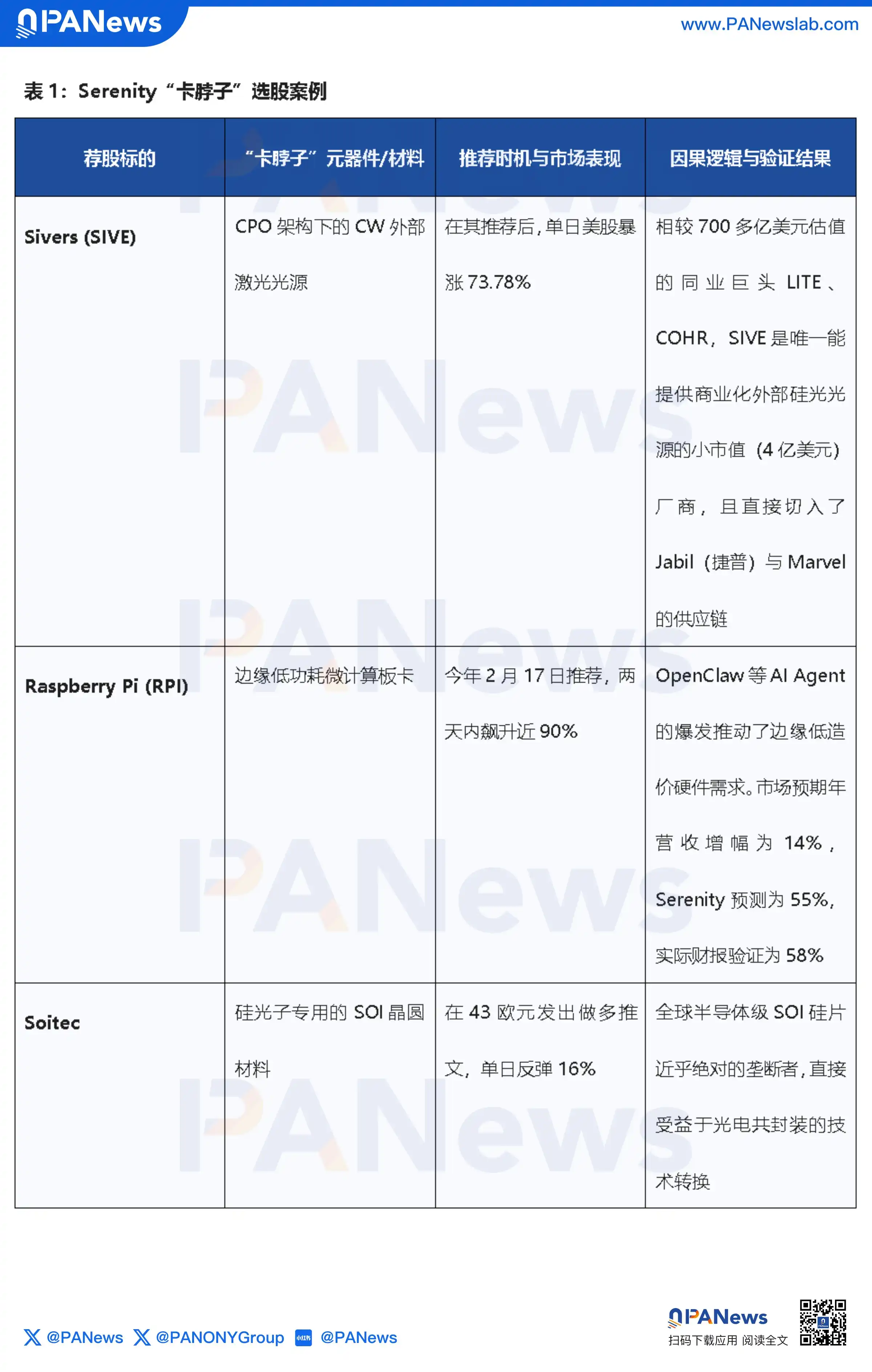
Based on this thesis, he has successively identified and recommended to the market three high-potential bottleneck targets: Sivers, Raspberry Pi, and Soitec.
Serenity continues to delve deeper into the very bottom of the supply chain. He has also unearthed NCI, a Japanese chemical company producing semiconductor-grade high-purity phosphorus precursor materials, pushing the "bottleneck point" to the molecular material level.
Leopold: From $200M to $10B, Mastering the Infrastructure Arbitrage Strategy
Unlike Serenity, the elusive folk hunter hidden in the depths of the internet, Leopold Aschenbrenner is a Silicon Valley genius standing in the spotlight, commanding tens of billions in capital.
His resume reads like an "elite template." Graduated top of his class from Columbia University at 19, worked at FTX Future Fund and OpenAI's Superalignment team. In April 2024, however, Leopold was reportedly fired from OpenAI over suspected information leaks.
This event catalyzed his transition into investing. In June 2024, he published a 165-page industry manifesto, "Situational Awareness: The Next Decade." In it, Leopold boldly predicted that AGI would arrive around 2027, with superintelligence emerging by 2030. The real bottleneck to achieving this, he argued, lies not in algorithms and models, but in physical resources like the power grid, land, data centers, and high-bandwidth memory.
Based on this highly forward-looking thesis, he founded the hedge fund Situational Awareness LP. Silicon Valley heavyweights like Nat Friedman, Daniel Gross, and Stripe founders the Collison brothers generously opened their wallets, and a $225 million seed round was swiftly secured.
Leopold's circles are also noteworthy. His fiancée, Avital Balwit, previously worked at the University of Oxford's Future of Humanity Institute (FHI), focusing on issues related to transformative AI, and later joined Anthropic as Chief of Staff to CEO Dario Amodei. FTX was once one of Anthropic's earliest and most important investors. Before FTX's collapse, both Leopold and Avital also held key roles at its philanthropic arm, the FTX Future Fund.
This network provides Leopold with a unique flow of information, cognitive perspective, and resources for his subsequent research framework and investment positioning—perhaps his greatest and most difficult-to-replicate alpha.
On May 18th, Situational Awareness LP filed its Q1 13F holdings report, revealing Leopold's fund now manages over $10 billion. This document gave the market its first glimpse of his highly concentrated long positions in memory stocks, along with a massive portfolio of put options totaling nearly $8.5 billion targeting the entire semiconductor and chip manufacturing sector.
Judging by his portfolio layout, Leopold employs an infrastructure arbitrage strategy. On one hand, he has made significant purchases of memory hardware manufacturer SanDisk and specialized compute cloud CoreWeave, solidly positioning himself at the hard barriers of physical storage.
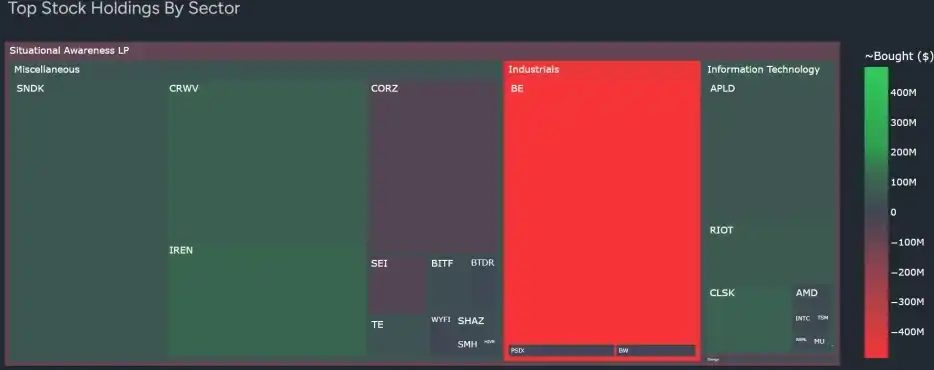
On the other hand, he has allocated billions of dollars to put options against NVIDIA (NVDA), TSMC (TSM), Broadcom (AVGO), ASML (ASML), and the Semiconductor ETF (SMH), essentially shorting the entire semiconductor sector.
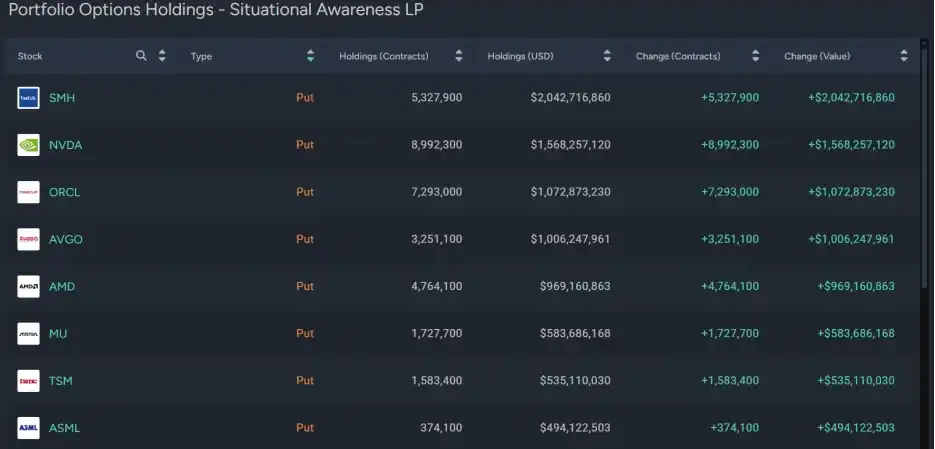
In his view, current valuations in the chip sector have severely detached from the actual construction speed of physical infrastructure like the power grid and data centers. The deployment of AI compute clusters relies on stable electricity, ample land, and mature cooling systems. The construction cycles for these physical infrastructures span 3-5 years, far slower than chip shipment rates. In the short term, the high growth of chip giants is unsustainable, and valuations may face a pullback. Put options would capture profits from this sector downturn.
Crypto enterprises are also part of Leopold's investment map. He has placed a roughly $1 billion long bet on Bitcoin mining companies, heavily buying into IREN, Core Scientific, Riot, CleanSpark, and others. In his eyes, Bitcoin miners are discounted substitutes for AI compute centers, severely undervalued by the market.
Abandoning Software, Emphasizing Physicality: The Hidden Peril of AI Computing's "Toll"
Despite their different "toolkits," the core of Serenity's and Leopold's AI investing is highly similar: abandoning the software layer lacking physical barriers, and heavily investing in hardware constrained by physical laws.
Whether it's the external CW laser light source and high-purity phosphorus in Serenity's view, or the substations and land in Leopold's, they both reveal one point: Regardless of innovation at the model layer, whoever controls scarce resources in the physical world holds the power to levy a "compute toll" on tech giants in the AI era.
However, no strategy is perfect. Both their approaches will face tests on different fronts.
For Serenity, his biggest vulnerability lies in the "liquidity abyss" of micro-cap stocks. When he recommends a micro-cap stock with a market cap of only a few hundred million dollars to his 400,000 followers on X, even a small influx of retail capital can push up the stock price. However, this "frenzy" is built on low liquidity. Once overall market liquidity tightens, or if a recommended company faces setbacks in technology validation, the prices of these micro-cap stocks can plummet, potentially wiping out retail investors who jumped in at high points.
Furthermore, while Serenity's supply chain research is technically thorough, his identity, background, and track record remain unverified. Investors should not worship him as a "stock god" and blindly copy his portfolio wholesale. Blindly following his calls carries high risk. While the micro-cap "bottleneck" strategy is highly explosive, the high capital expenditures, thin margins, and potential customer attrition risks behind these companies mean this strategy is only suitable as a "high-beta catalyst" within an asset allocation framework, complemented by large-cap blue-chip stocks for risk hedging and executed with strict position sizing.
For Leopold, his biggest enemy is the "time lag" in macro dynamics. The fact that physical infrastructure construction lags significantly behind compute demand is entirely valid in terms of causality and is an objective reality. However, capital markets are often driven by irrational sentiment and exhibit longer lag effects, which could allow the high valuations of chip giants to persist longer than expected. When faced with stronger-than-expected earnings reports and short squeezes in stocks like NVIDIA, his massive short positions via put options could incur significant paper losses.
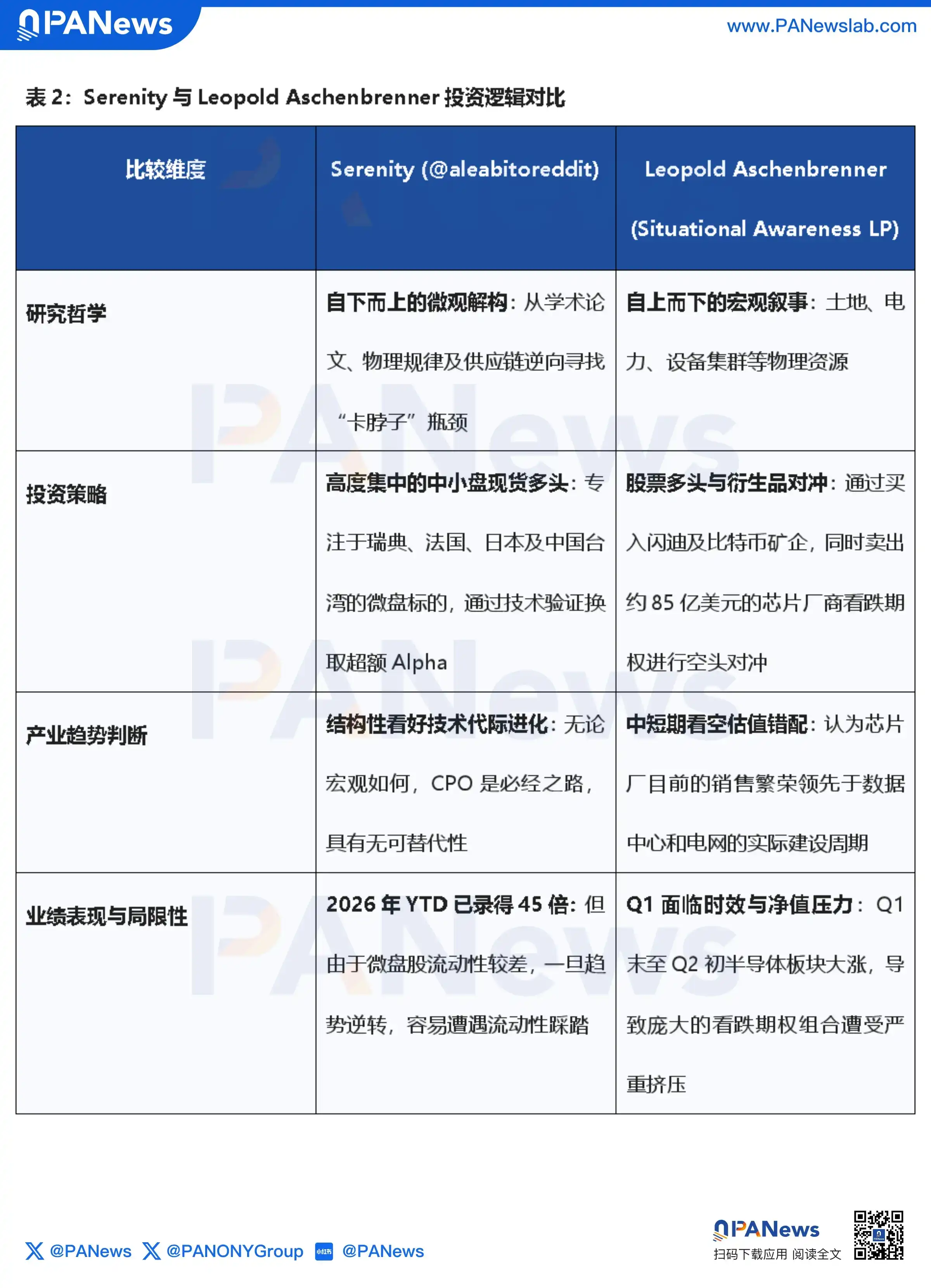
In a way, Serenity and Leopold represent a new phase of AI investment logic. Value capture in the AI industry is shifting from semiconductors themselves to the materials, equipment, power, and land behind the chips.
As model scales and compute demands continue to grow, key links within the AI industry that possess scarcity, technological barriers, and supply constraints are likely to receive increasing market attention in the future.