Restoring Crypto Privacy: ZCASH (ZEC) Makes A Move After 50% Crash

bitcoinist2026-06-11 tarihinde yayınlandı2026-06-11 tarihinde güncellendi

Özet

Following a severe price crash of over 50% triggered by the discovery of a critical counterfeiting vulnerability in its Orchard privacy pool, Zcash (ZEC) is taking steps to restore confidence. The bug, found by a security researcher using AI, could have allowed undetected creation of fake ZEC tokens. Developers from the Zcash Open Development Lab (ZODL) and others quickly patched the flaw, helping the price rebound over 70%. However, Orchard's privacy features make it impossible to verify if any counterfeit tokens were actually created before the fix. To address this, key ecosystem groups including Shielded Labs and The Zcash Foundation have proposed a new system called Ironwood. Its primary goal is to restore users' ability to independently verify Zcash's total circulating supply. Once activated, node operators could confirm the supply hasn't been tampered with. The Ironwood proposal would also block any new coin minting in the Orchard pool and restrict fund movement through a controlled mechanism. This system could provide evidence on whether the vulnerability was ever exploited. If no excess ZEC attempts to leave the pool, it suggests no counterfeiting occurred. Any attempted exit of fake coins would be blocked and destroyed, publicly revealing any attack while protecting the legitimate supply.

Zcash (ZEC) is making a push to restore confidence in its privacy-focused network after a major exploit scare triggered a sharp market selloff. Following a more than 50% price crash in ZEC, developers moved quickly to patch the network vulnerability. They are now proposing a new system designed to help users independently verify the cryptocurrency’s circulating supply and solidify the network’s security protocols.

Zcash Price Rebounds After Exploit Scare and Iron Wood Proposal

Last week, Zcash suffered a steep decline of more than 50%, falling to $250 after reports of a dangerous counterfeiting bug in its Orchard zero-knowledge proof circuit spread across the market. The incident rattled investors and contributed to $116 million in liquidations across the market.

Notably, the flaw was discovered by Taylor Hornby, a security researcher, using an AI auditing framework powered by Claude Opus 4.8. Developers said the vulnerability could have allowed an attacker to create fake ZEC tokens within the Orchard pool without detection.

Despite the sharp selloff and price crash that followed the news, ZEC’s price recovered some of its losses after developers released an emergency fix. CoinMarketCap data shows that the cryptocurrency rebounded by more than 70% to $433 after the Orchard vulnerability was quickly patched through a coordinated effort involving the Zcash Open Development Lab (ZODL) and other ecosystem participants.
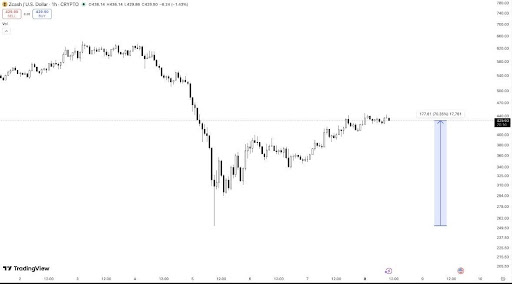
Source: Chart from Simon Dedic on X

While the team successfully fixed the flaw, it remains unclear whether counterfeit ZEC was created before the patch. This concern is more unsettling because the bug had existed within the Zcash network without being detected until recently. Although developers believe exploitation was unlikely, they also noted that Orchard’s privacy features make it impossible for users to verify whether any fake tokens were minted.

To address that issue, Shielded Labs, a non-profit supporting Zcash, is working alongside The Zcash Foundation, Tachyon Group, Valar Group, and the ZODL on a proposal known as Ironwood. The initiative aims to restore users’ ability to verify the soundness of Zcash’s circulating supply without relying on assumptions about other participants or waiting for funds to migrate out of the Orchard pool.

Ironwood Proposal To Restore Zcash Supply Verification

The new proposal was announced in an X post on June 6, in a report authored by the founder and former CEO of Zcash, Jason McGee, founder of Shielded Labs, and Hornby.

The primary goal of Ironwood is to give each user the ability to independently verify Zcash’s supply. Developers said that once activated, users running a node would be able to confirm that the circulating supply has not been tampered with.

The proposal also blocks any transaction that tries to mint a new coin in the Orchard pool. As a result, ZEC would no longer freely circulate within that pool, and funds would only move out through a turnstile mechanism.

The report said Ironwood could also provide evidence about whether the vulnerability was ever exploited during last week’s incident. As users move funds into a new pool, any potential counterfeiter would face a difficult choice: either try to transfer fake coins, risking exposure, or leave the coins behind.

If no extra ZEC tries to leave the Orchard pool, the report noted that it would strongly suggest the flaw was never exploited. If excess funds actually try to exit, they would be blocked and effectively destroyed, preserving the current circulating supply while publicly showing that counterfeiting had occurred.

ZEC trading at $426 on the 1D chart | Source: ZECUSDT on Tradingview.com

İlgili Sorular

QWhat caused Zcash (ZEC) to experience a sharp price crash of over 50% last week?

AThe price crash was triggered by reports of a dangerous counterfeiting bug in its Orchard zero-knowledge proof circuit, which could have allowed an attacker to create fake ZEC tokens without detection.

QWho discovered the vulnerability in Zcash's Orchard circuit and how was it found?

AThe flaw was discovered by security researcher Taylor Hornby using an AI auditing framework powered by Claude Opus 4.8.

QWhat is the main purpose of the proposed Ironwood system for Zcash?

AThe primary goal of the Ironwood proposal is to give each user the ability to independently verify Zcash's circulating supply, confirming it has not been tampered with, without relying on assumptions about other participants.

QHow would the Ironwood proposal potentially reveal if the Orchard vulnerability was ever exploited?

AAs users move funds out of the Orchard pool through a new turnstile mechanism, any attempt to transfer counterfeit coins would be blocked and exposed. If no extra ZEC tries to leave, it suggests the flaw was never used. If excess funds try to exit, they are blocked and destroyed, publicly showing counterfeiting occurred.

QWhich organizations are collaborating on the Ironwood proposal for Zcash?

AThe organizations involved are Shielded Labs, The Zcash Foundation, Tachyon Group, Valar Group, and the Zcash Open Development Lab (ZODL).

İlgili Okumalar

Promised Year of Crypto IPOs? Only One Went Public in Six Months, Down 70%

The much-anticipated wave of crypto IPOs in 2026 has failed to materialize, with market conditions worsening dramatically. While SpaceX prepares for the largest IPO in history, raising $75 billion at a $1.75 trillion valuation, the crypto sector faces a frozen pipeline. The sole crypto IPO success this year, BitGo, serves as a cautionary tale. After launching on the NYSE in January at $18, its stock has plummeted approximately 70%. Other major contenders have stalled or delayed. Kraken, which secretly filed in late 2025, has put its plans on ice, seeing its valuation drop 33% to $13.3 billion. Consensys has postponed its filing until autumn at the earliest, and Bitpanda is poised to miss its self-imposed H1 deadline for a Frankfurt listing. This widespread retreat is driven by a severe liquidity crunch. Bitcoin has fallen below $60,000, with capital being diverted to AI stocks and the massive SpaceX offering. The poor performance of earlier crypto listings like Gemini and the stagnant price of Coinbase further dampen investor appetite. A key underlying pressure is the impending US midterm elections in November, which could alter the currently favorable regulatory landscape. Companies had hoped to go public during this window of policy certainty, but challenging market dynamics have overridden those plans. The transparency that comes with being a public company is now seen as a potential liability rather than a benefit in a down market. The industry's fate now hinges on a few critical watchpoints: whether Kraken restarts its process in H2, if Consensys files in the fall, and if SpaceX's debut can revitalize market liquidity. Otherwise, the promised "crypto IPO year" will likely be pushed beyond the election.

marsbit7 dk önce

Promised Year of Crypto IPOs? Only One Went Public in Six Months, Down 70%

marsbit7 dk önce

Behind Musk and Huang Jen-hsun's 'AI Factories', an Unseen Battle for Freshwater Has Begun

Behind the "AI factories" of Elon Musk and Jensen Huang lies a hidden battle for a critical resource: fresh water. As AI models like ChatGPT and Claude process billions of prompts daily, they consume vast amounts of water for cooling. By 2030, global AI infrastructure is projected to use 9.3 trillion liters annually—enough to meet the basic needs of 1.3 billion people. This "water grab" stems from the massive heat generated by high-powered GPUs. Over 70% of data centers use evaporative cooling systems, where water absorbs heat and evaporates into the atmosphere, depleting local groundwater. Training models like GPT-4 can consume over 600 million liters of water. Tech giants like Google and Microsoft report skyrocketing water usage, sparking conflicts with local communities over resources. A flashpoint occurred in Memphis, Tennessee, where Musk's xAI built the Colossus supercomputer. It draws nearly 3.8 million liters of drinking water daily from local aquifers, leading to public outrage and legal action. In response, xAI is building an $80 million water recycling plant to use treated wastewater instead. Facing pressure, companies like Microsoft promote "waterless" closed-loop cooling systems. However, these systems increase electricity consumption by 20-30%, shifting the water burden to power plants, which require immense cooling water themselves—a case of indirect water footprint transfer. For China's AI industry, this crisis offers a strategic warning and opportunity. Instead of replicating the West's resource-intensive model, China can leverage its "East Data, West Computing" policy to locate data centers in cooler, water-rich regions like Guizhou. Furthermore, developing lightweight edge computing for smart homes and embodied AI robots can drastically reduce the need for constant cloud queries, cutting both water and energy consumption at the source. The freshwater war underscores a fundamental question: Will AI be a tool for human advancement or a silicon-based monster competing for our planet's last drops of clean water? The answer is becoming clearer as the water vapor rises.

marsbit53 dk önce

Behind Musk and Huang Jen-hsun's 'AI Factories', an Unseen Battle for Freshwater Has Begun

marsbit53 dk önce

AGI is Just One Step Away

The article discusses Anthropic's release of the Fable 5 model, a heavily restricted version of its powerful Mythos model. Initially unveiled in April, Mythos reportedly identified over 10,000 high-risk vulnerabilities for 50 enterprise clients, causing significant concern. Due to its dangerous capabilities in areas like autonomous cyber-attacks and biochemical weapons design guidance (classified as CB-1 level), the unaltered Mythos 5 remains limited to about 200 vetted entities like government agencies. Fable 5, released with a safety classifier, demonstrates extraordinary performance, leading benchmarks in coding (SWE-Bench Pro), software engineering, and research. It exhibits true "long-horizon agency," autonomously planning and executing complex, multi-step tasks like migrating 50 million lines of code in a day, moving beyond simple question-answering. The article positions Fable 5 at OpenAI's Level 3 ("Agent") and progressing toward Level 4 ("Innovator"), suggesting AGI (Artificial General Intelligence) is within reach, potentially 18-24 months away. To mitigate risks, Anthropic implemented a two-layer safety "cage": a silent routing system that redirects dangerous queries to a weaker model, and a mandatory 30-day data retention policy for all Mythos traffic to detect patterns of malicious use. Despite its high cost ($10/$50 per million input/output tokens), the model targets the enterprise market, where its unparalleled productivity and defensive capabilities against AI-powered cyber threats justify the premium. This signals a market maturation where top-tier AI becomes a strategic, high-value tool for businesses, potentially widening the gap with consumer-focused models and accelerating the rise of "one-person companies" while disrupting labor markets.

marsbit1 saat önce

AGI is Just One Step Away

marsbit1 saat önce

AI Investors' 2026 Anxiety: When Models Devour Everything, What Moat Is Left for Startups?

In 2026, a wave of investor anxiety questions the defensibility of AI startups as models improve, fearing that most companies are just "thin wrappers" destined to be absorbed by foundation models or chipmakers. The author argues against this despair, positing that true moats lie not in benchmark performance but in areas models cannot easily reach. The logic of despair is that if models excel at all measurable tasks, only compute and cutting-edge model weights hold lasting value. However, the essay contends that the most valuable work is inherently "untrainable." Benchmarks measure what can be measured and thus optimized for, but real-world correctness often resides in private, complex systems. Examples include legacy codebases, intricate legal transactions, or hospital workflows. This kind of correctness is proprietary, costly to establish, and cannot be validated quickly—it requires time and trust within an organization. As models commodify visible, measurable tasks from both above (labs absorbing scaffolding) and below (saturation by cheaper models), value shifts to "untrainable ground." This encompasses work where correctness is a private truth, locked behind integration barriers, licenses, liability frameworks, and entrenched user habits. Trust and adoption are slow, human-centric processes that smarter models cannot accelerate. Successful companies defend their position by embedding deeply into client operations, owning the definition of "good" within a specific domain (e.g., Harvey in law, OpenEvidence in medicine), and pricing on outcomes rather than tokens. While labs compete fiercely, they are incentivized to keep the application layer vibrant. The future belongs not to those competing on generic benchmarks but to those navigating unscoreable terrain, doing the "unsexy work" of translation between models and messy human realities. The most cited benchmark scores are thus maps of territory about to become worthless, signaling who will lose the right to define what counts as good.

marsbit2 saat önce

AI Investors' 2026 Anxiety: When Models Devour Everything, What Moat Is Left for Startups?

marsbit2 saat önce

İşlemler

Spot
Futures

Popüler Makaleler

ZEC Nasıl Satın Alınır

HTX.com’a hoş geldiniz! Zcash (ZEC) satın alma işlemlerini basit ve kullanışlı bir hâle getirdik. Adım adım açıkladığımız rehberimizi takip ederek kripto yolculuğunuza başlayın. 1. Adım: HTX Hesabınızı OluşturunHTX'te ücretsiz bir hesap açmak için e-posta adresinizi veya telefon numaranızı kullanın. Sorunsuzca kaydolun ve tüm özelliklerin kilidini açın. Hesabımı Aç2. Adım: Kripto Satın Al Bölümüne Gidin ve Ödeme Yönteminizi SeçinKredi/Banka Kartı: Visa veya Mastercard'ınızı kullanarak anında Zcash (ZEC) satın alın.Bakiye: Sorunsuz bir şekilde işlem yapmak için HTX hesap bakiyenizdeki fonları kullanın.Üçüncü Taraflar: Kullanımı kolaylaştırmak için Google Pay ve Apple Pay gibi popüler ödeme yöntemlerini ekledik.P2P: HTX'teki diğer kullanıcılarla doğrudan işlem yapın.Borsa Dışı (OTC): Yatırımcılar için kişiye özel hizmetler ve rekabetçi döviz kurları sunuyoruz.3. Adım: Zcash (ZEC) Varlıklarınızı SaklayınZcash (ZEC) satın aldıktan sonra HTX hesabınızda saklayın. Alternatif olarak, blok zinciri transferi yoluyla başka bir yere gönderebilir veya diğer kripto para birimlerini takas etmek için kullanabilirsiniz.4. Adım: Zcash (ZEC) Varlıklarınızla İşlem YapınHTX'in spot piyasasında Zcash (ZEC) ile kolayca işlemler yapın.Hesabınıza erişin, işlem çiftinizi seçin, işlemlerinizi gerçekleştirin ve gerçek zamanlı olarak izleyin. Hem yeni başlayanlar hem de deneyimli yatırımcılar için kullanıcı dostu bir deneyim sunuyoruz.

563 Toplam GörüntülenmeYayınlanma 2024.12.12Güncellenme 2026.06.02

ZEC Nasıl Satın Alınır

Tartışmalar

HTX Topluluğuna hoş geldiniz. Burada, en son platform gelişmeleri hakkında bilgi sahibi olabilir ve profesyonel piyasa görüşlerine erişebilirsiniz. Kullanıcıların ZEC (ZEC) fiyatı hakkındaki görüşleri aşağıda sunulmaktadır.

活动图片













