Resolv exploit triggers USR depeg after $80M uncollateralized mint

ambcrypto2026-03-23 tarihinde yayınlandı2026-03-23 tarihinde güncellendi

Özet

Resolv protocol was exploited due to a private key compromise, leading to an unauthorized mint of approximately $80M in unbacked USR stablecoins. This inflated the total supply by 71M tokens, causing a severe depeg—USR fell 56% to around $0.19. The team paused contracts, burned 9M of the attacker’s tokens, and confirmed that underlying collateral remains intact with only $0.5M in losses from redemptions. Recovery efforts include allowlisted redemptions and tracing illicit tokens. The incident highlights risks from over-reliance on off-chain controls in DeFi minting mechanisms.

Resolv has paused its protocol after a private key compromise enabled a malicious actor to mint approximately $80M in uncollateralized USR. This triggered a sharp depeg and raised concerns about the stablecoin’s integrity.

In an update shared, the team said the attacker gained unauthorized access to its infrastructure and minted new USR tokens without backing. Smart contracts were quickly paused, and around 9M USR held by the attacker has since been burned.

Resolv stated that its underlying collateral was not directly compromised. Also, the only confirmed loss so far is roughly $0.5M in redemptions processed before the pause.

Exploit inflates USR supply rather than draining funds

Unlike typical DeFi exploits that drain protocol funds, the Resolv incident centers on supply inflation.

Before the incident, around 102M USR was in circulation. Following the exploit, an additional ~71M USR was minted without collateral. This effectively diluted the backing of the stablecoin.

This pushed total supply far above the value of the protocol’s assets, altering the relationship between supply and collateral.

The team said the exploit resulted from a compromised private key tied to infrastructure access, rather than a failure of its underlying collateral system.

Design assumptions exposed in minting process

While Resolv attributed the breach to unauthorized access, the incident has drawn attention to how minting authority was structured.

The exploit was made possible because a privileged role could authorize token issuance without sufficient on-chain validation of collateral backing.

This meant that once access was obtained, large amounts of USR could be minted without checks tied to deposited assets.

Such architecture relies on trusted off-chain controls to enforce limits — an assumption that can break down if those controls are compromised.

USR loses peg as market confidence drops

Market reaction to the exploit was swift, with USR losing its dollar peg.

At the time of writing, USR was trading near $0.19, down more than 56% over 24 hours, according to CoinMarketCap data. The sharp decline reflects a repricing of the token as supply expanded beyond its collateral base.
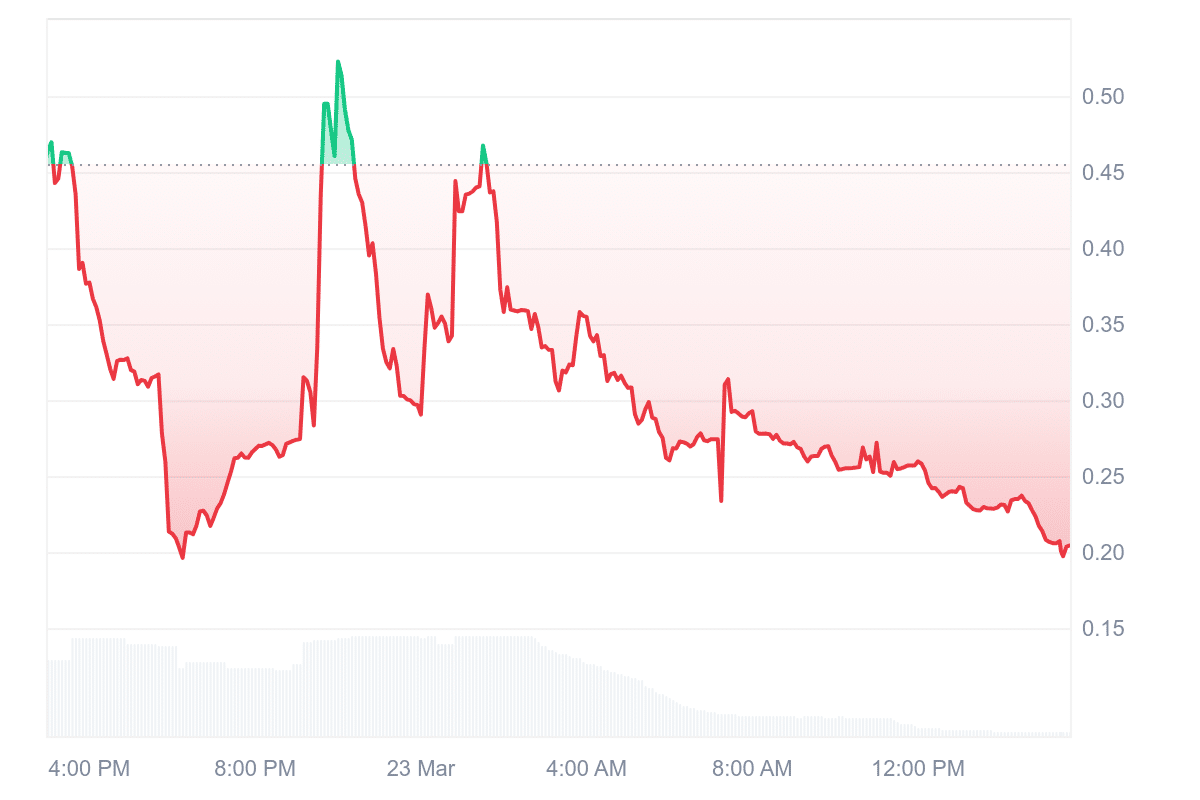
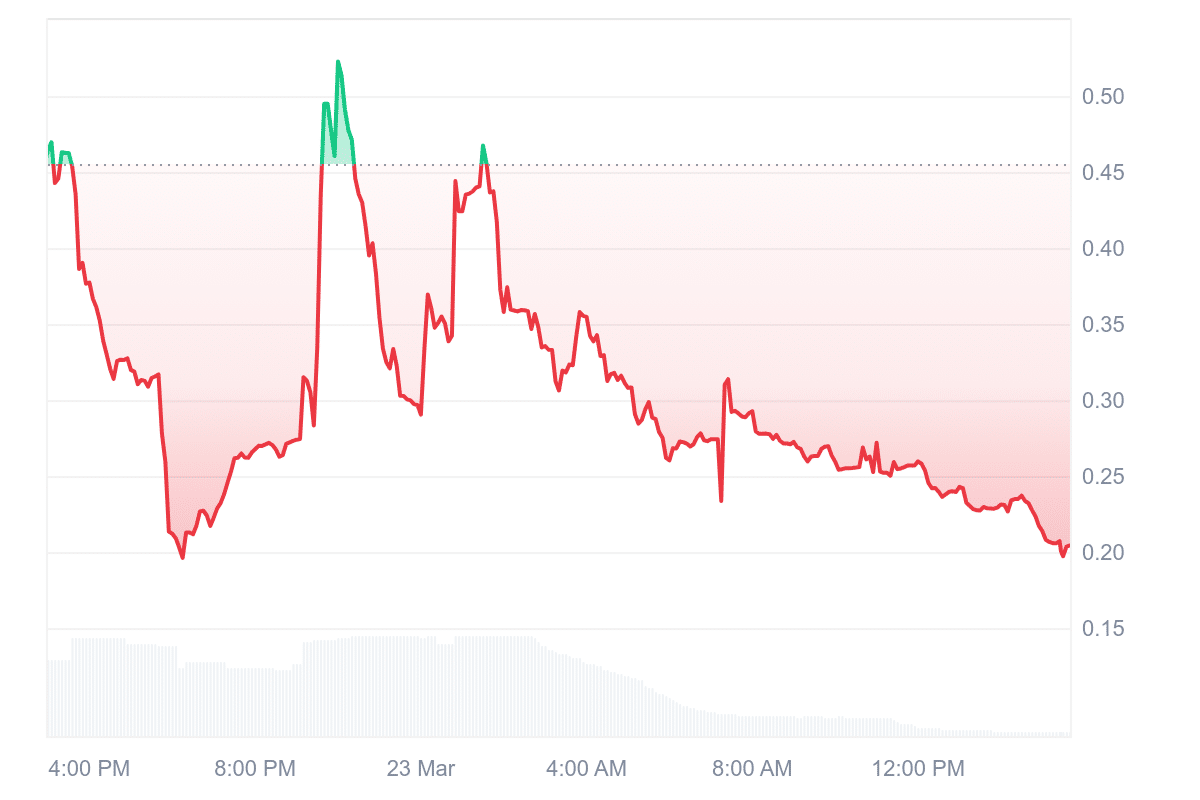
Source: CoinMarketCap

Trading activity has also weakened significantly, with volumes dropping as users exit positions or avoid exposure during the recovery process.

Recovery efforts underway as redemptions planned

Resolv said it is preparing to enable redemptions for pre-incident USR holders, starting with allowlisted users.

The protocol currently holds approximately $141M in assets, and the team is working with partners, analytics firms, and law enforcement to trace and contain illicitly minted tokens.

Users have been advised not to trade USR or related assets during the recovery phase. Post-exploit activity could impact the outcome of the process.

Stablecoin integrity under scrutiny

The incident highlights a broader risk in DeFi systems where critical safeguards depend on off-chain controls rather than enforced on-chain limits.

Although Resolv’s collateral pool remains intact, the ability to mint unbacked tokens has undermined confidence in the system’s accounting.

As the situation unfolds, the key challenge will be restoring trust in USR’s backing and stabilizing its supply.


Final Summary

  • The Resolv exploit inflated USR supply by $80M without draining collateral, exposing risks tied to off-chain control mechanisms.
  • USR’s sharp depeg reflects a loss of market confidence, with recovery now dependent on isolating illicit supply and restoring backing integrity.


İlgili Sorular

QWhat was the primary method used by the attacker to exploit the Resolv protocol?

AThe attacker gained unauthorized access to Resolv's infrastructure through a compromised private key, which allowed them to mint approximately $80M in uncollateralized USR tokens.

QHow did the exploit mechanism in this incident differ from a typical DeFi attack?

AUnlike typical DeFi exploits that drain protocol funds, this incident centered on supply inflation by minting new, unbacked tokens rather than stealing existing collateral.

QWhat was the immediate market consequence of the exploit on the USR stablecoin?

AThe USR stablecoin lost its dollar peg, trading near $0.19 at the time of writing, which represents a decline of more than 56% over 24 hours.

QWhat key vulnerability in the protocol's design did this exploit expose?

AThe exploit exposed a vulnerability where a privileged role could authorize token issuance without sufficient on-chain validation of collateral backing, relying instead on trusted off-chain controls.

QWhat are the main steps Resolv is taking for recovery according to the article?

AResolv has paused the protocol, burned approximately 9M USR held by the attacker, is preparing to enable redemptions for pre-incident holders, and is working with partners and law enforcement to trace illicitly minted tokens.

İlgili Okumalar

a16z: AI's 'Amnesia', Can Continuous Learning Cure It?

The article "a16z: AI's 'Amnesia' – Can Continual Learning Cure It?" explores the limitations of current large language models (LLMs), which, like the protagonist in the film *Memento*, are trapped in a perpetual present—unable to form new memories after training. While methods like in-context learning (ICL), retrieval-augmented generation (RAG), and external scaffolding (e.g., chat history, prompts) provide temporary solutions, they fail to enable true internalization of new knowledge. The authors argue that compression—the core of learning during training—is halted at deployment, preventing models from generalizing, discovering novel solutions (e.g., mathematical proofs), or handling adversarial scenarios. The piece introduces *continual learning* as a critical research direction to address this, categorizing approaches into three paths: 1. **Context**: Scaling external memory via longer context windows, multi-agent systems, and smarter retrieval. 2. **Modules**: Using pluggable adapters or external memory layers for specialization without full retraining. 3. **Weights**: Enabling parameter updates through sparse training, test-time training, meta-learning, distillation, and reinforcement learning from feedback. Challenges include catastrophic forgetting, safety risks, and auditability, but overcoming these could unlock models that learn iteratively from experience. The conclusion emphasizes that while context-based methods are effective, true breakthroughs require models to compress new information into weights post-deployment, moving from mere retrieval to genuine learning.

marsbit2 saat önce

a16z: AI's 'Amnesia', Can Continuous Learning Cure It?

marsbit2 saat önce

Can a Hair Dryer Earn $34,000? Deciphering the Reflexivity Paradox in Prediction Markets

An individual manipulated a weather sensor at Paris Charles de Gaulle Airport with a portable heat source, causing a Polymarket weather market to settle at 22°C and earning $34,000. This incident highlights a fundamental issue in prediction markets: when a market aims to reflect reality, it also incentivizes participants to influence that reality. Prediction markets operate on two layers: platform rules (what outcome counts as a win) and data sources (what actually happened). While most focus on rules, the real vulnerability lies in the data source. If reality is recorded through a specific source, influencing that source directly affects market settlement. The article categorizes markets by their vulnerability: 1. **Single-point physical data sources** (e.g., weather stations): Easily manipulated through physical interference. 2. **Insider information markets** (e.g., MrBeast video details): Insiders like team members use non-public information to trade. Kalshi fined a剪辑师 $20,000 for insider trading. 3. **Actor-manipulated markets** (e.g., Andrew Tate’s tweet counts): The subject of the market can control the outcome. Evidence suggests Tate’sociated accounts coordinated to profit. 4. **Individual-action markets** (e.g., WNBA disruptions): A single person can execute an event to profit from their pre-placed bets. Kalshi and Polymarket handle these issues differently. Kalshi enforces strict KYC, publicly penalizes insider trading, and reports to regulators. Polymarket, with its anonymous wallet-based system, has historically been more permissive, arguing that insider information improves market accuracy. However, it cooperated with authorities in the "Van Dyke case," where a user traded on classified government information. The core paradox is reflexivity: prediction markets are designed to discover truth, but their financial incentives can distort reality. The more valuable a prediction becomes, the more likely participants are to influence the event itself. The market ceases to be a mirror of reality and instead shapes it.

marsbit3 saat önce

Can a Hair Dryer Earn $34,000? Deciphering the Reflexivity Paradox in Prediction Markets

marsbit3 saat önce

İşlemler

Spot
Futures

Popüler Makaleler

RESOLV Nasıl Satın Alınır

HTX.com’a hoş geldiniz! Resolv (RESOLV) satın alma işlemlerini basit ve kullanışlı bir hâle getirdik. Adım adım açıkladığımız rehberimizi takip ederek kripto yolculuğunuza başlayın. 1. Adım: HTX Hesabınızı OluşturunHTX'te ücretsiz bir hesap açmak için e-posta adresinizi veya telefon numaranızı kullanın. Sorunsuzca kaydolun ve tüm özelliklerin kilidini açın. Hesabımı Aç2. Adım: Kripto Satın Al Bölümüne Gidin ve Ödeme Yönteminizi SeçinKredi/Banka Kartı: Visa veya Mastercard'ınızı kullanarak anında Resolv (RESOLV) satın alın.Bakiye: Sorunsuz bir şekilde işlem yapmak için HTX hesap bakiyenizdeki fonları kullanın.Üçüncü Taraflar: Kullanımı kolaylaştırmak için Google Pay ve Apple Pay gibi popüler ödeme yöntemlerini ekledik.P2P: HTX'teki diğer kullanıcılarla doğrudan işlem yapın.Borsa Dışı (OTC): Yatırımcılar için kişiye özel hizmetler ve rekabetçi döviz kurları sunuyoruz.3. Adım: Resolv (RESOLV) Varlıklarınızı SaklayınResolv (RESOLV) satın aldıktan sonra HTX hesabınızda saklayın. Alternatif olarak, blok zinciri transferi yoluyla başka bir yere gönderebilir veya diğer kripto para birimlerini takas etmek için kullanabilirsiniz.4. Adım: Resolv (RESOLV) Varlıklarınızla İşlem YapınHTX'in spot piyasasında Resolv (RESOLV) ile kolayca işlemler yapın.Hesabınıza erişin, işlem çiftinizi seçin, işlemlerinizi gerçekleştirin ve gerçek zamanlı olarak izleyin. Hem yeni başlayanlar hem de deneyimli yatırımcılar için kullanıcı dostu bir deneyim sunuyoruz.

262 Toplam GörüntülenmeYayınlanma 2025.06.11Güncellenme 2025.06.11

RESOLV Nasıl Satın Alınır

Tartışmalar

HTX Topluluğuna hoş geldiniz. Burada, en son platform gelişmeleri hakkında bilgi sahibi olabilir ve profesyonel piyasa görüşlerine erişebilirsiniz. Kullanıcıların RESOLV (RESOLV) fiyatı hakkındaki görüşleri aşağıda sunulmaktadır.

活动图片