Research Debunks AI Layoff Myth: 80% of Companies Cut Jobs, None Made Money From It

marsbit2026-05-13 tarihinde yayınlandı2026-05-13 tarihinde güncellendi

Özet

Research Debunks AI Layoff Myth: 80% of Firms That Cut Jobs Saw No Financial Gain A Gartner survey of 350 large enterprises (revenue >$10B) found 80% that deployed AI/automation conducted layoffs, but found no positive correlation between the scale of layoffs and financial return. Companies that cut more jobs did not outperform those that cut fewer. The highest returns were achieved by "human-amplified" businesses using AI to augment employee productivity rather than replace them. Meanwhile, nearly 50,000 U.S. jobs were cut due to AI in the first four months of 2026, with tech sector layoffs hitting a three-year high. The report suggests that current AI-driven layoffs may often be small-scale experiments or "AI washing"—using AI as a pretext for cuts driven by other economic pressures. Short-term challenges are significant, with over 40% of AI agent projects predicted to be cancelled by 2027 due to cost and value issues. However, Gartner forecasts AI will become a net job creator by 2028-2029, creating new roles that AI cannot fulfill. Despite high project failure rates, AI software spending is projected to grow rapidly, from $86.4B in 2025 to $376.3B in 2027.

Author: Claude, Shenchao TechFlow

Shenchao Introduction: A Gartner survey of 350 companies with annual revenues exceeding $1 billion shows that 80% of firms that have deployed AI or automation technologies have implemented layoffs, but there is no positive correlation between the layoff rate and return on investment—companies that cut more jobs aren't earning more than those that cut fewer.

Companies achieving high returns are actually those using AI to amplify employee output rather than replace employees. Meanwhile, in the first four months of 2026, nearly 50,000 positions have been cut due to AI, and tech industry layoffs have hit a new high since 2023.

The logic of companies using AI to replace employees is being contradicted by data.

According to a Fortune report on May 11, a survey by research and advisory firm Gartner of 350 global corporate executives found that companies conducting major layoffs in the name of AI have not gained better financial returns as a result. The surveyed companies all have annual revenues exceeding $1 billion and are already piloting or deploying AI agents, intelligent automation, or autonomous technologies.

Helen Poitevin, Vice President Analyst at Gartner and lead researcher for the study, told Fortune: "Focusing solely on layoffs to extract value from AI is a short-sighted move. Purely chasing returns by cutting headcount is likely to lead most companies down a dead-end with limited gains."

This survey was completed in Q3 2025. Its conclusion is bluntly glaring: Layoffs create budgetary space, not return on investment.
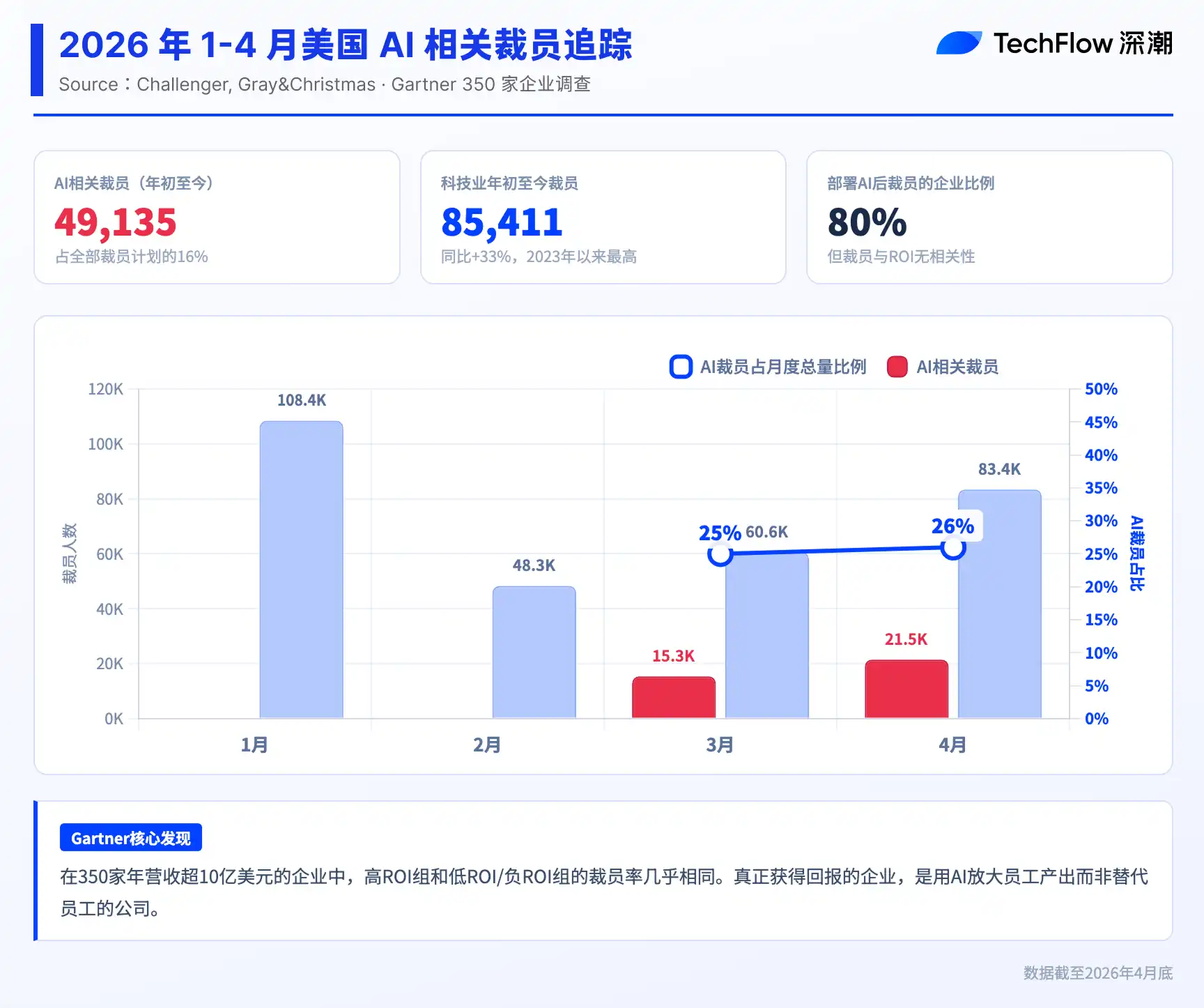
80% of Companies Cut Jobs, But Those Cutting More Aren't Earning More Than Those Cutting Less

Gartner's core finding is: Among companies that have deployed autonomous business capabilities, about 80% reported layoff actions. However, there is almost no difference in the proportion of layoffs between high-return companies and low-return (or even performance-deteriorating) companies.

In other words, from a statistical perspective, there is no discernible causal relationship between cutting jobs and making money.

The survey shows that companies achieving the highest returns are taking an opposite path. They position AI as "people amplification," using technology to enhance the output efficiency of existing employees rather than directly replacing human labor. Poitevin calls this model the "human-amplified business," where AI empowers humans rather than replaces them.

In another independent Gartner survey targeting CEOs, about one-third of executives expect AI to assist humans in decision-making but not make independent decisions, while another 27% expect AI to operate autonomously with minimal or no human intervention. The divergence between these two approaches is deepening.

Nearly 50,000 Jobs Cut Due to AI in First Four Months of This Year, Tech Industry Layoffs Hit Three-Year High

Gartner's research conclusions sharply contrast with the current reality of the job market.

According to the latest report released in May by outplacement firm Challenger, Gray & Christmas, AI has been the primary reason for U.S. corporate layoffs for two consecutive months. In April 2026, 21,490 positions were cut due to AI, accounting for 26% of the total layoffs of 83,387 that month. Cumulatively for the first four months of 2026, positions cut due to AI reached 49,135, representing about 16% of the year's total layoffs so far, up from 13% at the end of March.

Andy Challenger, Chief Revenue Officer at Challenger, summarized it pointedly: "Whether individual roles are truly being replaced by AI or not, the budget for those roles is being taken by AI."

By industry, the tech sector is the hardest hit. The tech industry cut 33,361 jobs in April, with a year-to-date total of 85,411, a 33% increase year-over-year, the highest for the period since 2023. Cognizant plans to cut 12,000 to 15,000 jobs globally, Cloudflare is laying off about 1,100 employees (approximately 20% of its workforce), Coinbase is cutting 14% of its staff, and Snap is eliminating 1,000 positions—all citing AI as a core driver.

Contrasting with the layoff wave is a sharp contraction in hiring. In April, companies announced only 10,049 new hiring plans, a staggering 69% decrease month-over-month and a 38% drop year-over-year.

"AI Washing" Layoffs: How Many Layoffs Are Really Due to AI?

A recurring question is raised: How many of the layoffs implemented by companies in the name of AI are genuinely driven by AI?

OpenAI CEO Sam Altman directly raised this question in an interview this past February. He acknowledged the existence of so-called "AI washing" phenomena: companies packaging layoffs they would have conducted anyway as AI-driven structural adjustments. "I don't know the exact percentage, but there is certainly some AI washing, where people attribute layoffs they were going to do anyway to AI," Altman said.

Deutsche Bank analysts also noted in a recent research report that "AI redundancy washing will be a prominent feature of 2026," with large companies using AI as a rhetorical shield for layoffs, while actual drivers may be tariffs, economic uncertainty, or other cost pressures.

Gartner's Poitevin leans towards a milder interpretation: current AI-related layoffs are more like companies "testing the waters" rather than genuine structural resets. "In our view, this looks more like a one-off, small-scale experiment for many companies, not something that translates into full return on AI investment."

Long-term Forecast: AI to Become a Net Job Creator by 2028-2029

Gartner's stance is distinctly two-sided.

Short-term data is not optimistic. Previous Gartner research shows that AI agents successfully complete standard office tasks about 30% to 35% of the time. Gartner also predicts that over 40% of AI agent projects will be canceled by the end of 2027 due to cost overruns, unclear business value, and insufficient risk management.

But Gartner offers an optimistic long-term forecast: autonomous business will begin to become a net job creator between 2028 and 2029, when new types of jobs that AI cannot perform will emerge. Poitevin emphasizes: "In the long term, autonomous business will create more work for humans, not less. Structural factors like demographic decline and high-trust consumption scenarios will ensure that human capital remains central to operating, governing, and scaling autonomous systems."

On the spending front, Gartner expects AI agent software spending to grow from $86.4 billion in 2025 to $206.5 billion in 2026, and to $376.3 billion in 2027. Even with most projects failing, capital is still accelerating its influx.

This creates an absurd yet real situation: corporate layoffs have not brought returns, AI project failure rates remain high, but no one is willing to get off the ride.


İlgili Sorular

QWhat was the main finding of the Gartner study regarding AI-driven layoffs and financial performance?

AThe study found that while 80% of companies deploying AI reported layoffs, there was no positive correlation between the rate of layoffs and the company's return on investment. Companies that laid off more people did not see better financial returns than those that laid off fewer.

QAccording to the article, what is the 'human-amplified business' model, and how does it relate to AI investment success?

AThe 'human-amplified business' model uses AI to enhance and amplify the output of existing employees rather than to directly replace them. The study found that companies adopting this approach were the ones achieving the highest returns on their AI investments.

QWhat does the term 'AI washing' refer to in the context of corporate layoffs?

A'AI washing' refers to the practice where companies blame layoffs on AI-driven structural changes when, in reality, the layoffs were planned or driven by other factors like economic uncertainty or cost pressures, using AI as a rhetorical shield.

QWhat were the key statistics about AI-related job losses in the first four months of 2026, according to the article?

AIn the first four months of 2026, 49,135 jobs were cut due to AI, accounting for about 16% of total layoffs in that period. In April 2026 alone, 21,490 jobs (26% of the month's total) were attributed to AI.

QWhat is Gartner's long-term prediction regarding AI's impact on employment by 2028-2029?

AGartner predicts that autonomous business powered by AI will become a net creator of jobs by 2028-2029. New types of work that AI cannot perform are expected to emerge, and human capital will remain central to operating and governing these systems.

İlgili Okumalar

From South Korea to the United States: Blue-Collar Jobs Are Becoming Increasingly Popular, Thanks to AI

AI is reshaping the labor market's value proposition. The traditional four-year college degree is losing its appeal as a guaranteed career path, while skilled blue-collar trades like electricians, welders, and plumbers are experiencing historic demand and wage premiums. This shift is driven by dual pressures: AI's displacement of certain white-collar roles and a booming need for physical infrastructure and data center construction. Data confirms the trend. In the U.S., vocational school revenue surged, and a significant portion of recent layoffs are AI-related. Surveys show a majority of Gen Z adults plan to pursue blue-collar work, citing better job security against AI automation. Vocational education interest has exploded recently. Experts cite a psychological shift as younger generations seek tangible, AI-resistant careers and avoid high student debt. In many cases, salaries for skilled trades now match or exceed those requiring a bachelor's degree. In South Korea, semiconductor vocational high schools boast near-total employment, with graduates securing high-paying roles at companies like Samsung. The shortage is structural, exacerbated by a retiring baby boomer workforce and massive infrastructure projects. Companies like JPMorgan Chase, Meta, and Lowe's are investing heavily in training programs. However, overcoming historical stigma and a "perception gap" around trade careers remains a key challenge to closing the talent gap.

marsbit52 dk önce

From South Korea to the United States: Blue-Collar Jobs Are Becoming Increasingly Popular, Thanks to AI

marsbit52 dk önce

Qualcomm: AI Hype Subsides, When Will Smartphones Emerge from the Gloom?

Qualcomm reported its Q3 FY2026 results (ending June 2026), with revenue of $9.95B, down 4% YoY but above expectations. Gross margin declined to 53.1%, pressured by rising costs across manufacturing and memory. Key business segments showed mixed performance: Handset revenue fell 19.6% YoY to $5.09B, dragged by an 11% decline in non-Apple Android shipments and weaker high-end mix. Conversely, Automotive revenue surged 61% to $1.59B, and IoT grew 9% to $1.83B. Core operating profit dropped 41% YoY due to margin compression and higher expenses. Management's Q4 FY2026 guidance projects revenue of $9.7B-$10.5B, in line with consensus, but Non-GAAP EPS guidance of $2.05-$2.25 fell short of expectations. Amidst persistent weakness in its core handset market, Qualcomm is pursuing growth in AI, focusing on Edge AI (smartphones, PCs, automotive) and Data Center AI. Its data center strategy includes four pillars: AI accelerators (e.g., AI200), commercial CPUs (Dragonfly C1000), custom silicon, and connectivity solutions. While these initiatives initially boosted its stock, concerns over AI capital expenditure sustainability have since erased those gains. The company targets $5B in data center revenue for FY2027 and $15B for FY2029. The report concludes that with the traditional handset business still under pressure, the data center opportunity is currently viewed as a longer-term option, and a more conservative valuation based on core operations may be warranted until AI contributions materialize.

marsbit56 dk önce

Qualcomm: AI Hype Subsides, When Will Smartphones Emerge from the Gloom?

marsbit56 dk önce

From TPU to Self-Evolving Agents: How Jeff Dean Predicts the Next Step in AI

At the 2026 YC Startup School, Jeff Dean outlined his vision for AI's next phase, shifting focus from simply scaling models to building intelligent, autonomous systems. He believes AI's progress is no longer just about creating smarter models, but about integrating them into systems capable of long-term, iterative work, automated experimentation, and continuous learning. This evolution moves the competition from "who has the bigger model" to "who can best organize intelligence." Dean suggests AI capabilities are now comparable to a junior engineer, enabling the automation of complex workflows. However, the true challenge and opportunity lie in managing these AI "workers" at scale. He emphasizes the importance of **context engineering**—structuring tools, memory, and feedback loops—over raw model power. For startups, this means building deep expertise in niche domains where general models currently fail (near 0-1% success rates), leveraging proprietary data, specialized tools, and domain-specific evaluators. A recurring theme is re-examining fundamental constraints. Dean's past work, like moving Google's search index to memory or creating the TPU, stemmed from questioning outdated assumptions about hardware and cost. He sees similar inflection points today, particularly in **specialized inference hardware** to drastically reduce latency and energy consumption for real-time Agent operation. Notably, he points out that in modern AI systems, the dominant cost is often not computation but **data movement**. Reliable, long-running Agents require robust system design, borrowing concepts from distributed computing like checkpointing, state management, and parallel exploration to handle failures and maintain progress over days or weeks. As AI automates execution, the scarcest human skills will shift to **defining clear specifications**, **judging what problems are worth solving** (taste), and designing effective feedback loops. Ultimately, Dean's framework prioritizes understanding the problem deeply, identifying the true bottlenecks, and systematically building closed-loop systems where AI can not only perform tasks but also improve AI itself.

marsbit56 dk önce

From TPU to Self-Evolving Agents: How Jeff Dean Predicts the Next Step in AI

marsbit56 dk önce

İşlemler

Spot
活动图片




