Research Debunks AI Layoff Myth: 80% of Companies Cut Jobs, None Made Money From It

marsbit2026-05-13 tarihinde yayınlandı2026-05-13 tarihinde güncellendi

Özet

Research Debunks AI Layoff Myth: 80% of Firms That Cut Jobs Saw No Financial Gain A Gartner survey of 350 large enterprises (revenue >$10B) found 80% that deployed AI/automation conducted layoffs, but found no positive correlation between the scale of layoffs and financial return. Companies that cut more jobs did not outperform those that cut fewer. The highest returns were achieved by "human-amplified" businesses using AI to augment employee productivity rather than replace them. Meanwhile, nearly 50,000 U.S. jobs were cut due to AI in the first four months of 2026, with tech sector layoffs hitting a three-year high. The report suggests that current AI-driven layoffs may often be small-scale experiments or "AI washing"—using AI as a pretext for cuts driven by other economic pressures. Short-term challenges are significant, with over 40% of AI agent projects predicted to be cancelled by 2027 due to cost and value issues. However, Gartner forecasts AI will become a net job creator by 2028-2029, creating new roles that AI cannot fulfill. Despite high project failure rates, AI software spending is projected to grow rapidly, from $86.4B in 2025 to $376.3B in 2027.

Author: Claude, Shenchao TechFlow

Shenchao Introduction: A Gartner survey of 350 companies with annual revenues exceeding $1 billion shows that 80% of firms that have deployed AI or automation technologies have implemented layoffs, but there is no positive correlation between the layoff rate and return on investment—companies that cut more jobs aren't earning more than those that cut fewer.

Companies achieving high returns are actually those using AI to amplify employee output rather than replace employees. Meanwhile, in the first four months of 2026, nearly 50,000 positions have been cut due to AI, and tech industry layoffs have hit a new high since 2023.

The logic of companies using AI to replace employees is being contradicted by data.

According to a Fortune report on May 11, a survey by research and advisory firm Gartner of 350 global corporate executives found that companies conducting major layoffs in the name of AI have not gained better financial returns as a result. The surveyed companies all have annual revenues exceeding $1 billion and are already piloting or deploying AI agents, intelligent automation, or autonomous technologies.

Helen Poitevin, Vice President Analyst at Gartner and lead researcher for the study, told Fortune: "Focusing solely on layoffs to extract value from AI is a short-sighted move. Purely chasing returns by cutting headcount is likely to lead most companies down a dead-end with limited gains."

This survey was completed in Q3 2025. Its conclusion is bluntly glaring: Layoffs create budgetary space, not return on investment.
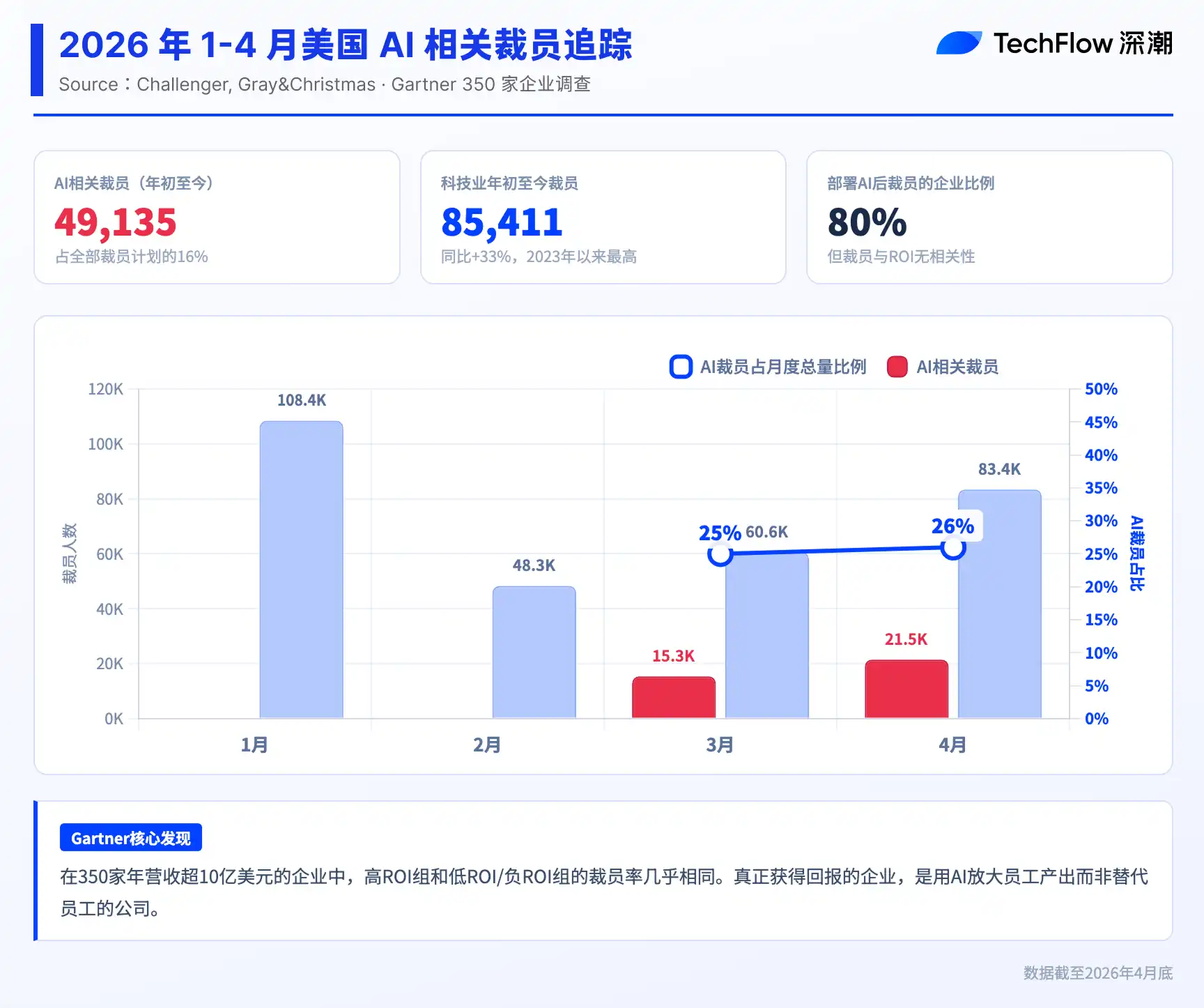
80% of Companies Cut Jobs, But Those Cutting More Aren't Earning More Than Those Cutting Less

Gartner's core finding is: Among companies that have deployed autonomous business capabilities, about 80% reported layoff actions. However, there is almost no difference in the proportion of layoffs between high-return companies and low-return (or even performance-deteriorating) companies.

In other words, from a statistical perspective, there is no discernible causal relationship between cutting jobs and making money.

The survey shows that companies achieving the highest returns are taking an opposite path. They position AI as "people amplification," using technology to enhance the output efficiency of existing employees rather than directly replacing human labor. Poitevin calls this model the "human-amplified business," where AI empowers humans rather than replaces them.

In another independent Gartner survey targeting CEOs, about one-third of executives expect AI to assist humans in decision-making but not make independent decisions, while another 27% expect AI to operate autonomously with minimal or no human intervention. The divergence between these two approaches is deepening.

Nearly 50,000 Jobs Cut Due to AI in First Four Months of This Year, Tech Industry Layoffs Hit Three-Year High

Gartner's research conclusions sharply contrast with the current reality of the job market.

According to the latest report released in May by outplacement firm Challenger, Gray & Christmas, AI has been the primary reason for U.S. corporate layoffs for two consecutive months. In April 2026, 21,490 positions were cut due to AI, accounting for 26% of the total layoffs of 83,387 that month. Cumulatively for the first four months of 2026, positions cut due to AI reached 49,135, representing about 16% of the year's total layoffs so far, up from 13% at the end of March.

Andy Challenger, Chief Revenue Officer at Challenger, summarized it pointedly: "Whether individual roles are truly being replaced by AI or not, the budget for those roles is being taken by AI."

By industry, the tech sector is the hardest hit. The tech industry cut 33,361 jobs in April, with a year-to-date total of 85,411, a 33% increase year-over-year, the highest for the period since 2023. Cognizant plans to cut 12,000 to 15,000 jobs globally, Cloudflare is laying off about 1,100 employees (approximately 20% of its workforce), Coinbase is cutting 14% of its staff, and Snap is eliminating 1,000 positions—all citing AI as a core driver.

Contrasting with the layoff wave is a sharp contraction in hiring. In April, companies announced only 10,049 new hiring plans, a staggering 69% decrease month-over-month and a 38% drop year-over-year.

"AI Washing" Layoffs: How Many Layoffs Are Really Due to AI?

A recurring question is raised: How many of the layoffs implemented by companies in the name of AI are genuinely driven by AI?

OpenAI CEO Sam Altman directly raised this question in an interview this past February. He acknowledged the existence of so-called "AI washing" phenomena: companies packaging layoffs they would have conducted anyway as AI-driven structural adjustments. "I don't know the exact percentage, but there is certainly some AI washing, where people attribute layoffs they were going to do anyway to AI," Altman said.

Deutsche Bank analysts also noted in a recent research report that "AI redundancy washing will be a prominent feature of 2026," with large companies using AI as a rhetorical shield for layoffs, while actual drivers may be tariffs, economic uncertainty, or other cost pressures.

Gartner's Poitevin leans towards a milder interpretation: current AI-related layoffs are more like companies "testing the waters" rather than genuine structural resets. "In our view, this looks more like a one-off, small-scale experiment for many companies, not something that translates into full return on AI investment."

Long-term Forecast: AI to Become a Net Job Creator by 2028-2029

Gartner's stance is distinctly two-sided.

Short-term data is not optimistic. Previous Gartner research shows that AI agents successfully complete standard office tasks about 30% to 35% of the time. Gartner also predicts that over 40% of AI agent projects will be canceled by the end of 2027 due to cost overruns, unclear business value, and insufficient risk management.

But Gartner offers an optimistic long-term forecast: autonomous business will begin to become a net job creator between 2028 and 2029, when new types of jobs that AI cannot perform will emerge. Poitevin emphasizes: "In the long term, autonomous business will create more work for humans, not less. Structural factors like demographic decline and high-trust consumption scenarios will ensure that human capital remains central to operating, governing, and scaling autonomous systems."

On the spending front, Gartner expects AI agent software spending to grow from $86.4 billion in 2025 to $206.5 billion in 2026, and to $376.3 billion in 2027. Even with most projects failing, capital is still accelerating its influx.

This creates an absurd yet real situation: corporate layoffs have not brought returns, AI project failure rates remain high, but no one is willing to get off the ride.


İlgili Sorular

QWhat was the main finding of the Gartner study regarding AI-driven layoffs and financial performance?

AThe study found that while 80% of companies deploying AI reported layoffs, there was no positive correlation between the rate of layoffs and the company's return on investment. Companies that laid off more people did not see better financial returns than those that laid off fewer.

QAccording to the article, what is the 'human-amplified business' model, and how does it relate to AI investment success?

AThe 'human-amplified business' model uses AI to enhance and amplify the output of existing employees rather than to directly replace them. The study found that companies adopting this approach were the ones achieving the highest returns on their AI investments.

QWhat does the term 'AI washing' refer to in the context of corporate layoffs?

A'AI washing' refers to the practice where companies blame layoffs on AI-driven structural changes when, in reality, the layoffs were planned or driven by other factors like economic uncertainty or cost pressures, using AI as a rhetorical shield.

QWhat were the key statistics about AI-related job losses in the first four months of 2026, according to the article?

AIn the first four months of 2026, 49,135 jobs were cut due to AI, accounting for about 16% of total layoffs in that period. In April 2026 alone, 21,490 jobs (26% of the month's total) were attributed to AI.

QWhat is Gartner's long-term prediction regarding AI's impact on employment by 2028-2029?

AGartner predicts that autonomous business powered by AI will become a net creator of jobs by 2028-2029. New types of work that AI cannot perform are expected to emerge, and human capital will remain central to operating and governing these systems.

İlgili Okumalar

Xiaohongshu's Second Great Voyage, This Time Sailing Towards AI

Xiaohongshu's Second Voyage: Navigating Towards AI Since ChatGPT's emergence, Xiaohongshu's founder Mao Wenchao has been acutely aware of AI's potential threat, recognizing that the life advice people seek from chatbots overlaps directly with his platform's core business. Founded in 2013 as a PDF shopping guide for Chinese tourists, Xiaohongshu evolved into a massive community where millions share authentic, personal experiences—from product reviews to travel tips. This vast repository of "I've tried this" human judgment became its most valuable asset. However, the rise of AI, which delivers instant answers, challenges the very need for users to sift through numerous personal notes. Fearing its treasure trove of lived experience could become mere training data for others, Xiaohongshu is proactively adapting. In 2026, it established a dedicated AI division (Dots), launched RED Skill to turn user experiences into usable AI tools, and acquired the AI search product "Diandian." Its investments now extend to AI firms like MiniMax and hardware startups, moving upstream to address needs before they even become search queries. The platform's commercialization strategy is also evolving. With a newly acquired payment license and tools like the AIPS model to track consumer decision journeys, Xiaohongshu aims to seamlessly integrate recommendations with transactions, embedding commerce within AI-generated answers. Yet, a critical tension remains. While building smarter machines to organize and leverage its human experiences, Xiaohongshu must prevent AI from drowning out the authentic, flawed, and trustworthy "I've tried this" voices that built its community. Its core challenge is to harness AI's power without letting the map—the machine's perfect, synthesized answer—replace the territory of genuine human experience. This balance between technological advancement and preserving human trust defines its current journey and its future.

marsbit4 dk önce

Xiaohongshu's Second Great Voyage, This Time Sailing Towards AI

marsbit4 dk önce

SharpLink CEO: How to Understand Ethereum Developers Just Exceeded 1 Million?

SharpLink CEO reflects on the milestone of Ethereum surpassing 1 million historical developers, emphasizing that this figure represents the largest pool of technical talent ever assembled around an open, permissionless blockchain network. While approximately 232,000 developers remain active, the key question for the crypto industry is not which chain is fastest, but where the best builders choose to build long-term. Ethereum's advantage lies in a decade-long accumulation of infrastructure, standards, tools, liquidity, and a cohesive culture, making it the default operating system for programmable finance. This developer base is tackling complex challenges: the Glamsterdam upgrade aims to enhance scalability while preserving core principles; synchronous composability seeks to unify Rollup ecosystems; and significant efforts are underway for post-quantum security. Ethereum's deeper network effects stem from composability and shared standards (like the EVM and Solidity), creating a flywheel of more developers, tools, and liquidity. Three reinforcing strengths cement Ethereum's lead: credible neutrality (secured by ~900k validators), a modular architecture with interconnected Rollups, and a culture that attracts top researchers. The ecosystem is consolidating as the trusted coordination layer for internet-native finance, favored by large institutions valuing security and liquidity. The future of Ethereum is being built by this global community of founders and architects.

链捕手19 dk önce

SharpLink CEO: How to Understand Ethereum Developers Just Exceeded 1 Million?

链捕手19 dk önce

A Clod of Chinese Soil Chokes Two Japanese Giants

"Chinese Soil Chokes Japanese Giants" The production of a key electronic specialty gas, tungsten hexafluoride (WF6), vital for manufacturing AI chips, was halted by two leading Japanese producers—Kanto Denka and Central Glass. Their shutdown was not due to a technological failure but a sudden, critical shortage of a raw material they had long taken for granted: ultra-high-purity (6N-grade) tungsten powder, which is almost entirely sourced from China. Following a quiet Chinese export announcement in January 2026, tungsten powder shipments to Japan dropped to zero for months. Despite frantic efforts, Japanese companies found no viable alternative; imported powder was three times more expensive and lacked the required purity. Their existing stockpiles were exhausted by mid-2026. WF6 is essential for depositing tungsten into the microscopic contact holes of High Bandwidth Memory (HBM) chips, which are crucial for advanced processors like those from Nvidia. While Japanese firms had mastered producing ultra-pure WF6 gas, their entire supply chain relied on China's 6N tungsten powder—a dependency now revealed as a fatal vulnerability. China's dominance in this "soil" results from decades of painstaking R&D by companies like Xiamen Tungsten and China Tungsten & Hightech. They overcame immense technical hurdles, such as separating chemically similar molybdenum from tungsten, to achieve mass production of the world's purest tungsten powder. With their primary suppliers gone, Kanto Denka and Central Glass announced a permanent halt to WF6 production starting July 1, 2026. This immediately created a supply crisis for major semiconductor manufacturers like Samsung and SK Hynix, forcing them to urgently seek and certify new Chinese suppliers for WF6 itself. The reversal marks a dramatic shift: China has moved from exporting low-value raw materials to controlling the high-purity foundation of a critical global tech supply chain, upending a long-established industrial hierarchy.

marsbit50 dk önce

A Clod of Chinese Soil Chokes Two Japanese Giants

marsbit50 dk önce

İşlemler

Spot
Futures
活动图片