Report Review: Kyber Delay Tear NVIDIA Supply Chain, Only a Few Winners in the PCB Chain

marsbit2026-06-23 tarihinde yayınlandı2026-06-23 tarihinde güncellendi

Özet

Research Report Analysis: Kyber's Delay Reshapes NVIDIA Supply Chain, Winners Limited in PCB Sector Jefferies maintained a Buy rating on NVIDIA with a $300 price target (42% upside), but delivered a surprising take on the AI server PCB supply chain. The key finding is that the high-density orthogonal backplane PCB, codenamed "Kyber," is likely delayed to 2028 or even canceled. This prompts a downward revision in the global AI PCB market forecast for 2027/2028 by 5% and 11%, respectively, with CCL (copper-clad laminate) forecasts cut by 8% and 16%. While Kyber's postponement extends the lifecycle of the current Oberon architecture and defers some PCB volume, it does not halt the trend towards higher specifications. Migration to advanced materials like M9/M10-grade CCL and PTFE processes continues. The delay reshuffles the winners' list: upstream material suppliers (glass fabric, CCL) benefit from persistent tight supply and strong pricing power. Copper cable vendors gain a reprieve as the threat from PCB-based interconnects recedes. PCB manufacturers, however, face intensified competition, with mid-tier players most vulnerable to being squeezed out. The report stresses that the market adjustment reflects a timing shift, not a demand destruction. Kyber-related orders are deferred, not canceled. NVIDIA's core GPU competitiveness and the AI server growth trajectory remain intact. The analyst's investment thesis prioritizes "high-value-add" and "supply-constrained" segments: up...

Author:Rita

Trend Highlights

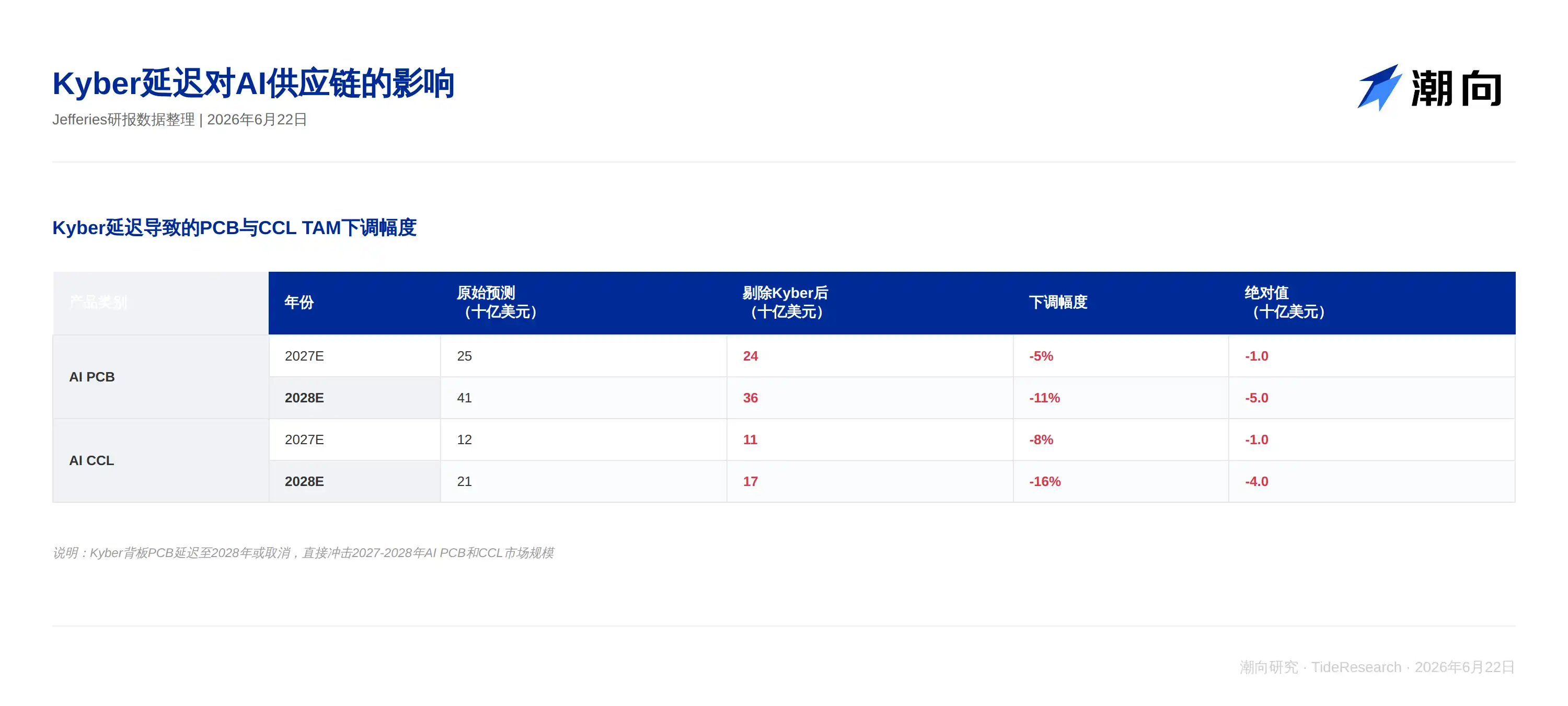
Jefferies issued a research report on NVIDIA on June 22, maintaining a Buy rating and raising the target price to $300 (implying a 42% upside from the current $210.69). The core view is surprising: while bullish on NVIDIA, it pours cold water on the AI server PCB supply chain. The backplane PCB product Kyber is highly likely to be delayed until 2028 or even canceled entirely, leading to a downward revision of the global AI PCB market size by 5% and 11% for 2027/2028 respectively, and the CCL (Copper Clad Laminate) market by 8% and 16% respectively. This adjustment might seem like bad news, but it is reshaping the list of winners in the AI server supply chain.

What the Kyber Delay Means

Jefferies believes the Kyber delay is essentially confirmed. Rubin Ultra was originally planned to use orthogonal backplane PCB (Kyber architecture), but due to bottlenecks in intra-rack connectivity technology, the Oberon architecture will still be used in 2027. Kyber is postponed to 2028 at the earliest, and could be canceled in the worst-case scenario. This change directly impacts the PCB iteration timeline.

However, delay does not mean regression. Switch boards and midplane boards continue to migrate towards high-end materials, with M9/10 grade CCL and PTFE processes becoming industry standards. CoWoP (Chip-on-Wafer-on-Substrate interconnect technology) penetration will begin earliest in 2027. The trend of rising unit value remains unchanged, only the timeframe has been extended.

Therefore, the biggest winners of this delay are not in manufacturing, but upstream. Upstream material suppliers like glass fiber cloth and CCL are already facing tight supply, with strong ability for sustained price increases and cost pass-through. PCB manufacturers face more direct pressure from order contraction. Copper cable suppliers benefit from the extended lifecycle of Oberon, reducing the risk of being replaced by PCB.

Why Focus on Specs, Not Just TAM

On the surface, the Kyber postponement led to significant downward revisions of the AI PCB and CCL market size estimates. But looking closely, this adjustment reflects a reshuffling of the pace of specification upgrades, not a disappearance of demand.

From the data, the original global AI PCB market expectation for 2027 was $25 billion; after excluding Kyber it's $24 billion, a 5% decrease. This is not a "shrinkage" but a "rescheduling." Kyber's order volume won't vanish; it will simply shift from 2027 to 2028. During this shift, the order volume left in 2027 will be used for Oberon upgrades, actually raising the specification standards.

This means the value per PCB doesn't change linearly. Lower-end products are revised down, higher-end products revised up. Within this mixed structure, there is room for total value recombination. Those who will profit are players positioned in high-end specifications and upstream materials, while manufacturers relying entirely on low-end capacity expansion will passively bear the pressure.
Supply Chain Divergence: Who's Out, Who's In the Inner Circle

The most direct impact of the Kyber delay is the acceleration of the elimination race in the PCB industry. Mid-tier manufacturers face the greatest pressure. High-end players have technical depth and customer stickiness, enabling them to follow NVIDIA's upgrade rhythm for spec iterations; low-end capacity has cost advantages, allowing them to quickly follow basic demand. But manufacturers stuck in the middle, unable to handle high-end complexity nor compete on cost, will be squeezed out.

Upstream material suppliers see structural opportunities. Glass fiber cloth and CCL suppliers face industry-wide demand. Kyber's cancellation won't reduce demand for glass fiber and CCL; it will only change the structure. The tight supply situation won't ease in the short term, with pricing power in the hands of material suppliers.

Copper cable suppliers gain a "reprieve" from the Kyber delay. Before Kyber's launch, copper cables faced the risk of gradual replacement by high-speed PCB interconnects. The extended lifecycle of the Oberon architecture means copper cables remain useful.

Why NVIDIA is Still Worth $300

Although Jefferies revised down the TAM expectations for PCB and CCL, it is not pessimistic about NVIDIA's prospects. The Kyber delay does not affect NVIDIA's core GPU competitiveness, nor does it change the growth trajectory of AI server shipments.

Kyber aims to further optimize rack efficiency in 2028 and beyond. Its delay means NVIDIA has one less innovation story for 2027, but it doesn't mean chip sales in 2027 will decline. Specification upgrades (M9/10, CoWoP) are still progressing as planned, and the unit value of AI servers continues to rise.

From a financial perspective, the CY28E NVIDIA EPS estimate is $14.14, leading to a $300 target price based on a 21x P/E ratio. This valuation level considers the certainty of long-term AI demand, not the timeline of a specific product generation.

What the Analysts are Betting On

Jefferies' final judgment points to: Upstream Materials > NVIDIA > Copper Cables > PCB Downstream.

They are bullish on the "high value-added end" and "supply bottleneck end" of the AI industry chain. GPU chips, as the core computing resource, have the highest value and most certain demand. Upstream materials are the bottleneck; scarcity determines premium. Copper cables get breathing room due to the delay. PCB manufacturing is most adversely affected because it is neither the bottleneck nor the core competency, just an executor.

This delay in PCB specification upgrades is not bad news, but a process of realignment. After the realignment, the profitability of players inside the inner circle and those positioned correctly will be higher, while those waiting on the sidelines will be left out.

Disclaimer

This article is a third-party brokerage research report summary and interpretation by Trend Research. The ratings, target prices, earnings forecasts, and related judgments cited are the views of that brokerage's analysts, representing only the position of their affiliated institution. They do not represent the views of Trend Research, nor constitute any investment advice.

Please note three points while reading: First, target prices are analysts' expectations for the next approximately 12 months, representing forecasts not promises, and are subject to frequent adjustments based on performance and market conditions. Second, sell-side research reports are inherently biased towards bullishness, and some covered companies may have investment banking relationships with the brokerage. Third, the value of a research report lies in its mainline logic and its underlying assumptions, not just a specific target price. Focus on the logic, not just the price.

The market carries risks; decisions should be made independently. This article should not serve as the basis for trading any securities.

Data Sources: Jefferies Research Report (Jacky He et al., June 22, 2026) · Prismark · NVIDIA Public Financial Reports

Tide Research · TideResearch · June 2026

İlgili Sorular

QAccording to the report, what is the main impact of Kyber's potential delay or cancellation on the AI server PCB supply chain?

AThe main impact is a reshuffling of winners and losers in the supply chain. While the total market size for AI PCBs and CCL is revised down slightly (5% in 2027, 11% in 2028), the delay acts as a catalyst for industry consolidation. It accelerates the淘汰赛 for mid-tier PCB manufacturers who lack the technical depth for high-end规格 or the cost advantage for low-end products. The primary beneficiaries shift upstream to material suppliers (like glass fiber cloth and CCL providers) and also to copper cable makers, who get a reprieve from potential replacement by PCBs.

QWhy does the Jefferies report maintain a bullish $300 target price for NVIDIA despite the negative implications for the PCB segment?

AJefferies maintains a bullish outlook on NVIDIA because Kyber's delay does not impact NVIDIA's core GPU competitiveness or the overall growth trajectory of AI server shipments. The delay only affects a specific interconnect architecture for future rack efficiency, not the fundamental demand for NVIDIA's AI chips. The analyst's $300 target price is based on long-term AI demand certainty and CY28E EPS expectations of $14.14, applying a 21x P/E ratio. The valuation focuses on NVIDIA's position as the highest-value component in the AI supply chain, which remains unchanged.

QWhat are the key structural opportunities identified for upstream material suppliers due to the Kyber schedule change?

AThe report identifies significant structural opportunities for upstream material suppliers, particularly glass fiber cloth and Copper Clad Laminate (CCL) providers. Their advantage stems from persistent supply tightness in these materials, which grants them strong pricing power and the ability to pass on costs. The demand for these materials is industry-wide and not fundamentally reduced by Kyber's delay; it merely shifts in规格 mix. Therefore, they occupy a bottleneck position in the supply chain with inherent scarcity value.

QHow does the 'delay' of Kyber affect the value proposition of individual PCBs versus the total market size (TAM)?

AThe delay affects the timing and规格 mix more than the ultimate value proposition. While the Total Addressable Market (TAM) numbers are revised down for 2027/2028, this represents a timing shift ('错期'), not a disappearance of demand. Crucially, the average value per PCB may not decline linearly because the orders originally intended for Kyber in 2027 are now allocated to upgrading the Oberon architecture (e.g., adopting M9/10 grade CCL and PTFE processes). This means a re-composition where high-end PCB规格 gain a larger share, benefiting companies positioned in that segment, even within a temporarily adjusted TAM.

QAccording to the analyst's final judgment, how does the report rank the relative attractiveness of different segments in the AI supply chain affected by this news?

AThe analyst's final judgment ranks the relative attractiveness as follows: 1. Upstream Materials (highest) - Due to supply bottleneck and pricing power. 2. NVIDIA (GPU) - Due to its core, high-value position in AI compute. 3. Copper Cable Makers - Benefiting from a prolonged lifecycle of the Oberon architecture, reducing near-term replacement risk. 4. PCB Downstream Manufacturers (lowest) - Facing the most direct pressure from order adjustments and lacking the定价权 or technological moat of the other segments.

İlgili Okumalar

Goldman Sachs Research Report Analysis: Circle and USDC Are Moving Beyond the Crypto World, Cross-Border Payments and AI Agents Become New Battlegrounds

Goldman Sachs published a summary of its meeting with Circle Internet Group (issuer of USDC) on July 5th. The core takeaway is that stablecoins, led by USDC, are evolving from a crypto-native tool into foundational infrastructure for traditional finance and the AI economy. USDC's use cases are rapidly expanding beyond crypto trading into cross-border payments, e-commerce, capital market settlements, and notably, payments for AI agents. Circle's management emphasized that stablecoin growth is now decoupled from crypto market cycles, driven by this diversification. They outlined five key application layers and highlighted USDC's network effects, global liquidity depth, and regulatory compliance as competitive moats. Circle distinguishes USDC from bank-issued tokenized deposits, arguing the former is an open, internet-native system without bank credit risk. Strategically, Circle is building a broader fintech platform with its Arc Layer 1 blockchain, the Circle Payments Network for cross-border transfers, and an "Agentic Stack" to serve AI agent economies, where USDC already dominates. Regarding regulation, Circle views potential U.S. legislation like the CLARITY Act as a catalyst for growth rather than a constraint, expecting it to encourage broader institutional adoption and active usage. Goldman Sachs maintains a Neutral rating on Circle with a $96 price target, noting the company's shift from a pure stablecoin issuer to a financial infrastructure provider. Key risks include competition from USDT and potential earnings pressure from declining interest rates on its reserve assets.

marsbit34 dk önce

Goldman Sachs Research Report Analysis: Circle and USDC Are Moving Beyond the Crypto World, Cross-Border Payments and AI Agents Become New Battlegrounds

marsbit34 dk önce

The Robinhood Stock Tokens You Bought Are Just Debts from Jersey Island

The Robinhood stock tokens you buy are essentially debt securities issued by a shell company in Jersey, not real equity. These tokens merely track stock prices like NVIDIA or Apple but grant no shareholder rights like voting or dividends. If the underlying company fails, you have no claim on its assets. Instead, you hold a debt instrument from Robinhood Assets (Jersey) Limited, which promises returns based on stock performance. If this Jersey entity goes bankrupt, you become an unsecured creditor. This complex structure stems from Robinhood's past crisis during the 2021 GameStop short squeeze, where T+2 settlement caused liquidity issues. The blockchain-based tokens enable instant settlement, theoretically preventing such trading halts. The product is classified by the SEC as a "linked security" or structured note, carrying counterparty risk not borne by actual shareholders. It is available globally but excluded from the US, UK, and other major markets, while Robinhood offers a fully compliant, asset-backed token model in Europe under MiFID II. The system relies on oracles for pricing, which poses risks like manipulation and faulty liquidations seen in DeFi exploits. Robinhood profits from spreads and aims to become a full-chain settlement layer. Meanwhile, competitors like Ondo have launched SEC-registered, fully compliant equity tokens in the US with actual voting rights and dividends. Robinhood’s Jersey debt model appears as a transitional, regulatory-arbitrage product, aiming to capture market share ahead of future regulatory clarity.

Foresight News1 saat önce

The Robinhood Stock Tokens You Bought Are Just Debts from Jersey Island

Foresight News1 saat önce

İşlemler

Spot
活动图片