Rented Conviction: How Much Real Money Is Behind the Bitcoin ETF Flows

marsbit2026-06-22 tarihinde yayınlandı2026-06-22 tarihinde güncellendi

Özet

Borrowed Belief: How much of Bitcoin ETF flows are real money? Weekly Bitcoin ETF flows, often interpreted as a measure of institutional conviction, are heavily influenced by a hidden arbitrage trade rather than genuine directional buying. A cash-and-carry arbitrage, where traders buy the ETF while simultaneously shorting Bitcoin futures on the CME to lock in a basis spread (the price difference between futures and spot), drives roughly half of the week-to-week flow volatility. This delta-neutral activity appears as ETF inflows but is unrelated to price views. Data shows a strong correlation (0.70) between weekly ETF inflows and increases in hedge fund short positions on CME futures, while Bitcoin’s weekly price returns have almost no explanatory power. However, this arbitrage activity dominates short-term *fluctuations*, not the cumulative *stock* of investments. Of the total ~$55 billion in net ETF inflows since launch, only about $1 billion currently represents net arbitrage exposure. The vast majority consists of steady, directional buying averaging around $400 million per week. The arbitrage trade has been unwinding for two years, with hedge fund short positions peaking near $14 billion in late 2024 and declining to ~$4.5 billion. Recent ETF outflows partly reflect this ongoing unwind as the basis compresses, not a loss of faith in Bitcoin. Thus, ETF flows overstate the *volatility* of belief, not its *level*. The headline number is more a gauge of arbitrage ...

Author: Darko, IOSG

ETF fund flows are often viewed as a "thermometer" of institutional big money's confidence in Bitcoin. But viewed week by week, they measure something else more: a hidden interest rate trade being turned on and off repeatedly. This article explains how to identify it, how large this trade really is, and why it is quietly unwinding.

TL;DR

  1. Week to week, ETF flows are driven primarily by a hidden arbitrage trade, not conviction. Cash-and-carry arbitrageurs buy ETFs while simultaneously shorting futures on the CME, hedging away price risk, but appear indistinguishable from genuine bulls in the data. About half of the weekly flow volatility can be explained by the single variable of new hedge fund futures shorts, with a correlation of 0.70.

  2. Bitcoin's weekly price change explains almost none of the flows. Using price returns to predict ETF flows yields a result statistically indistinguishable from zero. Weekly flows are not chasing price performance; they move in sync with a hedged interest rate trade.

  3. Arbitrage dominates the weekly "volatility," but never the bulk of the "stock." Of the roughly $55 billion cumulatively flowed into ETFs, the arbitrage trade currently represents a net balance of only about $1 billion; the rest is stable, directional buying, averaging about $400 million per week, which compounded over two years constitutes nearly the entire "mountain."

  4. The correct statement is: ETF flows overstate the "volatility" of conviction, not its "level." The weekly ups and downs are mostly "rented"—arbitrage capital coming and going; while the assets that truly settle are mostly "owned."

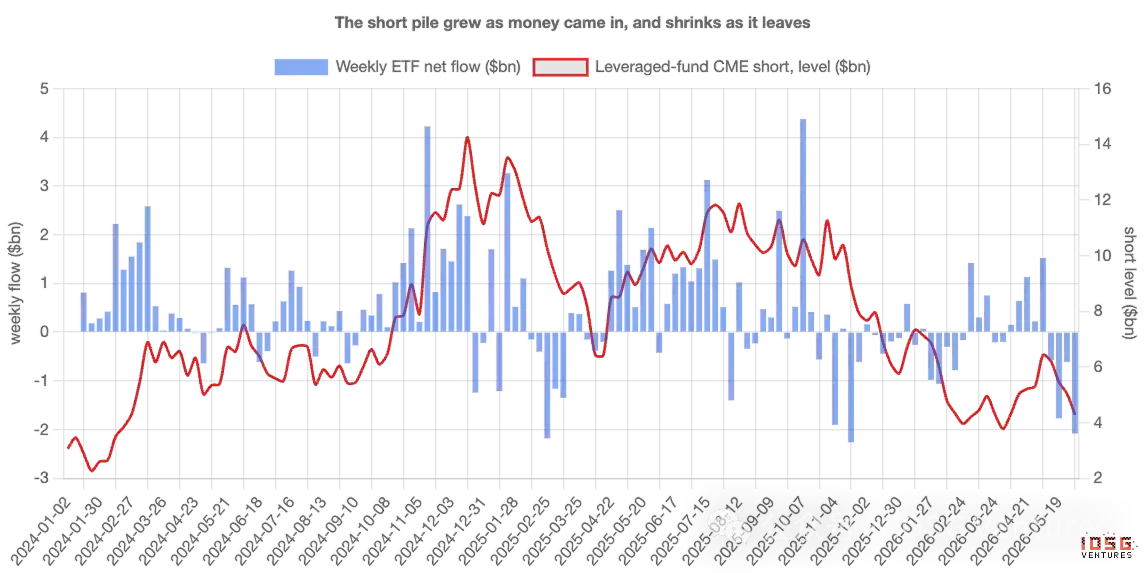
  5. This trade is unwinding, and has been for two years. Leveraged funds' short positions grew from about $3 billion at launch to about $14 billion by late 2024, before steadily retreating to about $4.5 billion. Once the basis compresses to unprofitability, inflows and shorts retreat together—don't mistake the resulting outflows as the market passing judgment on Bitcoin.

I. That Number Everyone Watches

Every week, Bitcoin ETF ETF flows—how much money comes in or goes out—are published, and this number is often treated as a verdict. Large inflows mean institutions are piling in; outflows signal shaken confidence. Flow data has quietly become the market's headline metric for measuring faith.

The problem is, not everyone buying an ETF is betting on Bitcoin. Some of the biggest buyers don't care which way the price goes—and once you account for them, the weekly flow number measures their activity more than anyone's belief. To understand why, you first need to meet a completely different kind of buyer.
A Buyer Who Doesn't Care About Price

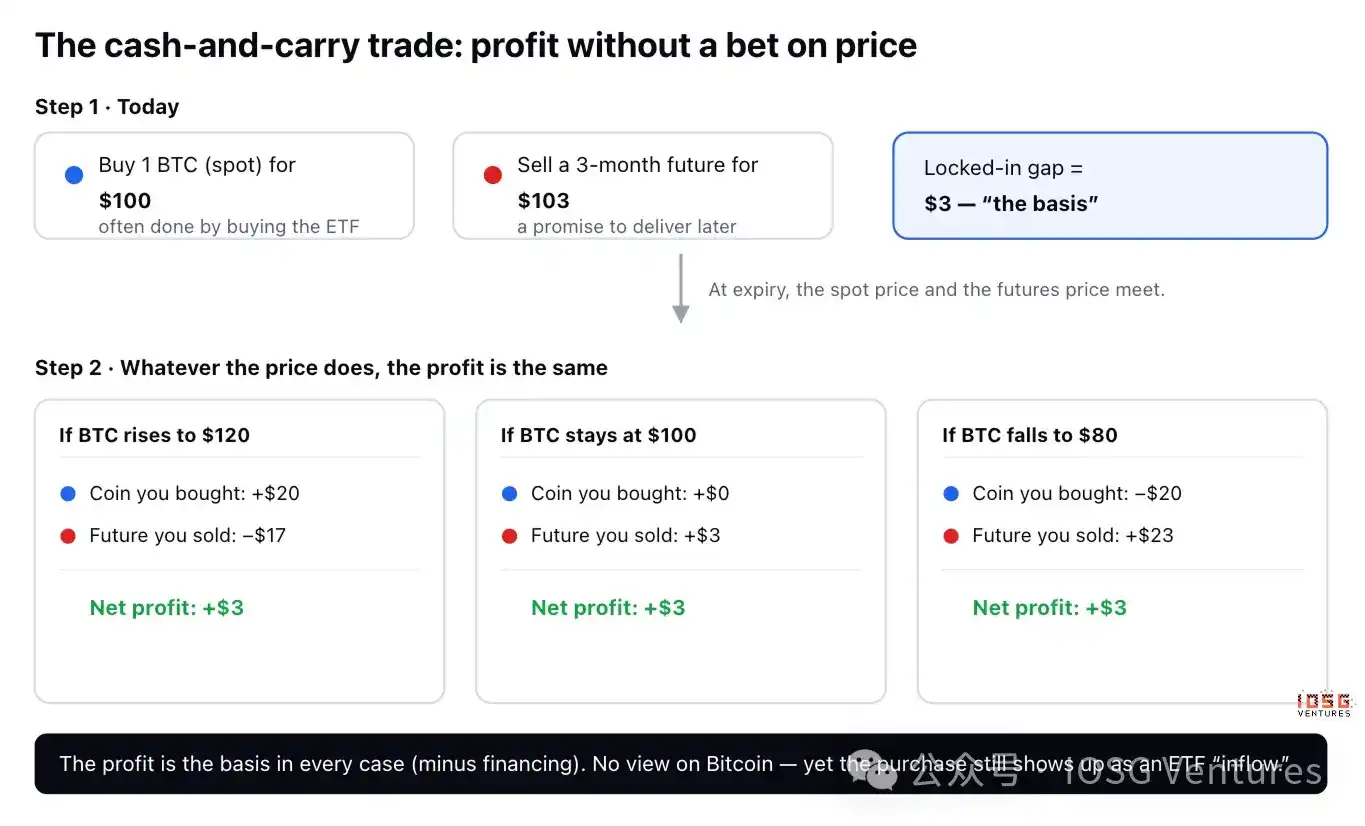
There is a classic, boring trade called cash-and-carry arbitrage. A Bitcoin "futures" contract is just an agreement to buy or sell Bitcoin at a set price on a future date, and most of the time, the futures price trades a bit above the current spot price—say Bitcoin is $100 now, but a contract expiring in three months sells for $103.

A trader can pocket that $3 difference without having any view on price:

  • Buy 1 Bitcoin today for $100 (often done by buying the ETF).

  • Sell a futures contract for $103, promising to deliver in three months.

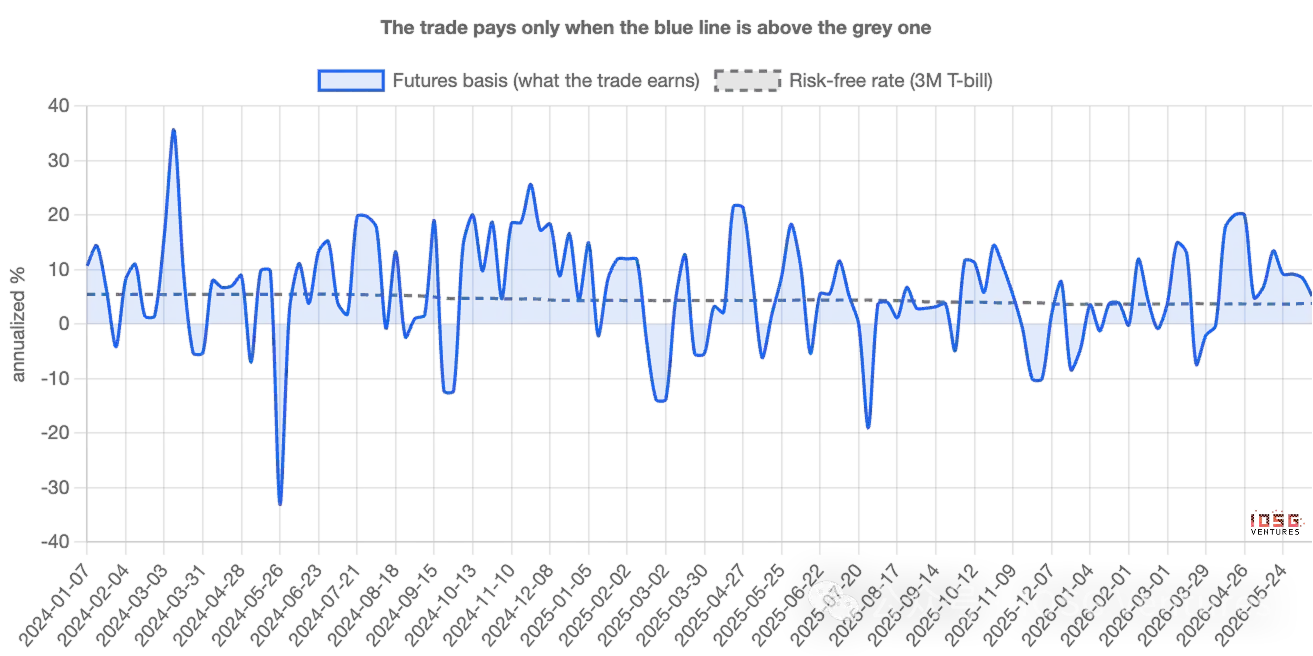
See what happens at expiration. If Bitcoin surges to $120, the trader makes $20 on the coin but loses $17 on the contract—a net gain of $3. If it crashes to $80, they lose $20 on the coin but make $23 on the contract—still a net gain of $3. If it stays flat, still $3. In every scenario, the profit is the same. The direction is hedged away; traders call this "delta neutral." This $3 price difference, expressed as an annualized rate, is the basis—essentially an interest rate earned for parking capital in this trade; it's worth doing as long as it exceeds the risk-free return one could get putting money in US Treasury bills (T-bills).
Why This Pollutes the Headline Number

The key is here. The first leg—buying 1 Bitcoin—is very commonly done by buying the ETF. Therefore, a trader with no view on Bitcoin, running delta neutral, appears in the data as an ETF inflow, indistinguishable on the surface from a true believer.

When lots of cash-and-carry is being set up, inflows look robust, and the narrative of "institutions are loading up" writes itself—even though these funds are hedged and will reverse the moment the trade ceases to be profitable. In other words, the flow number measures not just faith; it measures the activity of arbitrage desks. The challenge is separating the two—and how big each actually is.

How to Tell Them Apart

Cash-and-carry traders leave a second footprint. For every $1 of Bitcoin they buy, they short $1 of futures on the CME (the regulated US exchange where institutions trade Bitcoin futures). True believers leave only the first footprint; arbitrageurs leave both.

And the second footprint is public. The US derivatives regulator publishes a weekly report disclosing the size of long and short positions held by various trader types on the CME. One category—leveraged funds, essentially hedge funds—is precisely where the cash-and-carry crowd congregates. So you can take, week by week, the money flowing into ETFs and line it up against the new short positions these funds establish. If "demand" were truly conviction, the two shouldn't be closely linked; if a big chunk is that hidden trade, they should move together.

II. What the Data Says: Week to Week, Flows Follow Futures,Not Price

They move tightly together. Every single week since the ETFs launched, the weeks that saw more new futures shorting also saw more ETF inflows—almost one for one. About half of all weekly flow volatility can be explained by this single thing: how much shorting funds did. The correlation is 0.70, the kind of strength you see between two things that are clearly related, not coincidental.
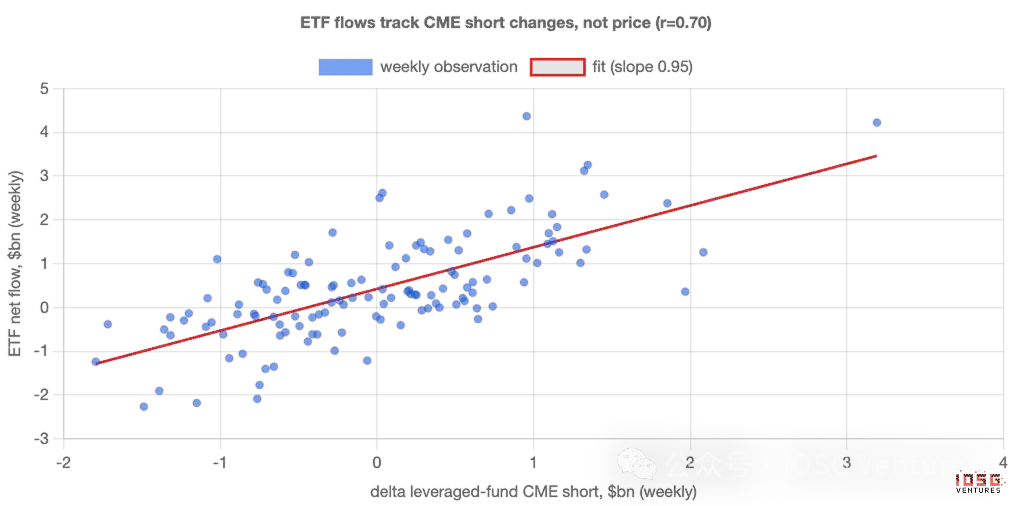
The point that should most unsettle believers: price itself explains almost nothing. Testing whether weekly Bitcoin returns predict ETF flows yields an answer statistically indistinguishable from zero. Weekly money is not chasing performance; it moves in lockstep with a hedged interest rate trade.

So, as a weekly signal, ETF "demand" is mostly arbitrage. The flow number is a poor thermometer for faith because its gyrations are the result of a basis trade being switched on and off, not anyone changing their mind about Bitcoin.

But How Much of the Money Is This Trade?

This is where the simplistic narrative—"it's all fake"—falls apart, and the real story gets more interesting. The basis trade dominates weekly volatility, but it never was the bulk of the stock of money.

Breaking weekly inflows into the part explained by futures shorts (hedged) and the rest (directional), and accumulating since launch: of the roughly $55 billion cumulatively flowed into ETFs, the basis trade currently represents a net balance of only about $1 billion—the rest is stable, directional buying. This buying averages about $400 million per week, week after week, regardless of basis or price, and compounded over two years, it is nearly the entire mountain.
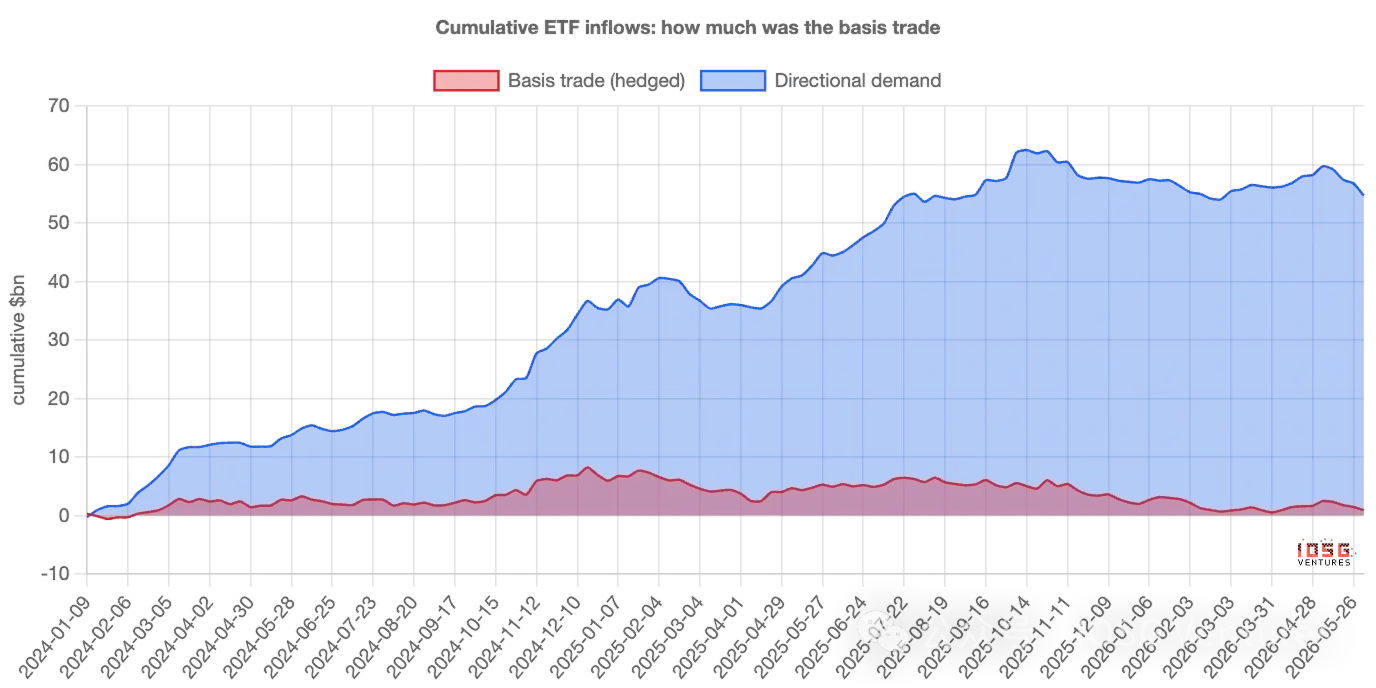
Looking at asset share rather than flows, the picture is the same: the hedged portion once neared 14% of ETF assets in 2024, and is now about 4%-5%. At its peak, it was a non-negligible minority; now it's a sliver.
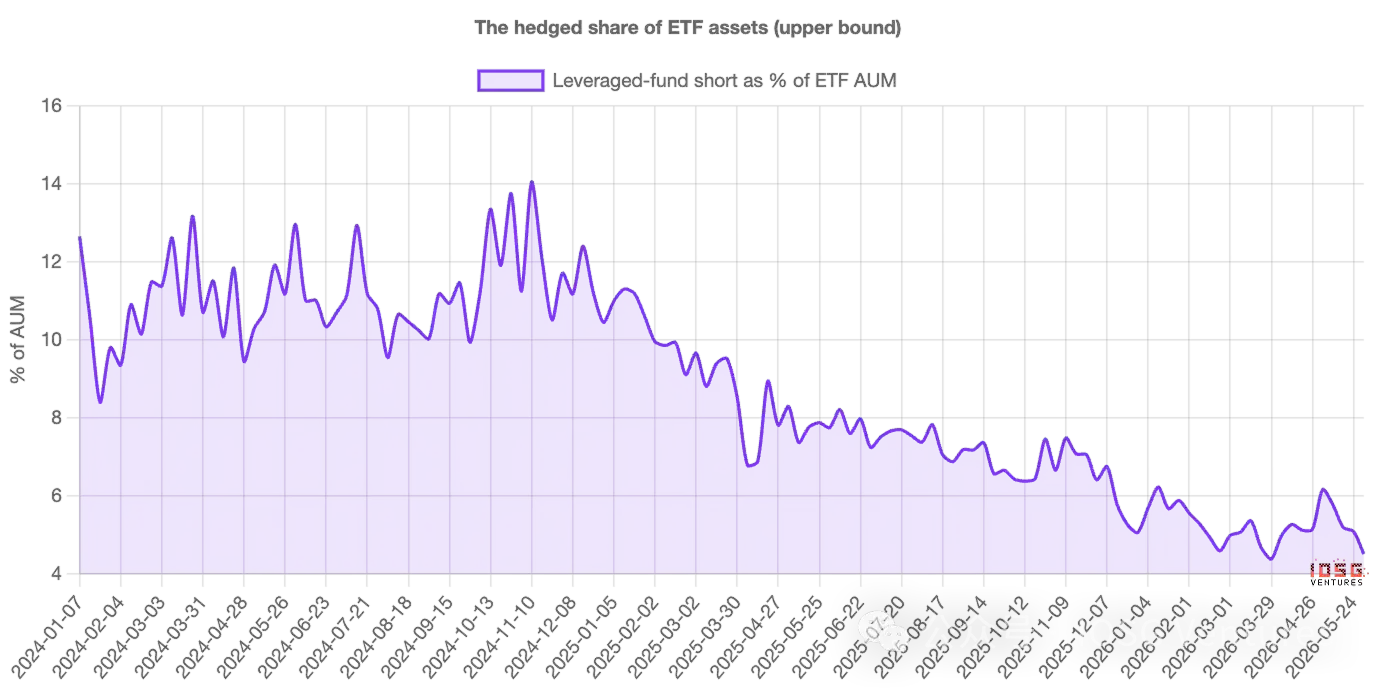
So, the more precise statement is: ETF flows overstate the volatility of conviction, not its level. The weekly ups and downs are mostly "rented"—arbitrage capital coming and going; but the assets that truly settle are mostly "owned." This trade churns through the flow data but was never the bulk of the balance.

And This Trade Is Unwinding

The hedged portion hasn't just always been small—it has been shrinking for two years. Leveraged funds' short positions grew from about $3 billion at launch to about $14 billion by late 2024, before steadily retreating to about $4.5 billion. This arbitrage trade has been unwinding across the entire period, not just recently.

This matters for reading the present. Entering June, hedged positions roughly halved again—funds' shorts fell from about $6.4 billion to $4.3 billion—while ETFs saw daily outflows of $300-$500 million. On the surface alone, that looks like panic capitulation. But paired with the futures data, it's just the routine cleanup of an interest rate trade that's no longer profitable. The same outflow number, two very different stories.

When the Basis Compresses, Demand Fades

The cleanest proof is what happens when the trade becomes unprofitable. When that $3 price difference narrows to approach what traders could earn risk-free, the trade isn't worth doing. If a big chunk of weekly demand really is this trade, then weekly demand should weaken precisely when the basis compresses—and it does. Stripping trend from each series and looking at moments around a compression: ETF inflows break below their usual rhythm, and funds simultaneously cover shorts, both moving in sync. Demand breathes with the trade.
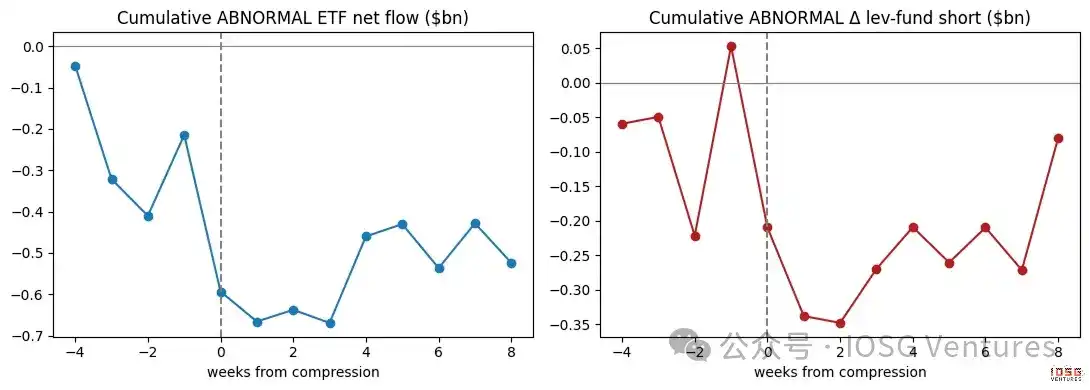
True believers wouldn't care about futures basis. And this weekly "demand" clearly does.

III. Which Comes First, and Who's Really Operating

First, the relationship is contemporaneous—strongest within the same week, with no clear lead or lag; and the slight directional evidence actually points the opposite way: it's ETF flows that seem to drive shorts, not the other way around. This fits the logic of a paired trade: buy the ETF first, and the futures hedge follows, rather than shorting magically "creating" an inflow. Second, the arbitrage crowd isn't the only driver. Flows follow leveraged funds' shorts most tightly, but they also resonate with directional institutional positions—both types of buyers are active. This article's claim is not that every inflow is hedged; rather, the hedged trade is the tightest, most reliable driver of week-to-week volatility.

Ethereum: The Same Trade, But the Math Hardly Works

Applying the same test to Ethereum ETFs reveals the signature, but weaker—a looser link to futures shorting, and that underlying stable directional buy flow is almost nonexistent. The reason is clear. Holding spot Ethereum instead of futures means forgoing the staking yield Ethereum offers, about 3%–4% annually. After netting this out, Ethereum's basis is often negative—the arbitrage trade often can't even clear its hurdle rate. So Ethereum ETFs have neither strong conviction buying nor robust arbitrage positioning to support them; they are just smaller, noisier cousins of Bitcoin's.

IV. How to Read ETF Flows From Now On

The point is not a call on price, but a method for reading flows. When the basis is rich, expect "institutional demand" to look strong, and largely hedged—don't mistake that strength for faith. When the basis compresses, expect inflows and shorts to retreat together—don't mistake the resulting outflows as the market passing judgment on Bitcoin. The two numbers worth watching are: the level of annualized basis returns relative to T-bill rates, and the net short position of leveraged funds in the weekly CME report. They'll tell you how much of the next "demand" headline is real.

How We Measured It

A few honest limitations. The basis is built from the nearest-month CME futures contract versus spot, excluding the final days before each expiry (where its extremely short tenor turns rounding errors into artificial spikes); building series contract by contract sharpens exact numbers but doesn't change conclusions. The link between flows and shorts is a strong contemporaneous relationship, not proof one causes the other—the key is they are two halves of the same trade. The futures short number is an upper bound on the proportion of ETF buying that is hedged, because some shorting hedges coins held elsewhere.

None of this changes the main story. Week to week, Bitcoin ETF "demand" is primarily a hidden interest rate trade, not faith—flows measure the activity of those arbitraging far more accurately than they measure belief. And that real buy flow is real, patient, and now the vast majority of what remains, because the "rented" part has been going home for two years.


Trend Kriptolar

İlgili Sorular

QWhat does the article argue is the primary driver of week-to-week Bitcoin ETF flow fluctuations, rather than genuine conviction?

AThe article argues that week-to-week Bitcoin ETF flow fluctuations are primarily driven by a cash-and-carry arbitrage trade, not genuine investor conviction. This trade involves buying the ETF while simultaneously shorting Bitcoin futures to lock in a spread, creating delta-neutral inflows that are indistinguishable from directional buys in the data. About half of the weekly flow volatility is explained by changes in hedge fund short futures positions.

QWhat two key data points does the author suggest investors should watch to better interpret the 'true' demand behind Bitcoin ETF flow headlines?

AThe author suggests investors should watch two key data points: 1) The level of the annualized basis (the futures premium) relative to the U.S. Treasury bill (T-bill) rate, and 2) The net short positions of leveraged funds reported weekly by the CFTC in its Commitments of Traders report for CME Bitcoin futures.

QHow does the article characterize the role of cash-and-carry trades in the *cumulative* amount of money that has flowed into Bitcoin ETFs since launch?

AThe article states that while cash-and-carry trades drive week-to-week *volatility* in flows, they have never been the main component of the cumulative *stock* of money. Out of the total cumulative inflow of approximately $55 billion, the net amount from arbitrage trades is only about $1 billion. The vast majority is stable, directional buying, averaging about $400 million per week, which has compounded over two years to form almost the entire 'mountain' of assets.

QWhat is the key difference in the dynamics of Ethereum ETF flows compared to Bitcoin ETF flows, according to the article?

AThe key difference is that the same arbitrage dynamic is much weaker for Ethereum ETFs. The correlation with futures shorts is looser, and the underlying steady directional buy flow is almost non-existent. This is because holding spot Ethereum (via an ETF) means forgoing staking rewards (approx. 3-4% annually), which often makes the effective basis negative, rendering the cash-and-carry trade unprofitable from the start.

QWhen the basis (futures premium) compresses towards the risk-free rate, what does the article predict will happen to ETF flows and futures short positions, and how should this be interpreted?

AThe article predicts that when the basis compresses to a level no longer profitable relative to the risk-free rate, ETF inflows will weaken and leveraged funds will simultaneously cover (reduce) their short futures positions. This should not be interpreted as a loss of conviction or a market judgment on Bitcoin, but rather as the routine unwinding of a hedged interest rate trade that is no longer worthwhile.

İlgili Okumalar

Coin Stock Barometer丨BitMine's Total Assets and Investment Reach $10.7 Billion, Exceeding ~$9.3 Billion Floating Loss; Strategy Buys Only 520 BTC, Strive Adds Positions Against the Trend (June 23)

This article provides a weekly market update on "coin-equity" trends, focusing on listed companies holding major cryptocurrencies. Key highlights include: **General Market Trends:** Global equities, particularly in the US, Japan, and South Korea, faced significant sell-offs, led by large tech and AI-related stocks. Analysts cite profit-taking and a shift from hype-driven to performance-driven valuation for AI companies. Market focus is on upcoming Micron Technology's earnings. **Cryptocurrency Treasury Updates:** * **Bitcoin (BTC):** Net weekly BTC purchases by listed companies (excluding miners) totaled approximately $86 million, down 13.97% from the prior week. Strategy (formerly MicroStrategy) purchased only 520 BTC for ~$34.9 million, while Strive Asset Management increased its holdings by 759 BTC for ~$50 million. Other notable actions include Mara Holdings adding 1,000 BTC and Capital B shareholders approving a massive financing plan (up to ~$1.2 trillion) to potentially expand its Bitcoin reserves. * **Ethereum (ETH):** BitMine emerged as the largest corporate ETH treasury, holding 5.67 million ETH (4.7% of supply). It purchased an additional 52,203 ETH ($92 million) in the past week. Sharplink completed a $75 million private placement to fund further ETH accumulation and stock buybacks. * **Solana (SOL):** The top five listed companies hold over 15.7 million SOL combined. However, Solmate Infrastructure, a SOL treasury firm, faces a lawsuit from its largest external shareholder alleging board misconduct and self-dealing. * **Other:** Updates include Canton Strategic's $50 million stock buyback plan and Lite Strategy's $1 million strategic investment in LitVM, a Layer-2 network for Litecoin. The article notes that while crypto treasury firms continue fundraising and accumulation, their stocks may struggle to rise against the broader market downturn until Q4.

marsbit5 dk önce

Coin Stock Barometer丨BitMine's Total Assets and Investment Reach $10.7 Billion, Exceeding ~$9.3 Billion Floating Loss; Strategy Buys Only 520 BTC, Strive Adds Positions Against the Trend (June 23)

marsbit5 dk önce

OpenAI Partners with PE Firms, Investing $4 Billion. Let's Talk About Silicon Valley's Hottest New Role: FDE.

The hottest new role in Silicon Valley is the Forward Deployment Engineer (FDE), a hybrid of engineer and business consultant whose core mission is to transform AI demos into native, practical workflows within client organizations. The recent surge in demand is driven by a strategic shift from leading AI companies. OpenAI, partnering with 19 private equity firms in a $4 billion investment, formed a Deployment Company and acquired Tomoro along with its 150 FDEs. Anthropic also announced a $1.5 billion joint venture with financial institutions like Blackstone. The article, based on interviews with industry experts Jove (FDE lead at Cresta) and Oliver (VP at Invisible Technologies, ex-McKinsey), explores the FDE role and the rise of deployment-focused companies. Key insights include: **The FDE Role:** Jove describes an FDE as a "Forward Deployed CTO"—a technically strong engineer who works intimately with clients to implement AI solutions, learn from the process, and feed those insights back to improve the core product. They require expertise in AI agents, client-facing experience, resilience, and the ability to handle complex, imperfect systems. While AI tools enhance their efficiency, the role's complexity makes full automation a distant prospect. **Industry Shift:** Model companies are moving beyond selling tools to ensuring real-world adoption. This blurs the line between model and application companies. Collaborations with private equity (PE) firms are key, providing access to large portfolios of traditional businesses needing AI transformation. For PE firms, these partnerships offer signal value to LPs, create tangible value in portfolio companies, and provide exposure to high-growth AI assets. **Consulting & Transformation:** AI deployment involves deep, customized workflow redesign, moving beyond simple tool augmentation. Companies like Invisible Technologies build modular platforms to create bespoke, AI-native workflows for clients. While traditional consulting will see growth in helping businesses rethink their models for AI, the real value is captured by firms that leave behind transformed, operational systems. Critical success factors include building robust data foundations and strategically deciding which workflow steps should be deterministic versus AI-driven. The ultimate goal shifts from pure cost-cutting to unlocking new revenue opportunities previously impossible without AI-scale capabilities.

marsbit17 dk önce

OpenAI Partners with PE Firms, Investing $4 Billion. Let's Talk About Silicon Valley's Hottest New Role: FDE.

marsbit17 dk önce

Why Is DeFi Insurance Unpopular?

The article explores the core reasons why DeFi insurance remains largely unutilized despite its potential to eliminate traditional insurance inefficiencies and malicious claim denials through automated smart contracts. Key points include: 1. **Low Adoption & Minimal Payouts:** Leading provider Nexus Mutual has paid only ~$18M in claims since 2019, dwarfed by single hack losses (e.g., Kelp DAO's $292M loss). 2. **High Correlation Risk:** Unlike traditional insurance (e.g., house fires), DeFi risks (oracle failures, bridge hacks) are systemic and can simultaneously impact multiple protocols, threatening to drain entire insurance pools. 3. **Prohibitive Cost vs. Reward:** For many protocols (Aave, Morpho, Compound), insurance premiums (1.5%-6%) consume a significant portion or even all of the native yield (3%-4%), leaving investors with meager returns. In some cases (Maple Finance, Ethena), premiums can even result in net-negative yields. 4. **Inadequate Capacity:** The total DeFi insurance pool (e.g., Nexus Mutual's $81.56M) is minuscule compared to the hundreds of billions in total value locked (TVL), creating a massive supply-demand gap. 5. **Structural Flaws:** The claims assessment model (e.g., Nexus Mutual's member voting) creates a conflict of interest, as voters bear the loss if a claim is paid. There is also no regulatory mandate forcing DeFi protocols to obtain insurance. The industry is adapting by focusing on preventative measures (e.g., bug bounty coverage) and seeking external capital via reinsurance. However, the fundamental issues of small pool size, correlated risk, and misaligned economic incentives persist. The article concludes that DeFi insurance, like a public lighthouse, provides shared security benefits, but if everyone relies on others to pay for it, no one will, leaving the ecosystem vulnerable.

Foresight News32 dk önce

Why Is DeFi Insurance Unpopular?

Foresight News32 dk önce

İşlemler

Spot
Futures

Popüler Makaleler

BITCOIN Nedir

HarryPotterObamaSonic10Inu (ERC-20)'yu ve Kripto Alanındaki Yerini Anlamak Son yıllarda, kripto para piyasası, hem ticaret yapanların hem de topluluk etkileşimi ve eğlence değeri arayanların ilgisini çeken meme coin'lerin popülaritesinde bir artış gördü. Bu benzersiz token'lar arasında, kripto para dokusuna kültürel referansları harmanlayan ilginç bir proje olan HarryPotterObamaSonic10Inu (ERC-20) bulunmaktadır. Bu makale, HarryPotterObamaSonic10Inu'nun temel yönlerini, mekanizmalarını, topluluk odaklı ethosunu ve daha geniş kripto manzarasıyla etkileşimini incelemektedir. HarryPotterObamaSonic10Inu (ERC-20) Nedir? Adından da anlaşılacağı gibi, HarryPotterObamaSonic10Inu, Ethereum blok zinciri üzerinde inşa edilen bir meme coin'dir ve ERC-20 standardı altında sınıflandırılmaktadır. Geleneksel kripto paraların pratik kullanılabilirlik veya yatırım potansiyeline odaklandığı durumların aksine, bu token eğlence değeri ve topluluğunun gücü üzerine kuruludur. Proje, bağlı kullanıcıların bir araya gelebileceği, fikirlerini paylaşabileceği ve çeşitli kültürel fenomenlerden ilham alan etkinliklere katılabileceği bir ortam yaratmayı hedeflemektedir. HarryPotterObamaSonic10Inu'nun dikkate değer özelliklerinden biri işlemlerde sıfır vergi olmasıdır. Bu çekici unsur, küçük ölçekli yatırımcıları caydırabilecek ek ücretlerden yoksun olarak ticareti ve topluluk katılımını teşvik etmeyi amaçlamaktadır. Coin'in toplam arzı bir milyar token olarak belirlenmiştir; bu, topluluk içinde önemli bir dolaşım sağlama niyetini göstermektedir. HarryPotterObamaSonic10Inu (ERC-20) Yaratıcısı HarryPotterObamaSonic10Inu'nun kökenleri bir miktar gizemlidir; yaratıcısı hakkında spesifik bilgilerin ne olduğu bilinmemektedir. Bu token'ın geliştirilmesi, belirli bir ekip veya açık bir plan eksikliği ile gerçekleşmiştir; bu durum, meme coin sektöründe oldukça yaygındır. Proje, topluluğunun heyecanı ve katılımına dayalı olarak organik bir şekilde ortaya çıkmıştır. HarryPotterObamaSonic10Inu (ERC-20) Yatırımcıları Dış yatırımlar ve destekler söz konusu olduğunda, HarryPotterObamaSonic10Inu da belirsiz kalmaktadır. Token, bilinen herhangi bir yatırım fonunu veya önemli bir kurumsal desteği listelememektedir. Bunun yerine, projenin can damarı, kolektif eylem ve kripto alanındaki katılım yoluyla büyüme ve sürdürülebilirlik sağlayan temel topluluğudur. HarryPotterObamaSonic10Inu (ERC-20) Nasıl Çalışır? Bir meme coin olarak, HarryPotterObamaSonic10Inu, genellikle varlık değerini yöneten geleneksel çerçevelerin dışında çalışmaktadır. Projenin nasıl çalıştığını tanımlayan birkaç özelliği vardır: Sıfır Vergi İşlemleri: İşlemlerde vergi ücreti olmadan, kullanıcılar gizli maliyet endişesi olmadan token'ı serbestçe alıp satabilirler. Topluluk Etkileşimi: Proje, topluluk etkileşimi üzerine kuruludur ve sosyal medya platformlarını kullanarak heyecan yaratarak katılımı kolaylaştırır. Tartışmalar, içerik paylaşımı ve katılım, projenin erişimini genişletmeye ve destekleyiciler arasında sadakat oluşturmaya yardımcı olan kritik unsurlardır. Pratik Kullanılabilirlik Yok: HarryPotterObamaSonic10Inu'nun mali ekosistem içinde somut bir kullanılabilirlik sunmadığı belirtilmelidir. Daha ziyade, eğlence ve topluluk etkinlikleri için bir token olarak sınıflandırılmaktadır. Kültürel Referans: Token, popüler kültürden unsurları zekice harmanlayarak ilgi çekmektedir ve hem meme meraklıları hem de kripto takipçileriyle bağlantı kurmaktadır. HarryPotterObamaSonic10Inu, meme coin'lerin, daha geleneksel kripto para projelerinden nasıl farklı çalıştığını örneklendirmektedir; bu projeler, utilitarist varlıklar yerine yenilikçi sosyal yapıların bir parçası olarak piyasaya girmektedir. HarryPotterObamaSonic10Inu (ERC-20) Zaman Çizelgesi HarryPotterObamaSonic10Inu'nun tarihi, birkaç dikkate değer kilometre taşı ile işaretlenmiştir: Oluşum: Token, birçok kripto meraklısının hayal gücünü yakalayan bir viral meme'den ortaya çıkmıştır. Spesifik yaratım tarihleri mevcut değildir ve bu onun organik yükselişini vurgulamaktadır. Borsa Listelemeleri: HarryPotterObamaSonic10Inu, topluluğun daha kolay erişim ve ticaret yapabilmesini sağlamak için çeşitli borsalarda yer bulmuştur. Topluluk Katılım İnisiyatifleri: Yarışmalar, sosyal medya kampanyaları ve hayranlar ile destekçilerden içerik üretimini içeren topluluk etkileşimini artırmayı amaçlayan devam eden etkinlikler. Gelecek Genişleme Planları: Projenin yol haritası, kültürel temalarına ilişkin bir NFT koleksiyonu, ticari ürünler ve bir e-ticaret sitesi başlatılmasını içermektedir; bu da topluluğun daha fazla katılımını sağlamayı ve ekosistemine daha fazla boyut kazandırmayı hedeflemektedir. HarryPotterObamaSonic10Inu (ERC-20) Hakkında Kilit Noktalar Topluluk Odaklı Doğası: Proje, kullanıcı katılımını geliştirme önceliği taşır ve böylece kullanıcıların sürecin en önünde yer almasını sağlar. Meme Coin Sınıflandırması: Eğlenceye dayalı kripto paranın doruk noktasıdır ve geleneksel yatırım araçlarından ayrılmaktadır. Bitcoin ile Doğrudan İlişki Yok: Ticker ismindeki benzeliğe rağmen, HarryPotterObamaSonic10Inu ayırt edicidir ve Bitcoin veya diğer yerleşik kripto paralarla herhangi bir ilişkisi yoktur. İşbirliğine Odaklanma: HarryPotterObamaSonic10Inu, sahipleri arasında işbirliği ve hikaye paylaşımı için bir alan oluşturmak üzere tasarlanmıştır ve bu da yaratıcılık ve topluluk bağlarını sağlamaktadır. Gelecek Beklentileri: Başlangıçta belirlendiği temalardan NFTs ve ticari ürünlere genişleme arzusu, projenin dijital kültürde daha ana akıma girebilmesi için bir yol haritası çizmektedir. Meme coin'ler, kripto para topluluğunun hayal gücünü çalmaya devam ederken, HarryPotterObamaSonic10Inu (ERC-20), kültürel bağları ve topluluk merkezli yaklaşımıyla öne çıkmaktadır. Geleneksel bir hizmet odaklı token modeliyle uyumlu olmasa da, özünde destekçileri arasında sağlanan neşe ve dostluğu vurgulayarak, giderek dijitalleşen bir çağda kripto paraların evrilen doğasını göstermektedir. Proje gelişmeye devam ettikçe, topluluk dinamiklerinin blockchain teknolojisi dünyasındaki seyrini nasıl etkilediğini izlemek önemli olacaktır.

2.0k Toplam GörüntülenmeYayınlanma 2024.04.01Güncellenme 2024.12.03

BITCOIN Nedir

BTC Nasıl Satın Alınır

HTX.com’a hoş geldiniz! Bitcoin (BTC) satın alma işlemlerini basit ve kullanışlı bir hâle getirdik. Adım adım açıkladığımız rehberimizi takip ederek kripto yolculuğunuza başlayın. 1. Adım: HTX Hesabınızı OluşturunHTX'te ücretsiz bir hesap açmak için e-posta adresinizi veya telefon numaranızı kullanın. Sorunsuzca kaydolun ve tüm özelliklerin kilidini açın. Hesabımı Aç2. Adım: Kripto Satın Al Bölümüne Gidin ve Ödeme Yönteminizi SeçinKredi/Banka Kartı: Visa veya Mastercard'ınızı kullanarak anında Bitcoin (BTC) satın alın.Bakiye: Sorunsuz bir şekilde işlem yapmak için HTX hesap bakiyenizdeki fonları kullanın.Üçüncü Taraflar: Kullanımı kolaylaştırmak için Google Pay ve Apple Pay gibi popüler ödeme yöntemlerini ekledik.P2P: HTX'teki diğer kullanıcılarla doğrudan işlem yapın.Borsa Dışı (OTC): Yatırımcılar için kişiye özel hizmetler ve rekabetçi döviz kurları sunuyoruz.3. Adım: Bitcoin (BTC) Varlıklarınızı SaklayınBitcoin (BTC) satın aldıktan sonra HTX hesabınızda saklayın. Alternatif olarak, blok zinciri transferi yoluyla başka bir yere gönderebilir veya diğer kripto para birimlerini takas etmek için kullanabilirsiniz.4. Adım: Bitcoin (BTC) Varlıklarınızla İşlem YapınHTX'in spot piyasasında Bitcoin (BTC) ile kolayca işlemler yapın.Hesabınıza erişin, işlem çiftinizi seçin, işlemlerinizi gerçekleştirin ve gerçek zamanlı olarak izleyin. Hem yeni başlayanlar hem de deneyimli yatırımcılar için kullanıcı dostu bir deneyim sunuyoruz.

7.9k Toplam GörüntülenmeYayınlanma 2024.12.12Güncellenme 2026.06.02

BTC Nasıl Satın Alınır

$BITCOIN Nedir

DİJİTAL ALTIN ($BITCOIN): Kapsamlı Bir Analiz DİJİTAL ALTIN ($BITCOIN) Tanıtımı DİJİTAL ALTIN ($BITCOIN), geleneksel değerli metallerin özelliklerini merkeziyetsiz teknolojilerin yeniliği ile birleştirmeyi amaçlayan Solana ağı üzerinde çalışan blockchain tabanlı bir projedir. Bitcoin ile aynı isme sahip olmasına rağmen, genellikle bir değer saklama aracı olarak algılandığı için “dijital altın” olarak anılmaktadır; DİJİTAL ALTIN, Web3 ortamında benzersiz bir ekosistem yaratmak için tasarlanmış ayrı bir tokendir. Hedefi, uygulanabilir bir alternatif dijital varlık olarak kendini konumlandırmaktır, ancak uygulamaları ve işlevleri ile ilgili ayrıntılar hala gelişmektedir. DİJİTAL ALTIN ($BITCOIN) Nedir? DİJİTAL ALTIN ($BITCOIN), Solana blockchain'inde kullanılmak üzere açıkça tasarlanmış bir kripto para tokenidir. Bitcoin'in yaygın olarak tanınan bir değer saklama rolü sağlamasının aksine, bu token daha geniş uygulamalara ve özelliklere odaklanıyor gibi görünmektedir. Dikkate değer yönler şunlardır: Blockchain Altyapısı: Token, yüksek hızlı ve düşük maliyetli işlemleri yönetme kapasitesi ile bilinen Solana blockchain'inde inşa edilmiştir. Arz Dinamikleri: DİJİTAL ALTIN'ın maksimum arzı 100 katrilyon token (100P $BITCOIN) ile sınırlıdır, ancak dolaşımdaki arzı ile ilgili ayrıntılar şu anda açıklanmamıştır. Kullanım Alanı: Kesin işlevler açıkça belirtilmemiş olsa da, token'ın merkeziyetsiz uygulamalar (dApps) veya varlık tokenizasyon stratejileri ile ilgili çeşitli uygulamalar için kullanılabileceğine dair işaretler bulunmaktadır. DİJİTAL ALTIN ($BITCOIN) Yaratıcısı Kimdir? Şu anda, DİJİTAL ALTIN ($BITCOIN) arkasındaki yaratıcıların ve geliştirme ekibinin kimliği bilinmemektedir. Bu durum, merkeziyetsiz finans ve meme coin fenomenleriyle uyumlu olan birçok yenilikçi proje arasında yaygındır. Böyle bir anonimlik, topluluk odaklı bir kültürü teşvik edebilirken, yönetişim ve hesap verebilirlik konusundaki endişeleri artırmaktadır. DİJİTAL ALTIN ($BITCOIN) Yatırımcıları Kimlerdir? Mevcut bilgiler, DİJİTAL ALTIN ($BITCOIN) için bilinen herhangi bir kurumsal destekçi veya önde gelen risk sermayesi yatırımı olmadığını göstermektedir. Proje, geleneksel finansman yolları yerine topluluk desteği ve benimsemeye odaklanan bir eşler arası modelde çalışıyor gibi görünmektedir. Faaliyetleri ve likiditesi esas olarak PumpSwap gibi merkeziyetsiz borsalarda (DEX'ler) yer almakta olup, bu da onun taban hareketine vurgu yapmaktadır. DİJİTAL ALTIN ($BITCOIN) Nasıl Çalışır DİJİTAL ALTIN ($BITCOIN) 'ın operasyonel mekanikleri, blockchain tasarımı ve ağ özellikleri temelinde açıklanabilir: Konsensüs Mekanizması: Solana'nın benzersiz tarih kanıtı (PoH) ile bir hisse kanıtı (PoS) modelini birleştirerek, proje ağın yüksek performansına katkıda bulunan verimli işlem doğrulamasını sağlar. Tokenomik: Belirli deflasyonist mekanizmalar kapsamlı bir şekilde detaylandırılmamış olsa da, geniş maksimum token arzı, henüz tanımlanmamış mikro işlemler veya niş kullanım durumlarına hitap edebileceğini ima etmektedir. Etkileşim: Solana'nın daha geniş ekosistemi ile entegrasyon potansiyeli bulunmaktadır; bu, çeşitli merkeziyetsiz finans (DeFi) platformlarını içermektedir. Ancak, belirli entegrasyonlarla ilgili ayrıntılar belirtilmemiştir. Önemli Olayların Zaman Çizelgesi DİJİTAL ALTIN ($BITCOIN) ile ilgili önemli kilometre taşlarını vurgulayan bir zaman çizelgesi: 2023: Token'ın Solana blockchain'inde ilk dağıtımı, sözleşme adresi ile işaretlenmiştir. 2024: DİJİTAL ALTIN, PumpSwap gibi merkeziyetsiz borsalarda işlem görmeye başladıkça görünürlük kazanır ve kullanıcıların bunu SOL karşısında ticaret yapmasına olanak tanır. 2025: Proje, topluluk odaklı etkileşimlere yönelik potansiyel ilgi ve ara sıra ticaret faaliyetleri görür, ancak şu ana kadar dikkate değer ortaklıklar veya teknik ilerlemeler belgelenmemiştir. Kritik Analiz Güçlü Yönler Ölçeklenebilirlik: Temel Solana altyapısı, yüksek işlem hacimlerini destekleyerek $BITCOIN'in çeşitli işlem senaryolarındaki faydasını artırabilir. Erişilebilirlik: Token başına potansiyel düşük ticaret fiyatı, perakende yatırımcıları çekebilir ve parçalı mülkiyet fırsatları sayesinde daha geniş katılımı kolaylaştırabilir. Riskler Şeffaflık Eksikliği: Kamuya açık olarak bilinen destekçilerin, geliştiricilerin veya bir denetim sürecinin olmaması, projenin sürdürülebilirliği ve güvenilirliği konusunda şüpheler doğurabilir. Piyasa Volatilitesi: Ticaret faaliyeti büyük ölçüde spekülatif davranışa dayanmakta olup, bu da yatırımcılar için önemli fiyat dalgalanmalarına ve belirsizliklere yol açabilir. Sonuç DİJİTAL ALTIN ($BITCOIN), hızla gelişen Solana ekosisteminde ilginç ama belirsiz bir proje olarak ortaya çıkmaktadır. “Dijital altın” anlatısını kullanmaya çalışırken, Bitcoin'in değer saklama rolünden ayrılması, amaçlanan faydasının ve yönetişim yapısının daha net bir şekilde tanımlanması gerekliliğini vurgulamaktadır. Gelecekteki kabul ve benimseme, mevcut belirsizliklerin giderilmesine ve operasyonel ile ekonomik stratejilerinin daha açık bir şekilde tanımlanmasına bağlı olacaktır. Not: Bu rapor, Ekim 2023 itibarıyla mevcut olan sentezlenmiş bilgileri kapsamaktadır ve araştırma döneminin ötesinde gelişmeler yaşanmış olabilir.

104 Toplam GörüntülenmeYayınlanma 2025.05.13Güncellenme 2025.05.13

$BITCOIN Nedir

Tartışmalar

HTX Topluluğuna hoş geldiniz. Burada, en son platform gelişmeleri hakkında bilgi sahibi olabilir ve profesyonel piyasa görüşlerine erişebilirsiniz. Kullanıcıların BTC (BTC) fiyatı hakkındaki görüşleri aşağıda sunulmaktadır.

活动图片