Redemption Wave Meets Credit Withdrawal Wave, US Private Credit Industry Faces 'Run Storm'

marsbit2026-03-12 tarihinde yayınlandı2026-03-12 tarihinde güncellendi

Özet

US private credit industry faces a liquidity crisis as investor redemptions surge and major banks tighten financing. Cliffwater and Morgan Stanley restricted withdrawals from multi-billion-dollar funds after redemption requests spiked to 14% and 10.9% of assets respectively in Q1, forcing partial payouts to avoid fire sales of illiquid assets. Simultaneously, JPMorgan reduced collateral values for software-sector loans in fund portfolios, curtailing future leverage availability. The squeeze stems from a net asset value (NAV) arbitrage dynamic: while public market software assets plummeted, private credit valuations remained inflated, prompting investors to redeem at above-market prices. This triggered a bank-run-like cycle where remaining investors face diluted values. Apollo plans to boost transparency with monthly NAV reporting. The $1.8 trillion industry, which expanded rapidly during the pandemic using bank leverage, now confronts underlying assets originated at peak valuations. Despite claims of continued software sector growth, pressure mounts as institutions reassess liquidity risks and valuation opacity.

Original Author: Ye Zhen

Original Source: Wall Street News

The US private credit industry is facing a dual squeeze of liquidity contraction and asset revaluation. As investors rush to withdraw funds and major Wall Street financial institutions reduce credit lines, this massive market worth $1.8 trillion is teetering.

According to the Financial Times, private credit giants Cliffwater and Morgan Stanley have recently imposed redemption restrictions on their multi-billion-dollar funds. In the first quarter, these semi-liquid funds faced a surge in withdrawal requests, with the scale of outflows forcing management to trigger "gates" to avoid fire sales of underlying illiquid assets.

While the funding side is under pressure, private credit institutions are also facing tightening from large banks on the financing side. JPMorgan Chase recently notified relevant institutions that it has downgraded the collateral value of some software-related loans in their portfolios. Although this move did not immediately trigger margin calls, it directly reduced the future financing scale available to the relevant funds, marking a comprehensive reassessment of risk exposure in this sector by the traditional banking system.

The core of this two-way squeeze lies in the net asset value (NAV) arbitrage logic. As the value of related assets in public markets plummeted, private credit institutions failed to synchronously mark down their holdings, prompting investors to rush to cash out at the book value, which is higher than the market fair value. This chain reaction, similar to a bank run, not only intensifies the liquidity pressure on funds but also forces the market to re-examine the true pricing of private credit assets.
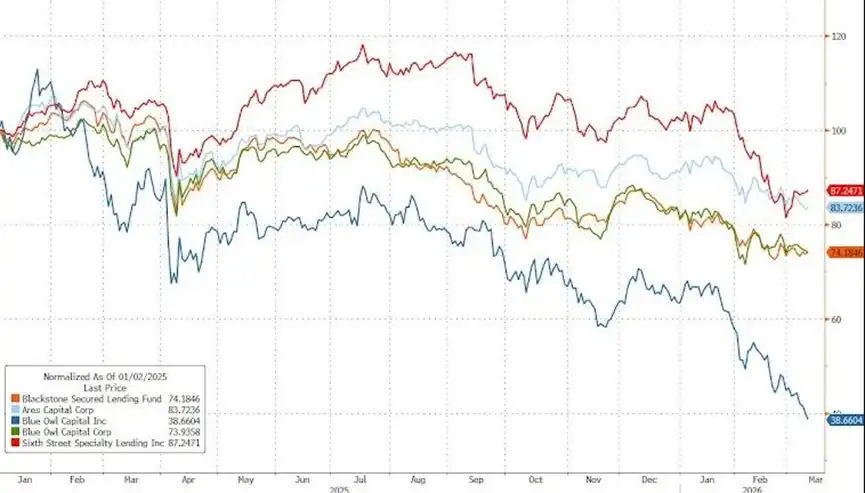
(Private credit company stock prices continue to decline)

Redemption Wave Spreads, Semi-Liquid Funds Face Major Test

According to the Financial Times, Cliffwater restricted redemptions from its $33 billion flagship fund (CCLFX) in the first quarter. The fund received redemption requests accounting for 14% of its total shares, ultimately approving only about half and repurchasing 7% of the shares.

Just hours after Cliffwater took action, Morgan Stanley also notified investors in its $7.6 billion North Haven Private Income Fund that it would limit withdrawals. The fund saw redemption requests jump to 10.9% in the first quarter, ultimately fulfilling only 45.8% of those shares.

This trend has been spreading across the industry in recent months. HPS recently set a 5% redemption cap for its flagship fund targeting high-net-worth clients. Blackstone's Bcred fund fully paid out after redemption requests reached 7.9% of net asset value, while Blue Owl and Ares previously also met high redemption requests, although Blue Owl has imposed a permanent redemption restriction on another fund this year.

Cliffwater raised $16.5 billion last year, expanding at a pace on par with industry giant KKR. However, this model, which relies on independent brokers to manage retail funds, makes it more vulnerable to market sentiment fluctuations.

To address the situation, the report stated that Cliffwater is raising $1 billion by selling loan portfolios and expects to attract $3 billion in new commitments this quarter to offset outflows. The company emphasized in a letter to investors that the fund generated an 8.9% return in 2025 and has a net leverage ratio of only 0.23x, far lower than most similar vehicles.

This capital outflow highlights the risks faced by many new semi-liquid funds, which were originally promoted as a way to invest in private credit but, because their underlying assets are rarely traded, can only offer selling opportunities occasionally.

Overvaluation Triggers Arbitrage, Run Risk Highlighted

The core driver behind investors rushing to withdraw is net asset value arbitrage.

According to a Bloomberg column analysis, software stocks and related debt in public markets have fallen sharply this year, but private credit institutions, which tend to hold loans to maturity, have not synchronously marked down their portfolio valuations.

This lag in pricing creates an arbitrage opportunity. If a fund claims its loan is worth $100, but investors believe its actual market value is only $98, investors will try to redeem and cash out at the $100 book value.

This operation logic triggers dynamics similar to a bank run: if the fund pays out at $100, the asset value of the remaining investors will be further diluted, prompting more people to join the redemption queue. This puts immense pressure on interval funds that promise partial liquidity when facing investors.

To alleviate concerns about opaque valuations, some institutions are trying to increase transparency. John Zito, co-president of the asset management division at Apollo Global Management, said the company is preparing to start reporting the net asset value of its credit funds monthly, with the ultimate goal of achieving daily NAV reporting and introducing third-party valuations.

JPMorgan Takes Proactive Action, Tightens Leveraged Financing

As internal funds drain, the external leverage sources for private institutions are also being tested. According to the Financial Times, JPMorgan proactively downgraded the valuation of some corporate loans in the portfolios of private institutions, primarily concentrated in the software sector, which is considered particularly vulnerable to the impact of artificial intelligence.

JPMorgan has a special clause in its private credit financing business that reserves the right to revalue assets at any time, whereas most other banks typically wait for trigger conditions like interest defaults before taking action. Media analysis indicates this move aims to preemptively compress the available credit lines to these funds, allowing for timely action if necessary, rather than waiting until a crisis erupts.

This tightening action was foreshadowed. JPMorgan CEO Jamie Dimon has repeatedly expressed a cautious stance towards the private credit sector publicly. The bank's executive Troy Rohrbaugh said in February this year that, compared to peers, JPMorgan is becoming more conservative regarding private credit risk. A fund manager also confirmed that JPMorgan has been "significantly tougher" in providing back-end leverage over the past three months.

Industry Expansion Logic Damaged, Subsequent Risks Questioned

The rapid expansion of the private credit industry heavily relies on leveraged financing provided by regulated banks. Since the end of 2020, private institutions have raised hundreds of billions of dollars, quickly gaining the ability to compete directly with banks for large-scale leveraged buyout financing.

However, a large number of underlying assets were formed during the work-from-home boom when software company valuations were high. As corporate cash flow expectations are revised downward, related debts will come due over the next few years, by which time the market environment will be vastly different from when they were issued.

Currently, private credit institutions insist that enterprise software companies are still growing and expect loans to continue performing normally. Although no other banks have explicitly followed JPMorgan's tightening stance, with major banks leading the reassessment of asset values and retail redemption pressure remaining high, the market's scrutiny of the industry's liquidity and valuation transparency is expected to continue intensifying.


İlgili Sorular

QWhat is the core reason behind the surge in redemption requests in the US private credit industry?

AThe core reason is NAV (Net Asset Value) arbitrage. Public market assets like software stocks and related debt have fallen sharply, but private credit funds have not marked down their portfolios accordingly. This creates an arbitrage opportunity where investors redeem at the higher book value to realize a profit, leading to a bank-run-like dynamic.

QWhich two private credit giants recently imposed redemption restrictions on their multi-billion dollar funds?

ACliffwater and Morgan Stanley recently imposed redemption restrictions on their funds. Cliffwater restricted its $33 billion flagship fund (CCLFX), and Morgan Stanley restricted its $7.6 billion North Haven Private Income Fund.

QWhat action did JPMorgan take that signifies a tightening of leverage for private credit funds?

AJPMorgan proactively marked down the value of collateral for some software sector loans within private credit fund portfolios. This action reduces the amount of future financing available to these funds, representing a significant reassessment of risk exposure by the traditional banking system.

QHow did the redemption requests in the first quarter compare to what was ultimately paid out by Cliffwater and Morgan Stanley's funds?

ACliffwater received redemption requests for 14% of its fund's shares but only paid out approximately half, repurchasing 7% of the shares. Morgan Stanley received requests for 10.9% of its fund's shares but only fulfilled 45.8% of those requests.

QWhat long-term factor from the pandemic era is contributing to the current stress in the private credit market?

AA significant amount of the underlying assets were originated during the work-from-home boom when software company valuations were high. As expectations for these companies' cash flows are revised downward, the debt issued during that period is maturing into a much less favorable market environment, creating potential stress.

İlgili Okumalar

Near Returns to the AI Stage: Transformation into a Public Chain Due to 'Payroll Difficulties,' Agent and Privacy Emerge as New Growth Narratives

NEAR Returns to AI Origins: From Payroll Struggles to Blockchain, Now Focusing on AI Agents and Privacy NEAR Protocol's journey began not with grand blockchain ambitions, but from a practical hurdle: its AI startup founders, including Transformer paper co-author Illia Polosukhin, couldn't efficiently pay international developers in 2017. This led them to pivot and build a high-performance, scalable blockchain. After years navigating various crypto narratives like sharding and cross-chain interoperability, NEAR is now leveraging its AI roots to re-enter the AI arena. A key driver is its "NEAR Intents" layer, which abstracts complex cross-chain transactions. Users simply state their goal (e.g., swap BTC for ETH), and a solver network finds the optimal route. This system has processed over $20B in cross-chain volume, generating significant fee revenue. A major growth area is private transactions via "Confidential Intents/Swaps," which hide trade details until settlement to protect against MEV and front-running. Remarkably, private swaps recently accounted for over 40% of NEAR's transaction volume, highlighting strong demand but also potential regulatory scrutiny. With its AI-founder pedigree, NEAR is positioning itself at the intersection of blockchain, AI agents, and privacy, aiming to become infrastructure for the emerging agent economy while navigating the challenges of its rapid adoption.

marsbit1 saat önce

Near Returns to the AI Stage: Transformation into a Public Chain Due to 'Payroll Difficulties,' Agent and Privacy Emerge as New Growth Narratives

marsbit1 saat önce

From Ethereum to AI's 'CROPS': What Exactly is This Set of 'Slow Variables' That Vitalik Repeatedly Emphasizes?

In recent discussions, Vitalik Buterin has frequently emphasized the concept of "CROPS," a framework defining core values for Ethereum's development. CROPS stands for Censorship Resistance, Capture Resistance, Open Source, Privacy, and Security. Initially outlined in the Ethereum Foundation's "EF Mandate," it represents a commitment to user sovereignty, ensuring that the network resists external control, remains open, protects privacy, and prioritizes security. The relevance of CROPS extends beyond Ethereum's foundational principles, becoming crucial in the context of AI integration. As AI agents begin handling wallet operations and automated transactions, the risk increases that users may cede control over their digital assets, privacy, and intentions to centralized AI service providers. A "CROPS AI" would therefore emphasize local execution where possible, privacy-preserving remote model calls (e.g., using zero-knowledge proofs), and transparent, verifiable processes to maintain user agency. Vitalik highlights a significant convergence between "CROPS Ethereum access layer" and "CROPS AI." Both address the same fundamental challenge: how users can access powerful services—be it blockchain data via RPCs or AI models—without exposing sensitive information or relinquishing ultimate control. This intersection points toward a future digital entry point that is more private, secure, and user-controlled. Ultimately, CROPS is not merely an abstract ideal but a practical guidepost. It steers development—from protocol resilience and wallet design to AI agent safety—towards a future where users retain self-sovereignty even as digital systems grow more complex and powerful. In an era of accelerating AI adoption, these "slow variables" of censorship resistance, openness, privacy, and security may define Ethereum's enduring value.

marsbit1 saat önce

From Ethereum to AI's 'CROPS': What Exactly is This Set of 'Slow Variables' That Vitalik Repeatedly Emphasizes?

marsbit1 saat önce

Silicon Valley 'Startup Guru' Steve Hoffman: Web3 + AI Could Be a Trap

Silicon Valley investor and "Godfather of Startups" Steve Hoffman warns that combining Web3 with AI is likely a trap, not a promising venture. In an interview, Hoffman argues that while AI is a foundational technology touching all industries, Web3 adds complexity, friction, and regulatory risk without solving mainstream consumer or business needs. He advises founders to focus on deep, specialized applications where startups can out-iterate giants, rather than on generic features easily replicated by large tech companies. Hoffman observes that Silicon Valley will lead foundational AI research, while China excels at rapid, large-scale application and commercialization, particularly in robotics. He stresses that AI-driven autonomous agents capable of collaborative, multi-step tasks are 2-4 years away, which will cause significant job displacement. The solution is not to slow AI but to redesign business models around human-AI collaboration and reform social systems like education and retraining. For startups, Hoffman recommends focusing on vertical, expertise-heavy domains to build defensibility. He sees major opportunities in AI fraud detection and cybersecurity. Key founder mindsets include systemic thinking over feature-focus, relentless customer centricity, building adaptive teams, and deeply understanding AI's capabilities and limits. Hoffman is also leading a non-profit initiative to establish university centers aimed at training future leaders in responsible, human-value-aligned AI innovation.

marsbit2 saat önce

Silicon Valley 'Startup Guru' Steve Hoffman: Web3 + AI Could Be a Trap

marsbit2 saat önce

Token Inefficient, Economy Tokenless

The article "Tokens Aren't Economical, Economics Aren't Tokenized" analyzes a pivotal shift in the AI industry from a technology-driven narrative to one dominated by capital efficiency. It highlights two concurrent trends: a severe capital shortage due to the exorbitant and recurring costs of compute (e.g., OpenAI's high burn rate) and a wave of corporate spin-offs where major tech companies are separating their AI units (like Kuaishou's Kling and Baidu's Kunlunxin). The core argument is that AI's "anti-internet" business model, where user growth increases costs rather than profits, has created a disconnect between high valuations and actual cash flow. Spin-offs address this by allowing AI assets to be valued independently. Within a parent company, they are seen as cost centers, but as standalone entities, they are priced based on their growth potential and scarcity in the primary market, leading to massive valuation premiums (e.g., Kling's estimated value tripling post-spin-off). The industry is at an inflection point, moving from "model worship" to "value realization." The competition is evolving from a pure compute (GPU) race to a broader focus on systemic efficiency and full-stack engineering (involving CPUs and orchestration) to achieve viable commercialization. The year 2026 is framed as a critical moment where the industry must definitively answer how to economically translate AI capability into tangible business value, reshaping the sector's future power structure.

marsbit2 saat önce

Token Inefficient, Economy Tokenless

marsbit2 saat önce

İşlemler

Spot
Futures
活动图片




