Real Estate Has Trapped Generations, Until Someone Decided to 'Cut' It Apart

比推2026-03-04 tarihinde yayınlandı2026-03-04 tarihinde güncellendi

Özet

The article "The Frozen Fortune" discusses the impending $124 trillion "Great Wealth Transfer" of wealth, primarily in real estate, from the Baby Boomer generation to their heirs. While often portrayed as a windfall, this wealth is largely illiquid and locked in homes that were bought under favorable economic conditions now unavailable to younger generations. Millennials and Gen Z face high housing costs, student debt, and mortgage rates, making homeownership difficult. Inheriting a valuable but illiquid asset creates complex dilemmas around selling, maintaining, or dividing the property. The piece argues that tokenization—representing physical assets like real estate on a blockchain—can bridge this generational gap. It solves key problems: enabling partial sales for liquidity, simplifying distribution among multiple heirs, allowing remote management, and providing access to asset ownership without requiring full purchase. Major financial institutions are already building the infrastructure for this shift. The core issue is translating a generation's wealth, stored in physical property, into the digital, liquid form that the inheriting generation understands and prefers. Tokenization doesn't solve the housing affordability crisis but addresses the friction of transferring massive, illiquid assets between generations with different financial paradigms.

Author: Thejaswini M A

Original Title: The Frozen Fortune

Compiled and Arrangement: BitpushNews


The house—your parents never saw it as an investment. They bought it because they needed a place to live, because the mortgage was affordable on a single income back then, because the schools in the community were excellent, because it was the default choice people made at the time. They painted the living room twice, replaced the roof once, and argued about renovating the kitchen for years without ever doing it. They raised children in it, grew old in it. In the process, without really meaning to, they built the most valuable asset they would ever own.

Now, they are struggling to pay medical bills, and that house is worth $1.2 million.

A number keeps recurring in financial research: $124 trillion.

This is the estimated value of assets expected to pass from the older generation to the younger one over the next 25 years. Analysts call it the "Great Wealth Transfer." In media portrayals, it sounds like pure good news for the heirs.

But is it really?

Much of this wealth being transferred is illiquid. A large portion is real estate. These are houses bought by Baby Boomers when prices were reasonable, paid down over decades, and appreciated in value, ultimately becoming the primary store of their wealth.

The generation inheriting these houses grew up watching those same prices put homeownership out of their reach. Now, these houses are about to them—illiquid, emotionally burdensome, legally complex, and increasingly impractical.

This is the problem the "$124 trillion" headline fails to capture.

To understand why this matters, you must understand what happened to housing from the 1960s to now. It changed categories. It started as shelter, a place to live, and slowly became the primary financial instrument for the American middle class. For families outside the high-income bracket, a house isn't one asset among many; it is the only asset. Real estate equity represents the largest single item on the median American family's balance sheet, dwarfing the combined value of retirement accounts, stocks, and all other assets.

The Baby Boomers accumulated this wealth under conditions that no longer exist. They bought when the price-to-income ratio was between 2 and 3.5. They paid off their mortgages during decades of real wage growth. By Q1 2025, the real estate held by Boomers had reached $19.5 trillion, up from a fraction of that in 1990.
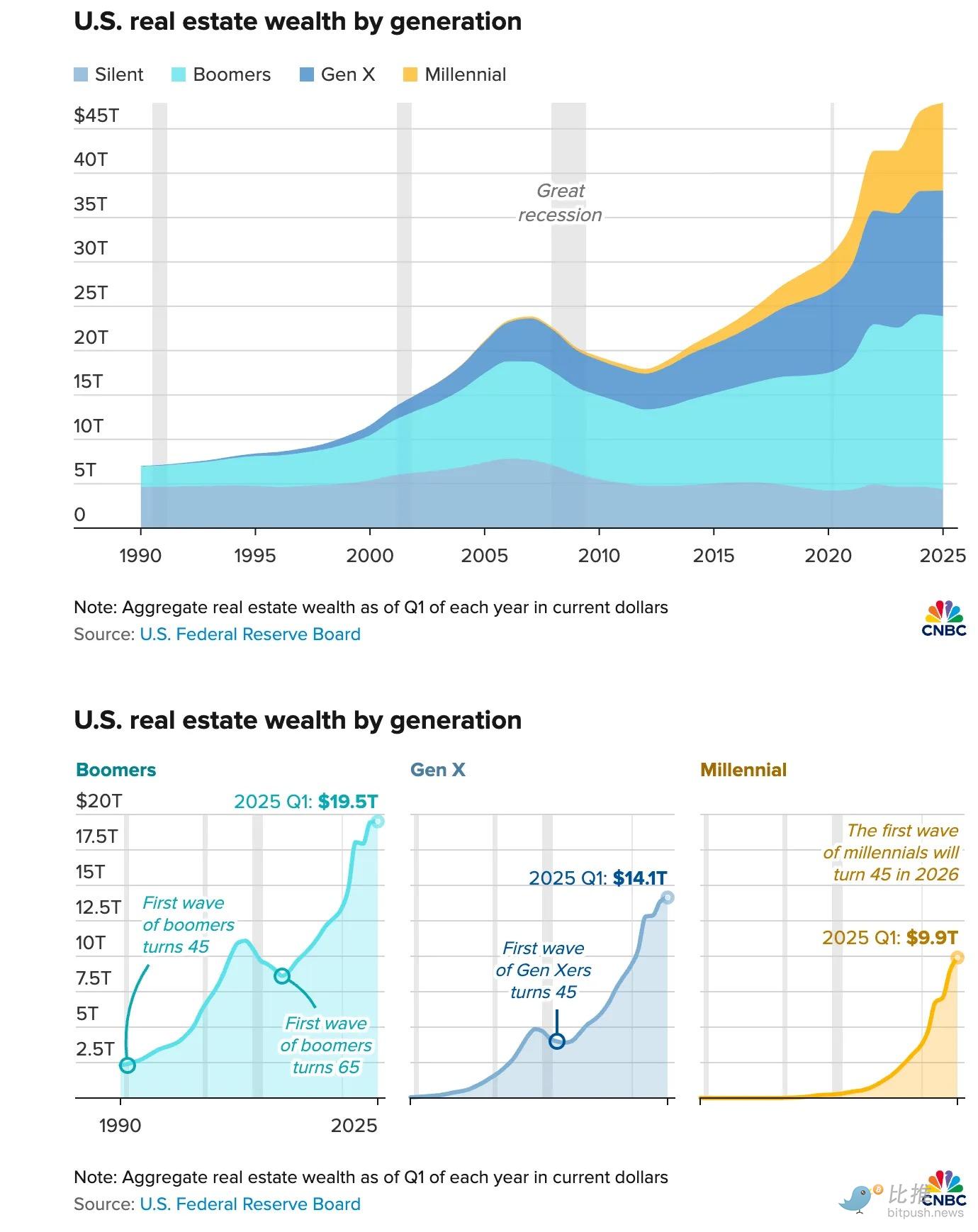
(Data from cnbc.com)

Millennials entering the market today face a price-to-income ratio more than double what their parents faced. They carry student loan debts their parents didn't have. They face mortgage rates that make the monthly payment on a median-priced home nearly unaffordable for a median-income family. The down payment alone—in a market where prices rise faster than savings accumulate—has become a trap.
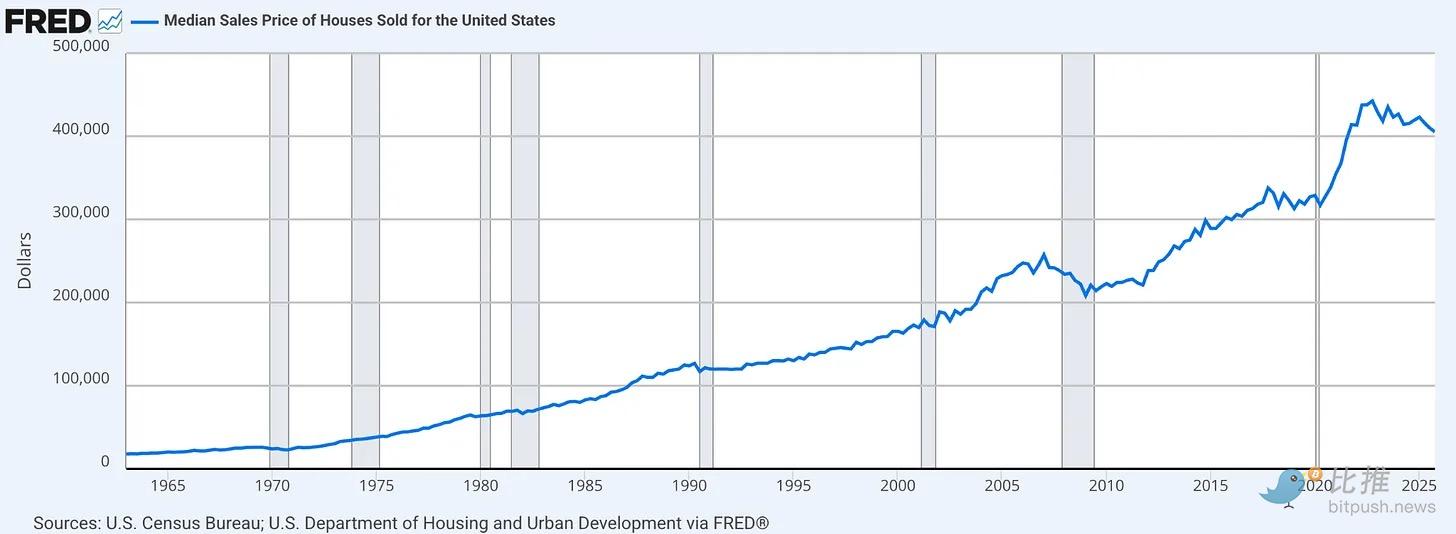
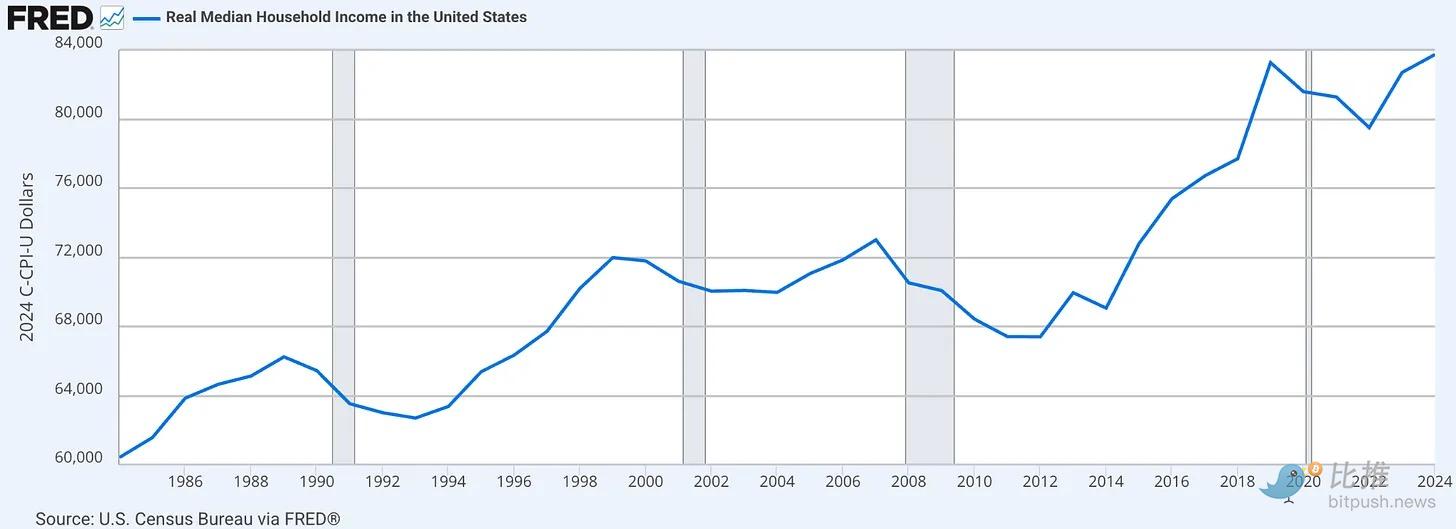
Chart from @fred.stlouisfed data

The result is a generational rift that is no longer cyclical. The generation that could afford to buy, did. The generation that couldn't is poised to inherit.

Real estate is one of the most illiquid assets a person can hold.

When you need cash, you can't sell 10% of the house. When your job moves, you can't relocate it. You can't cleanly divide it among four siblings without triggering a legal process that can take 18 months and drain the estate's funds. Inheriting a million-dollar house in a city you can't afford to live in isn't good news; it's a dilemma: Sell it? Keep it and bear the maintenance costs? Rent it out and become a landlord? Or spend years negotiating with siblings over which option to choose?

Baby Boomers currently hold about 40% of U.S. housing wealth. 61% say they will never sell. When you see the incentive structure, this isn't stubbornness. Selling triggers capital gains taxes on decades of appreciation; it resets a 3% mortgage rate to 7%; in California, it could instantly multiply property taxes tenfold. And there are no affordable houses available for them to downsize into.

So they stay put. The houses stop circulating. Younger buyers are locked out, waiting for an inheritance that has become the only realistic path to homeownership in many cities. When the inheritance finally happens, the liquidity problem doesn't disappear; it just transfers to the next generation.

Nansen co-founder Alex Svanevik describes the coming situation as a "tsunami." He stated in January 2026 that about $100 trillion will be inherited over the next 20 years, and the force driving these funds into cryptocurrency is structural, not speculative. He estimates that if just 3% of these inherited assets flow into crypto, its market cap could double from its current size.

3% sounds small? Consider who is inheriting: According to a recent OKX survey, Gen Z trusts cryptocurrency five times more than Baby Boomers do. Millennials already hold more digital assets than their parents. We don't need to convince them crypto is real; they grew up using it the way previous generations used savings accounts. What they need is for inherited wealth to meet them in a form they understand.

This is the gap. And "Tokenisation" is the bridge.

Real World Asset (RWA) tokenization means representing ownership of a physical asset on a blockchain. Once tokenized, ownership can be fractionalized, transferred without intermediaries, held in a wallet, used as collateral, or traded without requiring consensus from all stakeholders. Friction costs that were once prohibitive become manageable.

Specifically for inheriting property, tokenization solves four currently intractable problems:

  1. Liquidity: Tokenized property can be sold partially. An heir who urgently needs $50,000 but holds a $500,000 share of a house can sell 10% of their ownership instead of being forced to sell the entire house or get nothing. This also makes borrowing against it much simpler, as the underlying asset is liquid, allowing lenders to underwrite more easily.

  2. Distribution: When four siblings inherit a property, tokenization allows each to digitally hold their exact share, enabling them to trade, sell, or keep it independently without requiring unanimous agreement on the disposition of the physical asset. When ownership is "programmable," the legal disputes that currently drain estates are significantly simplified.

  3. Liquidity/Mobility: Tokenized property can sit in a portfolio alongside stocks, crypto, and other assets. It can be managed remotely, transferred across borders, and eventually used as collateral in DeFi (Decentralized Finance) protocols. The "geographic lock" of real estate ceases to be a constraint on the heir's financial flexibility.

  4. Access: For heirs who can't afford a house but are destined to inherit one, tokenization allows for early participation. For younger members receiving smaller inheritance shares, fractional ownership allows them to hold a piece of a physical asset without being forced to liquidate immediately.
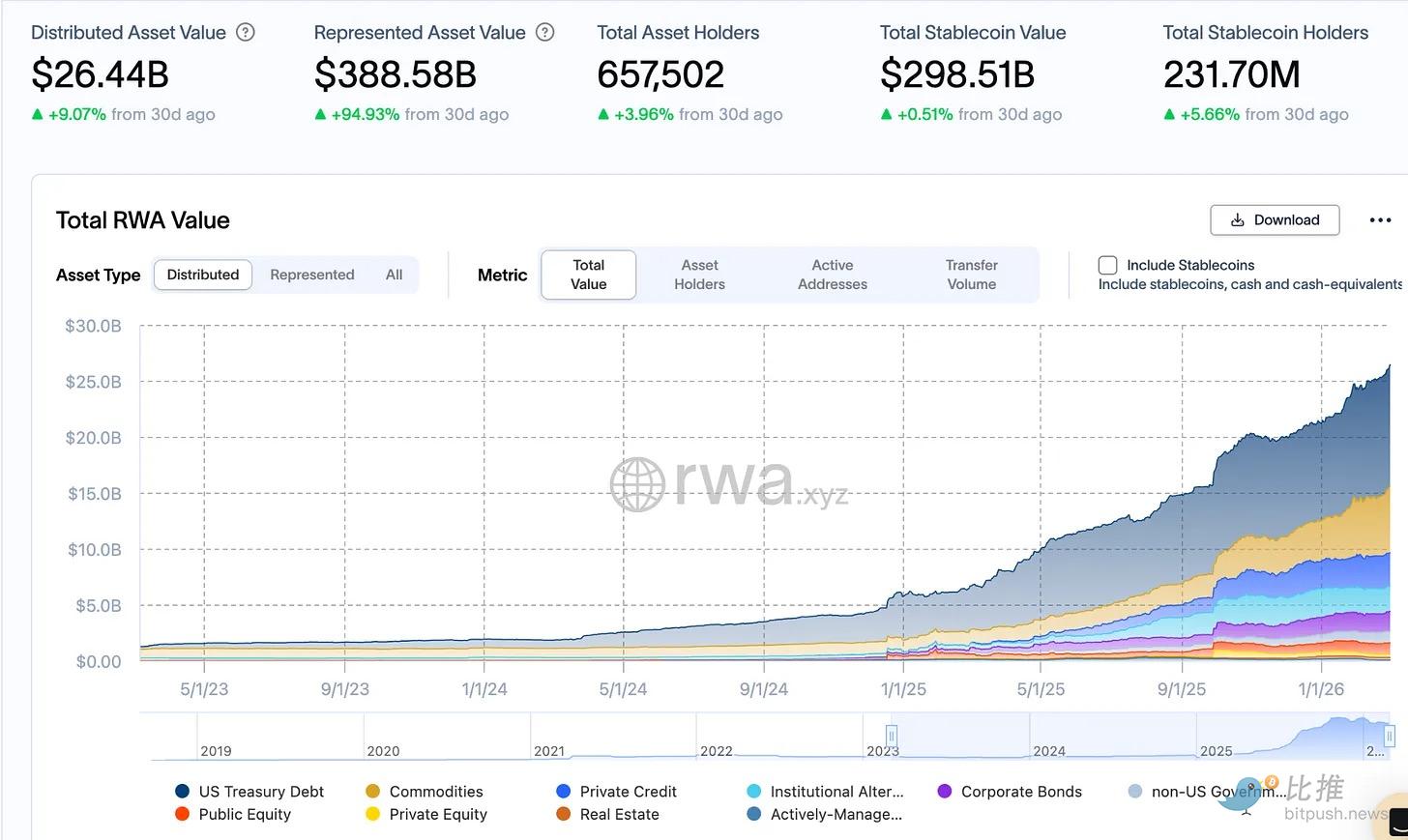
The market is already moving in this direction. By early 2026, the total value of tokenized real-world assets had reached $26 billion in on-chain assets and $388 billion in represented assets, with strong growth momentum. While real estate currently represents a small portion of this, the infrastructure being built—wallets, on-chain settlement, programmable ownership—is far more functional than it was just two years ago. Svanevik points out that the products Nansen is building today couldn't have existed two years ago because the underlying infrastructure wasn't ready. Now, it is.

This doesn't mean tokenization solves the housing affordability crisis. Prices won't drop just because ownership becomes more portable. The structural problems of the market—constrained supply, rate lock-in, the long-term decoupling of prices from wages—remain. And it's uncertain whether "financializing" the last non-liquid asset most families own improves their lives or just makes their troubles more tradable.

Tokenization solves a more specific, more urgent problem. It's about what happens when $25 trillion in housing wealth transfers from a generation accustomed to storing everything in real estate to a generation that believes wealth should be liquid, digital, and not tied to a specific physical address.

Currently, the tools for accessing home equity are broken for most holders. Cash-out refinancing means giving up a 3% rate for a 7% rate. Home Equity Lines of Credit (HELOCs) require income verification that retirees often can't provide. Reverse mortgages carry 30 years of stigma and create complex inheritance issues. Selling triggers both tax traps and rate resets. Every option comes at a cost the holder can ill afford.
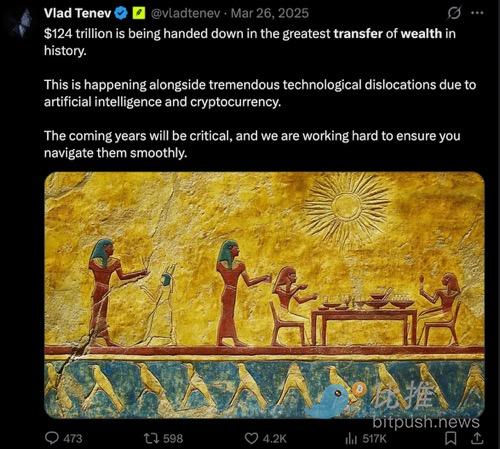
The wealth transfer is already happening, at a rate of about $1.5 trillion per year and accelerating. The first Millennials will turn 45 in 2026. JPMorgan, BlackRock, and Franklin Templeton have all entered the tokenized asset space in the last two years, building infrastructure for this moment. Robinhood CEO Vlad Tenev wrote last year that this wealth transfer is happening alongside a technological shift that will make the coming years critical.

This generation inheriting wealth sees financial assets not as papers in a filing cabinet, but as digits living in a mobile wallet.

The real obstacle is that the current system for transferring title still relies on paper documents, on intermediary steps—a language they no longer think in.

Every generation accumulates wealth in the language it knows. The next generation must translate it before it can inherit it.


Twitter:https://twitter.com/BitpushNewsCN

Bitpush TG Discussion Group:https://t.me/BitPushCommunity

Bitpush TG Subscription: https://t.me/bitpush

Original link:https://www.bitpush.news/articles/7616852

İlgili Sorular

QWhat is the estimated value of assets expected to be transferred from older to younger generations over the next 25 years, and why is this transfer problematic?

AThe estimated value is $124 trillion. This transfer is problematic because a significant portion of these assets are illiquid real estate. The inheriting generation faces challenges with properties that are emotionally burdensome, legally complex, difficult to utilize practically, and hard to divide or sell partially.

QHow did the role of housing change for the middle class from the 1960s to the present, according to the article?

AHousing changed categories. It initially served as shelter and a place to live but gradually became the primary financial instrument for the American middle class. For families outside the high-income bracket, a house is not just one asset among many; it is often their only significant asset, representing the largest portion of their net worth.

QWhat are the four main problems with inheriting real estate that tokenization aims to solve?

ATokenization aims to solve: 1) Liquidity: Allows for partial sales of ownership. 2) Distribution: Enables clean, digital division of ownership among multiple heirs without requiring unanimous decisions. 3) Portability: Allows the asset to be held in a digital portfolio, managed remotely, and used as collateral. 4) Access: Allows those who cannot afford a whole house to gain exposure to real estate assets through fractional ownership.

QWhat structural reasons does the article give for why 61% of baby boomers say they will never sell their homes?

ASelling would trigger high capital gains taxes on decades of appreciation, reset their low mortgage rates (e.g., 3%) to current high rates (e.g., 7%), potentially cause property taxes to skyrocket (as in California), and there is a lack of affordable smaller homes for them to downsize into.

QAccording to Alex Svanevik, what potential impact could the 'Great Wealth Transfer' have on the cryptocurrency market?

AAlex Svanevik estimates that if just 3% of the inherited assets (approximately $100 trillion over 20 years) flows into cryptocurrency, the market capitalization of crypto could double from its current size. This is driven by structural factors, as the inheriting generations (Millennials and Gen Z) are far more trusting and familiar with digital assets like crypto.

İlgili Okumalar

When the World Cup Collides with Agents: From Web2 to Web3, How Are Wallets Evolving into Agentic Wallets?

World Cup as a Catalyst for Agentic Wallets: From Web2 to Web3 This article explores how the World Cup provides a real-world scenario for observing the evolution of digital wallets from simple asset managers towards "Agentic Wallets"—intelligent, AI-powered interfaces. Using the example of prediction markets like Polymarket, it illustrates how AI Agents can lower the barrier to Web3 interaction. Instead of navigating complex DApps, users can express intent in natural language (e.g., "I think Portugal will win") within platforms like Discord or web pages. The Agent then interprets this intent, finds the relevant market, and seamlessly guides the user through the on-chain transaction via their wallet. The core shift is from wallets as mere "function menus" for signing transactions to "intent interpreters" that understand user goals. The article highlights parallel developments in traditional finance, such as Mastercard's "Agent Pay" and WeChat Pay's AI tests, which focus on granting AI controlled, authorized, and auditable payment capabilities. This underscores a broader trend of AI entering the financial layer. However, the article emphasizes that the primary challenge for Agentic Wallets in Web3 is not automation but establishing clear security boundaries. Unlike traditional systems with chargebacks, on-chain transactions are often irreversible. Therefore, future wallets must ensure users retain ultimate control and comprehension. They need to transparently communicate an Agent's permissions, spending limits, authorized durations, and provide easy ways to pause or revoke access. The World Cup experiments represent early steps toward wallets that are not just applications but ubiquitous, intelligent interfaces that simplify Web3 while keeping users securely in control.

marsbit33 dk önce

When the World Cup Collides with Agents: From Web2 to Web3, How Are Wallets Evolving into Agentic Wallets?

marsbit33 dk önce

Options Don't Work in DeFi? Vitalik Might Not Agree

For years, the prevailing view has been that options struggle to gain traction in DeFi due to complexity, fragmented liquidity, and lack of natural demand compared to products like perpetual futures. However, a recent algorithmic stablecoin design proposed by Vitalik Buterin presents a different perspective, using options not as a standalone trading product, but as foundational infrastructure for other financial instruments. In this design, one unit of ETH is split into two components: a "stable" side (P) that retains value up to a specified strike price, and an "upside" side (N) that captures all appreciation above that strike. Combined, they always equal one ETH, eliminating debt, margin, and liquidation risks inherent in typical collateralized debt position (CDP) stablecoins. The stable component essentially mimics the payoff of a covered call option. To function as a stablecoin, this structure requires continuously rolling deep in-the-money calls, which introduces challenges like rollover slippage, predictable transaction flow vulnerable to front-running, and persistent liquidity needs. A core hurdle is finding consistent buyers for the leveraged ETH upside exposure (N). While it offers leverage without funding rates or liquidation, it must compete with simpler alternatives like direct call options or perpetuals. The system's scalability depends on a sustained demand for this specific form of leverage. The author draws parallels to their experience with Rysk, where earlier versions of DeFi options protocols struggled. The breakthrough came with Rysk V12, which aligns incentives: asset holders generate yield by selling covered calls against their holdings, while market makers efficiently acquire the desired option exposure. This demonstrates that options can find product-market fit when embedded as a risk distribution and pricing engine within structured products, stablecoins, or yield-generating assets, rather than marketed as a complex direct trading instrument. Vitalik's proposal reinforces this architectural approach—using fully collateralized, non-custodial, and physically settled options as a fundamental building block. The real opportunity for options in DeFi may lie not in becoming the next perpetual swap, but in powering the next generation of on-chain financial products.

marsbit1 saat önce

Options Don't Work in DeFi? Vitalik Might Not Agree

marsbit1 saat önce

Conversation with Investor Zheng Di: MicroStrategy's Coin Sale Experiment, AI Economy, and Opportunities in US Stocks

Frontier tech investor Zheng "Didier" Di discusses the recent Bitcoin price drop, the financial strategy shift at MicroStrategy, the AI-driven surge in U.S. stocks, and the evolving role of crypto exchanges. Didier posits that the recent BTC decline stems less from macro factors or ETF outflows, and more from market repricing due to MicroStrategy's new financial structure. Following a wave of preferred stock and debt issuance (STRC, STRZ, etc.), MicroStrategy must now manage cash flow to pay dividends, potentially leading to a market expectation of sustained, small-scale BTC sales to maintain its "per-share bitcoin neutral" principle. Didier views this as a financial "experiment" testing market capacity for such recurring sell pressure, which, while creating near-term structural headwinds, likely avoids a true "death spiral" absent major new external shocks. Shifting to AI, Didier argues that tokens are becoming the new form of labor, with AI models and compute (tokenized inputs) increasingly replacing human roles in execution and middle-management. This drives enterprise efficiency and higher margins, fueling the sustained rally in U.S. semiconductor, data center, and infrastructure stocks. He foresees an emerging "machine economy" where automated agents transact and collaborate on-chain. Regarding crypto exchanges offering U.S. equities, Didier sees this as a natural evolution. With few crypto-native assets generating lasting value, exchanges are pivoting towards real-world assets (RWAs) like stocks and bonds. This doesn't necessarily cannibalize crypto but reflects a maturing industry focusing on blockchain's core utilities: decentralized choice and efficient settlement. He notes that trading logic for crypto natives doesn't need to drastically change, as meme-driven and fundamentalist strategies find analogs in U.S. markets. The "1011 event" (likely referring to a major market crash) severely damaged crypto market liquidity, marking a probable end to the altcoin speculative cycle, with capital flowing towards the deeper liquidity of U.S. markets. For the macro outlook, Didier is cautious about near-term market pressure from potential mega-IPOs (e.g., SpaceX) and the U.S. midterm elections, which could bring more regulatory scrutiny. Long-term, he remains bullish on AI's productivity gains and its convergence with blockchain/Web3, predicting a shift from speculative frenzy to a more institutionalized, industrial phase for the crypto sector.

marsbit1 saat önce

Conversation with Investor Zheng Di: MicroStrategy's Coin Sale Experiment, AI Economy, and Opportunities in US Stocks

marsbit1 saat önce

Playnance’s $GCOIN Lists on KoinBX Amid Rapid Growth in India

Playnance's native token, $GCOIN, has been listed on the cryptocurrency exchange KoinBX as of June 18. This move aims to enhance accessibility for its rapidly growing community, particularly in India, where the blockchain-powered Web3 iGaming ecosystem has gained significant traction. Over 130 partners in Playnance's "Be the Boss" program have built communities engaging thousands of active players in the region. The "Be the Boss" model allows participants to create and manage their own gaming communities, earning rewards tied to community activity. CEO Pini Peter noted India's high engagement, with community leaders successfully building player networks. One partner, Dr. Nicolas, reported earning over $57,000 through the program in recent months, highlighting both the financial rewards and the opportunity to grow an engaged community. $GCOIN serves as the ecosystem's core utility token, incentivizing participation and aligning the interests of players and community leaders ("Bosses"). The listing on KoinBX is part of Playnance's strategy to expand globally, increasing the token's utility and accessibility by combining community ownership, gamified engagement, and blockchain-based incentives. Founded in 2020, Playnance is a Web3 iGaming infrastructure company focused on creating live, non-custodial, on-chain products to onboard mainstream users. It currently processes approximately one million transactions daily, aiming to simplify the user experience while maintaining full on-chain transparency.

TheNewsCrypto2 saat önce

Playnance’s $GCOIN Lists on KoinBX Amid Rapid Growth in India

TheNewsCrypto2 saat önce

İşlemler

Spot
Futures
活动图片