‘Quietly rebuilding momentum’ – Scaramucci backs Polkadot despite low network activity

ambcrypto2026-03-22 tarihinde yayınlandı2026-03-22 tarihinde güncellendi

Özet

Anthony Scaramucci, founder of SkyBridge, has turned bullish on Polkadot, citing key catalysts that are "quietly rebuilding momentum" for the blockchain. These include recent regulatory clarity from the SEC, which classified DOT as a digital commodity, and a major tokenomics update that hard-capped the supply at 2.1 billion tokens and cut annual emissions by 53%. The launch of the 21Shares Spot DOT ETF was also noted, though it has seen minimal inflows since debuting. Despite these developments, Polkadot's network activity has declined significantly over the past two years, with weekly active addresses dropping from 16,000 to 5,000. The tokenomics changes briefly boosted trader sentiment, leading to an 18% price rally, but positive momentum faded at the $1.65 resistance level. If macroeconomic uncertainty continues, DOT could retreat to $1.23. While Scaramucci highlights bullish factors, Polkadot's adoption remains weak, and it is unclear how quickly recent upgrades will reignite growth and lift the token's value.

Anthony Scaramucci, founder of venture capital firm SkiBridge, has flipped bullish on Polkadot.

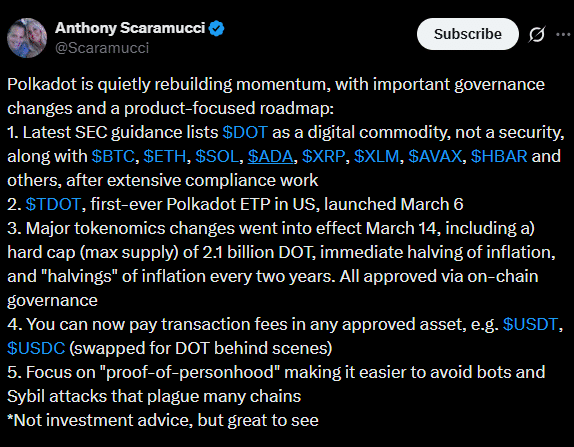
According to the crypto investor, the latest regulatory update and major tokenomics were some of the bullish catalysts that are ‘quietly rebuilding momentum’ for the chain.
Source: X

In the latest SEC guidance, DOT was categorized as a digital commodity like Bitcoin and Ethereum.

Beyond regulatory clarity, the recent tokenomics overhaul has hard-capped DOT supply at 2.1 billion. Additionally, the annual emissions were cut from 120 million DOT to 55 million DOT, marking a 53% cut.

The 21Shares Spot DOT ETF was another key catalyst, according to Scaramucci.

However, since the product debuted, it has only seen one day of inflow of $544.5K. For the rest of March, the Spot DOT ETF has seen zero flows, suggesting that the demand is not as strong as the analyst projected.

But the ETF demand isn’t the only thing lagging for DOT.

Polkadot network activity declining

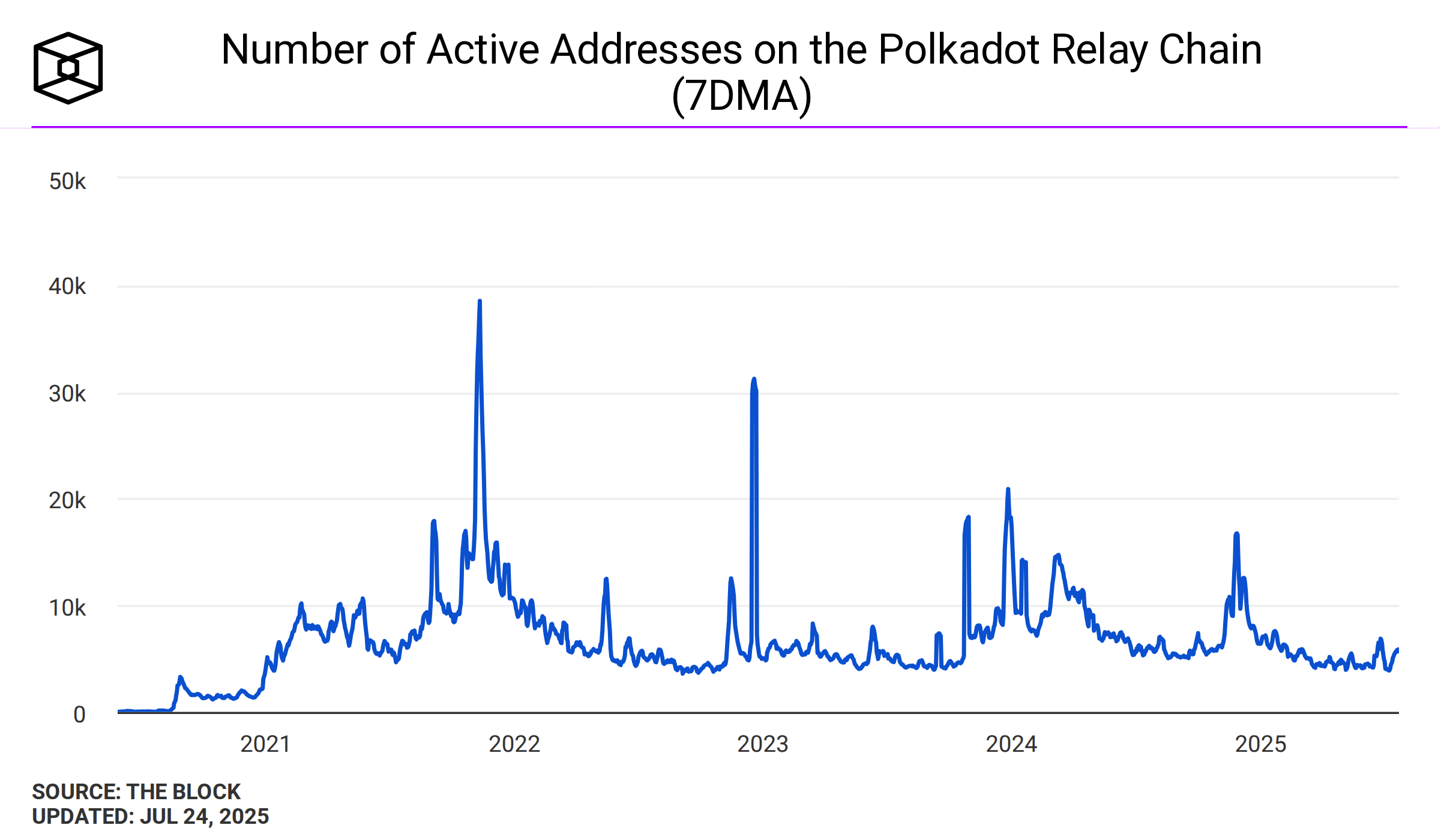
On the network activity and adoption, Polkadot has seen a significant loss in traction. Apart from the initial broader market hype and rally in late 2024, the chain’s adoption has been in a free fall.

This was illustrated by the drop in weekly average active addresses, slipping from 16K to 5K in the past two years.
Source: The Block

It remains to be seen whether the recent tokenomics overhaul will attract users again.

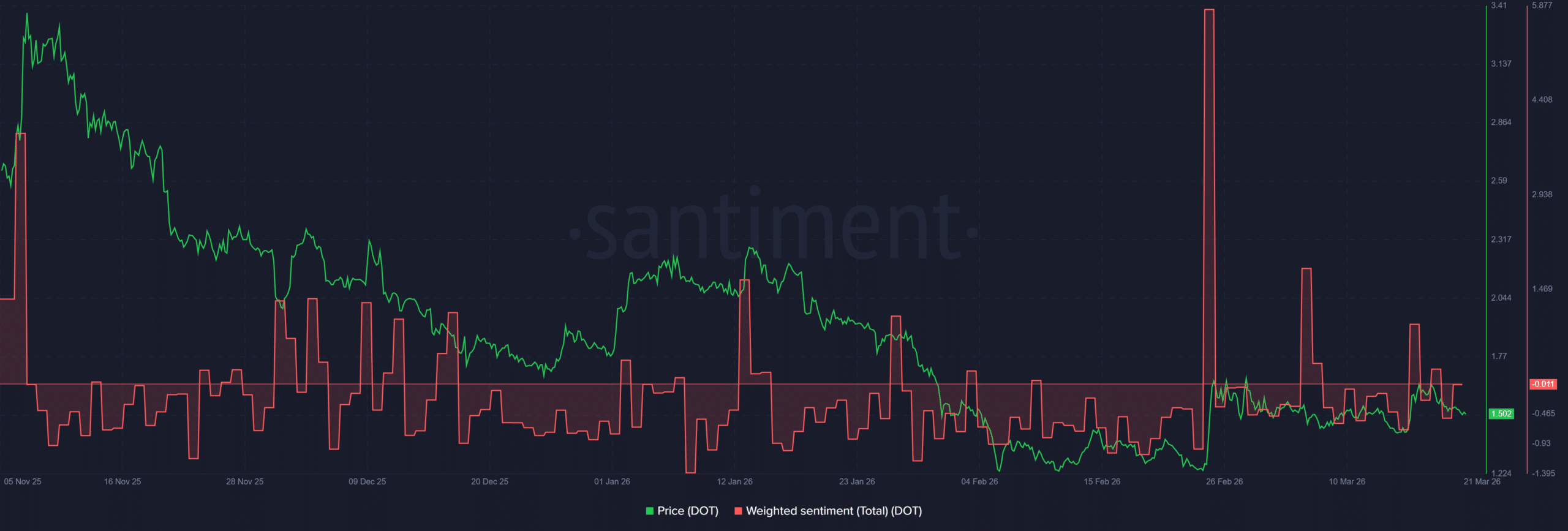
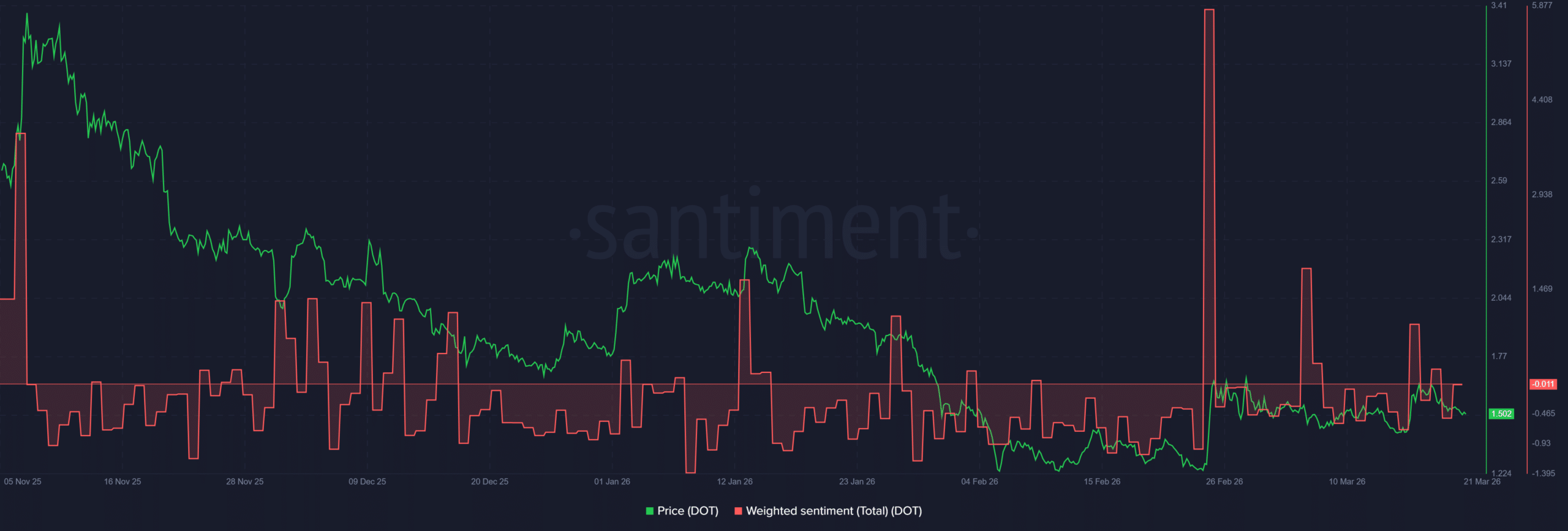
On market dynamics, DOT’s tokenomics and deflation push saw sentiment briefly flip positive before reverting to negative.
Source: Santiment

In other words, the changes temporarily tipped traders to go bullish on the altcoin. In fact, during the spike in positive sentiment, the altcoin rallied 18%. Put differently, the market welcomed the recent upgrades.

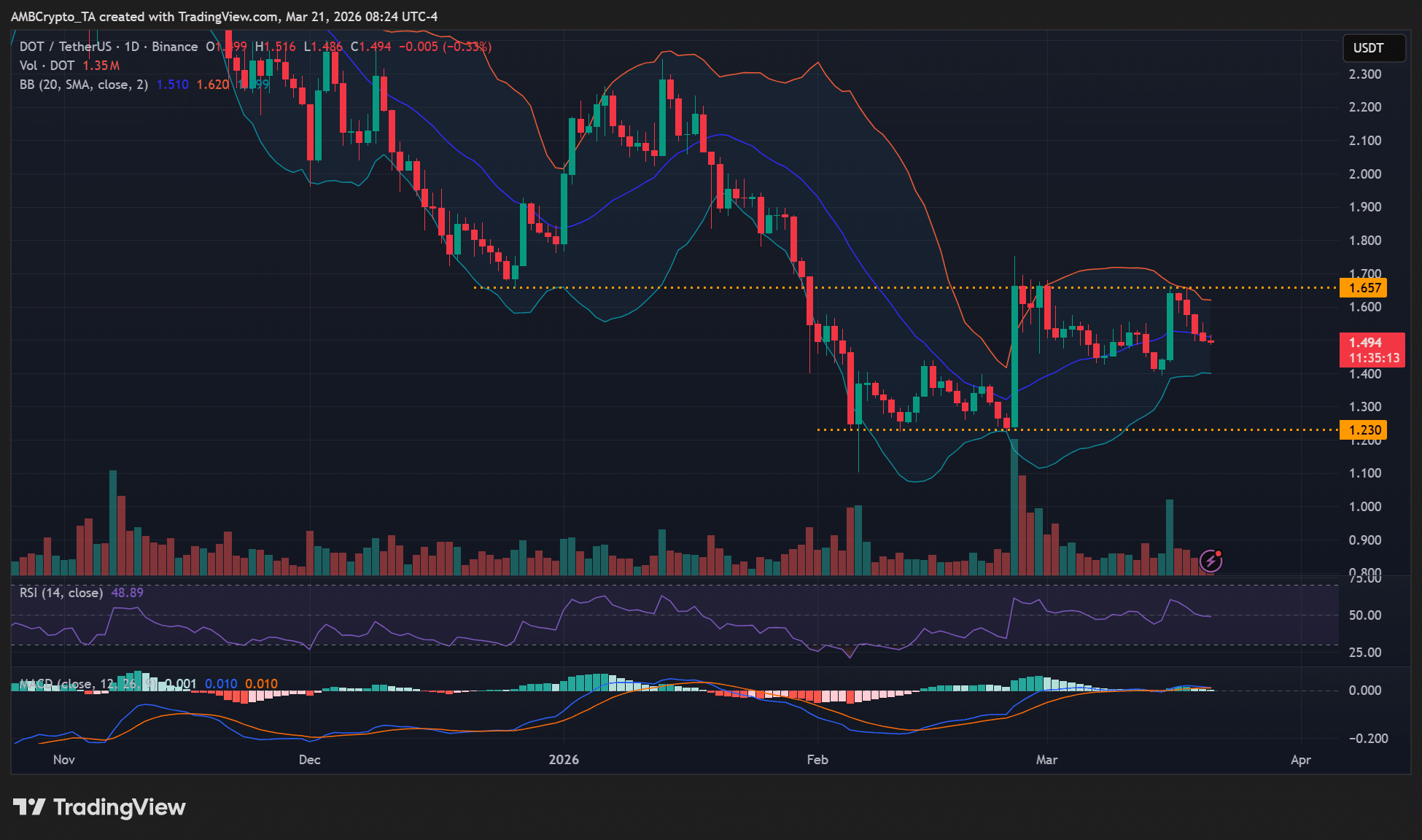
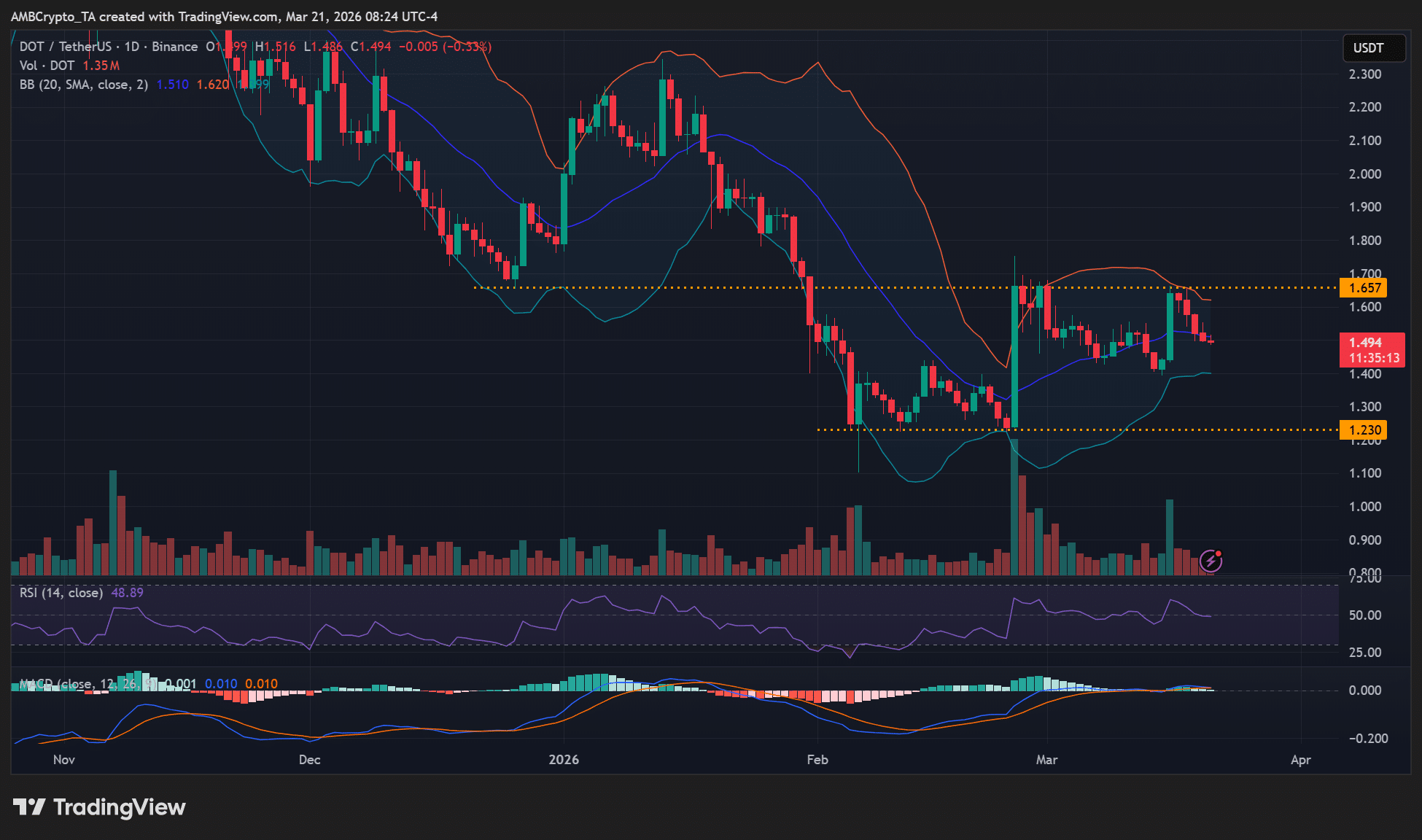
Meanwhile, the DOT rally faded at $1.65, a key roadblock in Q1 2026. If the ongoing macro uncertainty persists, DOT may extend the pullback to $1.23.
Source: DOT/USDT, TradingView

Overall, Scaramucci highlighted key bullish catalysts for the Polkadot chain and its native token. Even so, the chain’s traction has worsened in the past two years. It was unclear how fast the recent changes would reignite momentum and eventually lift DOT.


Final Summary

  • For SkiBridge’s Scaramucci, Polkadot’s bullish case was ‘quietly rebuilding momentum’ after recent upgrades.
  • The chain’s traction has declined in the past two years, but whether recent updates will help revive it remains to be seen.


İlgili Sorular

QWhat are the key bullish catalysts for Polkadot mentioned by Anthony Scaramucci?

AThe key bullish catalysts mentioned are the latest SEC guidance categorizing DOT as a digital commodity, the tokenomics overhaul that hard-capped DOT supply at 2.1 billion and cut annual emissions by 53%, and the launch of the 21Shares Spot DOT ETF.

QHow has Polkadot's network activity changed in the past two years according to the article?

APolkadot's network activity has significantly declined, with weekly average active addresses dropping from 16K to 5K over the past two years.

QWhat was the market reaction to Polkadot's recent tokenomics changes?

AThe tokenomics changes temporarily flipped market sentiment positive, resulting in an 18% price rally for DOT, though the positive sentiment eventually reverted to negative.

QWhat does the article say about the performance of the 21Shares Spot DOT ETF?

AThe ETF saw only one day of inflows totaling $544.5K since its debut and recorded zero flows for the rest of March, indicating weaker demand than projected.

QWhat are the key resistance and support levels mentioned for DOT's price?

AThe rally faded at the key resistance level of $1.65, and if macro uncertainty persists, DOT could extend its pullback to the support level of $1.23.

İlgili Okumalar

L2 'Recalibration': When L1 Becomes Its Own Rollup, What Is Ethereum's Endgame?

The article discusses the evolving relationship between Ethereum's Layer 1 (L1) and Layer 2 (L2) solutions, moving beyond the initial "L2 for scaling" model. As Ethereum L1 itself scales (increasing Gas Limit, statelessness, zkEVM), the unique value proposition of L2s shifts from merely providing cheap execution to offering differentiated features like application-specific optimization, privacy, and flexible governance. The piece explores three key themes: 1. **L2's New Role:** L2s are transitioning from a pure scaling technology to a spectrum of execution environments with varying degrees of security inheritance from Ethereum L1. 2. **Interoperability as State Trust:** Solving L2 fragmentation is less about cross-chain bridges and more about enabling faster, trust-minimized state verification between environments. This involves initiatives like faster L1 finality, intent-based architectures (Open Intents Framework), and native account abstraction. 3. **Blurring Layers:** With the potential integration of zk-proofs into L1 validation (making L1 akin to its own "Rollup") and the concept of "Native Rollups," the rigid boundary between L1 and L2 may fade. The future could be a unified system with multiple execution domains (for DeFi, gaming, privacy, etc.) sharing a common security, settlement, and state framework. In conclusion, Ethereum's goal is not to abandon L2s or re-centralize everything on L1, but to re-integrate the fragmented user experience—liquidity, accounts, applications—while preserving the scaling benefits of a multi-environment ecosystem. The endgame is a cohesive "one chain" feeling for users, powered by diverse but securely interconnected execution layers.

marsbit22 dk önce

L2 'Recalibration': When L1 Becomes Its Own Rollup, What Is Ethereum's Endgame?

marsbit22 dk önce

The Encryption Bill Clarity's Challenge: A Thorny Path of Bipartisan Compromise in the U.S.

U.S. lawmakers are attempting to advance the Clarity Act, a significant crypto market structure bill, but its path is fraught with partisan hurdles. The process has been rocky since January, when a prior bipartisan deal in the Senate Banking Committee was upended. A key compromise in May on "yield" issues allowed the bill to move forward in committee, but only with the conditional support of two Democratic senators, Angela Alsobrooks and Ruben Gallego. They emphasized that their final vote depends on reaching an agreement on ethics provisions for elected officials. Ultimately, the Senate Agriculture Committee passed its version along party lines without Democratic support. As Republicans push for a full Senate vote in July, the demand for strong ethics language has expanded beyond Democrats. Additional controversies surround provisions related to yields (aligning some Republicans with large banks) and developer protections (opposed by enforcement agencies). Core concerns about illicit finance and consumer protection remain central to the debate. Despite consensus on the need for legislation, achieving the necessary bipartisan compromise is proving difficult. While momentum exists—including recent meetings between senators and White House officials—a reconciled bill text faces skepticism. Senator Gallego has stated that without ethics terms acceptable to Democrats, they will not provide the needed votes. The immediate goals for the crypto community in Congress are unclear: a symbolic Senate vote before the August recess, eventual passage into law by 2026, or forging a final compromise framework. The arduous, vote-by-vote effort to build bipartisan support continues, mirroring the traditional legislative grind the industry must now navigate.

Foresight News1 saat önce

The Encryption Bill Clarity's Challenge: A Thorny Path of Bipartisan Compromise in the U.S.

Foresight News1 saat önce

İşlemler

Spot
活动图片