Qubic Starts Dogecoin Mining Phase 2, Shifting Rewards Away From XMR

bitcoinist2026-04-16 tarihinde yayınlandı2026-04-16 tarihinde güncellendi

Özet

Qubic has entered phase 2 of its Dogecoin mining rollout, shifting miner rewards from Monero (XMR) to DOGE-based incentives. Starting with epoch 209, computors can operate in either XMR or DOGE mode, with only the higher-yielding contribution counted per index—effectively phasing out XMR if DOGE is more profitable. All block rewards are used for QUBIC buybacks, which are then distributed proportionally based on Dogecoin shares submitted. This transition, part of a three-phase plan announced in March, aims to fully migrate from XMR to DOGE, allowing parallel operation of DOGE mining (via Scrypt ASICs) and AI training (on CPUs/GPUs). Phase 2 introduces weekly reward windows, aligning with Qubic’s goal of scaling toward full-capacity dual-workstream operations.

Qubic has moved its Dogecoin mining rollout into phase 2, a step that begins redirecting miner economics away from Monero and toward DOGE-linked rewards. For Qubic, the change matters because phase 2 is where the migration stops being a live test and starts becoming a real incentive shift.

In an April 15 Discord update shared on X by community member Rayyan, Qubic tech lead Joetom said phase 2 began with epoch 209 and that, from this point, “each computor can operate in either legacy XMR mode or Doge mode.” He added: “For every computor index, only one contribution is counted: max(XMR, DOGE). This effectively replaces XMR participation if Doge yields a higher contribution. No dual counting.”

Qubic Activates Dogecoin Phase 2

The move lines up with the transition plan Qubic published ahead of launch. In its March 27 rollout note, the team described a three-phase migration from XMR to DOGE. Phase 1 was a testing period in which XMR revenue remained intact while Dogecoin mining ran on mainnet in a non-rewarded validation mode.

Phase 2 was framed as the decision point, where computors could opt into DOGE rewards while XMR began phasing out. Phase 3 is the end state: XMR removed, DOGE running at full production, and Qubic’s CPU and GPU resources returned to full-time AI training.

That broader architecture is central to Qubic’s pitch. Under the old model, the network alternated between Monero hashing and AI-related work. With Dogecoin, Qubic says the jobs can run in parallel because DOGE mining relies on Scrypt ASICs, while the network’s AI training stack runs on CPUs and GPUs. The result, in Qubic’s telling, is a cleaner division of labor and a path toward running both workstreams at full capacity rather than splitting general-purpose compute between them.

Joetom’s April 15 message also clarified how rewards are now being routed. “All block rewards are used for Qubic buybacks,” he wrote. “The acquired Qubic is distributed proportionally based on delivered Doge shares.”

He then outlined how accounting will evolve as the system scales: “Target state is a daily reward window from 12:00 to 12:00 UTC. All blocks mined within a window are allocated to shares submitted within the same window. Phase 2 starts with a weekly window aligned to epochs.”

That mechanism fits the buyback structure Qubic had already outlined publicly. The network has said DOGE mined through its system is sold, the proceeds are used to buy back QUBIC, and those tokens are then distributed to participants based on contribution.

The timing also tracks the roadmap. Qubic launched Dogecoin mining on April 1 and said the full migration from Monero would likely play out across roughly four weeks, with phase lengths flexible depending on stability and network conditions. Phase 2 arriving in mid-April suggests that schedule is broadly holding, even if reward windows and other parameters remain adjustable.

At press time, DOGE traded at $0.09618.
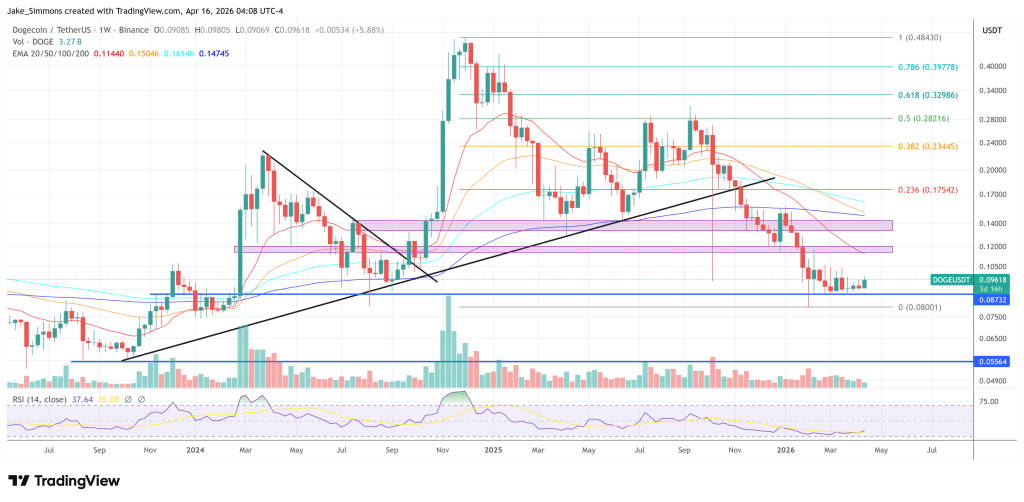
DOGE holds above key support, 1-month chart | Source: DOGEUSDT on TradingView.com

Trend Kriptolar

İlgili Sorular

QWhat is the main change introduced in Qubic's Dogecoin mining phase 2?

APhase 2 begins redirecting miner economics away from Monero (XMR) and toward DOGE-linked rewards, allowing computors to operate in either legacy XMR mode or Doge mode, with only the higher-yielding contribution being counted.

QHow does Qubic's reward distribution mechanism work in the new Dogecoin mining system?

AAll Dogecoin block rewards are used for Qubic buybacks. The acquired QUBIC tokens are then distributed proportionally to participants based on the Doge shares they delivered.

QWhat is the stated benefit of switching from Monero to Dogecoin mining for the Qubic network?

AThe switch allows Dogecoin mining (which relies on Scrypt ASICs) and AI training (which runs on CPUs and GPUs) to operate in parallel, creating a cleaner division of labor and enabling both workstreams to run at full capacity instead of splitting general-purpose compute between them.

QWhat are the three phases of Qubic's migration from XMR to DOGE mining?

APhase 1 was a testing period with XMR revenue intact. Phase 2 is the decision point where computors can opt into DOGE rewards while XMR phases out. Phase 3 is the end state with XMR completely removed and DOGE running at full production.

QHow does the reward window system work in the target state of phase 2?

AThe target state is a daily reward window from 12:00 to 12:00 UTC. All blocks mined within a window are allocated to shares submitted within that same window, though phase 2 starts with a weekly window aligned to epochs.

İlgili Okumalar

The Verdict in Choi Tae-won's Divorce Case: Revealing the Inheritance Undercurrent Behind SK Hynix's Trillion-Won Empire

SK Group Chairman Chey Tae-won's high-profile divorce case, involving a record 1.38 trillion won settlement, has drawn attention to the succession plans for Korea's second-largest conglomerate, especially its crown jewel, SK hynix. Unlike traditional chaebol scripts centered on the eldest son, Chey's three children from his marriage to former President Roh Tae-woo's daughter, Roh Soh-yeong, are carving distinct, non-traditional paths. Eldest daughter Chey Yun-jung (b. 1989) is seen as the most evident successor. With a scientific and consulting background, she holds executive roles at SK bioscience and SK Inc.'s growth support department, focusing on future strategy and biopharma. Her marriage is to an AI infrastructure entrepreneur, not a traditional business alliance. Second daughter Chey Min-jung (b. 1991) took a unique route, voluntarily serving as a South Korean naval officer, including an anti-piracy deployment. She later worked on policy and strategy for SK hynix in Washington D.C. before co-founding an AI-driven healthcare startup. She married a former U.S. Marine Corps officer, connecting her to U.S. defense and policy circles—networks crucial for a global semiconductor giant. The only son, Chey In-geun (b. 1995), who studied physics like his father, worked briefly at SK E&S before joining McKinsey. Despite fitting the traditional "heir" profile as the eldest son, he remains silent and holds no public position or shares in SK, suggesting the old succession playbook is obsolete. As SK hynix's valuation soars, becoming a geopolitical asset in the AI era, the heirs' legitimacy is no longer automatic. They must prove themselves in fields like AI biotech, global policy, and strategic consulting. Their marriages also reflect new elite networks in tech and defense, not old political alliances. Their inheritance is the complex challenge of navigating a globalized, tech-driven world, not just a corporate throne.

marsbitDün 09:06

The Verdict in Choi Tae-won's Divorce Case: Revealing the Inheritance Undercurrent Behind SK Hynix's Trillion-Won Empire

marsbitDün 09:06

From OpenSea to OpenRouter: Is Alex Atallah Repeating His 'Exit at the Peak' Playbook?

From OpenSea to OpenRouter: Is Alex Atallah Repeating His "Exit at the Peak" Playbook? According to the Wall Street Journal, payments giant Stripe is in talks to acquire the AI model aggregation platform OpenRouter in a potential deal valuing the company near $100 billion. This would mark founder Alex Atallah's second creation of a company reaching a $100 billion valuation, following his co-founding of NFT marketplace OpenSea. OpenRouter, founded just over three years ago, has grown rapidly by acting as a unified gateway for developers to access over 400 AI models. It currently has about 10 million users and processes over 200 trillion tokens monthly. While the platform's annualized revenue is around $50 million, its valuation has skyrocketed from $1.3 billion in March 2026. The potential acquisition by Stripe, a company OpenRouter's founder once likened it to, represents a major expansion into AI infrastructure for the payments leader. This move echoes Atallah's previous timing with OpenSea, where he departed before the NFT market's significant downturn. For OpenRouter, selling now may be strategic. Despite its scale, its business model—charging a 5-5.5% fee on AI inference calls—faces pressure from competition, open-source models, and potential price wars among model providers, limiting its profitability narrative for an IPO. A key asset for potential acquirers like Stripe is OpenRouter's vast repository of real-world AI usage data, which offers unique insights into model performance and developer preferences that are difficult to replicate. Whether this potential deal signifies a new valuation benchmark for AI infrastructure or another market peak signal remains to be seen.

链捕手Dün 08:42

From OpenSea to OpenRouter: Is Alex Atallah Repeating His 'Exit at the Peak' Playbook?

链捕手Dün 08:42

İşlemler

Spot

Popüler Makaleler

XMR Nasıl Satın Alınır

HTX.com’a hoş geldiniz! Monero (XMR) satın alma işlemlerini basit ve kullanışlı bir hâle getirdik. Adım adım açıkladığımız rehberimizi takip ederek kripto yolculuğunuza başlayın. 1. Adım: HTX Hesabınızı OluşturunHTX'te ücretsiz bir hesap açmak için e-posta adresinizi veya telefon numaranızı kullanın. Sorunsuzca kaydolun ve tüm özelliklerin kilidini açın. Hesabımı Aç2. Adım: Kripto Satın Al Bölümüne Gidin ve Ödeme Yönteminizi SeçinKredi/Banka Kartı: Visa veya Mastercard'ınızı kullanarak anında Monero (XMR) satın alın.Bakiye: Sorunsuz bir şekilde işlem yapmak için HTX hesap bakiyenizdeki fonları kullanın.Üçüncü Taraflar: Kullanımı kolaylaştırmak için Google Pay ve Apple Pay gibi popüler ödeme yöntemlerini ekledik.P2P: HTX'teki diğer kullanıcılarla doğrudan işlem yapın.Borsa Dışı (OTC): Yatırımcılar için kişiye özel hizmetler ve rekabetçi döviz kurları sunuyoruz.3. Adım: Monero (XMR) Varlıklarınızı SaklayınMonero (XMR) satın aldıktan sonra HTX hesabınızda saklayın. Alternatif olarak, blok zinciri transferi yoluyla başka bir yere gönderebilir veya diğer kripto para birimlerini takas etmek için kullanabilirsiniz.4. Adım: Monero (XMR) Varlıklarınızla İşlem YapınHTX'in spot piyasasında Monero (XMR) ile kolayca işlemler yapın.Hesabınıza erişin, işlem çiftinizi seçin, işlemlerinizi gerçekleştirin ve gerçek zamanlı olarak izleyin. Hem yeni başlayanlar hem de deneyimli yatırımcılar için kullanıcı dostu bir deneyim sunuyoruz.

267 Toplam GörüntülenmeYayınlanma 2024.12.10Güncellenme 2026.06.02

XMR Nasıl Satın Alınır

Tartışmalar

HTX Topluluğuna hoş geldiniz. Burada, en son platform gelişmeleri hakkında bilgi sahibi olabilir ve profesyonel piyasa görüşlerine erişebilirsiniz. Kullanıcıların XMR (XMR) fiyatı hakkındaki görüşleri aşağıda sunulmaktadır.

活动图片