Quantum Computing Will Trigger A Bitcoin Supply Shock: Michael Saylor

bitcoinist2025-12-20 tarihinde yayınlandı2025-12-20 tarihinde güncellendi

Özet

Quantum computing will not break Bitcoin but instead harden it, according to Michael Saylor. In response to a future quantum threat, a coordinated global upgrade to quantum-resistant encryption will be enforced. Active Bitcoin holders will migrate their coins to secure new wallets, while lost or inaccessible coins will remain permanently frozen. This process will enhance network security, reduce the effective supply of Bitcoin, and trigger a deflationary event. Saylor argues that the upgrade is inevitable and that the market will ultimately reach consensus, despite Bitcoin’s decentralized nature. The result will be a clearer accounting of lost BTC and a stronger, more secure network.

Quantum computing has become a durable risk narrative for Bitcoin. This week, Galaxy Digital head of research Alex Thorn sat down with Strategy executive chairman Michael Saylor addressing the issue, shortly after Saylor posted his own “Bitcoin Quantum Leap” thesis on X.

“The Bitcoin Quantum Leap: Quantum computing won’t break Bitcoin—it will harden it. The network upgrades, active coins migrate, lost coins stay frozen. Security goes up. Supply comes down. Bitcoin grows stronger,” Saylor wrote on Dec. 16, 2025.

Saylor Doubles Down On Freezing Dormant Bitcoin

In Thorn’s interview, Saylor’s argument is less a cryptography lesson than a coordination claim: when a quantum threat is broadly recognized, the response will not be optional, and Bitcoin will follow the same upgrade logic as the rest of the digital economy.

“There’s going to be a point when the world will form a consensus that there’s a quantum threat. We’re not there now, but you won’t miss it because the United States government will direct all of the defense contractors to upgrade their encryption algorithms to be quantum resistant,” Saylor said.

He described a cascade in which major platforms ship standardized quantum-resistant libraries across consumer devices and core financial systems, with enforced timelines and re-authentication requirements. In that scenario, Saylor suggested, Bitcoin’s transition would be a software upgrade problem, not an existential crisis.

“They will ship an upgrade and they will say [...] please install the new client software and reauthenticate yourself. And you’ve got X days, 90 days, 30 days... And if you don’t, we’re going to freeze your funds. For your own good,” Saylor said.

Saylor repeatedly returned to incentives as the decisive factor. In his view, owners of meaningful balances will not rationally opt out of an upgrade that preserves access to their holdings, and the same logic extends to the broader ecosystem’s ability to reach rough consensus.

“The Bitcoin network just runs on software. There’s going to be a quantum upgrade. It’s going to have quantum resistant encryption libraries,” he said, adding that he would expect those to align with widely adopted standards shipped across operating systems and enterprise infrastructure.

Where his answer becomes more explicitly market-relevant is in the downstream implication: coins that can be migrated will be migrated, and coins that cannot be migrated — because the holders are deceased or keys are irretrievable — would remain stranded. Saylor framed that as a security hardening event that also forces a clearer accounting of lost supply.

“We’re going to re-encrypt all the Bitcoin and all the wallets [...] It’s going to get re-encrypted if the holders of the private keys are alive and if they like money,” he said. “If they’re dead, they’re not going to re-encrypt. And if they’ve lost the keys, they’re not going to re-encrypt.”

Bitcoin Supply Shock Imminent

That is where the “deflationary event” language enters: the upgrade, in his view, would effectively separate recoverable BTC from unrecoverable BTC in a way the market would have to price. “This is going to be a massive upgrade to network security and it’s going to be a massive deflationary event,” Saylor said. “And we’re going to get the answer to the age old question, how much BTC has been lost?”

Saylor also addressed the common objection that decentralization makes coordinated upgrades impractical. He argued the opposite: decentralized networks still converge when sufficiently motivated, and global supply chains and defense ecosystems coordinate under pressure despite being fragmented across thousands of entities.

“You think you’re not going to get consensus? All the smart people with money in the world that thought it was smart to put their money on the crypto network, you think they’re the people too stupid to want to upgrade?” he said.

In his framing, the practical difference versus a bank-driven migration is timing. A centralized institution can enforce a short deadline; Bitcoin, because it is global and permissionless, would likely take longer, on the order of months to years, but would still converge. “We’re probably going to do this over the course of 30 days or 90 days. It’ll probably take two years or one year,” Saylor said.

At press time, BTC traded at $88,000.
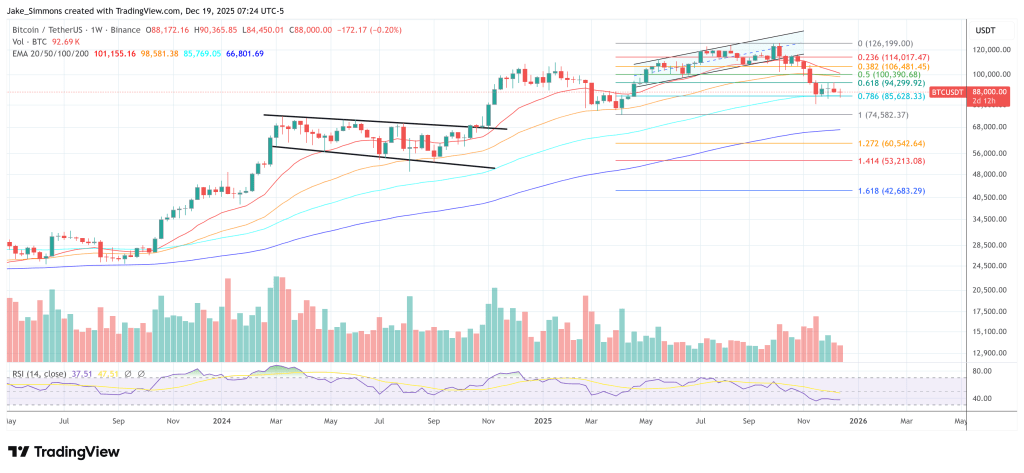
Bitcoin remains between the 0.618 and 0.786 Fib, 1-week chart | Source: BTCUSDT on TradingView.com

Trend Kriptolar

İlgili Sorular

QWhat is Michael Saylor's main argument about quantum computing and Bitcoin?

AMichael Saylor argues that quantum computing will not break Bitcoin but will instead harden it. He believes the network will upgrade, active coins to quantum-resistant encryption, while lost coins remain frozen. This process will increase security, reduce supply, and make Bitcoin stronger.

QAccording to Saylor, what will trigger the global consensus to upgrade encryption algorithms?

ASaylor states that the United States government will direct all defense contractors to upgrade their encryption algorithms to be quantum-resistant, which will signal a broad recognition of the quantum threat and trigger a global consensus for upgrades.

QHow does Saylor describe the process of Bitcoin's quantum upgrade?

ASaylor describes it as a software upgrade where quantum-resistant encryption libraries will be shipped. Users will be required to install new client software and reauthenticate within a deadline (e.g., 30-90 days), or their funds will be frozen for security reasons.

QWhy does Saylor believe the quantum upgrade will be a deflationary event for Bitcoin?

AHe explains that the upgrade will separate recoverable BTC (migrated by active users) from unrecoverable BTC (held by deceased or key-losers), effectively reducing the circulating supply and forcing the market to account for lost coins, thus creating a deflationary shock.

QHow does Saylor counter the argument that decentralization makes coordinated upgrades impractical?

ASaylor argues that decentralized networks can still reach consensus when motivated, citing examples like global supply chains and defense ecosystems coordinating under pressure. He believes Bitcoin holders, being smart and financially invested, will rationally choose to upgrade to protect their assets.

İlgili Okumalar

Welcome to the New Crypto World: Only This Time, The Place Where You Lose Money Is Called the Stock Market

Welcome to the New Crypto World: Only This Time, the Place to Lose Money is Called the Stock Market. The article depicts a future (2026) where global stock markets, particularly tech stocks, are exhibiting behaviors and risks reminiscent of the cryptocurrency world. The narrative centers on a sharp crash in South Korea's KOSPI index and leading stocks like SK Hynix, highlighting widespread retail losses, leverage-induced liquidations, and extreme volatility. It argues that a significant shift in market dynamics is underway: pricing is increasingly driven by narratives (like the AI boom) over fundamental valuation, amplified by high leverage and the rapid, emotion-fueled consensus formed on social media. Former crypto traders, seeking new opportunities, brought their high-risk strategies—chasing narratives, using leverage—into equity markets, focusing on sectors like AI and semiconductors. Ironically, data suggests some major tech stocks have recently shown greater volatility and faster crashes than Bitcoin, which is becoming relatively more stable and "stock-like" through institutional adoption. The piece details how leveraged ETFs in Korea, particularly those tied to single stocks, created a vicious cycle of forced selling that exacerbated the market plunge. It concludes that while stocks retain underlying fundamentals, the *trading* of them has undergone a "de-rationalization": markets now prioritize themes, social media sentiment, and leveraged bets over traditional analysis. In a paradoxical twist, Bitcoin is striving to become more like a traditional asset, while a segment of the stock market is becoming more like crypto—a cycle of grand stories, crowded trades, easy leverage, and the pervasive, often misplaced, belief that one can exit before everyone else. The final, poignant wish from a Korean retail investor—to go back to life before trading and get their money back—underscores that markets offer no refunds.

marsbit10 dk önce

Welcome to the New Crypto World: Only This Time, The Place Where You Lose Money Is Called the Stock Market

marsbit10 dk önce

Feishu Has Become Doubao

This may be the most important day in the ten-year history of Feishu. On July 30, ByteDance announced a major restructuring via internal email. Feishu, an independent operation for a decade, will no longer function separately and will lose its independent sales and marketing teams. Its product team is being integrated into Doubao AI, and its Go-to-Market strategy merges into the Volcano Engine's To B system. This move signals a strategic pivot, not a failure of Feishu. The era where Feishu sought to be an all-encompassing super-app for productivity is ending. AI has become the dominant logic. Industry trends show a shift from building platform "entrances" to embedding AI directly into workflows, as seen with Microsoft Copilot and Google's Gemini. Data reveals the driver: over 90% of Feishu's new clients in Q2 2026 purchased its AI products. Enterprises are now buying integrated AI solutions, not standalone software. By integrating Feishu's deep enterprise workflow scenarios, Doubao evolves from a consumer-facing chatbot into a powerful enterprise productivity engine. This gives Doubao a critical asset: real-world business application. Concurrently, ByteDance established the "Creative Services Platform," unifying its previously fragmented sales fronts (Feishu, Doubao, Volcano Engine) into a single customer-facing entity. This represents ByteDance's first genuine shift to thinking like a true To B company, organizing around client needs rather than internal product silos. The restructuring underscores that AI is no longer just a business line but foundational infrastructure. Doubao is becoming the new organizational core, mirroring TikTok's past ascendancy. This demonstrates a profound shift: AI is beginning to reshape corporate structures, determining resource allocation and strategic priorities. ByteDance is likely just the first of many companies to undergo such an AI-driven reorganization.

marsbit21 dk önce

Feishu Has Become Doubao

marsbit21 dk önce

The Second Half of the RWA Issuance Race: Amidst the Utilization Dilemma, Trillions Worth of On-Chain Assets Awaken

RWA (Real-World Asset) tokenization has surged to a record $32 billion in on-chain value. However, a structural challenge has emerged: approximately 87% of these tokenized assets are inactive, not participating in DeFi lending or trading activities. This "utilization gap" highlights a key question: what happens after assets are brought on-chain? Data shows a stark contrast among major platforms. While Securitize leads in scale ($4.9B), it has a DeFi utilization rate of only 0.7%. Similarly, Ondo Finance ($3.5B) sees about 2.7% utilization. In contrast, Maple Finance, with a smaller $2.3B in assets, achieves a 62% utilization rate by embedding its assets directly into lending activities from the outset. Three primary factors contribute to low utilization: 1) **Asset Nature**: Tokenized treasuries are often held for yield, not traded. 2) **Regulatory Barriers**: Securities laws and KYC requirements restrict free movement into permissionless DeFi pools. 3) **Infrastructure Gaps**: A lack of deep secondary markets, real-time pricing, and mature clearing mechanisms hinders liquidity. The RWA narrative is now shifting from a "race to issue" to a "battle for application." While native lending protocols like Maple have inherent advantages, distribution channels are becoming critical. The success of products like SyrupUSDG on platforms like Robinhood Crypto demonstrates that access to existing user bases can accelerate adoption far more effectively than protocol-led efforts alone. The $32 billion milestone validates the feasibility of tokenization, but low utilization underscores that bringing assets on-chain is just the first step. The true test for the sector is enabling these assets to circulate, be utilized, and create new economic value within the DeFi ecosystem.

marsbit21 dk önce

The Second Half of the RWA Issuance Race: Amidst the Utilization Dilemma, Trillions Worth of On-Chain Assets Awaken

marsbit21 dk önce

İşlemler

Spot

Popüler Makaleler

O Nasıl Satın Alınır

HTX.com’a hoş geldiniz! O1 exchange (O) satın alma işlemlerini basit ve kullanışlı bir hâle getirdik. Adım adım açıkladığımız rehberimizi takip ederek kripto yolculuğunuza başlayın. 1. Adım: HTX Hesabınızı OluşturunHTX'te ücretsiz bir hesap açmak için e-posta adresinizi veya telefon numaranızı kullanın. Sorunsuzca kaydolun ve tüm özelliklerin kilidini açın. Hesabımı Aç2. Adım: Kripto Satın Al Bölümüne Gidin ve Ödeme Yönteminizi SeçinKredi/Banka Kartı: Visa veya Mastercard'ınızı kullanarak anında O1 exchange (O) satın alın.Bakiye: Sorunsuz bir şekilde işlem yapmak için HTX hesap bakiyenizdeki fonları kullanın.Üçüncü Taraflar: Kullanımı kolaylaştırmak için Google Pay ve Apple Pay gibi popüler ödeme yöntemlerini ekledik.P2P: HTX'teki diğer kullanıcılarla doğrudan işlem yapın.Borsa Dışı (OTC): Yatırımcılar için kişiye özel hizmetler ve rekabetçi döviz kurları sunuyoruz.3. Adım: O1 exchange (O) Varlıklarınızı SaklayınO1 exchange (O) satın aldıktan sonra HTX hesabınızda saklayın. Alternatif olarak, blok zinciri transferi yoluyla başka bir yere gönderebilir veya diğer kripto para birimlerini takas etmek için kullanabilirsiniz.4. Adım: O1 exchange (O) Varlıklarınızla İşlem YapınHTX'in spot piyasasında O1 exchange (O) ile kolayca işlemler yapın.Hesabınıza erişin, işlem çiftinizi seçin, işlemlerinizi gerçekleştirin ve gerçek zamanlı olarak izleyin. Hem yeni başlayanlar hem de deneyimli yatırımcılar için kullanıcı dostu bir deneyim sunuyoruz.

315 Toplam GörüntülenmeYayınlanma 2026.06.19Güncellenme 2026.06.29

O Nasıl Satın Alınır

PROS Nasıl Satın Alınır

HTX.com’a hoş geldiniz! Pharos (PROS) satın alma işlemlerini basit ve kullanışlı bir hâle getirdik. Adım adım açıkladığımız rehberimizi takip ederek kripto yolculuğunuza başlayın. 1. Adım: HTX Hesabınızı OluşturunHTX'te ücretsiz bir hesap açmak için e-posta adresinizi veya telefon numaranızı kullanın. Sorunsuzca kaydolun ve tüm özelliklerin kilidini açın. Hesabımı Aç2. Adım: Kripto Satın Al Bölümüne Gidin ve Ödeme Yönteminizi SeçinKredi/Banka Kartı: Visa veya Mastercard'ınızı kullanarak anında Pharos (PROS) satın alın.Bakiye: Sorunsuz bir şekilde işlem yapmak için HTX hesap bakiyenizdeki fonları kullanın.Üçüncü Taraflar: Kullanımı kolaylaştırmak için Google Pay ve Apple Pay gibi popüler ödeme yöntemlerini ekledik.P2P: HTX'teki diğer kullanıcılarla doğrudan işlem yapın.Borsa Dışı (OTC): Yatırımcılar için kişiye özel hizmetler ve rekabetçi döviz kurları sunuyoruz.3. Adım: Pharos (PROS) Varlıklarınızı SaklayınPharos (PROS) satın aldıktan sonra HTX hesabınızda saklayın. Alternatif olarak, blok zinciri transferi yoluyla başka bir yere gönderebilir veya diğer kripto para birimlerini takas etmek için kullanabilirsiniz.4. Adım: Pharos (PROS) Varlıklarınızla İşlem YapınHTX'in spot piyasasında Pharos (PROS) ile kolayca işlemler yapın.Hesabınıza erişin, işlem çiftinizi seçin, işlemlerinizi gerçekleştirin ve gerçek zamanlı olarak izleyin. Hem yeni başlayanlar hem de deneyimli yatırımcılar için kullanıcı dostu bir deneyim sunuyoruz.

290 Toplam GörüntülenmeYayınlanma 2026.06.22Güncellenme 2026.06.29

PROS Nasıl Satın Alınır

VERONA Nedir

I. Proje Tanıtımı VERONA, zincir soyutlaması aracılığıyla herkes için, her yerde inşa edilmiş bir blok zinciridir. Genel Soyutlama katmanını kullanarak, VERONA, hesaplar, imzalar ve birlikte çalışabilirlik gibi karmaşık blok zinciri işlevlerini doğrudan protokol seviyesinde entegre ederek kendini ayırt eder. Bu yaklaşım, temel teknolojileri anlamaya gerek kalmadan blok zinciri uygulamalarıyla etkileşimde bulunmayı sağlar.1) Temel Bilgiler İsim: VERONA (VERONA)III. İlgili Bağlantılar Resmi web sitesi bağlantısı: https://xion.burnt.com/ Whitepaper: https://xion.burnt.com/whitepaper.pdf Keşif Araçları: https://explorer.burnt.com/ Sosyal Medya: https://x.com/burnt_xion Not: Proje tanıtımı, resmi proje ekibi tarafından yayımlanan veya sağlanan materyallerden alınmıştır, yalnızca referans içindir ve yatırım tavsiyesi teşkil etmez. HTX, ortaya çıkan doğrudan veya dolaylı kayıplardan sorumluluk kabul etmez.

261 Toplam GörüntülenmeYayınlanma 2026.06.22Güncellenme 2026.06.22

VERONA Nedir

Tartışmalar

HTX Topluluğuna hoş geldiniz. Burada, en son platform gelişmeleri hakkında bilgi sahibi olabilir ve profesyonel piyasa görüşlerine erişebilirsiniz. Kullanıcıların A (A) fiyatı hakkındaki görüşleri aşağıda sunulmaktadır.

活动图片