QCP Capital released a report titled 'Trial of Trust,' which analyzes why the surge of Bitcoin towards the $80,000 mark ahead of the Jackson Hole symposium is far from being solely dependent on the tone of the upcoming speech by Fed Chairman Kevin Warsh. According to the company's analysts, the market is simultaneously assessing how the regulator will balance persistently high inflation with broader financial conditions—including new pressure on the long end of the U.S. Treasury yield curve.
This issue intensified after the U.S. Treasury announced on August 19th its intention to at least double the volume of bond buybacks in the 10-30 year segment—from a maximum of $2 billion to at least $4 billion per operation, starting September 9th. The news immediately lowered the yield of long-term securities and weakened the dollar, while gold and Bitcoin rose.
The difference in interpretation, however, is crucial. The Treasury positions the program as a measure to improve liquidity in long-term nominal securities, not an attempt to set a specific yield level. The program's volume is small relative to the entire Treasury bond market, and it does not create central bank reserves as happens with quantitative easing. Nevertheless, the market's reaction once again demonstrated how crucial liquidity on the long end of the curve is for financial conditions across several asset classes.
Inflation Keeps the Fed in a Bind
The situation is complicated by inflation. The Personal Consumption Expenditures (PCE) index rose by 0.2% month-over-month and 3.7% year-over-year in July—the figure remained unchanged compared to June. Core PCE also added 0.2% month-over-month, with the annual indicator staying at 3.3%. Inflation remains above the Fed's 2% target, even though other segments of the economy have cooled noticeably.
This leaves the September rate decision open: the market is currently pricing in about a 35% probability of a 25 basis point rate hike, while maintaining the current level remains the more likely scenario. The Fed itself is divided: at the July meeting, three committee members voted against the decision to hold the rate in the 3.50—3.75% range, preferring a 25 basis point hike.
Against this backdrop, today's speech will be analyzed not so much for a direct signal regarding the September rate, but rather in terms of how Warsh will describe the connection between inflation, financial conditions, and the overall framework of the regulator's policy.
Risk Appetite Has a Cushion
Beyond interest rates, the backdrop for risk assets is supported by the AI investment cycle. Nvidia reported quarterly revenue of $96.2 billion—a 106% year-over-year growth, with its data center segment revenue reaching $89 billion, up 117%. The company provided guidance for the current quarter of around $108 billion, exceeding market expectations. Nvidia's stock jumped 8.7% following this, pulling the broader technology sector higher.
The results confirm the sustainability of demand for AI infrastructure. However, this investment cycle also has a flip side for the interest rate market: massive investments in data centers, chips, and energy infrastructure require huge amounts of capital, and technology companies are increasingly resorting to debt financing in addition to their own cash flows.
For the crypto market, this means that strong demand from the AI sector simultaneously supports overall risk appetite and contributes to capital demand, which affects long-term bond yields.
Beneath the Surface of the Rally
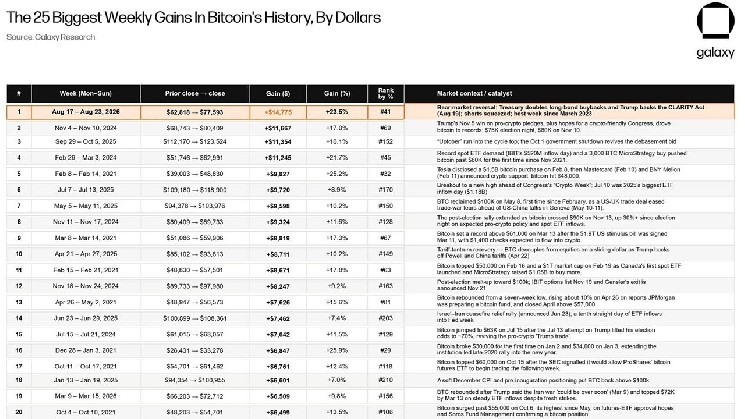
Bitcoin rose from $63,500 a week earlier to around $80,000, briefly touching above $81,000. Inflows into spot Bitcoin ETFs amounted to about $2.8 billion over eight consecutive trading sessions, giving the rally a notable spot-driven component.
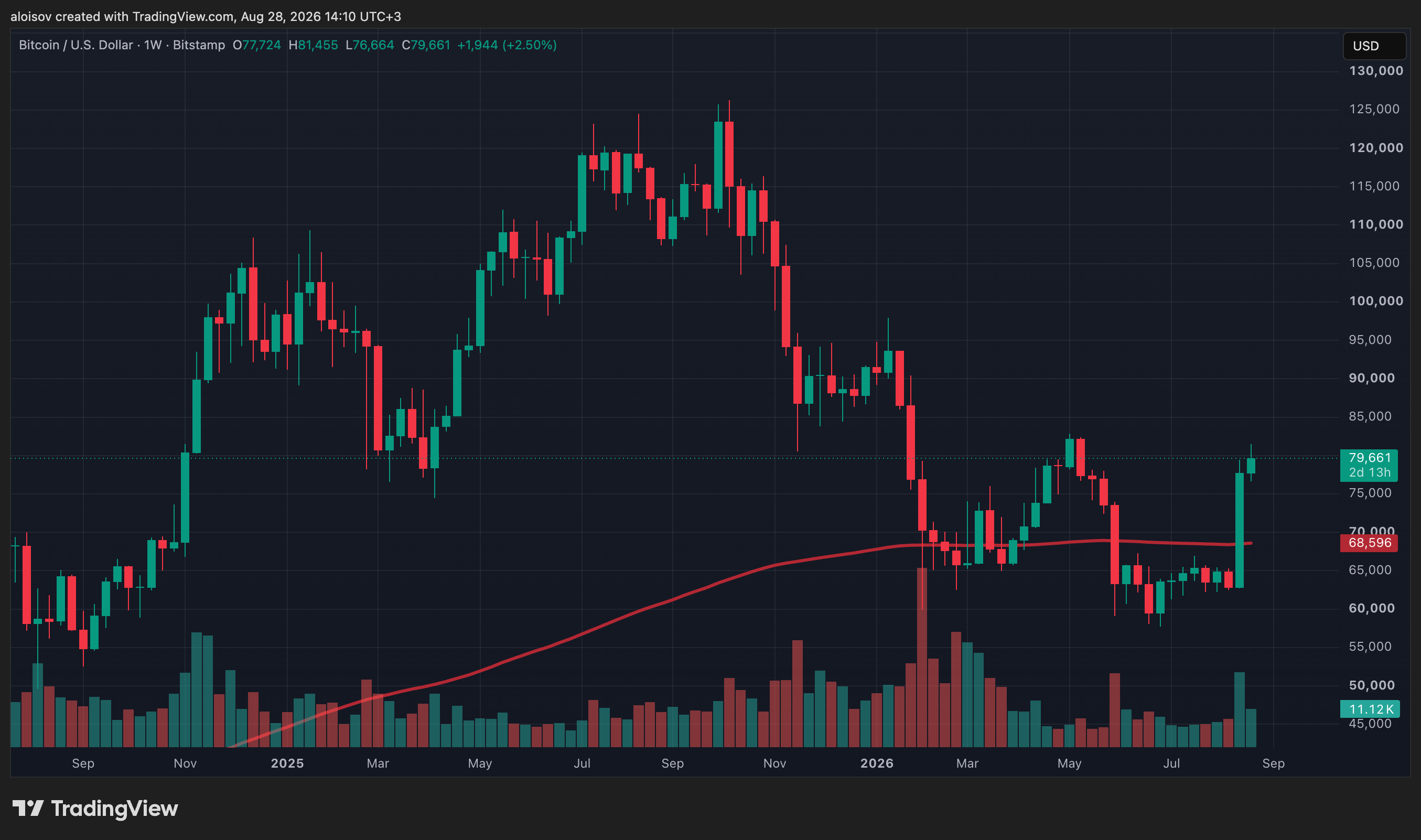
More importantly, leverage was decreasing while the price was rising. Open interest in Bitcoin futures fell from 646,000 $BTC in mid-August to about 588,000 $BTC, and funding rates remained subdued, not reaching levels typically indicative of overheated long positions.
This combination stands out against the overall backdrop. The price surged sharply without a corresponding increase in leverage, indicating short covering and spot demand as the primary drivers of the move, rather than new leveraged positions.
The options market is starting to catch up with spot. Options became more expensive for upside than downside, demand for puts fell below demand for calls, and the market significantly revised its volatility expectations ahead of Jackson Hole. This suggests strengthening demand for price increases in the derivatives market—but so far without the degree of positioning typical of extreme leveraged moves.
Overhang of Supply Over the Market
Bitcoin is approaching the $81,000—$86,000 zone, with the level around $83.3K falling within this broader area of interest. QCP suggests viewing these levels not as predetermined resistance or price targets, but as convenient benchmarks for assessing the structure of the move. If the price continues to rise with subdued funding rates and a gradual recovery in open interest, it would indicate a fundamentally different market structure than when leverage surges sharply alongside the price.
Therefore, the key question is not whether Bitcoin is trading above or below $83.3K, but whether further movement will remain anchored in spot demand or will begin to depend increasingly on leveraged positions.
Ahead of Jackson Hole
Warsh will deliver the opening speech at Jackson Hole today at 5:00 PM Moscow time; this year's symposium theme is 'Financial Innovations: Implications for Payments and Policy.' For markets, the speech comes at an unusual moment: inflation is above target, three members of the Federal Open Market Committee (FOMC) advocated for a rate hike in July, long-term bond yields remain elevated, and the Treasury expanded its liquidity support program for the long end of the U.S. Treasury yield curve.
Therefore, the issue extends far beyond the next 25 basis point step. Investors will assess how Warsh describes the Fed's inflation goal, the role of financial conditions, and the very framework through which the regulator evaluates the dynamics of long-term rates.
AI Opinion
From the perspective of machine data analysis, a rally ahead of a Fed chairman's speech is not a new phenomenon for the crypto market. A year ago, Bitcoin already soared to $117,421 after Jerome Powell at Jackson Hole hinted at a potential rate cut. The pattern repeats: the market reacts more strongly to the regulator's rhetoric than to the final decision, and the symposium has become an annual volatility trigger regardless of the speaker's name.
A technical nuance not mentioned in the article—the Treasury's buyback program on the long end of the curve resembles the Fed's 'Operation Twist' from the early 2010s, when the regulator shifted purchases towards long-term securities to lower yields without expanding its balance sheet. The scale is incomparable, but the logic of impacting the long end of the curve is recognizable. Will this pattern remain a one-time analogy or evolve into a tradition of a 'pre-Jackson Hole rally' by next August?
end-content