Public Chains 2025: The Bustle Belongs to the Casino, the Desolation to the Ecosystem

比推2025-12-18 tarihinde yayınlandı2025-12-18 tarihinde güncellendi

Özet

The 2025 public blockchain landscape reveals a stark divide between hype and reality, with a severe concentration of value and widespread "zombification" of projects. Analysis of DeFiLlama's on-chain fee data exposes a critical structural issue: the crypto space is dominated by a "profit concentration and long-tail zombie" era. Notable examples highlight this crisis. Algorand, a chain with a $1 billion market cap and advanced technology, generated a mere $17 in daily fees, while Cardano, a top-10 asset, saw only around $6,000. These "classic chains" are likened to empty, expensive cities with no real economic activity. The biggest value capturers are not the most technologically elegant chains. Tron leads with $1.24 million in daily fees, succeeding as a low-cost payment rail for USDT transfers—crypto's only true mass-adoption use case. Solana ($600k daily) thrives as a high-frequency casino for meme coins and speculation, and Base ($105k daily) demonstrates that distribution (via Coinbase) is more critical than pure technology. The only validated business models generating significant fees are low-cost payments, high-frequency speculation, and, to a lesser extent, Ethereum's asset settlement layer. The VC-driven model is failing. New chains like Sui, Sei, and Starknet, which raised hundreds of millions, show a severe disconnect between their high valuations and meager daily fee revenue (ranging from $320 to $12,000). Their lifecycle often follows a "pump and dump" pattern...

Author: BlockWeeks Block Weekly

In the cryptocurrency market, if you only look at Market Cap, you see a thriving, flourishing digital utopia. Valuations in the tens of billions, grand technical whitepapers, the halo of Turing Award winners... everything looks like the dawn of the next generation of the internet.

But if you put on a different pair of glasses—glasses that only see "on-chain real revenue (Fees)"—you see a completely different, even spine-chilling picture: in this so-called trillion-dollar market, the vast majority of "unicorns" are actually zombies that stopped breathing long ago.

Recently, BlockWeeks conducted a detailed analysis of the "Fees" data for public chains on DeFiLlama, and we discovered an unavoidable structural problem: crypto public chains have entered an era of "extremely concentrated profits and a collectively zombified long tail."

The core data of this article are sourced from DeFiLlama's "Fees / Revenue by Chain" panel (capture time: December 16, 2025). The "Fees" defined here refer to the total fees paid by users on-chain (top-line), serving as an approximate indicator of the scale of on-chain economic activity, not the protocol's net retained income (Protocol Revenue). This article aims to use this open, unified standard to examine the on-chain value capture ability of various public chains.

I. The $17 Humiliation: The Demise of the Technological Utopia

According to the public data we captured from DeFiLlama, the most alarming figure did not come from the million-dollar giants at the top, but from the $17 at the bottom.

This is the daily protocol revenue for Algorand—a chain once crowned the "blockchain trilemma solver," founded by Turing Award winner Silvio Micali, and boasting top-tier technical credentials.

You read that right, not $170,000, but $17.
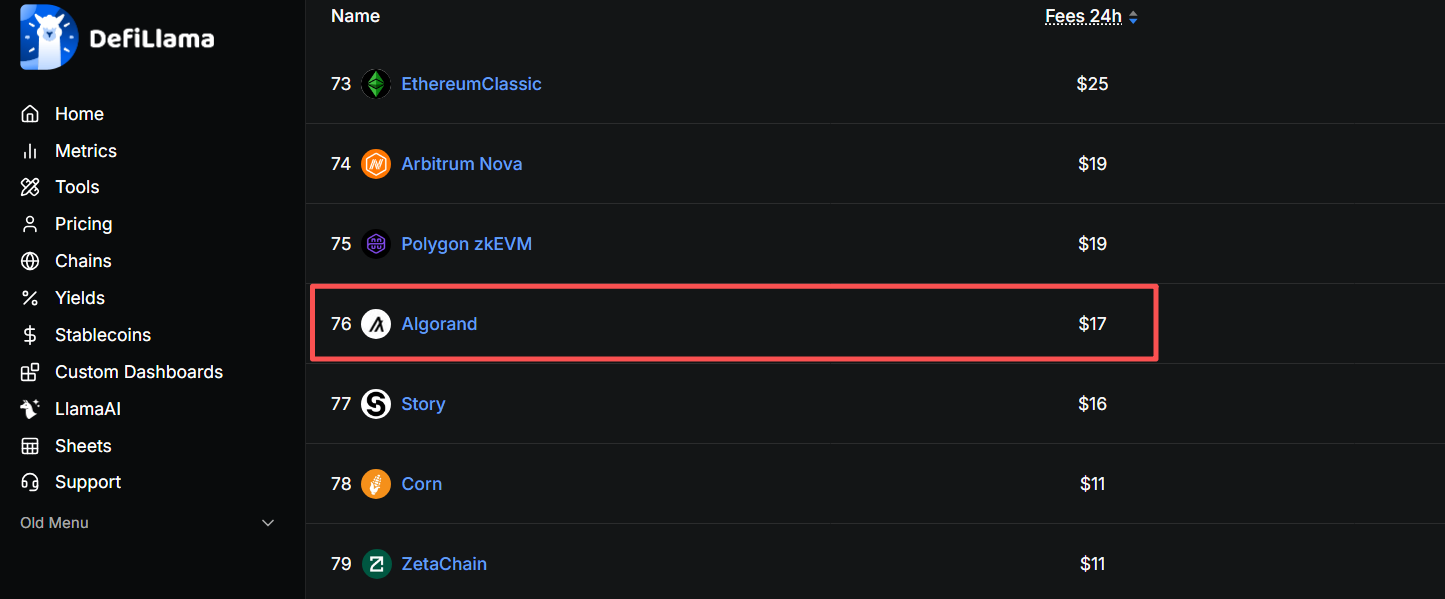
At this very moment, Algorand's market cap remains in the billion-dollar range. A "digital nation" with a billion-dollar market cap generates direct tax revenue from its digital economy that isn't enough to buy four lattes at Starbucks. It shows that despite possessing the most advanced decentralized technology, without real, sustained application demand, its economic value capture ability approaches zero.

This is not just an embarrassment for Algorand; it's the death knell for the entire "classic public chain" camp.

Look at Cardano (ADA), a behemoth consistently in the top 10 by market cap, with millions of token holding addresses. Yet the data tells us its recent average daily on-chain fees hover around $6,000. This means that aside from asset transfers between holders and network maintenance staking, there is a lack of commercial activity on that chain significant enough to generate substantial fees—no large-scale lending, no high-frequency trading, no real, paid value exchange.

These public chains are like luxurious empty cities built at great expense in the middle of a desert. The infrastructure is complete, the roads are wide, the city hall (foundation) is well-funded, but no citizens (active paying users) are seen on the streets. Their method of sustaining operation is often for the city hall to continuously sell off reserves (dumping tokens) to cover operational costs.

II. The Ugly Victory: Who is Actually Capturing Value?

When shifting focus to the top of the list, a fact that makes "technological purists" even more uncomfortable emerges: the ones making the most money are often not the most "elegant" or "decentralized" in terms of technology.

Topping the chart is Tron, with average daily fees as high as $1.24 million. In the eyes of many elitists, Tron might hardly be considered "technical." But the market has given the ultimate answer by voting with its feet: payments are a rigid demand. Tron carries the vast majority of the global on-chain transfer demand for USDT. In this industry full of speculation and bubbles, Tron has inadvertently become the only payment layer application with mass adoption—even if it merely serves as a shadow banking channel for fiat currencies.

One could say: payments, the oldest and most basic internet need, are currently the only mass adoption in the Crypto world. Tron's success is a powerful mockery of all project teams that pursue "perfect technology" while ignoring "real demand."

Close behind is Solana, with nearly $600,000 in average daily fees. Its success logic is even more straightforward: it is the world's most active on-chain casino. Meme coins, high-frequency DEX trading, front-running—these activities contribute the vast majority of the fees. Solana's moat is no longer TPS, but "attention traffic." The rise of Base is even more disruptive (approx. $105k daily): it proves that distribution channels are far more important than the technology itself. Backed by Coinbase's huge user base, Base delivers a dimensional打击 to other L2s.
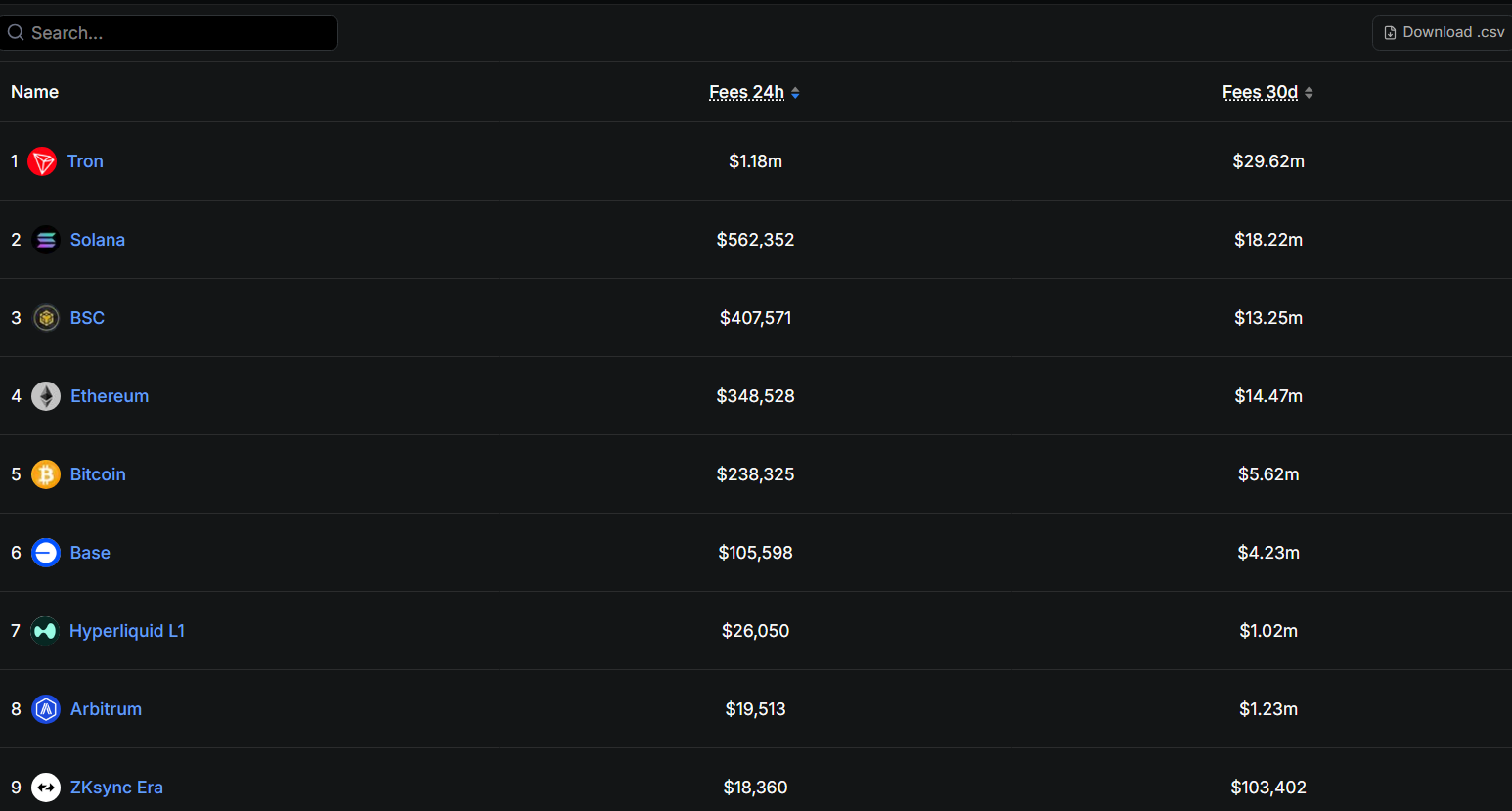
This provides a brutal yet clear revelation: the current Crypto market has only two and a half business models that are verified and can generate large-scale on-chain fees—low-cost payments (Tron), high-frequency speculation (Solana/Base), and the asset settlement layer (Ethereum), which is being constantly eroded by L2s.

Beyond these, those once highly anticipated "enterprise-level applications," "supply chain traceability," and "Web3 social" have, in the face of cold on-chain fee data, at least at this stage, not yet demonstrated规模化付费 demand.

III. The VC Syndicate Dilemma: Why "Peak at Launch"?

This data also reveals another deep crisis: the narrative model for new L1/L2s driven by massive venture capital (VC) financing is facing a brutal reality check regarding monetization.

We see that new public chains like Sui (~$12k daily), Sei (~$320 daily), Starknet (~$10k daily), which launched with great fanfare and raised hundreds of millions or even billions of dollars, have severely inverted链上手续费收入 compared to their fully diluted valuations (FDV) of tens or hundreds of billions.

The standard playbook of the past few years has been: VC investment -> team piles on technical highlights -> attract airdrop farmers to刷取数据 -> token lists on exchanges creating wealth -> retail investors buy into the narrative -> airdrop farmers撤离 -> on-chain activity data plummets.

This is why many new chains have astonishing TPS and hundreds of thousands of daily active users at launch, only to quickly become "ghost towns" months later. Because those users are mercenaries, not residents. When airdrop expectations are realized, when incentive subsidies stop, the real, organic demand is exposed for what it is—daily fee revenues of a few thousand or tens of thousands of dollars simply cannot support billion-dollar valuation dreams.

We are facing severe "block space inflation." The industry has built too many chains, too many L2s, too many data availability (DA) layers, but innovation at the application layer is extremely scarce. This is like狂热ly laying成千上万条光纤 in the early days of broadband internet普及, before Netflix, YouTube, or any killer app that must use this bandwidth has been born.

IV. Investor Awakening: From "Listening to Stories" to "Checking the Books"

For a long time, the valuation logic of the crypto market was built on "dream multiples." The grander the narrative, the richer the imagination, the higher the market cap could fly.

But 2024-2025 is becoming a watershed. As macro liquidity tightens and institutional investors demand more substantial returns, the market is being forced to return to rationality.

For investors, the logic must change:

  1. Beware of "Zombie Coins": If a project has a market cap of billions but daily on-chain fees of only a few hundred or thousand dollars, this extreme "unworthiness" is often the starting point for a long-term decline. Its only support—community faith—will eventually run out.

  2. Focus on "Positive Cash Flow" Ability: Look for ecosystems where users are willing to持续付费 for services even without token incentives. Tron's stablecoin transfer fees, Base and Solana's transaction fees are direct reflections of real demand.

  3. Acknowledge "Channels and Ecosystems are King": Base's success proves that pure technical advantages can hardly be a moat anymore. Giants entering with massive user bases (like Coinbase), or native communities that can breed狂热 cultures, are more valuable assets at the current stage. Purely technical public chains, if they cannot solve the "who will use it and why" problem, will ultimately become Algorand-style academic exhibits.

  4. See Through the VC Game: Stop paying for虚假繁荣 driven by subsidies and airdrops.

Faced with the harsh reality of $17 daily revenue, rather than paying for grand narratives and empty "digital ghost cities," it's better to tighten your purse strings and turn to the few ecosystems that can generate real cash flow and have active paying users.

This is not a denial of the long-term value of all technological exploration, but a necessary清算 of the current畸形的 valuation system. Only when the market learns to pay for "value actually generated," rather than透支 for "stories promised in the future," can this industry usher in a truly healthy dawn.

Important Notes and Evaluation Framework

The core of this article is to use "on-chain fees" as a unified, public ruler to measure the "immediate value capture ability" of various public chains. When reading and citing the conclusions of this article, please be sure to understand the following key background and limitations:

1. General Background Notes

  • Development Stage Differences: Some public chains may be technologically advanced but in their early stages, with a user base not yet formed for scale effects. The data in this article reflects the "current state," not the "ultimate potential."

  • Impact of Fee Models: Some public chains are designed to pursue ultra-low transaction fees (Gas Fee), and their native token prices are low. This means that even if the number of on-chain transactions is considerable, the "total fee revenue" denominated in USD appears tiny. This suggests that evaluating such chains should combine metrics like transaction count and active address number for a comprehensive judgment, but the upper limit of their USD-denominated economic throughput remains an objective fact.

2. Evaluation Notes for Specific Types of Chains

For a fairer discussion, we provide the following evaluation ideas for specific types of projects:

Chain Type This Article's Evaluation & Suggestion
Storage/Service Networks

(e.g., Filecoin, Arweave)

There is indeed a difference in口径. The core value of these networks lies in storage/retrieval services, and their revenue model differs from单纯 transaction fees. DeFiLlama's "Fees" metric may severely underestimate their actual commercial activity. If you are an investor, you should be on their storage market capacity, active交易订单, and real storage revenue streams.
Off-Chain/Consortium Business-Driven Public Chains

(e.g., some enterprise chains)

Data has limitations. DeFiLlama only statistics public on-chain activity, a point BlockWeeks fully agrees with. But we同样疑惑, if the main value of a public chain is not reflected on-chain, then what supports the market cap of its publicly issued tokens used for on-chain governance and security?
Technical Low-Fee/High-TPS Public Chains The design初衷 is good. However, extremely low per-transaction fees mean the value captured by the chain itself and validators is extremely low. The success of this model must rely on extremely high transaction volume to compensate for the low price disadvantage. If low fees fail to attract massive transactions, its economic model may face challenges.
Chains with Ecosystem Traffic Concentrated on CEXs Hard to evaluate. If a public chain's on-chain economic activity is weak and cannot generate sufficient fees, then its practical value and value capture ability as a "decentralized settlement layer" or "smart contract platform" are low. Its value may be closer to a单纯的 "digital collectible."

We始终 believe that in a world of highly concentrated profits, projects in the long tail are almost sentenced to fate unless they find unique application scenarios (like gaming or specific AppChains). Only platforms that can generate cash flow through real, sustained user demand have the potential to survive long-term and outperform the market.


Twitter:https://twitter.com/BitpushNewsCN

Bitpush TG Discussion Group:https://t.me/BitPushCommunity

Bitpush TG Subscription: https://t.me/bitpush

Original Link:https://www.bitpush.news/articles/7596644

Trend Kriptolar

İlgili Sorular

QWhat is the core metric used in the article to evaluate the health and value capture of public blockchains?

AThe article uses on-chain fees (total fees paid by users) as the core metric, sourced from DeFiLlama's 'Fees / Revenue by Chain' dashboard, to measure the scale of economic activity and value capture.

QAccording to the article, which blockchain has the highest daily on-chain fees, and what is the primary use case driving this activity?

ATron (TRX) has the highest daily on-chain fees at $1.24 million, driven primarily by its role as a low-cost payment layer for USDT stablecoin transfers, serving as a 'shadow banking channel'.

QWhat does the example of Algorand's $17 daily fee revenue illustrate about the current state of many 'classic' public blockchains?

AAlgorand's $17 daily fee revenue, despite its multi-billion dollar valuation and advanced technology, illustrates that many 'classic' public blockchains have become 'zombies'—they lack real, sustained application demand and their economic value capture is nearly zero, making them like 'luxury empty cities in the desert'.

QWhat are the two and a half business models that the article states have been validated to generate large-scale on-chain fees?

AThe two and a half validated business models are: 1. Low-cost payments (exemplified by Tron), 2. High-frequency speculation/gambling (exemplified by Solana and Base), and the half being the asset settlement layer (exemplified by Ethereum, which is being constantly eroded by L2s).

QWhat major shift in investor logic does the article suggest is happening in the 2024-2025 market?

AThe article suggests a shift from valuing projects based on grand narratives and 'dream ratios' to a more rational approach that focuses on 'checking the books'—prioritizing real cash flow-generating ability, active paying users, and avoiding 'zombie coins' with massive valuations but minuscule on-chain revenue.

İlgili Okumalar

After Three Consecutive Quarters of Decline, Can the Crypto Market Find a Window for Stabilization in Q3?

The cryptocurrency market has just concluded its worst-performing quarter since 2022, with total capitalization dropping 12.6% to $2.1 trillion. All core metrics indicate capital is leaving the sector, not just rotating within it. Bitcoin fell 14.2% and Ethereum dropped 25.4% in Q2, breaking their previous correlation with US tech stocks. A key driver is the reversal in US spot Bitcoin ETF flows, which saw a net outflow of approximately $4.67 billion in Q2, including a record monthly outflow near $4.5 billion in June. While recent data suggests long-term holders are accumulating again, sustained ETF outflows mean continued selling pressure. Market focus is now singularly on the Federal Reserve. The upcoming July FOMC meeting is seen as the most critical event for Q3. A dovish signal could support Bitcoin reclaiming a $68,000-$84,000 range, while a hawkish stance might establish a new trading band around $50,000-$56,000. Additionally, regulatory uncertainty persists, with the progress of the crucial *CLARITY Act* stalling in the Senate, reducing its perceived 2026 passage probability to 40-45%. Despite the broad downturn, a few sectors showed growth. Prediction markets saw nominal volume surge 48.7% year-over-year to $113.8 billion, and tokenized collectibles transaction volume rose 143% quarterly to $1.4 billion. The Real-World Asset (RWA) tokenization sector also continued steady growth, now representing ~$28.1 billion in on-chain value. The market's foundation for an extreme crash appears limited, with Bitcoin price hovering near its 200-week moving average. However, the trading paradigm has shifted from narrative-driven speculation to decisions based on price action, policy developments, and interest rate expectations, making a broad sentiment-driven rally unlikely in the near term.

marsbit2 saat önce

After Three Consecutive Quarters of Decline, Can the Crypto Market Find a Window for Stabilization in Q3?

marsbit2 saat önce

BIT Trading Moment: BTC Still Suppressed by Weekly 200 EMA, Rejection May Restart Decline; Storage and Semiconductors that Surged Last Night Begin Falling in Evening Trading

**Crypto & Stock Market Wrap: Bitcoin Tests Resistance, Stocks Retreat After AI Surge** Bitcoin consolidates around $66,000, facing key resistance near $68,000—an area seen as a major psychological and technical hurdle where previous rallies have failed. Analysts note the cryptocurrency is caught between its 200-week moving average (~$63,333) and 200-week EMA (~$68,328). A clear break above $68k is needed to signal a stronger bullish trend, while a rejection could lead to a retest of $63k support. Market sentiment remains cautious, with low futures open interest pointing to a low-liquidity rebound rather than a full bull market. Bitcoin spot ETFs saw another $203 million inflow. US stock futures pointed lower after a strong Tuesday session led by a massive rebound in semiconductors and memory stocks. The rally was fueled by renewed optimism about AI-driven hardware demand, with Micron, SanDisk, and SK Hynix surging. However, those gains reversed in pre-market trading. Super Micro Computer (SMCI) soared over 20% after hours on strong guidance and a record backlog. Other standouts included Rocket Lab and nuclear energy plays Oklo and X-Energy. Rising oil prices (Brent above $91) and climbing Treasury yields (10-year near 4.64%), however, are reigniting inflation concerns and acting as a headwind for equities. In Asia, markets were mixed. South Korea's KOSPI pared early gains to close slightly higher as semiconductor stocks like SK Hynix gave back initial surges. Japan's Nikkei edged lower as the yen hit a fresh 38-year low against the dollar, raising fears of potential market intervention. Key events to watch include the Samsung Galaxy launch, AMD's AI event, and a slew of major tech earnings from Alphabet, Tesla, and IBM after the close on Wednesday, followed by the ECB meeting and Intel's earnings on Thursday.

marsbit2 saat önce

BIT Trading Moment: BTC Still Suppressed by Weekly 200 EMA, Rejection May Restart Decline; Storage and Semiconductors that Surged Last Night Begin Falling in Evening Trading

marsbit2 saat önce

Former CFTC Chairman, Circle President Tarbert: Preaching Long-Termism While Cashing Out $30 Million Himself

Former CFTC Chairman and Circle President Heath Tarbert has consistently advocated for a long-term vision in public, urging patience from investors as Circle’s stock price has fallen significantly from its peak. However, it has been revealed that since Circle’s IPO, Tarbert has continuously sold his CRCL shares through pre-arranged trading plans, cashing out approximately $30 million, without making any public market purchases. This contrast between his public messaging and personal actions has drawn criticism. Tarbert joined Circle in July 2023 as Chief Legal Officer, leveraging his regulatory experience to help guide the company through its IPO and expansion. Despite promoting stablecoins as long-term infrastructure, he established a 10b5-1 trading plan just before Circle went public, leading to substantial stock sales over the following year. In March 2026, he initiated another plan to sell more shares. His career trajectory highlights a pattern of moving between high-level regulatory roles and influential positions in the financial sector. After resigning as CFTC Chairman in early 2021, he joined Citadel Securities as Chief Legal Officer just 27 days later, during a period of intense regulatory scrutiny for the firm. He later joined Circle, aiding its efforts to navigate regulatory challenges for its public listing. While Tarbert's expertise in policy and compliance is valuable to companies like Circle, his actions—advocating long-term confidence while personally divesting—raise questions about the alignment between his public statements and his private financial decisions, leaving investors who followed his advice to bear the market risks.

marsbit2 saat önce

Former CFTC Chairman, Circle President Tarbert: Preaching Long-Termism While Cashing Out $30 Million Himself

marsbit2 saat önce

Gate Research Institute: The 'Wall Street-ization' Wave of Crypto Financial Products – Competition or Integration?

The article titled "Gate Research Institute: Are Crypto Financial Products Sparking a 'Wall Street' Wave—Competition or Convergence?" explores the evolving relationship between the crypto ecosystem and traditional finance (TradFi). The piece begins by reflecting on Bitcoin's original 2009 vision of decentralization, disintermediation, and moving away from banks. It then contrasts this with the 2024 landscape, where key crypto assets like Bitcoin are increasingly held through Wall Street products like ETFs issued by giants like BlackRock. The article questions whether this signifies that TradFi is systematically taking over the rights to issue, price, custody, and distribute crypto financial assets. The core argument is that this is not a zero-sum takeover but rather a bidirectional convergence where each side addresses the other's weaknesses. Crypto offers 24/7 global markets, programmable settlement, and open access but lacks compliant channels, institutional-grade custody, deep fiat liquidity, and mainstream distribution. TradFi possesses these but is constrained by legacy systems, limited operating hours, and slow settlement. Two primary convergence paths are highlighted: * **Path A (CEX to TradFi):** Exemplified by Gate, which has progressed from offering tokenized stocks and CFDs to providing direct, real stock trading (US, Hong Kong, South Korea) within its platform, using USDT. * **Path B (TradFi to Crypto):** Exemplified by Robinhood, which has integrated crypto trading, acquired exchanges like Bitstamp, and is moving traditional assets like stocks onto the blockchain via tokenization and its own Layer 2. Both paths are ultimately competing to become the next-generation, unified financial account—a "super account" where users can seamlessly trade cryptocurrencies, stocks, ETFs, RWA (Real World Assets), and tokenized treasury products in one interface. The growth of RWA and tokenized treasuries (e.g., BlackRock's BUIDL) is presented as the asset-layer fusion, providing stable, yield-bearing assets on-chain and acting as a bridge between the two worlds. In conclusion, the "Wall Street-ization" of crypto is framed as a mutual transformation. Decentralized ideals persist in the protocol layer, while at the application layer, a more efficient, global, and accessible unified capital market is emerging from this convergence. The future competition lies not between crypto exchanges and stockbrokers, but between platforms vying to offer the most comprehensive asset coverage, liquidity, and user experience within a single account.

marsbit2 saat önce

Gate Research Institute: The 'Wall Street-ization' Wave of Crypto Financial Products – Competition or Integration?

marsbit2 saat önce

İşlemler

Spot

Popüler Makaleler

O Nasıl Satın Alınır

HTX.com’a hoş geldiniz! O1 exchange (O) satın alma işlemlerini basit ve kullanışlı bir hâle getirdik. Adım adım açıkladığımız rehberimizi takip ederek kripto yolculuğunuza başlayın. 1. Adım: HTX Hesabınızı OluşturunHTX'te ücretsiz bir hesap açmak için e-posta adresinizi veya telefon numaranızı kullanın. Sorunsuzca kaydolun ve tüm özelliklerin kilidini açın. Hesabımı Aç2. Adım: Kripto Satın Al Bölümüne Gidin ve Ödeme Yönteminizi SeçinKredi/Banka Kartı: Visa veya Mastercard'ınızı kullanarak anında O1 exchange (O) satın alın.Bakiye: Sorunsuz bir şekilde işlem yapmak için HTX hesap bakiyenizdeki fonları kullanın.Üçüncü Taraflar: Kullanımı kolaylaştırmak için Google Pay ve Apple Pay gibi popüler ödeme yöntemlerini ekledik.P2P: HTX'teki diğer kullanıcılarla doğrudan işlem yapın.Borsa Dışı (OTC): Yatırımcılar için kişiye özel hizmetler ve rekabetçi döviz kurları sunuyoruz.3. Adım: O1 exchange (O) Varlıklarınızı SaklayınO1 exchange (O) satın aldıktan sonra HTX hesabınızda saklayın. Alternatif olarak, blok zinciri transferi yoluyla başka bir yere gönderebilir veya diğer kripto para birimlerini takas etmek için kullanabilirsiniz.4. Adım: O1 exchange (O) Varlıklarınızla İşlem YapınHTX'in spot piyasasında O1 exchange (O) ile kolayca işlemler yapın.Hesabınıza erişin, işlem çiftinizi seçin, işlemlerinizi gerçekleştirin ve gerçek zamanlı olarak izleyin. Hem yeni başlayanlar hem de deneyimli yatırımcılar için kullanıcı dostu bir deneyim sunuyoruz.

177 Toplam GörüntülenmeYayınlanma 2026.06.19Güncellenme 2026.06.29

O Nasıl Satın Alınır

PROS Nasıl Satın Alınır

HTX.com’a hoş geldiniz! Pharos (PROS) satın alma işlemlerini basit ve kullanışlı bir hâle getirdik. Adım adım açıkladığımız rehberimizi takip ederek kripto yolculuğunuza başlayın. 1. Adım: HTX Hesabınızı OluşturunHTX'te ücretsiz bir hesap açmak için e-posta adresinizi veya telefon numaranızı kullanın. Sorunsuzca kaydolun ve tüm özelliklerin kilidini açın. Hesabımı Aç2. Adım: Kripto Satın Al Bölümüne Gidin ve Ödeme Yönteminizi SeçinKredi/Banka Kartı: Visa veya Mastercard'ınızı kullanarak anında Pharos (PROS) satın alın.Bakiye: Sorunsuz bir şekilde işlem yapmak için HTX hesap bakiyenizdeki fonları kullanın.Üçüncü Taraflar: Kullanımı kolaylaştırmak için Google Pay ve Apple Pay gibi popüler ödeme yöntemlerini ekledik.P2P: HTX'teki diğer kullanıcılarla doğrudan işlem yapın.Borsa Dışı (OTC): Yatırımcılar için kişiye özel hizmetler ve rekabetçi döviz kurları sunuyoruz.3. Adım: Pharos (PROS) Varlıklarınızı SaklayınPharos (PROS) satın aldıktan sonra HTX hesabınızda saklayın. Alternatif olarak, blok zinciri transferi yoluyla başka bir yere gönderebilir veya diğer kripto para birimlerini takas etmek için kullanabilirsiniz.4. Adım: Pharos (PROS) Varlıklarınızla İşlem YapınHTX'in spot piyasasında Pharos (PROS) ile kolayca işlemler yapın.Hesabınıza erişin, işlem çiftinizi seçin, işlemlerinizi gerçekleştirin ve gerçek zamanlı olarak izleyin. Hem yeni başlayanlar hem de deneyimli yatırımcılar için kullanıcı dostu bir deneyim sunuyoruz.

182 Toplam GörüntülenmeYayınlanma 2026.06.22Güncellenme 2026.06.29

PROS Nasıl Satın Alınır

VERONA Nedir

I. Proje Tanıtımı VERONA, zincir soyutlaması aracılığıyla herkes için, her yerde inşa edilmiş bir blok zinciridir. Genel Soyutlama katmanını kullanarak, VERONA, hesaplar, imzalar ve birlikte çalışabilirlik gibi karmaşık blok zinciri işlevlerini doğrudan protokol seviyesinde entegre ederek kendini ayırt eder. Bu yaklaşım, temel teknolojileri anlamaya gerek kalmadan blok zinciri uygulamalarıyla etkileşimde bulunmayı sağlar.1) Temel Bilgiler İsim: VERONA (VERONA)III. İlgili Bağlantılar Resmi web sitesi bağlantısı: https://xion.burnt.com/ Whitepaper: https://xion.burnt.com/whitepaper.pdf Keşif Araçları: https://explorer.burnt.com/ Sosyal Medya: https://x.com/burnt_xion Not: Proje tanıtımı, resmi proje ekibi tarafından yayımlanan veya sağlanan materyallerden alınmıştır, yalnızca referans içindir ve yatırım tavsiyesi teşkil etmez. HTX, ortaya çıkan doğrudan veya dolaylı kayıplardan sorumluluk kabul etmez.

174 Toplam GörüntülenmeYayınlanma 2026.06.22Güncellenme 2026.06.22

VERONA Nedir

Tartışmalar

HTX Topluluğuna hoş geldiniz. Burada, en son platform gelişmeleri hakkında bilgi sahibi olabilir ve profesyonel piyasa görüşlerine erişebilirsiniz. Kullanıcıların A (A) fiyatı hakkındaki görüşleri aşağıda sunulmaktadır.

活动图片














