Private Equity's "Detroit: Become Human" Moment: When AI Takes Over Alpha, What's Left for Human Fund Managers?

marsbit2026-03-18 tarihinde yayınlandı2026-03-18 tarihinde güncellendi

Özet

A recent report by Anthropic highlights that 94% of financial roles are susceptible to AI replacement, though only 28% have been automated so far. The private fund industry is rapidly adopting AI to enhance efficiency and reduce costs, especially in research, operations, and sales. AI researchers, such as tools like OpenClaw, offer advantages over human analysts: they work 24/7, require no salary or benefits, and avoid human limitations like bias or job-hopping. Quantitative funds, with strong computational infrastructure, are already deploying multi-agent systems that minimize human involvement. In contrast, subjective fund managers face pressure to adopt AI to stay competitive, as散户 investors also use AI to narrow information gaps. However, AI has limitations: it cannot fully grasp market sentiment, human irrationality, or emotional nuances in investing. If AI eventually replaces most fund managers and researchers, markets may become efficient, eliminating alpha opportunities. The future role of humans in asset management may lie in intuition, passion for investing, and handling uncertainty—areas where AI falls short. The industry must determine how humans and AI can collaborate effectively, rather than merely reacting to technological change.

Author: Yuanchuan Investment Review

A recent unemployment report from Anthropic sent chills down the spines of financial professionals.

The report indicated that the substitution rate for financial positions is as high as 94%, ranking second among all professions, but the current actual substitution rate is only 28%, leaving immense room for growth in the future. Fortunately, 30% of professions are almost unaffected, so financial professionals can still consider reemployment opportunities such as dishwashers and plumbers.
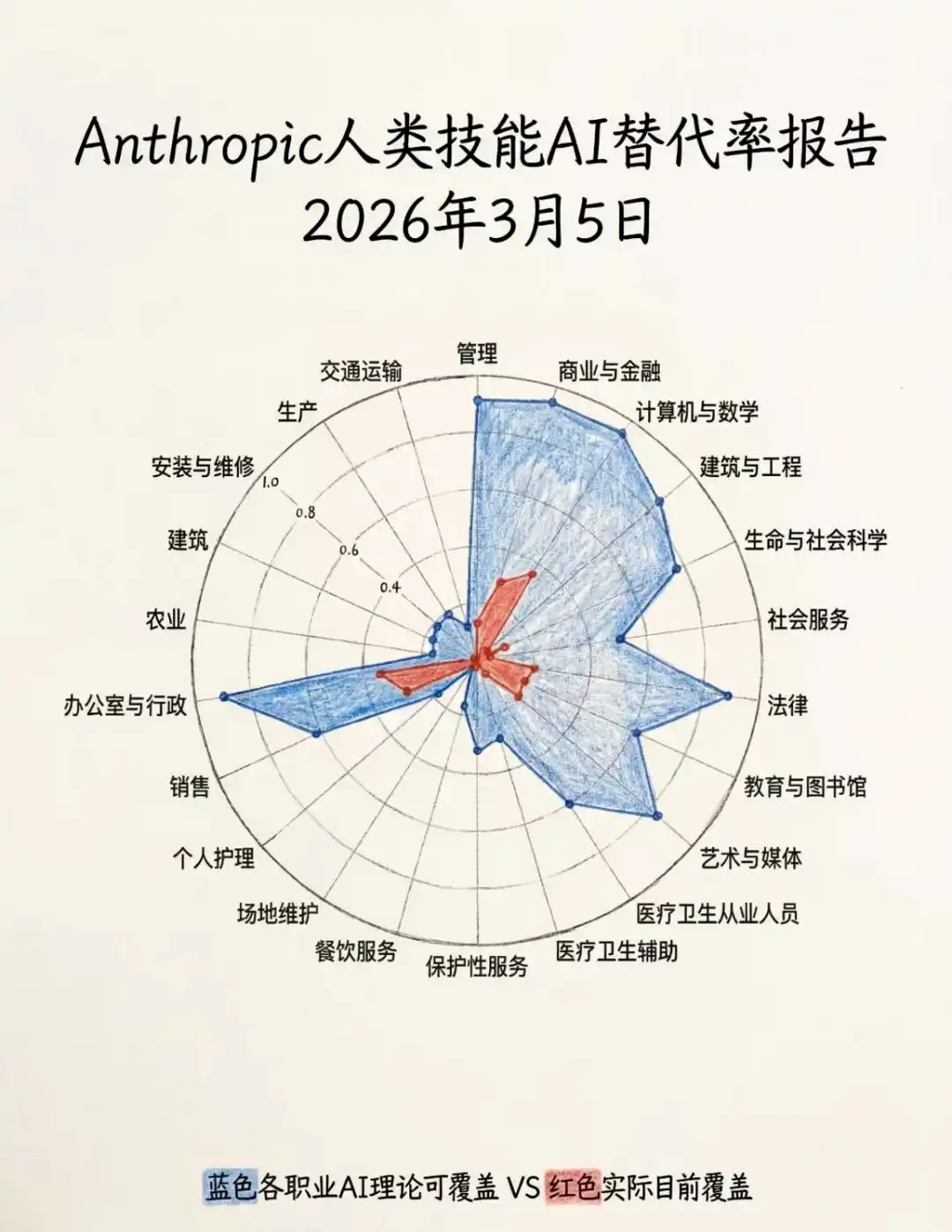
After being in the industry for a long time, one always feels anxious—financial professionals live in a world of "comparison," with daily pressure from sales evaluations and performance rankings. Not learning creates a sense of unease.

For example, after the Spring Festival holiday, while some financial registrars were still engaging in Q&A with chatbots upon returning to their desks, their colleagues at the next desk were already raising eight lobsters, passionately arguing about the rise and fall of crude oil.

The financial industry never rejects efficiency, from manual order reporting to programmatic trading, from offline bank sales to internet-based distribution. But this time, AI is not replacing inefficient financial tools but the people behind them who are inefficient. After all, the highest cost in the financial industry is people. Behind the profits of asset management companies lies the comparison of how to manage more money with fewer people.

Thus, private equity firms have begun embracing advanced productivity: Diewei Asset Management offers online courses on how to tame "digital researchers" that work autonomously 24/7; Mingxi Capital uses Manus to automatically generate promotional materials for dividend index enhancement, with layouts rivaling the sophistication of the magazine era. Even clients have become more cautious—while wealth managers are promoting popular private equity funds, they themselves turn to Douban to ask whether they should buy them.

The private equity industry is gradually entering its "Detroit: Become Human" moment, with substitution already taking place at every step of the mature chain: investment research, operations, and sales.

Salaries vs. Token Costs

In a competitive environment where operational costs remain high and Alpha is increasingly difficult to obtain, human efficiency is a metric that private equity bosses rack their brains to optimize every night before bed.

In the private equity industry chain, researchers' salaries are generally not low. According to Mulifang data, quantitative equity researchers typically earn an annual salary of 800,000 to 1.5 million yuan, while subjective researchers earn slightly less. However, there are occasionally astonishing incentives—earlier this year, a subjective researcher at a billion-yuan fund received a year-end bonus of over 20 million yuan for recommending Nvidia.

If private equity firms can successfully rely on AI for investment, they can save tens of millions in costs. If AI works 24/7, it reduces the hourly wage while increasing output. Expenses like travel, overtime, transportation, and meal allowances, which would otherwise be deducted from the boss's Carried Interest, are not required by AI.

In the asset management field, all technological advancements essentially boil down to two words: improve efficiency and reduce costs. Private equity bosses don’t care whether AI can truly think like a human; they only care whether the work gets done.

Howard Marks calculated the economic account: if AI can produce the analytical results of a research assistant with an annual salary of $200,000, it doesn’t matter to the payer whether it is truly thinking or merely pattern matching. The key is whether the work output is reliable enough to be useful.

After the Spring Festival, eight securities firms’ quantitative teams collectively released "lobster-raising" tutorials, accelerating the process of replacing human researchers. They tested OpenClaw, which can actively produce research results like a human.

On the Jinmen APP, a roadshow titled "OpenClaw: From Beginner to Master" by Kaiyuan Quantitative was played 4,839 times; Northeast’s Xu Jianhua promoted 20 skills that can skyrocket investment research efficiency tenfold; Fangzheng’s Cao Chunxiao used lobsters to replicate the PB-ROE strategy, the cup-with-handle stock selection strategy, and fully automated factor mining and backtesting.

Upon closer thought, this is equivalent to simultaneously OTA-updating the skill sets of Buffett, O’Neil, and Simons.

The studious trader

While sell-side firms are vigorously promoting, buy-side firms are learning actively. A Beijing-based private equity firm, fearing contamination of its main systems, issued new computers to each researcher and provided a 50,000-yuan token subsidy specifically for raising lobsters [1].

Yang Xinbin of Snowball Asset Management trained two lobster researchers, stating that he now has more conversations with AI than with humans. The AI Agent he independently trained can accomplish in two days what a mature quantitative researcher might take half a year to do, with even greater potential.

Paul Wu of Qinyuan Investment has gradually integrated AI into various departments, finding that AI can complete closed-loop tasks in some roles and operate independently with iterations. He foresees that in the near future, company expenses will shift to purchasing and maintaining an Apple analyst agent, and later perhaps an investment portfolio advisor named Paul.

In the past, many private equity firms suffered from wear and tear in research conversion—researchers felt fund managers were incompetent, while fund managers felt researchers were useless. The emergence of OpenClaw has given private equity bosses a glimpse of a new possibility: they no longer have to endure the internal friction of磨合 with mediocre researchers or worry about core researchers being poached by competitors with high salaries.

In terms of characteristics, lobsters meet all the ideal expectations fund managers have for researchers: they work around the clock without breaks or slacking; they have long-term memory沉淀, recalling key data effortlessly; they are absolutely loyal and obedient, never leaving to start their own firms with core strategies; they continuously self-iterate, unlike old-school researchers who become stuck in their ways and are淘汰 by the times.

If the cost of silicon-based tokens is far lower than carbon-based salaries in the future, how can private equity bosses resist an AI researcher that is obedient, useful, and trainable?

Substitution Isn’t Just Because of Lobsters

While subjective private equity is still weighing whether token costs are cost-effective, quantitative firms, with their self-built computing infrastructure, have already compressed token costs to extremely low levels. However, they remain unusually calm in the face of this热潮.

"OpenClaw is nothing more than a semi-finished product, like a toy, in the quantitative technology circle," a senior quantitative professional from Shanghai told me. Its significance lies in lowering the technical threshold for subjective institutions and retail investors, providing a clear cost recovery path for the massive upfront infrastructure investments of large model companies. But it holds little significance for严肃的生产 environments like quantitative investment.

Another top quantitative professional was more blunt, calling the lobster phenomenon in the financial circle akin to a pyramid scheme. OpenClaw has characteristics like randomness, non-systematicity, and low security, which could introduce significant uncertainty into the entire quantitative system.

Cui Yuchun of Xuntu Technology believes there is no need for anxiety, as OpenClaw is not advanced productivity in the quantitative circle:

Lobsters are even significantly weaker than Agents like Manus and Kimi in terms of Agent optimization and tool invocation (involving investment research browsers, writing, data analysis tools, etc.). For a researcher without a programming background, it takes 5-10 hours to deploy and launch, and most tasks cannot achieve results above 60 points.

While retail investors using the China Stock Analysis Skill via lobsters for stock selection feel like they’ve opened a door to a new world, quantitative firms have already built Multi-Agent platforms. With a richer arsenal of Agents, they碾压 lobsters. However, the operation of this powerful system may not require more humans.

Traditional quantitative investment research systems typically adopt a pipeline architecture: data cleaning → factor calculation → model prediction → portfolio optimization. In the AI era, some institutions have begun simplifying this to role分工 → tool invocation → workflow design, akin to top overseas quantitative firms like Man Group. Standardized, repetitive tasks are gradually being taken over by AI Agents, eliminating the need for so many researchers to be异化 in factor sweatshops.

For example, Xiyue Investment’s Apollo AI multi-agent system embeds AI Agents into various links such as investment research, data, trading, and operations. Founder Zhou Xin形容 it as having seven or eight hundred additional AI employees.

With quantitative firms' sci-fi-like "unmanned factory"碾压 from the front and retail investors reducing information asymmetry with OpenClaw from the rear, subjective fund managers in the middle efficiency zone are in an awkward position—watching the information painstakingly produced by their researchers, being降维打击 by quant above and步步紧逼 by retail below, inevitably falling into the着急 of AI FOMO (Fear Of Missing Out).

During the Spring Festival, I read the annual report of a top subjective manager in Shenzhen, who lamented that fund managers have excessively high expectations of researchers:

Fund managers hope researchers can remain sensitive to the market, promptly identify opportunities, provide leading research and judgments ahead of peers, and even stay within the "core circle" at all times. If a researcher can achieve this, why would they need a fund manager? They could simply trade stocks on their own to make a fortune. Why would they serve a fund manager?

Thus, he lowered his expectations—researchers are only responsible for researching specific targets and issues. They neither need to discover opportunities nor provide investment recommendations; these are the fund manager’s responsibilities.

Conversely, if what a subjective fund manager needs is merely someone who doesn’t penetrate the core of the industry front lines and only tracks targets through desk analysis, isn’t such a researcher the next to be replaced by an AI Agent?

Epilogue

Being in the A-share market these past two years feels like being put on fast-forward.

Especially in the first half of the year, there have been many events. Last Spring Festival, Deepseek was released; during the Qingming holiday, there was talk of violent tax increases; and this Spring Festival, everyone was raising lobsters. Before the first month was even over, war broke out in the Middle East. The brains of financial professionals have been in a state of overload, and it’s hard to remember when the last holiday without studying was. At least as a small editor, my brain’s computing power is already insufficient.

I recall that two years ago, when communicating with fund managers for articles, I often heard them happily describe their work state with an awkward sentence—"I tap dance to work every day." But in recent exchanges, they discuss the "iteration" organized by their teams, the "iteration" of investment philosophies, and the "iteration" of industry认知 without smiles.

AI is developing so fast, peers are improving so quickly—it seems that only through iteration can one avoid being淘汰.

The industry is still too anxious.

AI doesn’t understand human nature; it cannot predict whether the transactions in the A-share market, crowded with retail investors, are based on third-order or fifth-order derivatives at any given moment; AI lacks empathy—it cannot understand why someone would hold onto two oil stocks套了 for so many years, waiting only for the day they break even; AI cannot take responsibility—it won’t be堵在门口 by investors for losing 30%, nor does it need to憋 apology letters reflecting on its soul and检讨自我.

If AI replaces all fund managers and researchers in the future, the efficient market hypothesis would hold true, there would be no所谓的 Alpha, and it would be almost impossible for another Buffett to emerge.

So the real question is, in the future asset management industry, when AI takes over data scraping, model running, and report writing, what is left for humans? What remains is precisely the passion for investing, the intuition for uncertainty, and the reason to stay even when criticized for researching less effectively than AI.

We cannot change the trend of AI’s increasing proportion, but we can change the mindset of being busy coping and tired of chasing.

Just like in the game "Detroit: Become Human," the ultimate choice players must make is not to eliminate AI or submit to it, but to decide what roles humans and AI should各自 play.


İlgili Sorular

QAccording to the article, what is the current and potential replacement rate for financial jobs by AI, and what alternative career options are mentioned for financial professionals?

AThe current replacement rate for financial jobs by AI is 28%, with a potential future rate of 94%, ranking second among all professions. The article mentions that financial professionals could consider alternative careers such as dishwasher or plumber, as 30% of professions are almost unaffected by AI.

QHow does the article describe the economic rationale for私募 (private funds) to adopt AI researchers, and what cost savings are highlighted?

AThe article states that the economic rationale is to improve efficiency and reduce costs. It highlights that an AI researcher can work 24/7, eliminating costs like travel, overtime, car fees, and meal subsidies. It cites Howard Marks' calculation that if an AI can produce the analysis of a research assistant with a $200,000 salary, it doesn't matter if it truly thinks; what matters is if the work is reliable and usable, saving millions in costs.

QWhat are the perceived advantages of an AI researcher like 'OpenClaw' or a 'lobster' agent over a human researcher from a fund manager's perspective, as listed in the article?

AThe advantages listed are: working around the clock without breaks or slacking off; having long-term memory and instantly recalling key data; being absolutely loyal and obedient, preventing them from leaving to start a rival firm; and continuously self-iterating, avoiding becoming obsolete like a human researcher set in their ways.

QHow do quantitative funds (量化) view tools like OpenClaw, and what more advanced systems are they using instead, according to the article?

AQuantitative funds view OpenClaw as a 'toy-like semi-finished product' with randomness, non-systematic nature, and low security, making it unsuitable for their serious production environment. They are using more advanced Multi-Agent platforms with a richer arsenal of agents. For example, Xiyue Investment's Apollo AI multi-agent system embeds AI into research, data, trading, and operations, akin to having seven or eight hundred AI employees.

QWhat human qualities does the article suggest will remain valuable and irreplaceable by AI in the asset management industry, even if AI handles data and reports?

AThe article suggests that human qualities like a passion for investing, intuition about uncertainty, and the resilience to continue working even when criticized for being inferior to AI will remain valuable. It also mentions that AI cannot understand human nature, empathize (e.g., understanding why someone holds a losing stock for years), or take responsibility for losses and face investors.

İlgili Okumalar

Two Legends Lost in Three Days: Is Google's AI Talent Dam Cracking?

In three days, Google lost two AI legends. On June 18, Noam Shazeer, co-author of the seminal "Attention is All You Need" paper and Gemini co-lead, left for OpenAI. Just 48 hours later, John Jumper, 2024 Nobel laureate and AlphaFold lead, departed DeepMind for Anthropic. This follows Andrej Karpathy joining Anthropic in May. These moves highlight a structural trend: top AI talent is concentrating at mission-driven, pre-IPO firms like OpenAI and Anthropic, while Google becomes a primary source. The exodus stems from a core mission mismatch. Google's ad-centric model often subordinates AI research to product and revenue goals, creating friction for pioneers like Shazeer, who returned in 2024 only to leave again. In contrast, OpenAI and Anthropic offer singular focus on pushing AI boundaries, whether towards AGI or safety-aligned models, which deeply appeals to top researchers like Jumper. Financial incentives amplify the pull. With both OpenAI and Anthropic nearing IPO, employees stand to gain immensely from equity, an upside Google's mature stock cannot match. Furthermore, the 2023 merger of Google Brain and DeepMind, intended to consolidate strength, has instead created cultural tension and slowed the path from research to product, as evidenced by Gemini's pace. This talent redistribution is reshaping the AI landscape. While Google retains vast data and compute resources, its true crisis is the quiet, continuous loss of the people who define the field's future. The real moat in AI is not infrastructure, but the concentration of brilliant minds—a battle Google is currently losing.

marsbit2 saat önce

Two Legends Lost in Three Days: Is Google's AI Talent Dam Cracking?

marsbit2 saat önce

Behind the AI Report Card, Lies a Chinese 'Exam Setter'

Beyond the familiar performance charts like MMLU-Pro and MMMU, which major AI models strive to ace, stands a key "examiner": Chinese-Canadian researcher Wenhu Chen. An assistant professor at the University of Waterloo and founder of TIGERLab, Chen addresses the crucial need for more rigorous AI evaluation. As models like GPT-4 began scoring near-perfect results on older benchmarks like MMLU, it became difficult to distinguish their true capabilities. In response, Chen introduced MMLU-Pro in 2024, featuring harder, more reasoning-focused questions with more answer choices, successfully reintroducing meaningful performance gaps. His work extends to multi-modal evaluation with MMMU and its enhanced version, MMMU-Pro. These benchmarks test a model's ability to understand and reason with complex information from images, charts, and text across diverse academic subjects, exposing the significant challenges even top models face in genuine comprehension. Chen's background in complex QA, table reasoning, and his experience at Google DeepMind on projects like Gemini inform his approach. He understands that effective benchmarks must anticipate how models might "cheat" by memorizing data or avoiding visual analysis. His lab also actively researches video understanding and generation models (e.g., UniVideo, Vamba), ensuring his evaluation work is grounded in practical model-building challenges. Now at Meta's Super Intelligence Lab, Chen continues his focus on multi-modal data and evaluation, representing the deep yet often unseen contributions of Chinese talent in shaping the fundamental tools of the AI industry.

marsbit2 saat önce

Behind the AI Report Card, Lies a Chinese 'Exam Setter'

marsbit2 saat önce

Alliance Co-founder's Letter to Entrepreneurs: Written at the Moment Cursor Sold for $600 Billion

Alliance Co-founder's Letter to Entrepreneurs: On Cursor's $60 Billion Sale Many aspiring founders see massive exits like Cursor's $60B sale and wonder why they can't achieve the same, often concluding opportunities are exhausted. But great companies aren't built in obvious, crowded spaces. Cursor, like Stripe, Figma, and Shopify before it, started with a non-consensus belief about the future. Before ChatGPT, they believed AI would transform knowledge work. They focused on a genuinely exciting domain, became their own customer, and obsessed over power users. Their journey involved years of "glass-chewing" effort before the market was ready. The pattern is consistent: identify a long-term technological shift, find a missed entry point, and execute for years before the trend becomes obvious. First-generation products (PayPal, Adobe, Amazon) prove a market exists. Second-generation winners (Stripe, Figma, Shopify) rebuild that market around new insights, technology, or changing customer behaviors. Founders must identify their phase in the cycle. Early entrants like Coinbase or Cursor focus on making new technology usable for power users. Later entrants find the "yin" to the established "yang"—the blind spots incumbents miss as they grow distant from individual users. The key is deep market immersion. Use every product in your space. Talk to users. Build an audience. Stop looking for ideas and start *seeing* them everywhere. Then, choose one. The idea must offer a 10x improvement or solve a "hair-on-fire" pain point—something severe enough that users are already crafting workarounds. When building, avoid feature bloat. Ask: why would someone switch? Great startups rarely force new behaviors; they improve familiar workflows with drastically lower friction (e.g., Cursor forked VS Code instead of creating a new editor). Distribution is the underestimated moat. Before product-market fit, achieve distribution-market fit. How do customers discover new tools? Founders like those at Airbnb, Stripe, and Cursor did unscalable, manual work to recruit early users. The final, unteachable ingredient is resilience. Cursor built for years pre-market, faced rejection, and persisted. So did Airbnb, Nvidia, and Rain (which launched post-FTX collapse). The lesson isn't that these founders were smarter, but that they stayed in the game long enough for their insights to compound. Framework: Spot technological cycles. Cultivate unique insight. Obsess over your market. Talk to customers. Find a hair-on-fire problem. Build the simplest wedge. Win your distribution channel. Above all, don't quit when it gets hard. Most people won't do these things consistently. The few who do build the next generation of great companies. Go build.

marsbit2 saat önce

Alliance Co-founder's Letter to Entrepreneurs: Written at the Moment Cursor Sold for $600 Billion

marsbit2 saat önce

Weekly Editor's Picks (0613-0619)

Weekly Editor's Picks (0613-0619): Market Insights & Analysis This weekly digest curates in-depth analysis often lost in the information flow, focusing on key insights across macro trends, investment, and technology. **Macro & Geopolitics:** With the Strait of Hormuz reopening and military conflict shifting to negotiation, markets are pivoting from "war shock" to "supply restoration." Trades include shorting crude risk premiums, longing airlines/tourism, Asian energy importers, and bond duration, while shorting inflation expectations. LNG, fertilizer, and chemical chains are also being repriced. **Investment & VC:** Ray Dalio advises against betting on concentrated AI giants dominating indices, advocating for diversified portfolios of high-quality, low-correlation assets instead. Analysis covers the 4-year crypto cycle, predicting the core surviving product by 2029 will be asset trading markets. Current BTC metrics suggest a potential bottoming zone, presenting a patient accumulation window. SpaceX's high-profile IPO at a $2.1T valuation faces scrutiny over fundamentals, with key watchpoints being its likely inclusion in the Nasdaq index and Q2 earnings. Concerns are raised about potential "gamma squeeze" and systemic risks if its narrative-driven valuation gets amplified by passive index funds. Robinhood (HOOD) is noted for breaking its high correlation with crypto, bolstered by its stock trading and new underwriting business. **Web3 & AI:** A warning highlights ~$1.8T in off-balance-sheet AI infrastructure commitments (purchase commitments, leases) as a potential systemic risk if AI monetization lags. AI models are being used for World Cup predictions, adding a new layer for betting markets. A cost breakdown of a $20 AI subscription reveals the supply chain from model companies to cloud, GPUs, and power. **Prediction Markets:** The emergence of prediction market "concept stocks" is noted, with Robinhood developing its own platform, Rothera, signaling a shift from market competition to a "channel war" for user access. **CeFi & DeFi:** The SpaceX IPO tested perpetual contract mechanisms for pre-IPO assets, highlighting challenges in handling corporate actions like stock splits on-chain. The de-pegging of STRC (Strategy's preferred share) to ~$89 reflects market concerns over MicroStrategy's capital structure and BTC-backed leverage model. BlackRock's covered-call Bitcoin ETF (BITA) offers yield but caps upside, appealing to yield-seeking institutions. **Ethereum:** An opinion piece argues Ethereum's core strength is its vast developer community and composability, solidifying its role as the default operating system for the financial internet. **Weekly Hot Topics:** Include the US-Iran deal reopening the Strait of Hormuz, Fed's hawkish hold, Anthropic restricting model access, SpaceX acquiring Cursor, and a humorous stock surge for "Liuliumei" due to its "LLM" ticker.

marsbit2 saat önce

Weekly Editor's Picks (0613-0619)

marsbit2 saat önce

Alliance's Co-Founder's Letter to Entrepreneurs: Written on the Occasion of Cursor's $60 Billion Sale

In this letter to entrepreneurs, Alliance reflects on the success of Cursor's $60 billion sale to Elon Musk, using it as a case study to counter the misconception that opportunities in crowded fields like AI or crypto are exhausted. The piece argues that great companies like Cursor, Stripe, Figma, and Shopify are not built by geniuses with perfect ideas, but by founders who start with a non-consensus belief about the future and build for years before that future becomes obvious to everyone. They identify long-term shifts, find overlooked entry points, and execute relentlessly. The framework for success involves: 1. **Identifying your place in the technology cycle**: Early-stage opportunities focus on making new tech usable for power users (e.g., Coinbase, Cursor). Later-stage opportunities involve finding the "yin" to an existing "yang"—the blind spots of first-generation players (e.g., Stripe vs. PayPal, Figma vs. Adobe). 2. **Cultivating unique insights**: Immerse yourself deeply in the market. Use every product, talk to users, and build an audience. Insights will emerge naturally from deep engagement. 3. **Finding a "hair-on-fire" problem**: Look for a 10x improvement or a severe, urgent pain point. The strongest signal is people already building clumsy workarounds. 4. **Building a focused MVP**: Don't just add features because you can. Ask why users would abandon their current tool for yours. The best startups rarely force new behaviors; they improve familiar workflows with drastically lower friction. 5. **Winning a distribution channel**: Distribution is often the moat. Before product-market fit, achieve channel-market fit. Find where your customers are and build an engine to reach them, even through unscalable, manual efforts initially. 6. **Persistence**: The final, unteachable ingredient is resilience. Success stories like Cursor, Airbnb, and Nvidia involved years of grinding, rejection, and perseverance when the path forward seemed unclear. The conclusion is that there is no secret. Most people fail to consistently execute these steps over the long term. The few who do build the companies that define the next era. The world is yours to create.

链捕手2 saat önce

Alliance's Co-Founder's Letter to Entrepreneurs: Written on the Occasion of Cursor's $60 Billion Sale

链捕手2 saat önce

İşlemler

Spot
Futures
活动图片