Pricing Mechanism Failure: Bitcoin Lost in Conflicting Narratives

marsbit2026-02-05 tarihinde yayınlandı2026-02-05 tarihinde güncellendi

Özet

Bitcoin's identity crisis is causing its pricing mechanism to fail, as it simultaneously tries to function as four conflicting assets: an inflation hedge, a tech stock, digital gold, and an institutional reserve asset. This confusion was starkly exposed on January 29, 2026, when Bitcoin crashed 15% amid contradictory market events—falling both when it should have risen (as a safe haven during a stock market crash) and when it should have fallen (as a risk asset on hawkish signals). The article argues that Bitcoin's price is no longer driven by fundamentals like adoption or scarcity, but by institutional algorithmic trading and correlation assumptions with equities. Its volatility now moves in lockstep with stock market volatility (correlation of 0.88 with VIX), amplifying portfolio losses instead of providing diversification. Four potential resolution paths are outlined: Bitcoin could solidify as a strategic reserve asset (pushing price to $150K), normalize as a risk asset ($80K-$110K), become a true inflation hedge ($110K-$140K), or fail as a diversifier ($40K-$60K). The market's direction will be determined by key indicators like correlation shifts, government adoption announcements, on-chain activity, and volatility decoupling from stocks. Until Bitcoin’s identity is clearly defined, it will remain prone to reflexive price swings disconnected from utility.

Original Author: Luis Flavio Nunes

Original Compilation: Deep Tide TechFlow

Guide: On January 29, 2026, Bitcoin plummeted 15% in a single day, falling from $96,000 to $80,000. The strangeness lies in this: when the stock market crashed, it should have risen as a safe-haven asset, but it fell; when the Fed sent hawkish signals, it should have fallen as a risk asset, but it also fell. Bitcoin collapsed in both opposing events.

This article points out that Bitcoin is simultaneously playing four conflicting identities: inflation hedge, tech stock, digital gold, and institutional reserve asset. When these four identities vie for control, the result is chaos.

The author proposes four possible resolution paths and analyzes which path would push Bitcoin to $150,000.

Full Text Below:

On January 29, 2026, Bitcoin plummeted 15% in a single day, falling from $96,000 to $80,000. What is striking is not the crash itself, but that Bitcoin fell during the simultaneous occurrence of two opposing events.

The stock market crashed. This should have helped Bitcoin as a safe-haven asset.

The Fed signaled a tightening policy. This should have hit Bitcoin as a risk asset.

Bitcoin collapsed in both events. It moved with stocks when it should have moved opposite to them. It fell on hawkish news when digital gold should have risen. The fundamental logic of the market's understanding of what Bitcoin actually is was broken.

Four Incompatible Identities

Bitcoin is simultaneously trading as four different assets. Each identity demands different price behavior. When all four identities vie for control, the result is chaos.

Identity One: Inflation Hedge

Bitcoin has a fixed supply of 21 million coins. When governments print money and devalue currency, Bitcoin should rise. This was the original promise. Digital scarcity triumphs over government printing presses.

The data tells a different story. In 2025, when inflation panic dominated the markets, gold rose 64%. Bitcoin fell 26%. When the Consumer Price Index (CPI) showed unexpected increases, Bitcoin sometimes rose. When Core Personal Consumption Expenditures (Core PCE) showed inflation, Bitcoin sometimes fell. The reaction was random, not consistent.

If Bitcoin were truly an inflation hedge, it should react the same way to all inflation signals. Instead, it reacts to some signals and ignores others. This suggests Bitcoin is reacting to something else, perhaps energy prices that affect mining costs and consumer inflation.

Identity Two: Tech Stock

Bitcoin moves in sync with the Nasdaq. The 30-day correlation reached 0.68. When tech stocks fall due to growth concerns, Bitcoin falls. When the Fed hints at tightening and tech stocks sell off, Bitcoin sells off harder.

If Bitcoin were a tech stock, investors might as well buy the Nasdaq index directly. Tech stocks don't pay dividends, but they generate revenue and profits. Bitcoin generates neither. A pure tech bet through actual tech stocks makes more sense.

The problem goes deeper. Bitcoin was supposed to be uncorrelated with traditional markets. That was the whole value proposition. If Bitcoin is just a leveraged Nasdaq bet, then it has no place in a portfolio already holding stocks.

Identity Three: Digital Gold

In late January, when investors fled risk, gold soared to $5,500. Bitcoin crashed to $80,000. At the exact moment digital gold should have proven its value, the two assets moved in opposite directions.

Bitcoin's correlation with gold turned negative in 2026. Precisely negative 0.27. When gold rose 3.5% on hawkish Fed news, Bitcoin fell 15%. The Bitcoin-to-gold ratio hit a record low of 16.68x.

If Bitcoin is digital gold, it failed the most basic test. Gold works as a crisis hedge because it moves away from risk assets when panic rises. Bitcoin moves with risk assets, proving it is not gold in any meaningful sense.

Identity Four: Institutional Reserve Asset

Some companies and governments hold Bitcoin as a strategic reserve. Japan's Metaplanet holds 35,100 Bitcoins. The U.S. government integrates seized Bitcoin into its strategic reserves. This narrative suggests Bitcoin will become a core holding for pension funds and central banks.

The behavior doesn't match the story. Institutional investors are not holding through volatility. They are running basis trades, selling volatility, and treating Bitcoin as a trading tool. ETF flows mainly show arbitrage activity, not long-term conviction buying.

If institutions truly saw Bitcoin as a reserve asset like gold, they would accumulate during crashes and never sell. Instead, they sell during crashes and buy during rallies. This is trader behavior, not reserve manager behavior.

Valuation Paradox

Each identity implies a different fair value for Bitcoin.

If Bitcoin is an inflation hedge, based on gold's performance under similar monetary conditions, the price should be $120,000 to $150,000.

If Bitcoin is a tech stock, based on correlation with the Nasdaq and lack of cash flow, the price should be $50,000 to $70,000.

If Bitcoin is digital gold, based on gold's 65-year value trajectory applied to digital scarcity, the price should exceed $150,000.

If Bitcoin is an institutional reserve asset, the price should track government and corporate adoption rates, suggesting $100,000 to $120,000 by year-end.

The current price of $80,000 satisfies none of these frameworks. It is in the middle, pleasing no model and validating no thesis. This isn't the market finding equilibrium. This is a market that cannot agree on what it is pricing.

When Wall Street Can't Define What It Owns

Robbie Mitchnick manages digital asset strategy at BlackRock, the world's largest asset manager. In March 2025, he said something remarkable:

"Bitcoin fundamentally looks like digital gold. But some days it doesn't trade like it. Tariffs were announced, and it fell like a stock, which confused me because I don't understand why tariffs would affect Bitcoin. The answer is they don't."

Even Bitcoin's primary institutional advocates admit confusion. If BlackRock doesn't understand what Bitcoin is, how can retail investors be expected to know?

This confusion creates a mechanical problem. When institutions cannot classify an asset, they default to correlation-based risk models. These models assume historical correlations persist. When correlations shift suddenly, as in January, institutions must rebalance their portfolios. Rebalancing during a crash means forced selling. Forced selling creates a cascading effect.

Think of it like a ship's autopilot. The autopilot steers based on past wind patterns. When the wind suddenly changes direction, the autopilot overcorrects, causing violent swings. Human judgment could smooth the course, but the autopilot only knows historical patterns. Bitcoin's identity crisis is the changing wind, and institutional algorithms are the autopilot overcorrecting in the storm.
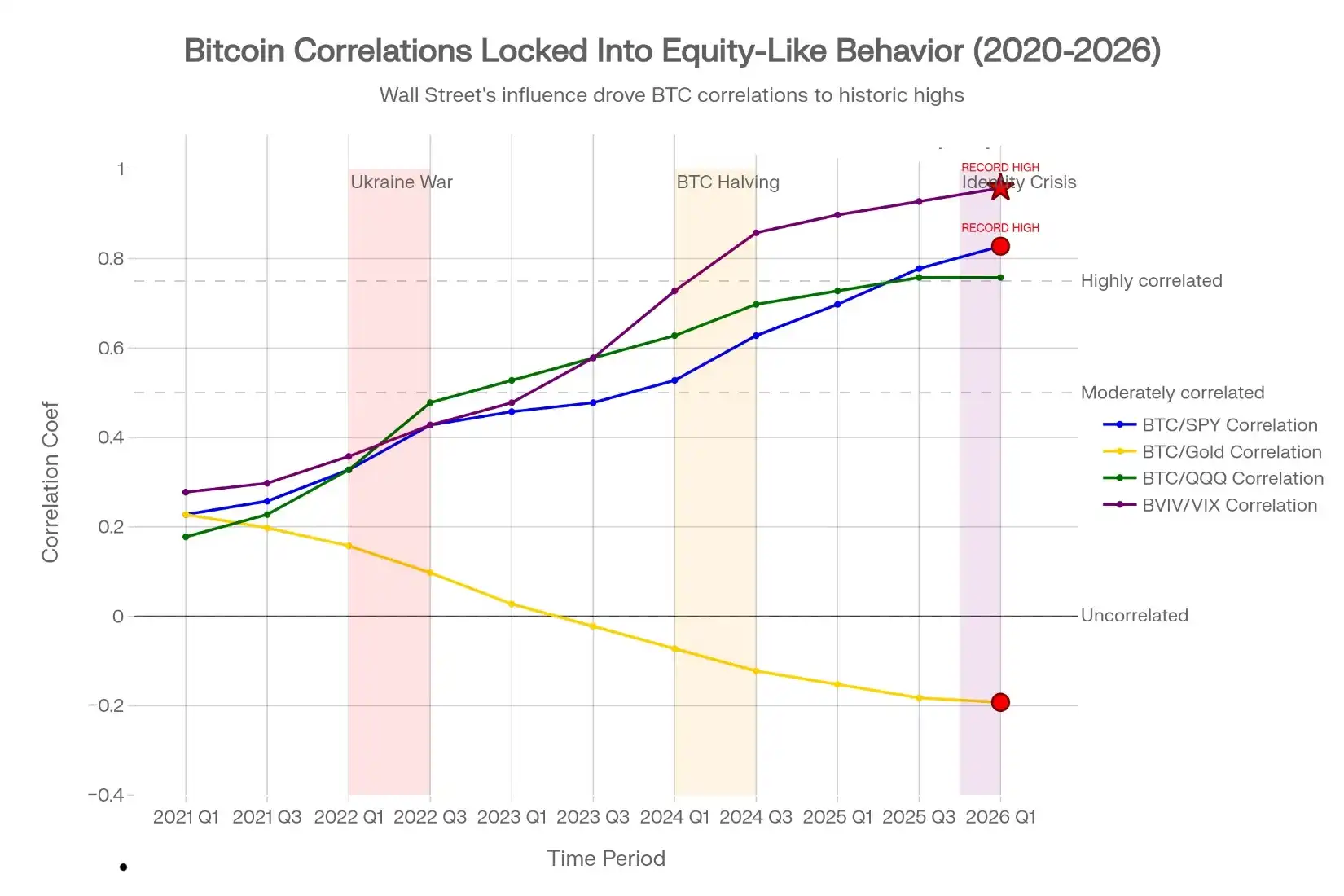
The Death of Diversification: Bitcoin's correlation with stocks surged from 0.15 (2021) to 0.75 (January 2026), a five-year shift driven entirely by institutional risk management, not Bitcoin adoption or fundamentals. A more destructive metric: Bitcoin volatility now correlates with stock volatility at 0.88 (purple line), the highest level ever recorded. This proves Bitcoin is traded mechanically based on stocks, not its own utility. Investors buying Bitcoin as a hedge are actually buying a leveraged, volatile stock bet that amplifies losses during crashes rather than offsetting them.

Volatility Homogenization

Bitcoin's volatility now moves in sync with stock market volatility. The correlation between Bitcoin volatility and the VIX stock volatility index reached 0.88 in January 2026. This is the highest reading ever recorded.

In 2020, this correlation was 0.2. Bitcoin volatility was independent. By 2026, it had become identical to stock volatility.

This is because institutional traders sell volatility across all asset classes simultaneously. When the VIX rises above certain levels, algorithms automatically sell Bitcoin, stocks, and commodities to reduce portfolio volatility. This mechanical selling has nothing to do with Bitcoin fundamentals. It is pure risk management, applied equally across all assets.

The result is that Bitcoin has lost independent price discovery. Its price is no longer driven by adoption, usage, or scarcity. It is driven by correlation assumptions and volatility control algorithms.

The data proves this. In January 2026, even as the price rebounded to $96,000, Bitcoin's daily active addresses were declining. Trading volume was falling even as institutional adoption was supposedly accelerating. The Lightning Network, which processes actual Bitcoin payments, grew 266% year-over-year. Yet the price fell.

Usage is up. Price is down. This proves that what drives the price is positioning and correlation, not fundamentals.

Reflexivity Trap

George Soros described reflexivity as a feedback loop where price movements themselves drive further movements, independent of fundamentals.

Bitcoin is caught in reflexivity.

Institutions assume a 0.75 correlation between Bitcoin and stocks. Option traders build hedges based on this assumption. When stocks move 2%, algorithms trigger a 2% move in Bitcoin. This creates a self-fulfilling prophecy. Bitcoin moves with stocks, so traders think it's a stock. Retail investors adopt this view and trade accordingly. Actual Bitcoin fundamentals become irrelevant. The price is completely detached from utility.

This is not temporary confusion. It is structural. Until institutions agree on what Bitcoin is, the reflexivity loop will persist. Every rally will contain the seeds of the next crash because the market cannot agree on why the rally is happening.

What Retail Investors Actually Own

Most retail investors think they own diversification when they buy Bitcoin. They believe Bitcoin protects against inflation and reduces stock exposure. The math proves otherwise.

Take a simple example. An investor holds $100,000 in stocks and allocates $5,000 to Bitcoin, expecting diversification.

When stocks fall 10%, the portfolio loses $9,000. But Bitcoin, with a 0.75 correlation, falls 15%. The Bitcoin position loses $750. Total loss: $9,750.

Without Bitcoin, the loss would have been $9,000. Bitcoin made the portfolio worse, not better. This correlation means Bitcoin amplifies stock losses rather than offsetting them.

True diversification requires negative correlation. Bonds are negatively correlated with stocks during risk-off periods. Gold is negatively correlated during crises. Bitcoin is positively correlated, making it useless as a hedge.

The Inevitable Resolution

Bitcoin cannot sustain four conflicting identities. The market will force a resolution in 2026 through one of four paths.

Path One: Strategic Reserve

Governments and corporations treat Bitcoin like gold reserves. They buy and never sell. Price volatility becomes irrelevant because holders measure success in decades, not quarters. Institutions stop trading Bitcoin and start hoarding it. Price finds equilibrium based on slow, steady accumulation. This path leads to $120,000 to $150,000 by year-end.

Path Two: Risk Asset Normalization

Institutions formally classify Bitcoin as a commodity derivative or stock analogue. They build risk models that account for extreme volatility. They accept that Bitcoin is not a hedge but a leveraged bet on monetary expansion. Position sizing adjusts accordingly. Correlations become predictable because everyone agrees on what Bitcoin is. Price trades in an $80,000 to $110,000 range with lower volatility.

Path Three: Inflation Hedge Acceptance

After resolving which inflation metric matters, the market agrees Bitcoin reacts to monetary debasement, not consumer price changes. Correlation with stocks falls to 0.3 or 0.4. Bitcoin becomes a true alternative to gold. This path leads to $110,000 to $140,000 as portfolio managers allocate for inflation protection.

Path Four: Diversification Failure

Institutions realize Bitcoin cannot diversify a stock portfolio. A 0.75 correlation is too high to justify an allocation. Capital flows reverse as portfolio managers exit. Retail investors understand Bitcoin is not a hedge. Price falls to $40,000 to $60,000 as the strategic allocation story collapses.

The most likely outcome is a slow resolution in 2026. Bitcoin will gradually shift from a risk asset to a reserve asset, with periodic corrections as institutions recalibrate. Price will consolidate between $80,000 and $110,000 until one path dominates.

What to Watch

Four indicators will show which path Bitcoin takes.

  • Correlation Inflection: If Bitcoin stops moving with stocks and correlation drops below 0.5, it becomes a hedge again. This favors Path Three.
  • Government Announcements: If a major government formally allocates Bitcoin to reserves, Path One accelerates. Watch for announcements from the U.S., E.U., or Japan.
  • On-Chain Metrics: If daily active addresses and transaction volume reverse upward while price is flat or falling, fundamentals are improving even as speculation decreases. This indicates long-term strength.
  • Volatility Normalization: If the correlation between Bitcoin volatility and stock volatility drops below 0.60, institutional volatility selling is easing. This allows true price discovery to return.

These indicators don't require capital to track. They provide better insight than price charts.

Conclusion

Bitcoin's fall to $80,000 was no accident. It was Bitcoin confronting a question it has avoided since institutional money arrived: What am I?

Until there is a clear answer to this question, every rally will contain the seeds of the next crash. Bitcoin will move with stocks when it should diverge. It will fall on news that should help it. It will rise on developments that shouldn't matter.

This is not temporary confusion. It is a structural identity crisis that defines the entire 2026 narrative.

Investors buying Bitcoin as an inflation hedge will be disappointed during inflation panics. Investors buying it for diversification will be disappointed when it amplifies stock losses. Investors buying it as digital gold will be disappointed when it trades like a tech stock.

The only investors who will succeed are those who understand Bitcoin is currently none of these things. It is a positioning-driven, correlation-dependent, volatility-controlled instrument that has temporarily lost its connection to its fundamental purpose.

The crash exposed this truth. The recovery will depend on Bitcoin's ability to answer what it is before institutions decide the answer for it.


İlgili Sorular

QWhat are the four conflicting identities that Bitcoin is simultaneously trying to embody according to the article?

AThe four conflicting identities are: 1) Inflation hedge, 2) Tech stock, 3) Digital gold, and 4) Institutional reserve asset.

QWhy did the author describe Bitcoin's price drop on January 29, 2026, as particularly significant?

AIt was significant because Bitcoin crashed in response to two opposing events simultaneously: a stock market crash (where it should have risen as a safe-haven asset) and a hawkish signal from the Fed (where it should have fallen as a risk asset). This broke the fundamental logic of how the market understood Bitcoin.

QWhat is the article's main argument for why Bitcoin's price action has become chaotic and disconnected from its fundamentals?

AThe main argument is that institutional algorithms and risk models, which trade Bitcoin based on its high correlation to stocks and volatility control mechanisms, have taken over price discovery. This creates a reflexive loop where price movements are driven by positioning and correlation assumptions rather than adoption, utility, or scarcity.

QWhat does the 'volatility homogenization' phenomenon refer to in the context of Bitcoin's trading behavior?

AVolatility homogenization refers to the phenomenon where Bitcoin's volatility has become highly correlated (0.88) with stock market volatility (VIX). This means algorithms automatically sell Bitcoin along with stocks when volatility spikes to manage portfolio risk, making its price movements mechanical and detached from its own fundamentals.

QAccording to the author, what are the four possible paths for a resolution to Bitcoin's identity crisis, and which one would push its price toward $150,000?

AThe four paths are: 1) Strategic Reserve (price target $120K-$150K), 2) Risk Asset Normalization ($80K-$110K), 3) Inflation Hedge Acceptance ($110K-$140K), and 4) Diversification Failure ($40K-$60K). The path that would push the price toward $150,000 is Path One, the Strategic Reserve path, where governments and corporations treat it like gold and accumulate it long-term without selling.

İlgili Okumalar

You Bet on the News, the Pros Read the Rules: The True Cognitive Gap in Losing Money on Polymarket

The article explains that the key to profiting on Polymarket, a prediction market platform, lies not just predicting real-world events correctly, but in meticulously understanding the specific rules that govern how each market will be resolved. It illustrates this with examples, such as a market on Venezuela's 2026 leader, where the official rules defining "officially holds" the office overruled the intuitive answer of who was in practical control. Other examples include debates over the definition of a "token" or what constitutes an "agreement." The core argument is that a "reality vs. rules" gap creates pricing discrepancies that savvy traders ("车头" or "whales") exploit. The platform has a formal dispute resolution process managed by UMA token holders to settle ambiguous outcomes. This process involves proposal submission, a challenge window, a discussion period, and a final vote. However, the article highlights a critical flaw in this system compared to a traditional court: the lack of separation between the arbiters (UMA voters) and the interested parties (traders with financial stakes in the outcome). This conflict of interest undermines the discussion phase, leads to herd mentality, and results in opaque final decisions without explanatory rulings. Consequently, the system lacks a body of precedent, making it difficult for users to learn from past disputes. The ultimate takeaway is that success on Polymarket requires a lawyer-like scrutiny of the rules to identify and capitalize on the cognitive gap between how events appear and how they are contractually defined for settlement.

marsbit36 dk önce

You Bet on the News, the Pros Read the Rules: The True Cognitive Gap in Losing Money on Polymarket

marsbit36 dk önce

Will the Fed Still Cut Interest Rates? Tonight's Data Is Crucial

The core debate surrounding the Federal Reserve's potential interest rate cuts is intensifying amid geopolitical conflict and rebounding inflation. The key question is whether high energy prices will cause persistent inflation or weaken consumer demand enough to force the Fed to cut rates. Citigroup presents a bullish case for cuts, arguing that oil supply disruptions from the Strait of Hormuz are temporary and will not lead to lasting inflationary pressure. They point to receding bond yields and oil prices as evidence the market is pricing in a short-lived shock. Citi's data also shows tightening financial conditions, a stabilizing labor market, and healthy tax returns, supporting their view that the path to lower rates remains open. Conversely, Deutsche Bank offers a starkly contrasting, more hawkish outlook. They argue the Fed's current policy is already neutral and expect rates to remain unchanged indefinitely. Their view is based on stalled disinflation progress and a shift toward more hawkish rhetoric from key Fed officials like Waller, who cited risks from prolonged Middle East conflict and tariffs. Other officials, including Williams and Hammack, signaled rates would likely stay on hold for a "considerable time." The market pricing has shifted dramatically, now forecasting zero cuts in 2026. The imminent release of the March retail sales "control group" data is highlighted as a critical test. This metric, which excludes gas station sales, will reveal if high gasoline prices are eroding consumer spending in other areas. A weak reading could support the case for imminent rate cuts, while a strong one would bolster the argument for the Fed to hold steady. This data is pivotal for determining the near-term policy path.

marsbit57 dk önce

Will the Fed Still Cut Interest Rates? Tonight's Data Is Crucial

marsbit57 dk önce

İşlemler

Spot
Futures

Popüler Makaleler

BITCOIN Nedir

HarryPotterObamaSonic10Inu (ERC-20)'yu ve Kripto Alanındaki Yerini Anlamak Son yıllarda, kripto para piyasası, hem ticaret yapanların hem de topluluk etkileşimi ve eğlence değeri arayanların ilgisini çeken meme coin'lerin popülaritesinde bir artış gördü. Bu benzersiz token'lar arasında, kripto para dokusuna kültürel referansları harmanlayan ilginç bir proje olan HarryPotterObamaSonic10Inu (ERC-20) bulunmaktadır. Bu makale, HarryPotterObamaSonic10Inu'nun temel yönlerini, mekanizmalarını, topluluk odaklı ethosunu ve daha geniş kripto manzarasıyla etkileşimini incelemektedir. HarryPotterObamaSonic10Inu (ERC-20) Nedir? Adından da anlaşılacağı gibi, HarryPotterObamaSonic10Inu, Ethereum blok zinciri üzerinde inşa edilen bir meme coin'dir ve ERC-20 standardı altında sınıflandırılmaktadır. Geleneksel kripto paraların pratik kullanılabilirlik veya yatırım potansiyeline odaklandığı durumların aksine, bu token eğlence değeri ve topluluğunun gücü üzerine kuruludur. Proje, bağlı kullanıcıların bir araya gelebileceği, fikirlerini paylaşabileceği ve çeşitli kültürel fenomenlerden ilham alan etkinliklere katılabileceği bir ortam yaratmayı hedeflemektedir. HarryPotterObamaSonic10Inu'nun dikkate değer özelliklerinden biri işlemlerde sıfır vergi olmasıdır. Bu çekici unsur, küçük ölçekli yatırımcıları caydırabilecek ek ücretlerden yoksun olarak ticareti ve topluluk katılımını teşvik etmeyi amaçlamaktadır. Coin'in toplam arzı bir milyar token olarak belirlenmiştir; bu, topluluk içinde önemli bir dolaşım sağlama niyetini göstermektedir. HarryPotterObamaSonic10Inu (ERC-20) Yaratıcısı HarryPotterObamaSonic10Inu'nun kökenleri bir miktar gizemlidir; yaratıcısı hakkında spesifik bilgilerin ne olduğu bilinmemektedir. Bu token'ın geliştirilmesi, belirli bir ekip veya açık bir plan eksikliği ile gerçekleşmiştir; bu durum, meme coin sektöründe oldukça yaygındır. Proje, topluluğunun heyecanı ve katılımına dayalı olarak organik bir şekilde ortaya çıkmıştır. HarryPotterObamaSonic10Inu (ERC-20) Yatırımcıları Dış yatırımlar ve destekler söz konusu olduğunda, HarryPotterObamaSonic10Inu da belirsiz kalmaktadır. Token, bilinen herhangi bir yatırım fonunu veya önemli bir kurumsal desteği listelememektedir. Bunun yerine, projenin can damarı, kolektif eylem ve kripto alanındaki katılım yoluyla büyüme ve sürdürülebilirlik sağlayan temel topluluğudur. HarryPotterObamaSonic10Inu (ERC-20) Nasıl Çalışır? Bir meme coin olarak, HarryPotterObamaSonic10Inu, genellikle varlık değerini yöneten geleneksel çerçevelerin dışında çalışmaktadır. Projenin nasıl çalıştığını tanımlayan birkaç özelliği vardır: Sıfır Vergi İşlemleri: İşlemlerde vergi ücreti olmadan, kullanıcılar gizli maliyet endişesi olmadan token'ı serbestçe alıp satabilirler. Topluluk Etkileşimi: Proje, topluluk etkileşimi üzerine kuruludur ve sosyal medya platformlarını kullanarak heyecan yaratarak katılımı kolaylaştırır. Tartışmalar, içerik paylaşımı ve katılım, projenin erişimini genişletmeye ve destekleyiciler arasında sadakat oluşturmaya yardımcı olan kritik unsurlardır. Pratik Kullanılabilirlik Yok: HarryPotterObamaSonic10Inu'nun mali ekosistem içinde somut bir kullanılabilirlik sunmadığı belirtilmelidir. Daha ziyade, eğlence ve topluluk etkinlikleri için bir token olarak sınıflandırılmaktadır. Kültürel Referans: Token, popüler kültürden unsurları zekice harmanlayarak ilgi çekmektedir ve hem meme meraklıları hem de kripto takipçileriyle bağlantı kurmaktadır. HarryPotterObamaSonic10Inu, meme coin'lerin, daha geleneksel kripto para projelerinden nasıl farklı çalıştığını örneklendirmektedir; bu projeler, utilitarist varlıklar yerine yenilikçi sosyal yapıların bir parçası olarak piyasaya girmektedir. HarryPotterObamaSonic10Inu (ERC-20) Zaman Çizelgesi HarryPotterObamaSonic10Inu'nun tarihi, birkaç dikkate değer kilometre taşı ile işaretlenmiştir: Oluşum: Token, birçok kripto meraklısının hayal gücünü yakalayan bir viral meme'den ortaya çıkmıştır. Spesifik yaratım tarihleri mevcut değildir ve bu onun organik yükselişini vurgulamaktadır. Borsa Listelemeleri: HarryPotterObamaSonic10Inu, topluluğun daha kolay erişim ve ticaret yapabilmesini sağlamak için çeşitli borsalarda yer bulmuştur. Topluluk Katılım İnisiyatifleri: Yarışmalar, sosyal medya kampanyaları ve hayranlar ile destekçilerden içerik üretimini içeren topluluk etkileşimini artırmayı amaçlayan devam eden etkinlikler. Gelecek Genişleme Planları: Projenin yol haritası, kültürel temalarına ilişkin bir NFT koleksiyonu, ticari ürünler ve bir e-ticaret sitesi başlatılmasını içermektedir; bu da topluluğun daha fazla katılımını sağlamayı ve ekosistemine daha fazla boyut kazandırmayı hedeflemektedir. HarryPotterObamaSonic10Inu (ERC-20) Hakkında Kilit Noktalar Topluluk Odaklı Doğası: Proje, kullanıcı katılımını geliştirme önceliği taşır ve böylece kullanıcıların sürecin en önünde yer almasını sağlar. Meme Coin Sınıflandırması: Eğlenceye dayalı kripto paranın doruk noktasıdır ve geleneksel yatırım araçlarından ayrılmaktadır. Bitcoin ile Doğrudan İlişki Yok: Ticker ismindeki benzeliğe rağmen, HarryPotterObamaSonic10Inu ayırt edicidir ve Bitcoin veya diğer yerleşik kripto paralarla herhangi bir ilişkisi yoktur. İşbirliğine Odaklanma: HarryPotterObamaSonic10Inu, sahipleri arasında işbirliği ve hikaye paylaşımı için bir alan oluşturmak üzere tasarlanmıştır ve bu da yaratıcılık ve topluluk bağlarını sağlamaktadır. Gelecek Beklentileri: Başlangıçta belirlendiği temalardan NFTs ve ticari ürünlere genişleme arzusu, projenin dijital kültürde daha ana akıma girebilmesi için bir yol haritası çizmektedir. Meme coin'ler, kripto para topluluğunun hayal gücünü çalmaya devam ederken, HarryPotterObamaSonic10Inu (ERC-20), kültürel bağları ve topluluk merkezli yaklaşımıyla öne çıkmaktadır. Geleneksel bir hizmet odaklı token modeliyle uyumlu olmasa da, özünde destekçileri arasında sağlanan neşe ve dostluğu vurgulayarak, giderek dijitalleşen bir çağda kripto paraların evrilen doğasını göstermektedir. Proje gelişmeye devam ettikçe, topluluk dinamiklerinin blockchain teknolojisi dünyasındaki seyrini nasıl etkilediğini izlemek önemli olacaktır.

1.4k Toplam GörüntülenmeYayınlanma 2024.04.01Güncellenme 2024.12.03

BITCOIN Nedir

BTC Nasıl Satın Alınır

HTX.com’a hoş geldiniz! Bitcoin (BTC) satın alma işlemlerini basit ve kullanışlı bir hâle getirdik. Adım adım açıkladığımız rehberimizi takip ederek kripto yolculuğunuza başlayın. 1. Adım: HTX Hesabınızı OluşturunHTX'te ücretsiz bir hesap açmak için e-posta adresinizi veya telefon numaranızı kullanın. Sorunsuzca kaydolun ve tüm özelliklerin kilidini açın. Hesabımı Aç2. Adım: Kripto Satın Al Bölümüne Gidin ve Ödeme Yönteminizi SeçinKredi/Banka Kartı: Visa veya Mastercard'ınızı kullanarak anında Bitcoin (BTC) satın alın.Bakiye: Sorunsuz bir şekilde işlem yapmak için HTX hesap bakiyenizdeki fonları kullanın.Üçüncü Taraflar: Kullanımı kolaylaştırmak için Google Pay ve Apple Pay gibi popüler ödeme yöntemlerini ekledik.P2P: HTX'teki diğer kullanıcılarla doğrudan işlem yapın.Borsa Dışı (OTC): Yatırımcılar için kişiye özel hizmetler ve rekabetçi döviz kurları sunuyoruz.3. Adım: Bitcoin (BTC) Varlıklarınızı SaklayınBitcoin (BTC) satın aldıktan sonra HTX hesabınızda saklayın. Alternatif olarak, blok zinciri transferi yoluyla başka bir yere gönderebilir veya diğer kripto para birimlerini takas etmek için kullanabilirsiniz.4. Adım: Bitcoin (BTC) Varlıklarınızla İşlem YapınHTX'in spot piyasasında Bitcoin (BTC) ile kolayca işlemler yapın.Hesabınıza erişin, işlem çiftinizi seçin, işlemlerinizi gerçekleştirin ve gerçek zamanlı olarak izleyin. Hem yeni başlayanlar hem de deneyimli yatırımcılar için kullanıcı dostu bir deneyim sunuyoruz.

7.2k Toplam GörüntülenmeYayınlanma 2024.12.12Güncellenme 2025.03.21

BTC Nasıl Satın Alınır

$BITCOIN Nedir

DİJİTAL ALTIN ($BITCOIN): Kapsamlı Bir Analiz DİJİTAL ALTIN ($BITCOIN) Tanıtımı DİJİTAL ALTIN ($BITCOIN), geleneksel değerli metallerin özelliklerini merkeziyetsiz teknolojilerin yeniliği ile birleştirmeyi amaçlayan Solana ağı üzerinde çalışan blockchain tabanlı bir projedir. Bitcoin ile aynı isme sahip olmasına rağmen, genellikle bir değer saklama aracı olarak algılandığı için “dijital altın” olarak anılmaktadır; DİJİTAL ALTIN, Web3 ortamında benzersiz bir ekosistem yaratmak için tasarlanmış ayrı bir tokendir. Hedefi, uygulanabilir bir alternatif dijital varlık olarak kendini konumlandırmaktır, ancak uygulamaları ve işlevleri ile ilgili ayrıntılar hala gelişmektedir. DİJİTAL ALTIN ($BITCOIN) Nedir? DİJİTAL ALTIN ($BITCOIN), Solana blockchain'inde kullanılmak üzere açıkça tasarlanmış bir kripto para tokenidir. Bitcoin'in yaygın olarak tanınan bir değer saklama rolü sağlamasının aksine, bu token daha geniş uygulamalara ve özelliklere odaklanıyor gibi görünmektedir. Dikkate değer yönler şunlardır: Blockchain Altyapısı: Token, yüksek hızlı ve düşük maliyetli işlemleri yönetme kapasitesi ile bilinen Solana blockchain'inde inşa edilmiştir. Arz Dinamikleri: DİJİTAL ALTIN'ın maksimum arzı 100 katrilyon token (100P $BITCOIN) ile sınırlıdır, ancak dolaşımdaki arzı ile ilgili ayrıntılar şu anda açıklanmamıştır. Kullanım Alanı: Kesin işlevler açıkça belirtilmemiş olsa da, token'ın merkeziyetsiz uygulamalar (dApps) veya varlık tokenizasyon stratejileri ile ilgili çeşitli uygulamalar için kullanılabileceğine dair işaretler bulunmaktadır. DİJİTAL ALTIN ($BITCOIN) Yaratıcısı Kimdir? Şu anda, DİJİTAL ALTIN ($BITCOIN) arkasındaki yaratıcıların ve geliştirme ekibinin kimliği bilinmemektedir. Bu durum, merkeziyetsiz finans ve meme coin fenomenleriyle uyumlu olan birçok yenilikçi proje arasında yaygındır. Böyle bir anonimlik, topluluk odaklı bir kültürü teşvik edebilirken, yönetişim ve hesap verebilirlik konusundaki endişeleri artırmaktadır. DİJİTAL ALTIN ($BITCOIN) Yatırımcıları Kimlerdir? Mevcut bilgiler, DİJİTAL ALTIN ($BITCOIN) için bilinen herhangi bir kurumsal destekçi veya önde gelen risk sermayesi yatırımı olmadığını göstermektedir. Proje, geleneksel finansman yolları yerine topluluk desteği ve benimsemeye odaklanan bir eşler arası modelde çalışıyor gibi görünmektedir. Faaliyetleri ve likiditesi esas olarak PumpSwap gibi merkeziyetsiz borsalarda (DEX'ler) yer almakta olup, bu da onun taban hareketine vurgu yapmaktadır. DİJİTAL ALTIN ($BITCOIN) Nasıl Çalışır DİJİTAL ALTIN ($BITCOIN) 'ın operasyonel mekanikleri, blockchain tasarımı ve ağ özellikleri temelinde açıklanabilir: Konsensüs Mekanizması: Solana'nın benzersiz tarih kanıtı (PoH) ile bir hisse kanıtı (PoS) modelini birleştirerek, proje ağın yüksek performansına katkıda bulunan verimli işlem doğrulamasını sağlar. Tokenomik: Belirli deflasyonist mekanizmalar kapsamlı bir şekilde detaylandırılmamış olsa da, geniş maksimum token arzı, henüz tanımlanmamış mikro işlemler veya niş kullanım durumlarına hitap edebileceğini ima etmektedir. Etkileşim: Solana'nın daha geniş ekosistemi ile entegrasyon potansiyeli bulunmaktadır; bu, çeşitli merkeziyetsiz finans (DeFi) platformlarını içermektedir. Ancak, belirli entegrasyonlarla ilgili ayrıntılar belirtilmemiştir. Önemli Olayların Zaman Çizelgesi DİJİTAL ALTIN ($BITCOIN) ile ilgili önemli kilometre taşlarını vurgulayan bir zaman çizelgesi: 2023: Token'ın Solana blockchain'inde ilk dağıtımı, sözleşme adresi ile işaretlenmiştir. 2024: DİJİTAL ALTIN, PumpSwap gibi merkeziyetsiz borsalarda işlem görmeye başladıkça görünürlük kazanır ve kullanıcıların bunu SOL karşısında ticaret yapmasına olanak tanır. 2025: Proje, topluluk odaklı etkileşimlere yönelik potansiyel ilgi ve ara sıra ticaret faaliyetleri görür, ancak şu ana kadar dikkate değer ortaklıklar veya teknik ilerlemeler belgelenmemiştir. Kritik Analiz Güçlü Yönler Ölçeklenebilirlik: Temel Solana altyapısı, yüksek işlem hacimlerini destekleyerek $BITCOIN'in çeşitli işlem senaryolarındaki faydasını artırabilir. Erişilebilirlik: Token başına potansiyel düşük ticaret fiyatı, perakende yatırımcıları çekebilir ve parçalı mülkiyet fırsatları sayesinde daha geniş katılımı kolaylaştırabilir. Riskler Şeffaflık Eksikliği: Kamuya açık olarak bilinen destekçilerin, geliştiricilerin veya bir denetim sürecinin olmaması, projenin sürdürülebilirliği ve güvenilirliği konusunda şüpheler doğurabilir. Piyasa Volatilitesi: Ticaret faaliyeti büyük ölçüde spekülatif davranışa dayanmakta olup, bu da yatırımcılar için önemli fiyat dalgalanmalarına ve belirsizliklere yol açabilir. Sonuç DİJİTAL ALTIN ($BITCOIN), hızla gelişen Solana ekosisteminde ilginç ama belirsiz bir proje olarak ortaya çıkmaktadır. “Dijital altın” anlatısını kullanmaya çalışırken, Bitcoin'in değer saklama rolünden ayrılması, amaçlanan faydasının ve yönetişim yapısının daha net bir şekilde tanımlanması gerekliliğini vurgulamaktadır. Gelecekteki kabul ve benimseme, mevcut belirsizliklerin giderilmesine ve operasyonel ile ekonomik stratejilerinin daha açık bir şekilde tanımlanmasına bağlı olacaktır. Not: Bu rapor, Ekim 2023 itibarıyla mevcut olan sentezlenmiş bilgileri kapsamaktadır ve araştırma döneminin ötesinde gelişmeler yaşanmış olabilir.

92 Toplam GörüntülenmeYayınlanma 2025.05.13Güncellenme 2025.05.13

$BITCOIN Nedir

Tartışmalar

HTX Topluluğuna hoş geldiniz. Burada, en son platform gelişmeleri hakkında bilgi sahibi olabilir ve profesyonel piyasa görüşlerine erişebilirsiniz. Kullanıcıların BTC (BTC) fiyatı hakkındaki görüşleri aşağıda sunulmaktadır.

活动图片