Prediction Market Leaders Are Frantically Competing for Top-Tier Sports IPs

Odaily星球日报2026-01-28 tarihinde yayınlandı2026-01-28 tarihinde güncellendi

Özet

Prediction market platforms are aggressively securing exclusive partnerships with major sports leagues, as seen in Polymarket's recent multi-year deal with Major League Soccer (MLS). This follows similar agreements with the NHL and UFC. While these "official exclusive prediction market" designations don’t legally prevent other platforms from offering markets on these leagues (due to the current ambiguous regulatory landscape for prediction markets compared to sports betting), they provide significant advantages. The core benefits include access to official, high-quality data for more accurate odds and faster settlements, brand authorization for marketing, and collaborative integrity monitoring to prevent market manipulation. With sports-related markets dominating trading volume on leading platforms like Kalshi (over 90%) and Polymarket (43%), competition for these lucrative partnerships is intensifying. This trend mirrors the established sports betting industry, where data and brand deals are crucial for service quality. While the top players battle for mainstream sports, data suggests emerging platforms may find opportunity in niche markets, such as crypto-native events, to differentiate themselves.

Original | Odaily Planet Daily (@OdailyChina)

Author | Azuma (@azuma_eth)

On January 27 local time in the United States, the commercial department of Major League Soccer (MLS), Soccer United Marketing (SUM), announced a multi-year cooperation agreement with the prediction market platform Polymarket. According to the agreement, Polymarket will become the official exclusive prediction market partner for the MLS league, MLS All-Star Game, MLS Cup Final, and the Leagues Cup. Meanwhile, MLS will require Polymarket to use the league's official data and third-party integrity monitoring systems, and it is not allowed to set up betting items that the league deems easily manipulated or potentially involving insider information.

This is not the first time a sports league has partnered with a prediction market. As early as last October, the National Hockey League (NHL) reached multi-year licensing agreements with both Kalshi and Polymarket; later, in November last year, Polymarket also reached an agreement with the Ultimate Fighting Championship (UFC), becoming UFC's official exclusive prediction market partner.

What does "official exclusive prediction market" mean? Does this mean that other unauthorized platforms will no longer be able to offer related markets in the future? What impact will this have on future competition? Although there are currently limited mature cases of prediction markets cooperating with sports events, and the observable samples are few, we can find similar answers to the above questions from the sports betting market, which has extremely similar service effects.

  • Odaily Note: For the similarities in services and differences in regulation between prediction markets and sports betting, as well as the regulatory博弈 surrounding prediction markets, please refer to our article from two weeks ago: "Prediction Markets Are Being Chased by the Old Order for Moving a Trillion-Dollar Cake of the Betting Industry."

Exclusive Authorization Market Licensing

First, let's answer the most critical question — Does the existence of exclusive authorization mean that other unauthorized platforms will no longer be able to offer related markets in the future?

The current situation in sports betting is that since the U.S. Supreme Court overturned the federal law "Professional and Amateur Sports Protection Act" (PASPA), which had prohibited commercial sports betting, on May 14, 2018, U.S. states have gained the autonomy to decide whether to legalize sports betting within their jurisdictions. In other words, the legality of betting services depends on state-level licensing, not commercial authorization from the leagues — in reality, when betting companies set up markets or provide betting services for various legal sports events, they do not need to obtain commercial authorization from the league operators.

However, in a few states like Tennessee, state-level sports betting regulatory agencies require betting companies to use the league's official data when providing in-play betting services, unless it can be proven that the data is not applicable or unavailable. This makes official authorization affect the scope of services of betting companies at a factual level — only by obtaining data authorization can they provide the most complete betting services.

But this logic does not directly apply to prediction markets at present. Due to the unclear (and objectively more lenient) regulatory system for prediction markets, before the final results of the appellate court or even the Supreme Court are determined, Polymarket and Kalshi are not obliged to follow similar requirements in betting regulations.

Therefore, although Polymarket has now obtained exclusive authorization from MLS, at least at this stage, it does not mean that other platforms like Kalshi are no longer allowed to set up MLS-related markets.

If Not Necessary, What Is the Significance of Authorization?

Although it is not "necessary to have authorization to open markets," in actual commercial operations, there are indeed a large number of commercial cooperation and authorization agreements between major sports leagues and betting companies. For example, the NFL has signed a long-term cooperation agreement with Genius Sports, authorizing real-time event data to betting companies through Genius as the sole official data provider, including rosters, match reports, technical statistics, etc.

For betting companies, the main significance of authorization is that they can directly obtain official data and brand authorization from the operators of sports events through commercial agreements to improve their service quality and user experience. If it is an exclusive authorization, an additional layer of exclusivity can be added on this basis.

The most core significance naturally lies in the quality and completeness of the data. Compared with data scraping through third-party channels, the official data obtained based on authorization agreements will definitely be more accurate, timely, and complete, which has a direct impact on improving the accuracy of betting odds, accelerating settlement efficiency, and expanding betting categories. As for brand and trademark authorization, it can allow betting companies to be more flexible in promoting related markets — they can use the logos of leagues, teams, and players while avoiding infringement risks.

Conversely, for sports events, reaching authorization agreements directly with betting companies also helps reduce the possibility of market manipulation (which may sound a bit abstract...). Both parties can standardize the betting range and share abnormal betting data to promptly detect potential manipulation possibilities. For example, in the cooperation between Polymarket and MLS, it has been clearly stated that markets that are easily manipulated by individuals, such as red and yellow card decisions, or those that may involve insider information, such as coach dismissals and player transfers, are not allowed.

Given the high overlap in service effects between prediction markets and sports betting, the significance of authorization agreements for the sports betting market will also take effect in prediction markets.

Head-on Clash of the Leaders, the Unconventional Second Tier

Sports betting has long been verified as a business with a huge scale and certain growth, and in prediction markets, sports events have gradually become the category with the highest transaction volume proportion.

Dovey Wan (@DoveyWan), founder of Primitive Ventures, yesterday posted the proportion of turnover of various types of events on several major prediction markets. Among them, the betting scale proportion of sports events on Kalshi has exceeded 90%, and the proportion of sports events on Polymarket has also reached 43% — obviously, sports events have become the core traffic source for these two leading prediction markets.
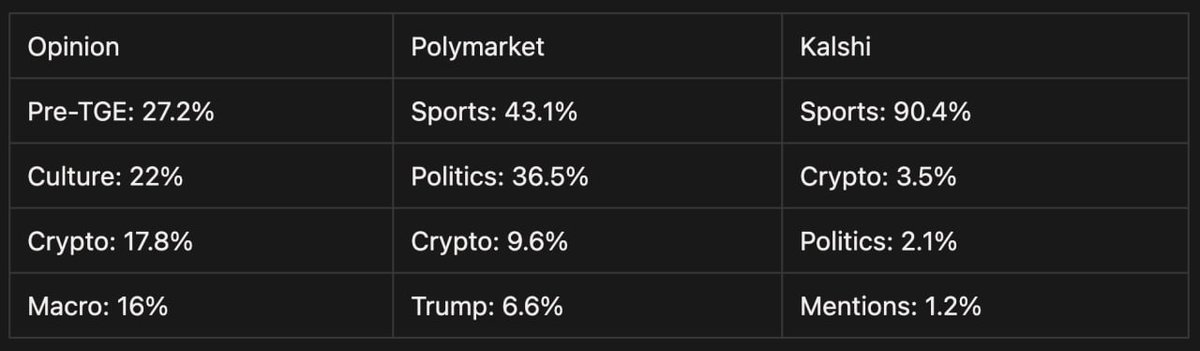
In the face of the huge存量规模 and visible增量空间, market competition is inevitable. Currently, among the four major U.S. sports leagues, only the NHL has stepped in and signed authorization agreements with Kalshi and Polymarket respectively, while the NFL, NBA, and MLB are still in a wait-and-see stage. It is expected that after Polymarket has successively seized the exclusive authorization of UFC and MLS, Kalshi and Polymarket, the two leaders with compliance and capital advantages, are likely to engage in more intense competition for the authorization of various top-tier sports events in the future, and there will inevitably be more exclusive agreements.

But the data also reveals another interesting phenomenon — perhaps due to cultural differences and user habits, emerging prediction markets on the other side of the world are moving towards截然不同的差异化道路. As shown in the previous figure, the proportion of event turnover围绕ing原生加密市场 events on Opinion is much higher than that on Kalshi and Polymarket. While the leaders are clashing head-on over the huge cake of sports events, choosing to take an unconventional path may be an opportunity for second-tier projects to catch up on a curve.


İlgili Sorular

QWhat is the significance of the partnership between MLS's Soccer United Marketing (SUM) and Polymarket?

AThe partnership makes Polymarket the official exclusive prediction market partner for MLS, MLS All-Star Game, MLS Cup, and Leagues Cup, allowing it to use official league data and integrity monitoring systems while restricting markets prone to manipulation or insider information.

QDoes an exclusive prediction market partnership like Polymarket's with MLS prevent other platforms from offering related markets?

ANo, it does not necessarily prevent other platforms from offering markets, as prediction markets currently operate under a less clear regulatory framework compared to sports betting, and authorization isn't legally required to open markets in most cases.

QWhat are the key benefits for a prediction market platform in securing an official data授权 from a sports league?

AOfficial data授权 provides more accurate, timely, and complete data, improving odds accuracy, settlement efficiency, and market variety. It also includes brand授权 for marketing and helps mitigate manipulation through regulated markets and shared monitoring.

QAccording to the data shared by Dovey Wan, what is the proportion of sports-related event volume on Kalshi and Polymarket?

ASports-related event volume accounts for over 90% on Kalshi and 43% on Polymarket, making it a core traffic source for these leading prediction markets.

QHow might the competition for top sports IP affect the prediction market landscape, particularly for second-tier projects?

AThe intense competition for exclusive sports授权 between giants like Kalshi and Polymarket may push second-tier projects to pursue差异化 strategies, such as focusing on crypto-native markets, as seen with Opinion's higher volume in that area.

İlgili Okumalar

The Waged Worker Driven to Poverty by AI Subscriptions

"AI Membership: The Hidden Cost Pushing Workers Toward 'Poverty'" The widespread corporate push for AI adoption is creating a hidden financial burden for employees. Companies, from giants like Alibaba to small firms, are mandating AI use, often tying token consumption to KPIs, but frequently refuse to cover the costs. Workers are forced to pay for subscriptions out of pocket to stay competitive and avoid being replaced. Front-end developer Long Shen spends up to 2000 RMB monthly on tools like Cursor and ChatGPT Plus, seeing it as a necessary 3% salary investment to handle 90% of his coding tasks. While it boosted his performance and led to promotions, he now faces idle time at work, pretending to be busy. Designer Peng Peng navigates strict company firewalls by using personal devices and accounts for AI image generation tools like Midjourney, spending hundreds monthly without reimbursement, while her boss demands faster, more numerous revisions. The pressure creates workplace anxiety and suspicion. Programmer Li Huahua, after a friend's experience of raised KPIs following AI success, fears being branded a "traitor" for using it yet worries about falling behind if she doesn't. The dynamic allows management to demand results without understanding the tools or covering expenses, treating employees like AI "agents." While some, like entrepreneur Jin Tu, find high value in paid AI, building entire systems and winning competitions, for most, it's a trap. Free tools like Kimi and Doubao are introducing fees, closing off alternatives. The initial efficiency gains individual advantage, but as AI becomes ubiquitous, the personal edge disappears, workloads increase, and a cycle of dependency begins. Workers like Long Shen realize they cannot maintain AI-generated code without AI, making stopping harder than continuing to pay. The tool promising liberation is instead becoming a compulsory, costly chain in the modern workplace.

marsbit5 dk önce

The Waged Worker Driven to Poverty by AI Subscriptions

marsbit5 dk önce

SK Hynix's Trillion-Won Empire: The Successors

"SK Hynix's Trillion-Won Empire and Its Heirs" explores the unconventional succession narrative within SK Group, South Korea's second-largest conglomerate, following SK Hynix's dramatic market rise. Unlike traditional chaebol scripts prioritizing the eldest son, ownership, and political marriages, Chairman Choi Tae-won's three children from his first marriage are charting distinct paths. The eldest daughter, Choi Yun-jeong, is considered the most visible candidate. With a background in biology, consulting, and a PhD, she holds executive roles at SK Bioscience and SK Inc.'s growth strategy unit, focusing on biopharma and new businesses. Her marriage is to an AI infrastructure entrepreneur, not a traditional chaebol heir. The second daughter, Choi Min-jeong, took a unique route by voluntarily serving as a South Korean naval officer, including a tour in the Gulf of Aden. She later worked on policy and strategy for SK Hynix in Washington D.C. before co-founding an AI-driven healthcare startup in San Francisco. She married a former U.S. Marine Corps officer, connecting the family to U.S. defense and policy networks. The son, Choi In-geun, who has Type 1 diabetes, followed a more classic preparatory path with a physics degree and a stint at SK E&S but left to join McKinsey's Seoul office. He remains publicly silent and holds no SK shares, defying the traditional "crown prince" archetype. Their paths unfold against the backdrop of their parents' high-profile, contentious divorce and a record-setting asset division lawsuit. The article argues that as SK Hynix becomes a geopolitical asset in the AI era, the conventional rules of chaebol inheritance are changing. The heirs are being groomed not simply to take over, but to navigate a complex global landscape defined by AI, biotech, geopolitics, and policy, forging legitimacy through their own expertise and networks rather than birth order alone.

marsbit14 dk önce

SK Hynix's Trillion-Won Empire: The Successors

marsbit14 dk önce

BitMart Research Institute Weekly Highlights: A Comprehensive Review of Macro Environment, Crude Oil, AI Tech Stocks, and Crypto Market

**Weekly Market Review: Macro, Oil, AI Tech Stocks & Crypto Market** **Macroeconomic & Traditional Finance** The April U.S. Non-Farm Payrolls report of 115K new jobs exceeded expectations, but the data's quality was questioned. Growth was heavily concentrated in healthcare, while other sectors contracted, and manufacturing employment turned negative. A statistical model accounted for a large portion of the gains, conflicting with household survey data showing a loss of 226K jobs. Meanwhile, AI's impact on jobs is emerging, with information sector roles declining, though overall unemployment remains at ~4.3%. Oil prices hovered near $100 per barrel. Global oil buffer inventories have drawn down significantly, supporting prices, but high costs are suppressing demand. China's recent reduction in crude imports acted as a market stabilizer. Geopolitically, the U.S. and Iran are likely to reach a tentative agreement to keep the Strait of Hormuz open and avoid price spikes. For AI tech stocks, short-term prospects are mixed. A potential SpaceX IPO in June could pressure current index heavyweights like Nvidia, while smaller components might benefit. The mid-term focus shifts to Q2 earnings, emphasizing AI's return on investment. Long-term risks include potential election policy shifts and massive IPOs from companies like OpenAI, which could test the sector's sustainability. **Crypto Market & Ecosystem** Crypto markets rose moderately, with BTC climbing from ~$77K to ~$82K, driven by improved risk sentiment. Spot trading volumes remain low, but buying pressure is evident. ETF inflows continued (~$791M last week). However, institutional purchases of BTC and ETH were more modest than expected. The derivatives market shows lingering bearish bets, particularly on alts and ETH. A key trend is the "dual-track" model where projects pursue public listings for traditional funding while also building their own blockchains/tokens to capture crypto liquidity, as seen with Circle's ARC chain. Stablecoins and institutional chains present significant future opportunities. *Disclaimer: This is market analysis, not investment advice.*

marsbit48 dk önce

BitMart Research Institute Weekly Highlights: A Comprehensive Review of Macro Environment, Crude Oil, AI Tech Stocks, and Crypto Market

marsbit48 dk önce

İşlemler

Spot
Futures
活动图片




