Prediction Market Leaders Are Frantically Competing for Top-Tier Sports IPs

Odaily星球日报2026-01-28 tarihinde yayınlandı2026-01-28 tarihinde güncellendi

Özet

Prediction market platforms are aggressively securing exclusive partnerships with major sports leagues, as seen in Polymarket's recent multi-year deal with Major League Soccer (MLS). This follows similar agreements with the NHL and UFC. While these "official exclusive prediction market" designations don’t legally prevent other platforms from offering markets on these leagues (due to the current ambiguous regulatory landscape for prediction markets compared to sports betting), they provide significant advantages. The core benefits include access to official, high-quality data for more accurate odds and faster settlements, brand authorization for marketing, and collaborative integrity monitoring to prevent market manipulation. With sports-related markets dominating trading volume on leading platforms like Kalshi (over 90%) and Polymarket (43%), competition for these lucrative partnerships is intensifying. This trend mirrors the established sports betting industry, where data and brand deals are crucial for service quality. While the top players battle for mainstream sports, data suggests emerging platforms may find opportunity in niche markets, such as crypto-native events, to differentiate themselves.

Original | Odaily Planet Daily (@OdailyChina)

Author | Azuma (@azuma_eth)

On January 27 local time in the United States, the commercial department of Major League Soccer (MLS), Soccer United Marketing (SUM), announced a multi-year cooperation agreement with the prediction market platform Polymarket. According to the agreement, Polymarket will become the official exclusive prediction market partner for the MLS league, MLS All-Star Game, MLS Cup Final, and the Leagues Cup. Meanwhile, MLS will require Polymarket to use the league's official data and third-party integrity monitoring systems, and it is not allowed to set up betting items that the league deems easily manipulated or potentially involving insider information.

This is not the first time a sports league has partnered with a prediction market. As early as last October, the National Hockey League (NHL) reached multi-year licensing agreements with both Kalshi and Polymarket; later, in November last year, Polymarket also reached an agreement with the Ultimate Fighting Championship (UFC), becoming UFC's official exclusive prediction market partner.

What does "official exclusive prediction market" mean? Does this mean that other unauthorized platforms will no longer be able to offer related markets in the future? What impact will this have on future competition? Although there are currently limited mature cases of prediction markets cooperating with sports events, and the observable samples are few, we can find similar answers to the above questions from the sports betting market, which has extremely similar service effects.

  • Odaily Note: For the similarities in services and differences in regulation between prediction markets and sports betting, as well as the regulatory博弈 surrounding prediction markets, please refer to our article from two weeks ago: "Prediction Markets Are Being Chased by the Old Order for Moving a Trillion-Dollar Cake of the Betting Industry."

Exclusive Authorization Market Licensing

First, let's answer the most critical question — Does the existence of exclusive authorization mean that other unauthorized platforms will no longer be able to offer related markets in the future?

The current situation in sports betting is that since the U.S. Supreme Court overturned the federal law "Professional and Amateur Sports Protection Act" (PASPA), which had prohibited commercial sports betting, on May 14, 2018, U.S. states have gained the autonomy to decide whether to legalize sports betting within their jurisdictions. In other words, the legality of betting services depends on state-level licensing, not commercial authorization from the leagues — in reality, when betting companies set up markets or provide betting services for various legal sports events, they do not need to obtain commercial authorization from the league operators.

However, in a few states like Tennessee, state-level sports betting regulatory agencies require betting companies to use the league's official data when providing in-play betting services, unless it can be proven that the data is not applicable or unavailable. This makes official authorization affect the scope of services of betting companies at a factual level — only by obtaining data authorization can they provide the most complete betting services.

But this logic does not directly apply to prediction markets at present. Due to the unclear (and objectively more lenient) regulatory system for prediction markets, before the final results of the appellate court or even the Supreme Court are determined, Polymarket and Kalshi are not obliged to follow similar requirements in betting regulations.

Therefore, although Polymarket has now obtained exclusive authorization from MLS, at least at this stage, it does not mean that other platforms like Kalshi are no longer allowed to set up MLS-related markets.

If Not Necessary, What Is the Significance of Authorization?

Although it is not "necessary to have authorization to open markets," in actual commercial operations, there are indeed a large number of commercial cooperation and authorization agreements between major sports leagues and betting companies. For example, the NFL has signed a long-term cooperation agreement with Genius Sports, authorizing real-time event data to betting companies through Genius as the sole official data provider, including rosters, match reports, technical statistics, etc.

For betting companies, the main significance of authorization is that they can directly obtain official data and brand authorization from the operators of sports events through commercial agreements to improve their service quality and user experience. If it is an exclusive authorization, an additional layer of exclusivity can be added on this basis.

The most core significance naturally lies in the quality and completeness of the data. Compared with data scraping through third-party channels, the official data obtained based on authorization agreements will definitely be more accurate, timely, and complete, which has a direct impact on improving the accuracy of betting odds, accelerating settlement efficiency, and expanding betting categories. As for brand and trademark authorization, it can allow betting companies to be more flexible in promoting related markets — they can use the logos of leagues, teams, and players while avoiding infringement risks.

Conversely, for sports events, reaching authorization agreements directly with betting companies also helps reduce the possibility of market manipulation (which may sound a bit abstract...). Both parties can standardize the betting range and share abnormal betting data to promptly detect potential manipulation possibilities. For example, in the cooperation between Polymarket and MLS, it has been clearly stated that markets that are easily manipulated by individuals, such as red and yellow card decisions, or those that may involve insider information, such as coach dismissals and player transfers, are not allowed.

Given the high overlap in service effects between prediction markets and sports betting, the significance of authorization agreements for the sports betting market will also take effect in prediction markets.

Head-on Clash of the Leaders, the Unconventional Second Tier

Sports betting has long been verified as a business with a huge scale and certain growth, and in prediction markets, sports events have gradually become the category with the highest transaction volume proportion.

Dovey Wan (@DoveyWan), founder of Primitive Ventures, yesterday posted the proportion of turnover of various types of events on several major prediction markets. Among them, the betting scale proportion of sports events on Kalshi has exceeded 90%, and the proportion of sports events on Polymarket has also reached 43% — obviously, sports events have become the core traffic source for these two leading prediction markets.
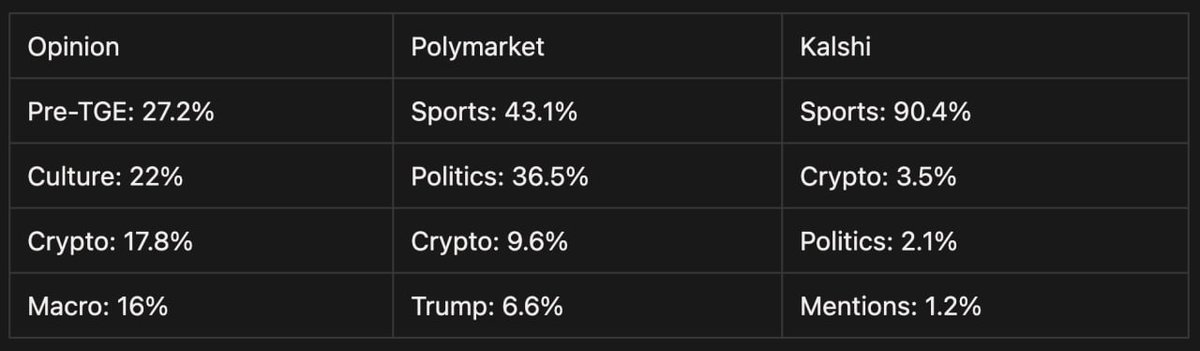
In the face of the huge存量规模 and visible增量空间, market competition is inevitable. Currently, among the four major U.S. sports leagues, only the NHL has stepped in and signed authorization agreements with Kalshi and Polymarket respectively, while the NFL, NBA, and MLB are still in a wait-and-see stage. It is expected that after Polymarket has successively seized the exclusive authorization of UFC and MLS, Kalshi and Polymarket, the two leaders with compliance and capital advantages, are likely to engage in more intense competition for the authorization of various top-tier sports events in the future, and there will inevitably be more exclusive agreements.

But the data also reveals another interesting phenomenon — perhaps due to cultural differences and user habits, emerging prediction markets on the other side of the world are moving towards截然不同的差异化道路. As shown in the previous figure, the proportion of event turnover围绕ing原生加密市场 events on Opinion is much higher than that on Kalshi and Polymarket. While the leaders are clashing head-on over the huge cake of sports events, choosing to take an unconventional path may be an opportunity for second-tier projects to catch up on a curve.


İlgili Sorular

QWhat is the significance of the partnership between MLS's Soccer United Marketing (SUM) and Polymarket?

AThe partnership makes Polymarket the official exclusive prediction market partner for MLS, MLS All-Star Game, MLS Cup, and Leagues Cup, allowing it to use official league data and integrity monitoring systems while restricting markets prone to manipulation or insider information.

QDoes an exclusive prediction market partnership like Polymarket's with MLS prevent other platforms from offering related markets?

ANo, it does not necessarily prevent other platforms from offering markets, as prediction markets currently operate under a less clear regulatory framework compared to sports betting, and authorization isn't legally required to open markets in most cases.

QWhat are the key benefits for a prediction market platform in securing an official data授权 from a sports league?

AOfficial data授权 provides more accurate, timely, and complete data, improving odds accuracy, settlement efficiency, and market variety. It also includes brand授权 for marketing and helps mitigate manipulation through regulated markets and shared monitoring.

QAccording to the data shared by Dovey Wan, what is the proportion of sports-related event volume on Kalshi and Polymarket?

ASports-related event volume accounts for over 90% on Kalshi and 43% on Polymarket, making it a core traffic source for these leading prediction markets.

QHow might the competition for top sports IP affect the prediction market landscape, particularly for second-tier projects?

AThe intense competition for exclusive sports授权 between giants like Kalshi and Polymarket may push second-tier projects to pursue差异化 strategies, such as focusing on crypto-native markets, as seen with Opinion's higher volume in that area.

İlgili Okumalar

Must-Watch Events Next Week|CLARITY Act Could Face Senate Vote; SpaceX, Circle to Report Earnings (8.3-8.9)

**Summary: Key Events and Developments to Watch (August 3-9)** The upcoming week is marked by significant financial disclosures, key legislative deadlines, and notable product updates. **Major Financial Events:** Several companies are scheduled to release their Q2 2026 earnings. American Bitcoin (ABTC) will report on August 3, followed by SpaceX and Hut 8 Mining Corp. on August 4, and Circle on August 5. Notably, a significant portion of SpaceX shares (up to 12% of total shares) will be unlocked on August 6 following their earnings release. **Key Legislative Deadline:** The U.S. Senate faces an August 7 deadline to secure 60 votes for the CLARITY Act, a bipartisan bill aiming to establish a federal regulatory framework for cryptocurrencies. The Senate may hold a full vote on the bill during the week. **Economic Data:** The U.S. July Non-Farm Payrolls report will be released on August 7, providing crucial labor market data. **Technology & Product Updates:** * **Shutdowns:** DeFi portfolio tracker Zapper and wallet app Ctrl Wallet will cease operations on August 3. * **Upgrades:** LayerZero will deprecate its v1 relayers on August 3. XRP Ledger's new version 3.3.0, featuring five new functions, is expected next week. * **AI:** Elon Musk announced that the advanced Grok 4.6 AI model is set for release around August 7. * **Bitcoin:** The BIP-110 forced signaling for a potential Bitcoin network change is scheduled to begin around August 8. **Other Notable Events:** Chinese robotics firm Unitree Tech has set its preliminary price inquiry for its IPO for August 5. South Korean exchange Upbit will delist AQT and AERGO tokens on August 3.

marsbit17 dk önce

Must-Watch Events Next Week|CLARITY Act Could Face Senate Vote; SpaceX, Circle to Report Earnings (8.3-8.9)

marsbit17 dk önce

Stocks Are Plummeting More Sharply Than Cryptocurrencies. Where Has the Money Gone?

Stock Markets Plunge Deeper Than Cryptocurrencies: Where Did the Money Go? In late July, Seoul's Kospi index triggered circuit breakers for two consecutive days, plummeting over 40% from its June high. The collapse was led by heavyweight stocks like SK Hynix, whose record profits still disappointed investors, and devastating leveraged ETFs, with one major product losing over 83% of its value. This signaled a global, forced deleveraging targeting the most crowded trades. Interestingly, while stocks exhibited extreme volatility akin to crypto markets, Bitcoin rose nearly 15% in July after a prior steep drop. Analysis shows the money fleeing equities did not flow into Bitcoin. Instead, Bitcoin had already absorbed its sell-off in May-June, when U.S. spot Bitcoin ETFs saw historic outflows. The true safe-haven beneficiary was gold, whose price rose over 20% year-on-year, highlighting a decoupling between Bitcoin and gold as "digital gold." The sell-off was a targeted unwinding of leveraged positions in tech and semiconductors, accelerated by broker-dealer risk management and shifts in the AI narrative, including new competition from Chinese memory chipmakers. The retreat path was clear: from high-valuation tech stocks to cash and U.S. Treasuries, then to gold. For Bitcoin to attract sustained institutional inflows, conditions like eased global liquidity pressure, a "soft-landing" Fed rate cut, and U.S. regulatory clarity via legislation like the stalled CLARITY Act are needed. Currently, Bitcoin is not a safe haven but an already-cleared asset. Its low correlation with tech stocks, however, makes it a potential diversification play for institutional portfolios once the storm passes. The money isn't here yet, but the positioning is underway.

marsbit17 dk önce

Stocks Are Plummeting More Sharply Than Cryptocurrencies. Where Has the Money Gone?

marsbit17 dk önce

In Conversation with Ray Dalio: We Are Currently in an AI Bubble, with 1% of My Portfolio in Bitcoin

Ray Dalio, founder of Bridgewater Associates, warns in an interview that the current AI boom shows classic bubble characteristics, which could lead to significant economic downturns as seen in past cycles like 1929 or 2000. He explains that speculative enthusiasm, fueled by debt and overvaluation, often precedes a crash when rising rates or taxation force asset sales, causing widespread losses and recession. Dalio also outlines his "Big Cycle" theory, describing an approximate 80-year pattern where widening wealth gaps, massive government deficits, and shifting geopolitical power (like China's rise) create internal conflict and global instability. He emphasizes that we are in a late-cycle, transitional phase where traditional powers like the US and UK face decline. For personal wealth protection, Dalio advises diversification beyond cash into assets like stocks, bonds, real estate, and particularly gold, which he prefers over Bitcoin. While he holds about 1% of his portfolio in Bitcoin as a non-printable hard asset, he views gold as more secure from technological or governmental threats. Regarding AI's impact, Dalio believes it will disproportionately benefit capital owners, worsening inequality by replacing both physical and cognitive labor. He suggests that human intuition and emotional intelligence, combined with AI, will be key for future workers. On taxation, Dalio argues that wealth taxes are impractical and risk triggering asset sell-offs, reducing productive investment. He points to the UK as a cautionary example of debt, low productivity, and political strife. Geopolitically, Dalio foresees a more regionalized world, with the US showing weakness in prolonged conflicts like with Iran, akin to past imperial declines. The ideal outcome, he suggests, is coexisting powerful blocs (e.g., Americas, China-Asia Pacific) without major war.

marsbit4 saat önce

In Conversation with Ray Dalio: We Are Currently in an AI Bubble, with 1% of My Portfolio in Bitcoin

marsbit4 saat önce

Daily 7.2 Trillion KRW: Foreign Capital's Record Net Buying on Friday! Wall Street Says Headwinds for Korean Stock Fund Flows Have Subsided

South Korean stock market sees a dramatic shift in fund flows. On July 31, foreign investors made a record net purchase of approximately KRW 7.2 trillion in KOSPI stocks, marking a fundamental reversal from the persistent large-scale net outflows seen in previous months. This contributed to a significant narrowing of foreign net selling in July to KRW 9.8 trillion, down sharply from KRW 48.4 trillion in June and KRW 44.5 trillion in May. Simultaneously, domestic institutional pressure eased. South Korean pension funds and asset managers turned to a net buying position in July, purchasing KRW 1.0 trillion worth of KOSPI shares, contrasting with net sales in May and June. Market volatility is expected to be dampened by new financial regulations. Effective July 31, the Financial Services Commission tightened access for retail investors to single-stock leveraged ETFs by raising the minimum cash deposit requirement. Trading volumes for these products subsequently dropped to about 50% of their monthly average. Citigroup Research maintains its year-end KOSPI target of 10,000 points. The firm cites several supportive factors: the substantial easing of headwinds from capital outflows, a robust fundamental outlook for the semiconductor sector, historically low market valuations, strong economic fundamentals, and the potential for policy support from financial authorities if needed.

marsbit4 saat önce

Daily 7.2 Trillion KRW: Foreign Capital's Record Net Buying on Friday! Wall Street Says Headwinds for Korean Stock Fund Flows Have Subsided

marsbit4 saat önce

İşlemler

Spot
活动图片




