Predicting Market True and False Gambling Gods: Debunking the 8300x Miracle; Price Manipulation Nets $230,000

marsbit2026-01-19 tarihinde yayınlandı2026-01-19 tarihinde güncellendi

Özet

The article exposes two controversial cases on the prediction market platform Polymarket, highlighting issues of manipulation and deception. First, a trader named "ascetic" claimed to have turned $12 into over $100,000—an 8300x return—through 16 consecutive successful bets on Bitcoin volatility. However, another trader, "Moses," accused ascetic of using multiple fake accounts (a "Sybil farm") to fabricate the results. Moses provided evidence suggesting ascetic operated several accounts that started with small amounts and only promoted the one that succeeded, while others failed. Despite denials, the credibility of the "miracle" was heavily questioned. Second, a different trader exploited Polymarket’s "15-minute XRP price prediction" by manipulating the market. Using $1 million in capital on Binance, the trader bought XRP shortly before the prediction window closed, artificially inflating the price by 0.5% to ensure a winning "up" bet. After cashing out $233,000 in profit on Polymarket, the trader quickly sold the XRP, incurring minimal cost in slippage and fees. This manipulation drained liquidity from automated trading bots on Polymarket, one of which lost $160,000 in annual profits. The piece warns users to be cautious of sensational claims and manipulative strategies in prediction markets, where rules and outcomes can be exploited.

Original|Odaily Planet Daily(@OdailyChina)

Author|Wenser(@wenser 2010)

As a hot sector that has continued to rise since the beginning of the year, the prediction market is no stranger to wealth creation miracles.

But behind these miracles, it takes a discerning eye to tell whether they are genuine wonders achieved through shrewd timing and nimble maneuvering, or false hype created through artificial manipulation and obfuscation. Recently, a Polymarket trader on X claimed to have achieved an "8300x miracle," turning a $12 initial stake into over $100,000 through betting, but was quickly exposed for allegedly using multiple accounts for造假 (fraud) and traffic炒作 (hype). Meanwhile, another trader leveraged price manipulation of XRP to net $230,000 in the "15-minute price prediction" section, executing a one-sided harvest against Polymarket's betting bots.

On the stage of betting for or against, some want to dance with lies, while others exploit rule loopholes for clever plunder. In the bet of right and wrong, there is no unbeatable strategy, only flexible tactics.

The 8300x Miracle from $12 to $100,000: Polymarket's Living Billboard VS Traver's Fabricated Scheme

The story begins with a post "recounting the journey from a $12 principal to $100,000 in profit, achieving an 8300x return."

On January 16th, trader ascetic posted, stating that through "all-or-nothing bets on Bitcoin's short-term volatility," they doubled their principal 16 times consecutively, ultimately achieving the milestone of $100,000 in profit from $12. They also emphasized that they "specifically shared their betting strategy and reasoning" during the process.

Subsequently, they dropped their Polymarket account link in the comments, bluntly stating that such wealth creation miracles can only happen on Polymarket (Odaily Planet Daily Note: Does this sound familiar? Similar phrases have been used by traders for platforms including but not limited to OpenSea, Blur, Pump.fun, Hyperliquid, Aster, etc.).

The comments section then erupted into a "frenzied celebration by Polymarket community members," with countless congratulations, even Polymarket's Head of Global Growth, LeGate, chiming in: "Congrats bro! I think you deserve it! Congrats on the @PolymarketTrade badge!" (Odaily Planet Daily Note: This account is for Polymarket's active trader community.)

If you thought this was a常规 (routine) "overnight riches brag post," you might have underestimated the drama level.

Soon, the narrative of the "8300x return miracle on Polymarket" took a sharp turn.

From Betting Miracle to Fabricated Scam: 8300x Return Data Questioned

On the same day, January 16th, a trader named Moses, who自称 (claimed to be) "ranked 515th in Polymarket trading for 2025," questioned trader ascetic's account data: "Did you ever wonder why his account balance was $3000 in the first post? The answer is simple: he runs a massive 'Sybil farm.' He didn't start with $12, but with hundreds of accounts, each funded with $10 to $20. Once one account reached $2900, he started posting. Since then, he's made seven trades, all wins.

But note, he bets his entire stack every time. Real traders don't do that. He's just chasing clout, doing whatever it takes to get it.

Failing to get enough volume, he even seems to use other accounts for wash trading to hit his desired price.

Please do your own research before blindly trusting 'influencers.' The attached images show some of his failed Sybil accounts, which only made up to $1000."

Moses later added in the comments that all accounts were created 7 months ago and consistently participated in random markets, all starting the same challenge on the same day 2 months ago. The whole "$10 to $100,000" story is fake!

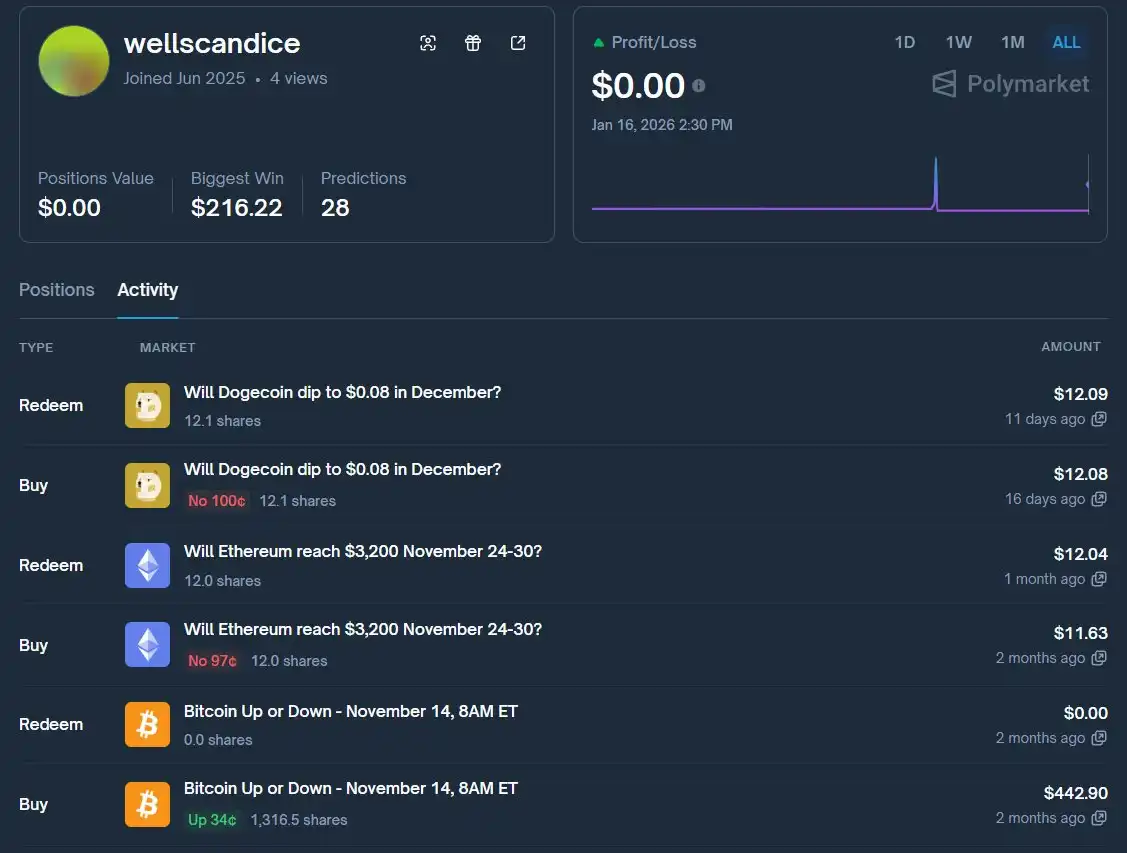
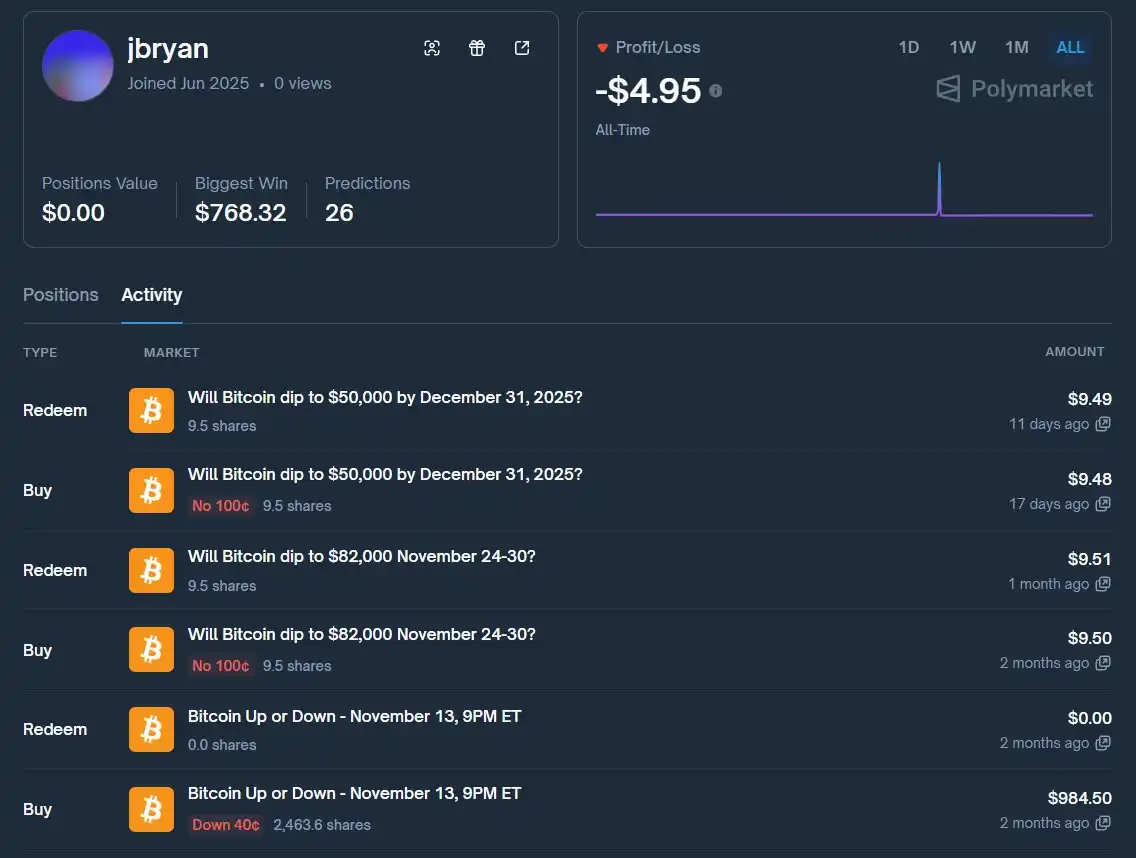
Not only that, he posted screenshots and links to the alleged Sybil account homepages:

  • Account 1: https://polymarket.com/@brockmatthew;
  • Account 2: https://polymarket.com/@wellscandice;
  • Account 3: https://polymarket.com/@jbryan.
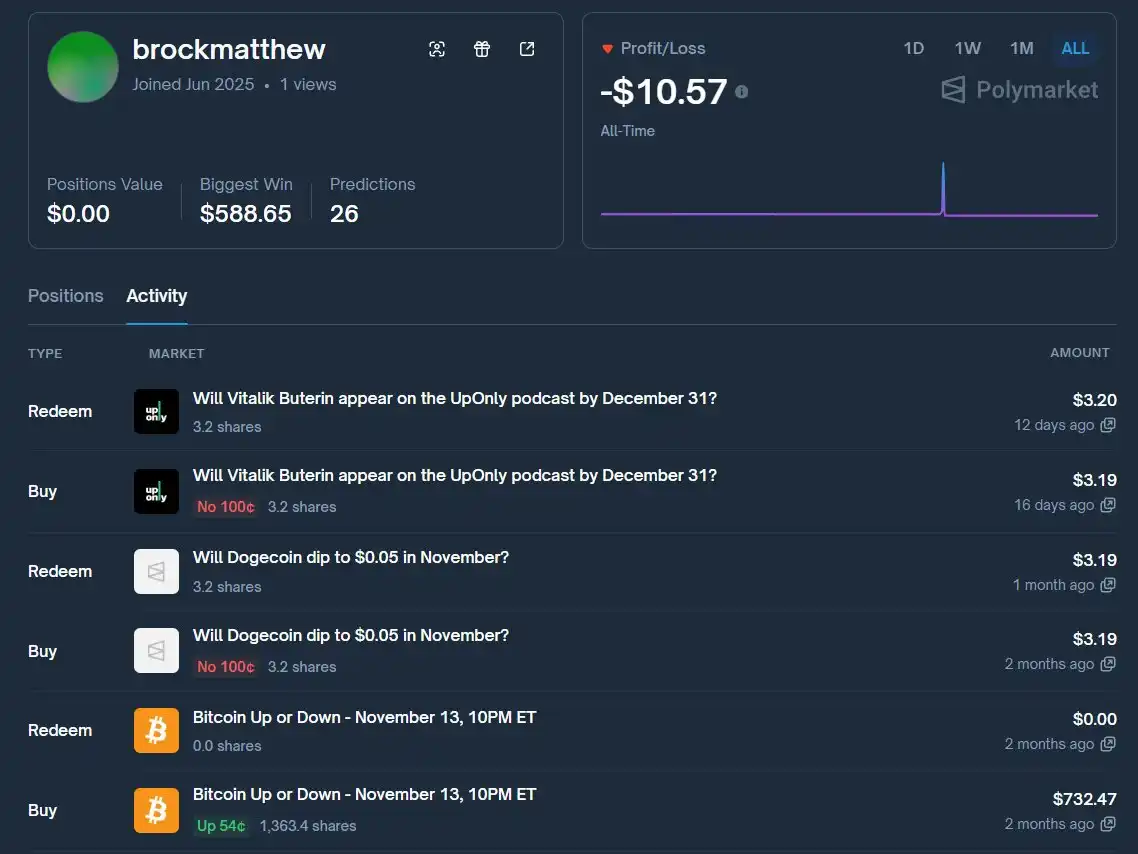
Although ascetic later responded in the comments that the wallets and accounts mentioned by Moses were unrelated to him, and some members of the ZSC DAO (a Polymarket trader community) also voiced support, calling Moses's actions a cyber attack, the association between ascetic's previous bot-like reply content, his Polymarket account, and numerous accounts with similar behavioral patterns significantly undermined the credibility of this "8300x return miracle."

Some commenters also expressed confusion about the motive, stating that "winning 7 consecutive bets" itself is impressive; but others pointed out it was still a game of "bot-like widespread casting of nets."

Somewhat ironically, Moses's own bio reads "The journey from $1 to $1,000,000"—whether this is a real track record or a personal goal remains unknown.

Compared to the hard-to-verify ascetic, the following case of a trader profiting $230,000 through price manipulation in the XRP "15-minute up/down betting market" might be more worthy of study for whale players.

Trader Uses Binance Spot to Counter-Harvest Prediction Market: $1M Principal Nets $230K Profit

On January 18th, Polymarket trader PredictTrader revealed a trader's操作 (operation) worthy of a "Wolf of Wall Street" drama—by harvesting liquidity from trading bots, he made $233,000 in just a few hours, largely unnoticed by the market.

The timing chosen by this trader, a4385, was also extremely clever—it was Saturday evening, with thin market liquidity and relatively poor liquidity on the Binance spot order book.

In the "XRP Up/Down—Jan 17th, 12:45-1:00 PM ET" market, he heavily bought "Yes" shares.

His counterparties were the common "individual market makers" on Polymarket—various trading bots. (Odaily Planet Daily Note: Market making on Polymarket is relatively simple, with low barriers to entry for individual developers, making trading bots very popular). By 10 minutes into the event, XRP was down about 0.3% from the opening price, but he had pushed the price of "Yes" shares up to 70%. The trading bots saw a profit opportunity but instead fell into the price trap set by this trader, selling him more "Yes" shares.

Ultimately, the trader bought $77,000 worth of "Yes" shares at an average price of 48%.

Then, just 2 minutes before the event settled, a wallet on Binance bought approximately $1 million worth of XRP spot, pushing its price up about 0.5%; seconds after the event settled, this $1 million in spot was quickly sold off.

In other words, the cost of this price manipulation was—approximately 0.25% one-way trade slippage + fees.

Using a Binance VIP Level 4 account (0.06%) (easily obtainable) and 0.25% two-way slippage, the total cost would be around $6,200, and the actual operational cost might be lower. By repeating this operation multiple times and exploiting the weekend liquidity漏洞 (loophole), this trader drained the funds of several bot wallets.

Some bots were shut down in time, while others reacted too slowly and lost all their funds—including @aleksandmoney, who lost an entire year's profits (about $160,000).

a4385 Polymarket account link: https://polymarket.com/profile/0x506bce138df20695c03cd5a59a937499fb00b0fe

In conclusion, we hope traders betting for or against on prediction markets can distinguish fact from appearance. Sometimes, the truth is not always objective, and the standards and rules judged by the platform are man-made.


İlgili Sorular

QWhat was the alleged 8300x return story on Polymarket, and who was accused of fabricating it?

AA trader named ascetic claimed to have turned $12 into over $100,000 in profit on Polymarket, achieving an 8300x return through 16 consecutive successful bets. However, another trader, Moses, accused ascetic of fabricating the story by using a 'sybil farm'—multiple accounts each starting with small amounts—to create the illusion of a single account's miraculous success, and even engaging in wash trading to manipulate market prices.

QHow did a trader allegedly manipulate the price of XRP to profit $230,000 on Polymarket?

AA trader (a4385) manipulated the 'XRP up/down - 15-minute' market on Polymarket by first accumulating a large position in 'up' shares at low prices, pushing their value to 70% despite XRP's price dropping. Then, just before the market settled, they bought approximately $1 million worth of XRP on Binance, artificially pumping its price by 0.5% to ensure the 'up' outcome. After settlement, they quickly sold the XRP, netting a $230,000 profit on Polymarket at a minimal cost of slippage and fees, while draining liquidity from automated market maker bots.

QWhat role did trading bots play in the XRP price manipulation incident on Polymarket?

ATrading bots on Polymarket, which act as automated market makers, were the counterparties selling 'up' shares to the manipulative trader (a4385) as he accumulated his position. These bots, perceiving an arbitrage opportunity as the 'up' share price was artificially high relative to the actual XRP price trend, continued selling to him. Their lack of speed and adaptability in a low-liquidity environment (a weekend) made them vulnerable, and several bots, including one run by @aleksandmoney, lost significant funds—in one case, an entire year's profits (~$160,000).

QWhat evidence did Moses provide to dispute ascetic's 8300x return claim?

AMoses provided links to several Polymarket accounts (e.g., brockmatthew, wellscandice, jbryan) that he alleged were ascetic's 'sybil' accounts. He pointed out that these accounts were all created around the same time (7 months ago) and started the same 'challenge' on the same day two months prior. He also noted that ascetic's main account shown in the initial post already had a balance of $3,000, suggesting the starting point was not $12 but a larger combined sum spread across many accounts, and that the all-in betting strategy was not typical of genuine traders but was for clout chasing.

QAccording to the article, what is a common vulnerability or challenge highlighted about prediction markets?

AThe article highlights that prediction markets like Polymarket are vulnerable to manipulation through both social engineering (e.g., fabricating success stories to gain influence) and direct market manipulation (e.g., using capital on external exchanges like Binance to influence the outcome of the event being predicted). It underscores that the 'truth' or outcome of a market can be manipulated, and the platform's rules and judgment criteria are ultimately human-defined and can be exploited.

İlgili Okumalar

SpaceX, OpenAI, Anthropic: The Three AI Giants Racing for IPO, Which One Is Worth Betting On?

SpaceX, OpenAI, and Anthropic are poised for historic IPOs within weeks, potentially raising a combined $180 billion—a sum exceeding the entire internet bubble's fundraising. The hosts of the Limitless Podcast argue this isn't just individual company financing but an unprecedented capital concentration for AI infrastructure, driven by an insatiable need for compute, data centers, power, and chips. SpaceX's IPO is notable for reportedly changing market index rules to allow faster inclusion, potentially funneling trillions in passive retirement funds into its stock, despite its unproven space-based data center business model. In contrast, Anthropic demonstrates explosive growth, with ARR reportedly hitting $45 billion and approaching profitability, fueled by strong enterprise adoption of products like Claude Code. Google's separate $80 billion raise highlights the immense capital pressure, even for giants. The discussion acknowledges bubble risks but leans optimistic. The hosts contend the massive spending is building essential physical infrastructure for the next technological era. A key bottleneck isn't capital but the real-world limits of chip manufacturing and construction speed. As long as demand for AI compute outstrips supply, this investment cycle represents a foundational build-out rather than a purely financial bubble. All three companies are seen as foundational bets on the future, with Anthropic often cited as the most immediately compelling due to its proven revenue trajectory.

marsbit1 saat önce

SpaceX, OpenAI, Anthropic: The Three AI Giants Racing for IPO, Which One Is Worth Betting On?

marsbit1 saat önce

From 'Old Guys' to 'New Favorites': How AI Is Revaluing Old Infrastructure from Dell to Nokia?

From "Vintage Tech" to "New AI Darlings": How AI Revalues Old Infrastructure One year ago, tech giants like Dell, Nokia, Cisco, and Western Data were seen as slow-growth, low-valuation stories, far from the AI spotlight dominated by players like Nvidia. Now, these legacy tech stocks are gaining market attention, sparking debate on whether this is genuine industry revaluation or a temporary narrative. As AI moves from model parameters to real-world data centers, the market is recognizing companies with proven delivery and infrastructure capabilities. This shift marks a change in the AI investment thesis: from pure model and GPU focus to the complex systems engineering required for deployment. Companies like Dell, HPE, and Corning are being revalued not for being "sexy" AI innovators, but for their decades of accumulated expertise in supply chains, enterprise delivery, and infrastructure—assets that have become critical in the AI buildout phase. The revaluation is unfolding across three key infrastructure lines: 1. **Servers & System Integration:** Dell and HPE are emerging as crucial system integrators or "general contractors" for AI data centers, translating GPU orders into complete, deployable server racks integrated with power, cooling, and networking. 2. **Networking & Connectivity:** AI's scale demands robust high-speed connections. Corning (fiber optics), Nokia (AI-RAN, 6G), and Cisco (data center switches) are gaining importance for enabling efficient data transfer within and between AI clusters. 3. **Storage:** Beyond high-speed memory (HBM/DRAM), the AI data explosion is driving demand for high-capacity hard drives (HDDs) from companies like Western Digital and Seagate to handle training data, logs, and cold storage cost-effectively. For this revaluation to be substantive and not just a narrative, three criteria are key: 1) Concrete AI-related order and revenue growth (e.g., Dell's AI server sales), 2) Upward revisions to company financial guidance, and 3) Sustainable improvements in profit quality, not just top-line revenue spikes. In essence, AI's transition to a real construction phase is re-pricing "old assets" against "new demand." The opportunity, however, is selective. Only those legacy firms that are demonstrably integrated into the capital expenditure chains of data center and enterprise AI deployment are likely to experience a true "logic re-rating" rather than just a temporary valuation bounce.

marsbit1 saat önce

From 'Old Guys' to 'New Favorites': How AI Is Revaluing Old Infrastructure from Dell to Nokia?

marsbit1 saat önce

The Merger of Codex and ChatGPT Marks the Beginning of a Major Reshuffle in Programming Tools

OpenAI is shifting its strategic focus from ChatGPT to Codex, merging them along with the browser tool Atlas into a unified desktop super-app. This move signals an internal belief that Codex, originally a programming tool, represents the next evolution of AI more than conversational models like ChatGPT. Over the past year, Codex's weekly active users have surged past 5 million. The key distinction is that while ChatGPT answers questions, Codex executes tasks. Enterprises increasingly value this ability to get work done over simply receiving advice. Consequently, Codex is attracting professionals beyond developers, including analysts, bankers, marketers, and product managers. OpenAI's reorganization and increased investment in Codex stem from recognizing that the future of AI competition lies in execution capabilities, not just conversation. The company is launching role-specific plugins (e.g., for data analysis, sales, design) to transform Codex into a broad knowledge work platform that automates and redefines white-collar workflows. Beyond being a tool, Codex reflects OpenAI's ambition to redefine software. New features like "Sites"—which generates interactive websites from documents—and collaborative "Annotations" aim to create a paradigm where the AI understands the goal and handles the tools and steps, functioning more like a digital colleague than traditional software. The ultimate goal is a unified experience where the user cares only about the completed task.

marsbit1 saat önce

The Merger of Codex and ChatGPT Marks the Beginning of a Major Reshuffle in Programming Tools

marsbit1 saat önce

Interpreting Investment Opportunities in the Age of Great Navigation, Invesco Great Wall Fund Releases '2026 Report on Chinese Enterprises Going Global'

Invesco Great Wall Fund has released its "2026 China Corporate Globalization Report," titled "The 'Great Navigation Era' of Chinese Enterprises." The report analyzes the new trends and investment opportunities as Chinese companies expand globally, moving from simple product exports to comprehensive overseas operations involving services, branding, and local production. Driven by factors like trade friction, the pursuit of higher profit margins abroad, and policy support, globalization is becoming essential for Chinese companies. The report outlines an evolution: from early product export ("Globalization 1.0") to the current "Globalization 2.0," characterized by overseas capacity, capital goods investment, consumer brand expansion, and service exports. Chinese firms' competitive advantages are highlighted, including a vast engineer talent pool, low-cost and robust infrastructure, and complete industrial clusters. Specific sectors with significant出海 potential are identified: * **Capital Goods** (e.g., engineering machinery, power equipment): Benefiting from global demand, especially in Belt & Road markets and the AI-driven power grid upgrade cycle. * **Consumer Brands**: Transitioning from cost to brand advantage, leveraging供应链 efficiency. * **Technology & Innovation**: Including AI applications, optical modules within global tech supply chains, and new energy vehicles focusing on local production. * **Pharmaceuticals**: Chinese biotech firms are becoming preferred partners for global pharma, with potential for breakthrough drugs in areas like oncology and weight loss. The report concludes that corporate globalization represents a sustained, core theme for China's capital markets, though companies must navigate challenges like geopolitics and localization.

marsbit1 saat önce

Interpreting Investment Opportunities in the Age of Great Navigation, Invesco Great Wall Fund Releases '2026 Report on Chinese Enterprises Going Global'

marsbit1 saat önce

İşlemler

Spot
Futures

Popüler Makaleler

GODS Nasıl Satın Alınır

HTX.com’a hoş geldiniz! Gods Unchained (GODS) satın alma işlemlerini basit ve kullanışlı bir hâle getirdik. Adım adım açıkladığımız rehberimizi takip ederek kripto yolculuğunuza başlayın. 1. Adım: HTX Hesabınızı OluşturunHTX'te ücretsiz bir hesap açmak için e-posta adresinizi veya telefon numaranızı kullanın. Sorunsuzca kaydolun ve tüm özelliklerin kilidini açın. Hesabımı Aç2. Adım: Kripto Satın Al Bölümüne Gidin ve Ödeme Yönteminizi SeçinKredi/Banka Kartı: Visa veya Mastercard'ınızı kullanarak anında Gods Unchained (GODS) satın alın.Bakiye: Sorunsuz bir şekilde işlem yapmak için HTX hesap bakiyenizdeki fonları kullanın.Üçüncü Taraflar: Kullanımı kolaylaştırmak için Google Pay ve Apple Pay gibi popüler ödeme yöntemlerini ekledik.P2P: HTX'teki diğer kullanıcılarla doğrudan işlem yapın.Borsa Dışı (OTC): Yatırımcılar için kişiye özel hizmetler ve rekabetçi döviz kurları sunuyoruz.3. Adım: Gods Unchained (GODS) Varlıklarınızı SaklayınGods Unchained (GODS) satın aldıktan sonra HTX hesabınızda saklayın. Alternatif olarak, blok zinciri transferi yoluyla başka bir yere gönderebilir veya diğer kripto para birimlerini takas etmek için kullanabilirsiniz.4. Adım: Gods Unchained (GODS) Varlıklarınızla İşlem YapınHTX'in spot piyasasında Gods Unchained (GODS) ile kolayca işlemler yapın.Hesabınıza erişin, işlem çiftinizi seçin, işlemlerinizi gerçekleştirin ve gerçek zamanlı olarak izleyin. Hem yeni başlayanlar hem de deneyimli yatırımcılar için kullanıcı dostu bir deneyim sunuyoruz.

153 Toplam GörüntülenmeYayınlanma 2024.12.13Güncellenme 2026.06.02

GODS Nasıl Satın Alınır

Tartışmalar

HTX Topluluğuna hoş geldiniz. Burada, en son platform gelişmeleri hakkında bilgi sahibi olabilir ve profesyonel piyasa görüşlerine erişebilirsiniz. Kullanıcıların GODS (GODS) fiyatı hakkındaki görüşleri aşağıda sunulmaktadır.

活动图片