Polymarket New Rules Released: How to Build a New Trading Bot

marsbit2026-02-25 tarihinde yayınlandı2026-02-25 tarihinde güncellendi

Özet

Polymarket has removed the 500ms taker delay and introduced dynamic taker fees, rendering many existing trading bots obsolete. The new meta shifts advantage from taker arbitrage to market making. A profitable bot in 2026 must be a maker bot, leveraging zero fees and USDC rebates. Key requirements include using WebSocket (not REST), fee-aware order signing with the `feeRateBps` field, and a sub-100ms cancel/replace loop to avoid adverse selection. The architecture involves connecting to the CLOB, querying fee rates per market, and placing maker orders on both YES/NO sides. For 5-minute BTC markets, a deterministic strategy involves placing maker orders at $0.90–0.95 with 10 seconds remaining, capitalizing on ~85% directional certainty. Critical mistakes to avoid are using REST, omitting feeRateBps, high-latency infrastructure, and outdated taker strategies. AI can assist in implementation, but must be guided by the new technical constraints.

Editor's Note: Polymarket removed the 500ms delay without prior announcement and introduced dynamic fees, instantly rendering a large number of existing bots obsolete overnight. This article systematically outlines the correct way to build trading bots under these new rules, providing a clear and actionable path—from the fee mechanism and order signing to market-making logic and low-latency architecture.

After publication, the article garnered 1.1M views, sparking widespread discussion. Under Polymarket's new rules, the advantage is shifting from taker arbitrage to long-term structures centered around market making and liquidity provision.

Original text below:

Polymarket Quietly Removed the 500ms Delay

Here’s the clear explanation: How to build a bot that actually runs and makes money under the new rules.

Two days ago, Polymarket removed the 500ms taker quote delay in crypto markets. No announcement, no warning. Overnight, half the bots on the platform stopped working. But at the same time, this created the biggest opportunity window for new bots since Polymarket launched.

Today I will explain in detail: How to build a bot that still works under the new rules.

Because every solution you saw before February 18th is now outdated.

If you ask an AI model to write Polymarket bot code for you right now, it will give you a solution based on the old rules: REST polling, no fee handling, completely unaware the 500ms buffer is gone.

Such a bot will lose money from the very first trade.

Let me explain: What exactly changed, and how to redesign your bot around these changes.

What Changed?

Three key changes happened over the past two months:

1. The 500ms Taker Delay Was Removed (February 18, 2026)

Previously, all taker orders waited 500ms before execution. Market makers relied on this buffer time to cancel "stale" quotes, which was almost like free insurance.

Now it's different. Taker orders execute immediately, with no cancellation window.

2. Dynamic Taker Fees Introduced in Crypto Markets (January 2026)

15-minute and 5-minute crypto markets now charge taker fees. The formula is: Fee = C × 0.25 × (p × (1 - p))²

Peak fee: ~1.56% around 50% probability

Fee approaches 0 in extreme probability ranges (near 0 or 1)

Remember that bot that arbitraged the price delay between Binance and Polymarket, making $515,000 in a month with a 99% win rate?

That strategy is completely dead. Because the fee alone is now higher than the arbitrageable spread.

What is the New Meta?

In one sentence: Be a maker, not a taker.

The reasons are simple:

· Makers pay no fees

· Makers earn daily USDC rebates (subsidized by taker fees)

· With the 500ms delay gone, maker order execution is actually faster

The top bots now profit just from rebates, without even needing the spread. If you're still running a taker bot, you're facing a constantly rising fee curve. Around 50% probability, you need at least a 1.56% edge just to break even.

Good luck.

So, How Should a Truly Viable 2026 Bot Be Built?

Here is a design思路 (design approach) for a bot architecture that remains effective in 2026:
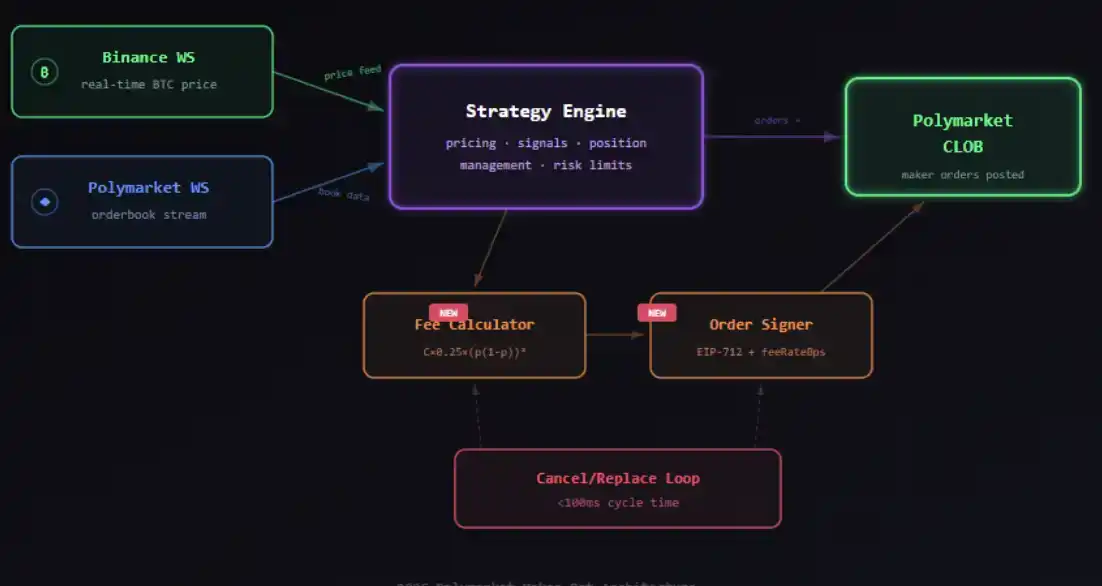
Core Components:

1. Use WebSocket, Not REST

REST polling is completely obsolete. By the time your HTTP request completes a round trip, the opportunity is long gone. You need a real-time order book data stream based on WebSocket, not intermittent pulling.

2. Fee-Aware Order Signing

This is a new requirement that didn't exist before. Now, the feeRateBps field must be included in the payload of the order you sign. If you omit this field, orders will be outright rejected in markets where fees are enabled.

3. Ultra-Fast Cancel/Replace Loop

With the 500ms buffer removed: If your cancel-replace process takes over 200ms, you will suffer from adverse selection. Others will snatch your stale quotes before you can update them.

How to Build It

1. Get Your Private Key

Use the same private key you use to log in to Polymarket (EOA / MetaMask / Hardware Wallet)

export POLYMARKET_PRIVATE_KEY="0xyour_private_key_here"

2. Set Up Approvals (One-Time Operation)

Before Polymarket can execute your trades, you need to approve the following contracts: USDC, Conditional Tokens.

This only needs to be done once per wallet.

3. Connect to the CLOB (Central Limit Order Book)

The official Python client can be used directly: pip install py-clob-client

However, there are now faster options in the Rust ecosystem:

· polyfill-rs (Hot path zero-allocation, SIMD JSON parsing, ~21% performance boost)

· polymarket-client-sdk (Official Polymarket Rust SDK)

· polymarket-hft (Complete HFT framework, integrates CLOB + WebSocket)

Which one you choose isn't critical; the key is to pick the one you can get up and running the fastest.

4. Query the Fee Rate Before Placing Every Order

GET /fee-rate?tokenID={token_id}

Never hardcode fees.
Fees vary by market, and Polymarket can adjust them at any time.

5. Include the Fee Field in Order Signing

When signing the order, the fee field must be written into the payload. Missing this will cause the order to be rejected in fee-enabled markets.

{
"salt": "...",
"maker": "0x...",
"signer": "0x...",
"taker": "0x...",
"tokenId": "...",
"makerAmount": "50000000",
"takerAmount": "100000000",
"feeRateBps": "150"
}

The CLOB will validate your order signature based on feeRateBps. If the fee rate in the signature doesn't match the current actual rate, the order will be rejected outright.

If you use the official SDK (Python or Rust), this logic is handled automatically; but if you implement the signing logic yourself, you must handle this, otherwise the order simply won't go through.

6. Place Maker Orders on Both Sides (Bid and Ask)

Provide liquidity to the market by placing limit orders: On both YES and NO tokens; Place both BUY and SELL orders. This is the core way you earn rebates.

7. Run a Cancel/Replace Loop

You need to monitor simultaneously: External price feeds (e.g., Binance WebSocket); Your current open orders on Polymarket.

Once the price changes: Immediately cancel outdated quotes; Re-place orders at the new price. The goal: Keep the entire cycle under 100ms.

Special Note on 5-Minute Markets

The 5-minute cycle BTC up/down markets are deterministic.

You can directly calculate the specific market just from the timestamp:
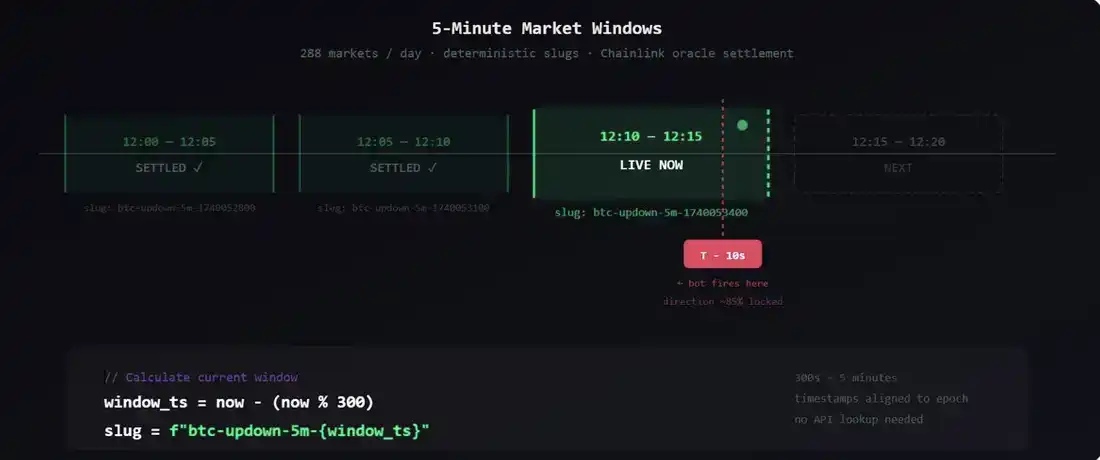
There are 288 markets per day. Each one is a fresh opportunity.

Currently validated effective strategy: By T–10 seconds before the window closes, the direction of BTC's move is about 85% determined, but the odds on Polymarket haven't fully reflected this information yet.

The method is: On the side with the higher probability; Place maker orders at a price of $0.90–0.95.

If filled: Profit $0.05–0.10 per contract at settlement; Zero fees; Plus you get rebates.

The real advantage comes from: Figuring out BTC's direction faster than other market makers, and getting your orders up sooner.

Common Mistakes That Will Get You Wiped Out

· Still using REST instead of WebSocket

· Not including feeRateBps in order signing

· Running the bot on home Wi-Fi (150ms+ latency, vs. <5ms for datacenter VPS)

· Market making near 50% probability without considering adverse selection risk

· Hardcoding fee rates

· Not merging YES/NO positions (locking up capital)

· Still using 2025's taker arbitrage mindset

The Right Way to Use AI

The technical part ends here. Now you understand: The architecture design, fee calculation method, and new market rules.

Next, you can open Claude or any reliable AI model and give it a sufficiently clear and specific task description, for example: "Here is the Polymarket SDK. Please write a maker bot for the 5-minute BTC market that: Listens to Binance WebSocket for prices; Places maker orders on both YES and NO sides; Includes feeRateBps in order signing; Uses WebSocket for order book data; Keeps the cancel/replace cycle under 100ms."

The correct workflow is: You define the tech stack, infrastructure, and constraints, and the AI generates the specific strategy and implementation logic on top of that.

Of course, no matter how perfectly you describe the bot's logic, you must test it before going live. Especially at this stage, where fees are already materially eroding profit margins, backtesting under the real fee curve is a mandatory step before deployment.

The bots that will truly win in 2026 are not the fastest takers, but the best liquidity providers.

Build your system accordingly.

İlgili Sorular

QWhat are the key changes in Polymarket's rules that have made old trading bots obsolete?

AThe key changes are: 1) Removal of the 500ms taker delay on February 18, 2026, which eliminated the free 'insurance' period for market makers to cancel stale quotes. 2) Introduction of a dynamic taker fee schedule in January 2026, calculated as `fee = C × 0.25 × (p × (1 - p))^2`, which peaks at ~1.56% near 50% probability. These changes rendered taker arbitrage strategies, like the one that previously profited from Binance-Polymarket delays, unprofitable.

QWhat is the new 'meta' or recommended approach for building a profitable bot on Polymarket in 2026?

AThe new meta is to be a maker, not a taker. This is because makers pay no fees, earn USDC rebates (subsidized by taker fees), and benefit from faster order execution with the 500ms delay removed. The most successful bots can now profit from rebates alone, even without capturing price spreads.

QWhat are the critical technical components of a viable 2026 Polymarket bot architecture?

AThe critical components are: 1) Using WebSocket for real-time data instead of REST polling. 2) Implementing fee-aware order signing by including the `feeRateBps` field in the signed payload. 3) Establishing an ultra-fast cancel/replace loop (aiming for under 100ms) to avoid adverse selection and update stale quotes before they are taken.

QWhat is a specific, effective strategy mentioned for the 5-minute BTC markets?

AAn effective strategy is to identify the likely direction of BTC price movement (which is ~85% determined in the last 10 seconds of the window) and place maker orders on the higher probability side at prices between $0.90–$0.95. If filled, this yields a profit of $0.05–$0.10 per contract at settlement, plus rebates, with zero fees.

QWhat are some common mistakes that will cause a bot to fail under the new rules?

ACommon fatal mistakes include: using REST instead of WebSocket; omitting the `feeRateBps` field in order signing; running the bot on high-latency home Wi-Fi (>150ms) instead of a low-latency VPS (

İlgili Okumalar

In Conversation with Ray Dalio: We Are Currently in an AI Bubble, with 1% of My Portfolio in Bitcoin

Ray Dalio, founder of Bridgewater Associates, warns in an interview that the current AI boom shows classic bubble characteristics, which could lead to significant economic downturns as seen in past cycles like 1929 or 2000. He explains that speculative enthusiasm, fueled by debt and overvaluation, often precedes a crash when rising rates or taxation force asset sales, causing widespread losses and recession. Dalio also outlines his "Big Cycle" theory, describing an approximate 80-year pattern where widening wealth gaps, massive government deficits, and shifting geopolitical power (like China's rise) create internal conflict and global instability. He emphasizes that we are in a late-cycle, transitional phase where traditional powers like the US and UK face decline. For personal wealth protection, Dalio advises diversification beyond cash into assets like stocks, bonds, real estate, and particularly gold, which he prefers over Bitcoin. While he holds about 1% of his portfolio in Bitcoin as a non-printable hard asset, he views gold as more secure from technological or governmental threats. Regarding AI's impact, Dalio believes it will disproportionately benefit capital owners, worsening inequality by replacing both physical and cognitive labor. He suggests that human intuition and emotional intelligence, combined with AI, will be key for future workers. On taxation, Dalio argues that wealth taxes are impractical and risk triggering asset sell-offs, reducing productive investment. He points to the UK as a cautionary example of debt, low productivity, and political strife. Geopolitically, Dalio foresees a more regionalized world, with the US showing weakness in prolonged conflicts like with Iran, akin to past imperial declines. The ideal outcome, he suggests, is coexisting powerful blocs (e.g., Americas, China-Asia Pacific) without major war.

marsbit19 dk önce

In Conversation with Ray Dalio: We Are Currently in an AI Bubble, with 1% of My Portfolio in Bitcoin

marsbit19 dk önce

Daily 7.2 Trillion KRW: Foreign Capital's Record Net Buying on Friday! Wall Street Says Headwinds for Korean Stock Fund Flows Have Subsided

South Korean stock market sees a dramatic shift in fund flows. On July 31, foreign investors made a record net purchase of approximately KRW 7.2 trillion in KOSPI stocks, marking a fundamental reversal from the persistent large-scale net outflows seen in previous months. This contributed to a significant narrowing of foreign net selling in July to KRW 9.8 trillion, down sharply from KRW 48.4 trillion in June and KRW 44.5 trillion in May. Simultaneously, domestic institutional pressure eased. South Korean pension funds and asset managers turned to a net buying position in July, purchasing KRW 1.0 trillion worth of KOSPI shares, contrasting with net sales in May and June. Market volatility is expected to be dampened by new financial regulations. Effective July 31, the Financial Services Commission tightened access for retail investors to single-stock leveraged ETFs by raising the minimum cash deposit requirement. Trading volumes for these products subsequently dropped to about 50% of their monthly average. Citigroup Research maintains its year-end KOSPI target of 10,000 points. The firm cites several supportive factors: the substantial easing of headwinds from capital outflows, a robust fundamental outlook for the semiconductor sector, historically low market valuations, strong economic fundamentals, and the potential for policy support from financial authorities if needed.

marsbit20 dk önce

Daily 7.2 Trillion KRW: Foreign Capital's Record Net Buying on Friday! Wall Street Says Headwinds for Korean Stock Fund Flows Have Subsided

marsbit20 dk önce

Thanks to Dice Rolls, Bitcoin Keys Are Stored Offline, But Not Everyone Will Do It

The article discusses using dice rolls to generate secure Bitcoin wallet seeds, providing entropy independent of potentially flawed hardware random number generators. It explains that each fair dice roll offers about 2.585 bits of entropy, with around 50 rolls needed for a standard 12-word seed phrase and 99+ recommended for higher security. This method gained attention after a vulnerability was revealed in some Coldcard hardware wallets, where a faulty firmware RNG (dating back to 2021) compromised generated keys. The analysis notes that while a dice-generated main seed was safe from this specific flaw, other Coldcard functions (like creating paper wallets, backup keys, or passwords) could still be vulnerable if they used the defective RNG. The piece argues that while dice-based entropy is technically robust, the manual process is error-prone, tedious, and unrealistic for most new users, who might make mistakes in recording or inputting rolls. It concludes that while manual entropy generation should remain an option for advanced users, the long-term goal is to develop reliable, user-friendly hardware and software that securely generates randomness without requiring specialized knowledge. Coldcard users are advised to check their firmware version and replace any secondary secrets (like paper wallet keys) created with vulnerable devices, while also considering multi-signature setups with devices from different manufacturers for added security.

cryptonews.ru5 saat önce

Thanks to Dice Rolls, Bitcoin Keys Are Stored Offline, But Not Everyone Will Do It

cryptonews.ru5 saat önce

İşlemler

Spot
活动图片





