Polymarket bets surge on Lighter airdrop as Hyperliquid lists LIT

cointelegraph2025-12-23 tarihinde yayınlandı2025-12-23 tarihinde güncellendi

Özet

Lighter, a perpetual decentralized exchange (perp DEX) and rival to Hyperliquid, is generating significant airdrop speculation. A core contributor announced the platform is finalizing its token generation event (TGE), including removing Sybil and wash-trading points from its Season 2 rewards program. Hype intensified when Hyperliquid listed the yet-to-launch LIT token. Lighter opened an airdrop allocation form, allowing users to direct tokens to additional wallets, with submissions accepted until Friday. The transfer of 250 million LIT tokens (25% of supply) further fueled expectations. On prediction market Polymarket, the odds of an airdrop occurring by December 31st have surged to 86%, with $9.5 million in betting volume. Lighter recently raised $68 million in a round led by Founders Fund and Ribbit Capital.

Lighter, a perpetual decentralized exchange (perp DEX) and a major rival to Hyperliquid, is fueling airdrop speculation as Polymarket traders bet on a token launch before year’s end.

Sebas, also known as Babastianj, a core contributor to the Lighter DEX, announced on the project’s Discord channel Monday that the platform is finalizing key processes ahead of the highly anticipated token generation event (TGE).

“We’re in the final stretch of Season 2 and are running data science to remove Sybil, self-trading, and wash-trading points,” he said, adding that all slashed and removed points are planned to be redistributed to the community.

The announcement has fueled growing optimism over Lighter’s airdrop, further amplified with Hyperliquid’s listing of the yet-to-launch Lighter token against USDC (USDC) on Monday.

Lighter’s airdrop allocation form open until Friday

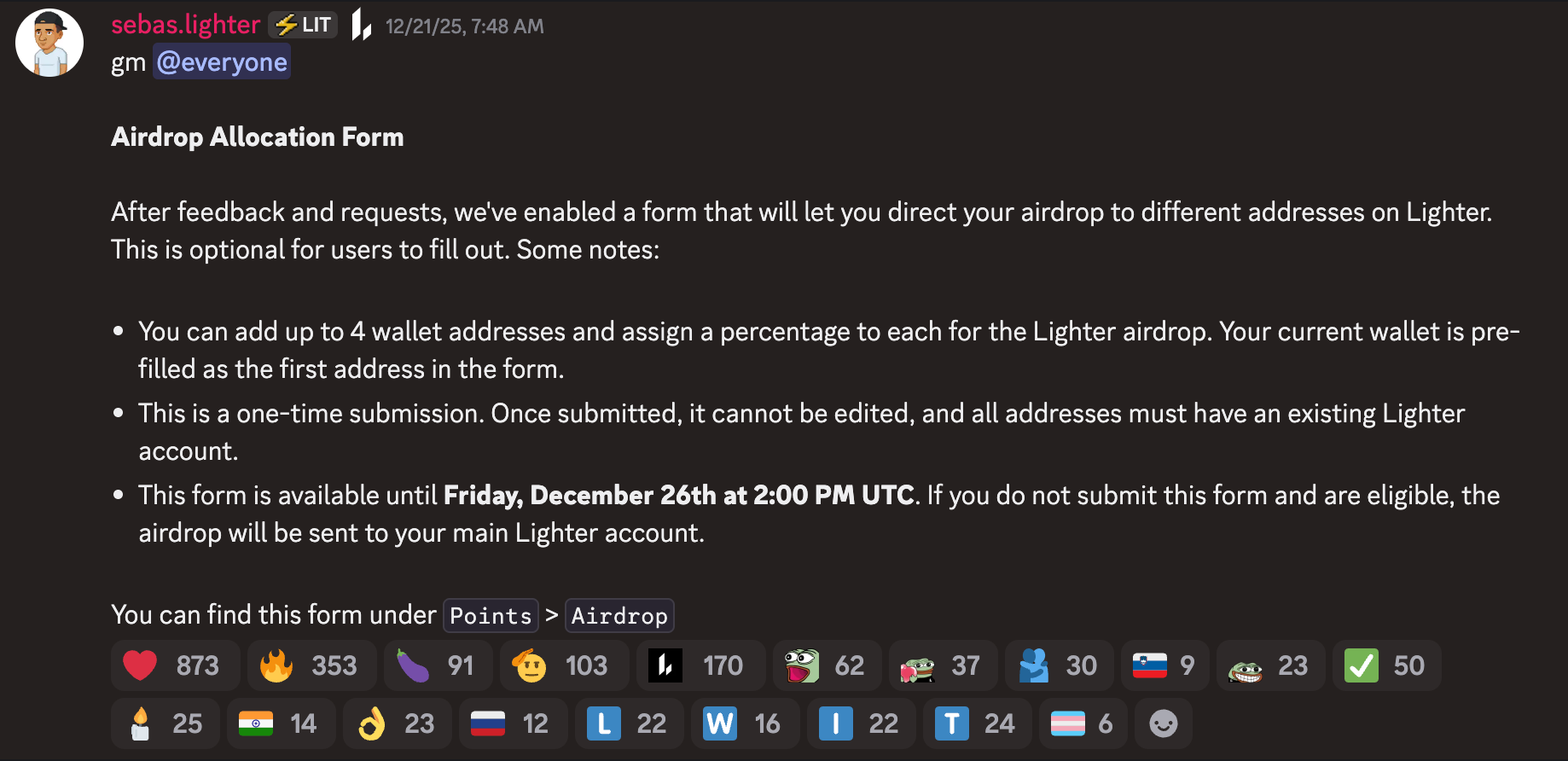
Lighter launched an airdrop allocation form on Sunday, allowing users to direct their tokens to up to four additional wallets.

The optional form lets users allocate different token amounts to each wallet, with submissions accepted through Friday.

“If you do not submit this form and are eligible, the airdrop will be sent to your main Lighter account,” Sebas said on Discord.
Source: Discord

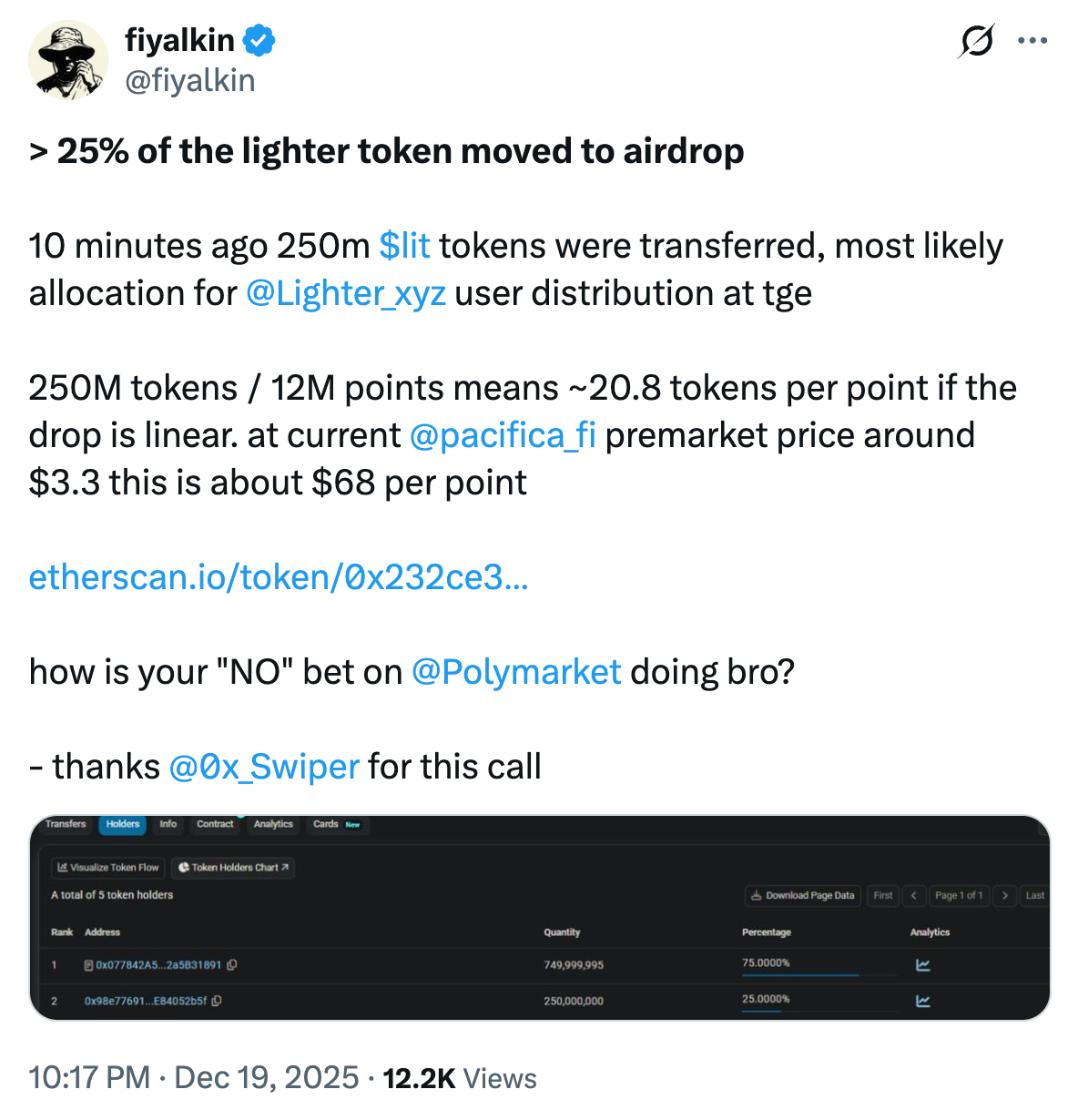
Lighter transferred 250 million LIT tokens — representing 25% of the total supply — on Friday, sparking community speculation that the move signaled an upcoming user airdrop ahead of the TGE, expected by Dec. 31.
Source: Fiyalkin

According to Lighter, its Season 1 points program ended with the final private beta distribution on Sept. 30, while Season 2 points are distributed every Friday.

Related: Hyperliquid says ex-employee responsible for HYPE token shorting

The points are earned by running organic trading strategies via user interface and application programming interface.

Polymarket odds on Lighter airdrop at 86%

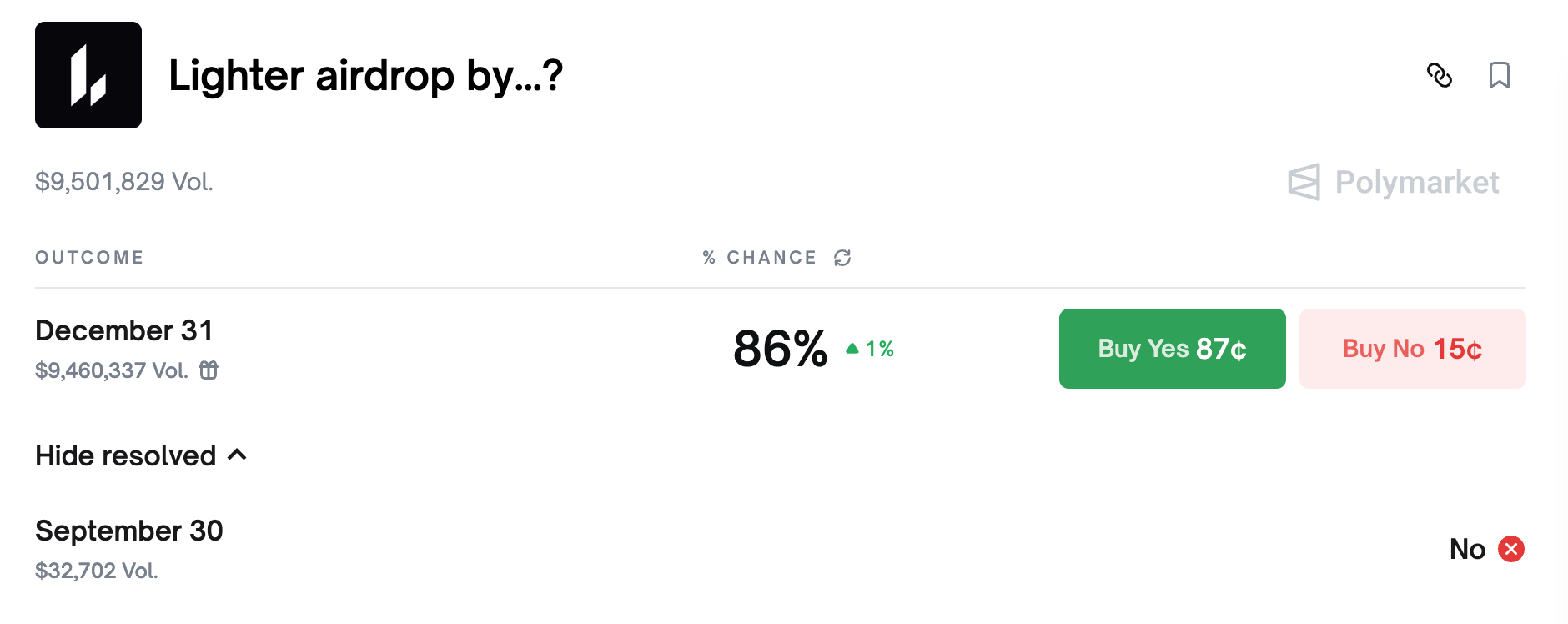
Amid rising community anticipation, the odds that Lighter’s airdrop will occur before the end of the year have been climbing on the prediction market Polymarket, with $9.5 million in volume backing bets that it will take place by Dec. 31.

At least 86% of traders have positioned their predictions on a “yes” scenario.

Onchain analyst Andrew 10 GWEI previously suggested that the airdrop would happen by the end of December, using an alleged insider bet proof on Polymarket.
Source: Polymarket

The news follows Lighter’s $68 million fundraising round announced in November, led by Peter Thiel’s Founders Fund and fintech investor Ribbit Capital, shortly after the platform launched its public mainnet in October.

Related: Coinbase opens Solana DEX access as CeFi and DeFi converge

Founded in 2022 by tech entrepreneur Vladimir Novakovski, Lighter has emerged as a key competitor in the perpetual decentralized exchange market, ranking as the second-largest perp DEX after Hyperliquid at the time of publication, according to DefiLlama data.

In mid-December, major US cryptocurrency exchange Coinbase added Lighter to its listing roadmap, signaling a potential future listing of the token, which has yet to be generated.

İlgili Sorular

QWhat is the current probability on Polymarket that Lighter's airdrop will occur before the end of the year?

AThe current probability on Polymarket is 86%, with $9.5 million in volume backing bets that the airdrop will take place by December 31st.

QWhat action did Hyperliquid take that amplified the speculation around Lighter's token?

AHyperliquid listed the yet-to-launch Lighter token (LIT) against USDC on Monday, which amplified the growing optimism over the airdrop.

QWhat is the purpose of the airdrop allocation form that Lighter launched, and until when is it open?

AThe optional airdrop allocation form allows eligible users to direct their tokens to up to four additional wallets, with different amounts for each. Submissions are accepted through Friday.

QWhat percentage of the total LIT token supply was transferred recently, and what did this action spark in the community?

ALighter transferred 250 million LIT tokens, representing 25% of the total supply. This sparked community speculation that it signaled an upcoming user airdrop ahead of the Token Generation Event (TGE).

QWho led Lighter's recent $68 million fundraising round?

AThe $68 million fundraising round was led by Peter Thiel's Founders Fund and fintech investor Ribbit Capital.

İlgili Okumalar

Can a Hair Dryer Earn $34,000? Deciphering the Reflexivity Paradox in Prediction Markets

An individual manipulated a weather sensor at Paris Charles de Gaulle Airport with a portable heat source, causing a Polymarket weather market to settle at 22°C and earning $34,000. This incident highlights a fundamental issue in prediction markets: when a market aims to reflect reality, it also incentivizes participants to influence that reality. Prediction markets operate on two layers: platform rules (what outcome counts as a win) and data sources (what actually happened). While most focus on rules, the real vulnerability lies in the data source. If reality is recorded through a specific source, influencing that source directly affects market settlement. The article categorizes markets by their vulnerability: 1. **Single-point physical data sources** (e.g., weather stations): Easily manipulated through physical interference. 2. **Insider information markets** (e.g., MrBeast video details): Insiders like team members use non-public information to trade. Kalshi fined a剪辑师 $20,000 for insider trading. 3. **Actor-manipulated markets** (e.g., Andrew Tate’s tweet counts): The subject of the market can control the outcome. Evidence suggests Tate’sociated accounts coordinated to profit. 4. **Individual-action markets** (e.g., WNBA disruptions): A single person can execute an event to profit from their pre-placed bets. Kalshi and Polymarket handle these issues differently. Kalshi enforces strict KYC, publicly penalizes insider trading, and reports to regulators. Polymarket, with its anonymous wallet-based system, has historically been more permissive, arguing that insider information improves market accuracy. However, it cooperated with authorities in the "Van Dyke case," where a user traded on classified government information. The core paradox is reflexivity: prediction markets are designed to discover truth, but their financial incentives can distort reality. The more valuable a prediction becomes, the more likely participants are to influence the event itself. The market ceases to be a mirror of reality and instead shapes it.

marsbit10 dk önce

Can a Hair Dryer Earn $34,000? Deciphering the Reflexivity Paradox in Prediction Markets

marsbit10 dk önce

First Day Review of "Musk's WeChat" XChat: Even Worse Than Expected

Elon Musk's much-anticipated "WeChat-like" app, XChat, has officially launched after multiple delays. The initial review reveals a product that falls short of expectations, offering an experience largely similar to X Platform's (formerly Twitter) direct messages, despite being marketed as an encrypted communication tool. Key observations from the first-day test include: 1. The app's promoted "end-to-end encryption" and its claimed relation to Bitcoin's architecture were criticized by experts as a superficial attempt to capitalize on crypto buzz, with no real technical connection. 2. Musk's vision of an ad-free "secure communication system" is technically met, but only because the app is currently extremely basic, featuring only a single chat interface. 3. A promised anti-screenshot feature appears inconsistent; it works in X Platform group chats but fails within the XChat app itself, where screenshots still capture avatars. 4. The app supports 45 languages and has a 16+ age rating, indicating a broader tolerance for content compared to WeChat's 13+ rating. 5. A puzzling login process requires users to verify the email associated with their X account. 6. The touted encryption" feels minimal in practice, with its presence only indicated by a simple "Encrypted - Yes" label on messages. 7. Disappearing message timers for groups can be set from 5 minutes to 4 weeks, with the timer starting upon being read by a user. 8. Group invite links are shared with X Platform groups. 9. Group size limits are planned to be increased, aiming for 1000 members, a move that has drawn user criticism. 10. The app offers 8 different colored icons, and its chat bubbles are notably similar to WeChat's. Message deletion options mimic Telegram's. Crucially, many pre-announced features like importing X contacts, integrating Grok AI, X Money payments, and Cashtags are not yet available. The initial release is seen as a bare-bones and underwhelming first step.

Odaily星球日报1 saat önce

First Day Review of "Musk's WeChat" XChat: Even Worse Than Expected

Odaily星球日报1 saat önce

İşlemler

Spot
Futures
活动图片

