Polymarket And Kalshi Are Now Under Congressional Investigation — The Evidence That Triggered It Is Hard To Dismiss

bitcoinist2026-05-22 tarihinde yayınlandı2026-05-22 tarihinde güncellendi

Özet

Congress has launched a formal investigation into prediction market platforms Polymarket and Kalshi, led by House Oversight Committee Chairman James Comer. The probe demands explanations on how the platforms prevent insider trading, sparked by suspicious bets tied to classified U.S. military actions. Evidence includes a U.S. soldier's trades before the Venezuela incursion and accounts netting millions from well-timed wagers on U.S.-Iran strikes and a ceasefire announcement. Both companies, which recently updated their rules, face scrutiny over their rapid growth and Washington lobbying. This investigation poses a significant threat that could reshape the prediction market industry.

Representative James Comer, Republican of Kentucky and chairman of the House Oversight and Government Reform Committee, announced a formal investigation into prediction market platforms Polymarket and Kalshi on May 22 — demanding that the CEOs of both companies explain how their platforms detect and prevent insider trading, in a probe triggered by a series of suspicious trades tied to classified US military operations and geopolitical events.

Comer, who announced the investigation on CNBC’s Squawk Box, sent formal letters to the leadership of both platforms seeking information on how they verify user identities, enforce bans on users from restricted jurisdictions, and identify unusual trading patterns that could indicate exploitation of non-public information, per CNBC’s reporting. The inquiry marks a significant escalation of congressional scrutiny that has been building across both parties for months.
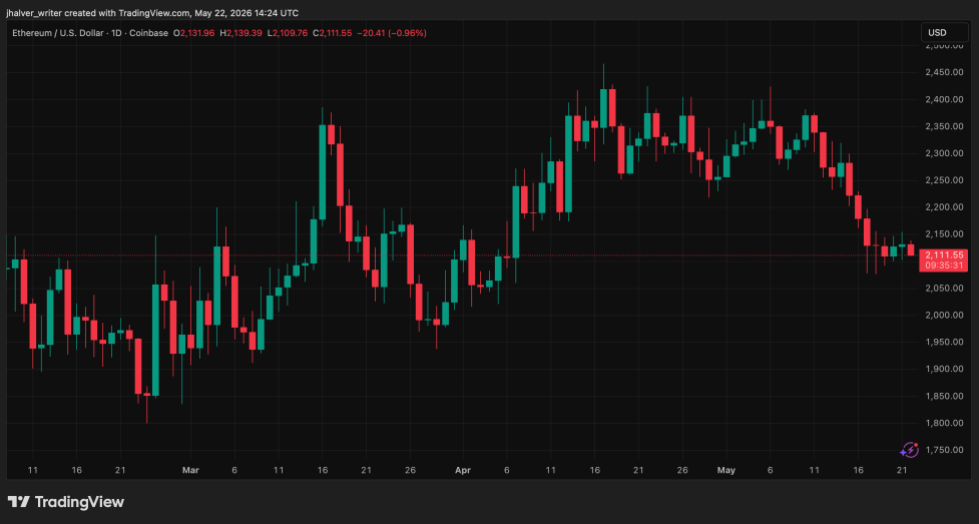
ETH's price trends to the downside on the daily chart. Source: ETHUSD on Tradingview 

The Evidence That Triggered The Probe

The specific trading patterns that prompted the investigation are difficult to dismiss as coincidence. A US special forces soldier was arrested for placing insider trades on Polymarket tied to the US military incursion into Venezuela that resulted in the capture of President Nicolás Maduro — bets placed hours before the operation became public knowledge, per The Hill’s reporting.

A separate trader accumulated nearly $1 million with a 93% success rate on wagers predicting unannounced US and Israeli operations against Iran, placing bets hours before strikes in October 2024, June 2025, and February 2026, according to a CNN report cited by Democratic lawmakers in a letter to Comer.

The February 28 incident is the most striking data point. A group of 38 accounts collectively netted more than $2 million on bets tied to that day’s Iran strikes — with the accounts preloaded with funds the preceding week, per the Democratic lawmakers’ letter. On April 7, at least 50 newly created accounts placed coordinated bets on a US-Iran ceasefire, some opened minutes before the announcement, per the same letter.

Polymarket separately reported suspicious activity across nearly 50 accounts in advance of the US-Iran ceasefire talks, per casino.org’s reporting of the congressional correspondence.

Both Platforms Push Back

Kalshi responded through its head of communications, Elisabeth Diana, who said the company looks forward to engaging with the committee and described its protections against insider trading as comprehensive, per CNBC. Polymarket did not immediately respond to a request for comment at the time of publication.

Both platforms announced updated rules and surveillance tools in March 2026, restricting politicians from trading on their own campaigns and barring athletes from sports-related contracts — moves that preceded but did not prevent the current congressional escalation.

The investigation lands at a moment of peak political sensitivity for prediction markets. Combined trading volumes on Kalshi and Polymarket reached tens of billions of dollars in March 2026 alone, per TipRanks. Both platforms count Donald Trump Jr. as an advisor. And both spent a combined nearly $1 million on federal lobbying in 2025, per CNBC — a Washington presence that may now complicate rather than protect their regulatory standing.

This development marks a pivotal and potentially consequential moment for the nascent prediction market sector. A formal congressional investigation with documented evidence of military-linked insider trading is a categorically different threat than a regulatory inquiry — and the outcome could reshape how these platforms operate, who can participate, and whether the CFTC’s current oversight framework survives intact.

Cover image from Grok, ETHUSD chart from Tradingview

İlgili Sorular

QWhat event prompted Representative James Comer to launch a congressional investigation into Polymarket and Kalshi?

AThe investigation was triggered by a series of suspicious trades tied to classified US military operations and geopolitical events, including bets placed by a US special forces soldier and other traders before the operations became public knowledge.

QWhat specific evidence of insider trading is cited in the article regarding the February 2026 Iran strikes?

AOn February 28, a group of 38 accounts collectively netted more than $2 million on bets tied to that day's Iran strikes. These accounts had been preloaded with funds the week before the event.

QWhat information did Representative Comer demand from the CEOs of Polymarket and Kalshi?

AHe demanded that the CEOs explain how their platforms detect and prevent insider trading, including their methods for verifying user identities, enforcing bans on users from restricted jurisdictions, and identifying unusual trading patterns.

QHow did the platforms of Polymarket and Kalshi attempt to address concerns before the investigation was launched?

ABoth platforms announced updated rules and surveillance tools in March 2026, which included restricting politicians from trading on their own campaigns and barring athletes from sports-related contracts.

QWhy is the current moment described as being of 'peak political sensitivity' for prediction markets like Polymarket and Kalshi?

AIt is a sensitive moment due to high trading volumes, the platforms' political connections (such as counting Donald Trump Jr. as an advisor), their significant spending on federal lobbying, and the formal congressional investigation into documented evidence of military-linked insider trading.

İlgili Okumalar

STRC Breaks Below $95: Why Does It Continue to Depeg? Is There Default Risk?

"STRC Falls Below $95: Why the Persistent Depegging and Is There Default Risk?" The article discusses the recent decline in the price of STRC, a perpetual preferred stock issued by Strategy (MSTR) designed to trade around a $100 par value. As of publication, STRC traded at $94.65, raising market concerns. STRC is described as a high-yield cash flow product, offering an 11.50% annual dividend paid monthly. Its "preferred" status grants it priority over common stock for dividends and in liquidation. Key reasons cited for the price depegging include: 1. **Bitcoin's Price Drop:** MSTR's assets are heavily tied to Bitcoin (BTC), which fell over 21% from its recent high, pressuring all Strategy-related products. 2. **Competitive Pressure:** Rival Strive Asset Management's similar product, SATA, offers daily dividends and has maintained its $100 par value with a ~13% yield. In response, Strategy has proposed changing STRC's dividend frequency from monthly to bi-weekly, pending shareholder vote. 3. **Technical Selling:** A break below $100 may have triggered algorithmic selling and stop-losses, exacerbating the decline. Regarding default risk, the analysis suggests it is currently low. Strategy founder Michael Saylor confirmed the June 2026 dividend rate remains at 11.50% with no cuts or suspensions. The company's massive reserve of 843,706 BTC provides a significant backstop for its obligations. Industry opinions are mixed. Some analysts view the BTC holdings as reliable support for dividends, while critics like Peter Schiff warn of potential dividend cuts leading to price crashes and lawsuits. Others highlight inflation risk and the company's ability to reduce dividends without a formal default. In summary, STRC's drop is attributed to BTC volatility, competition, and technical factors. While immediate default risk appears contained, the product faces challenges from market conditions and competitive dynamics.

marsbit1 saat önce

STRC Breaks Below $95: Why Does It Continue to Depeg? Is There Default Risk?

marsbit1 saat önce

AI Trading Cools, South Korean Stocks Plunge 1.8%, Spot Gold Rises 1%, Bitcoin Dives

A sell-off in AI-related stocks, triggered by Broadcom's disappointing earnings forecast, sent shockwaves through global markets. South Korea's KOSPI led Asia's decline, plunging 1.8% as the risks from concentrated chip stock gains and surging leveraged investments came to the fore. The tech-heavy Nasdaq 100 futures fell 0.5% following Broadcom's 14% after-hours plunge, which signaled a slower-than-expected transition to AI clients. This pullback extended Wall Street's weakness, halting the S&P 500's nine-day rally amid hawkish Fed signals and renewed Middle East tensions. South Korean authorities convened an emergency meeting, pledging "immediate measures" against market volatility and warning of record-high stock margin debt. The adjustment rippled across assets: Bitcoin fell to around $64,000, its lowest since February, while safe-haven gold rose 1% on bargain hunting. Oil prices dipped on Middle East ceasefire news. Market analysts noted the sell-off was driven by profit-taking after massive gains, particularly in chip stocks like Samsung and SK Hynix, which now dominate the KOSPI. Wall Street banks are divided on Korea's outlook, with Goldman Sachs raising its target while Citigroup and others warn of overvaluation and a potential bubble. Bridgewater's Ray Dalio noted that great technological shifts often create bubbles. Meanwhile, Fed officials' hints at potential future rate hikes added to the cautious mood ahead of key U.S. jobs data.

华尔街日报1 saat önce

AI Trading Cools, South Korean Stocks Plunge 1.8%, Spot Gold Rises 1%, Bitcoin Dives

华尔街日报1 saat önce

İşlemler

Spot
Futures

Popüler Makaleler

HOUSE Nasıl Satın Alınır

HTX.com’a hoş geldiniz! Housecoin (HOUSE) satın alma işlemlerini basit ve kullanışlı bir hâle getirdik. Adım adım açıkladığımız rehberimizi takip ederek kripto yolculuğunuza başlayın. 1. Adım: HTX Hesabınızı OluşturunHTX'te ücretsiz bir hesap açmak için e-posta adresinizi veya telefon numaranızı kullanın. Sorunsuzca kaydolun ve tüm özelliklerin kilidini açın. Hesabımı Aç2. Adım: Kripto Satın Al Bölümüne Gidin ve Ödeme Yönteminizi SeçinKredi/Banka Kartı: Visa veya Mastercard'ınızı kullanarak anında Housecoin (HOUSE) satın alın.Bakiye: Sorunsuz bir şekilde işlem yapmak için HTX hesap bakiyenizdeki fonları kullanın.Üçüncü Taraflar: Kullanımı kolaylaştırmak için Google Pay ve Apple Pay gibi popüler ödeme yöntemlerini ekledik.P2P: HTX'teki diğer kullanıcılarla doğrudan işlem yapın.Borsa Dışı (OTC): Yatırımcılar için kişiye özel hizmetler ve rekabetçi döviz kurları sunuyoruz.3. Adım: Housecoin (HOUSE) Varlıklarınızı SaklayınHousecoin (HOUSE) satın aldıktan sonra HTX hesabınızda saklayın. Alternatif olarak, blok zinciri transferi yoluyla başka bir yere gönderebilir veya diğer kripto para birimlerini takas etmek için kullanabilirsiniz.4. Adım: Housecoin (HOUSE) Varlıklarınızla İşlem YapınHTX'in spot piyasasında Housecoin (HOUSE) ile kolayca işlemler yapın.Hesabınıza erişin, işlem çiftinizi seçin, işlemlerinizi gerçekleştirin ve gerçek zamanlı olarak izleyin. Hem yeni başlayanlar hem de deneyimli yatırımcılar için kullanıcı dostu bir deneyim sunuyoruz.

341 Toplam GörüntülenmeYayınlanma 2025.04.27Güncellenme 2026.06.02

HOUSE Nasıl Satın Alınır

Tartışmalar

HTX Topluluğuna hoş geldiniz. Burada, en son platform gelişmeleri hakkında bilgi sahibi olabilir ve profesyonel piyasa görüşlerine erişebilirsiniz. Kullanıcıların HOUSE (HOUSE) fiyatı hakkındaki görüşleri aşağıda sunulmaktadır.

活动图片