Polymarket And Kalshi Are Now Under Congressional Investigation — The Evidence That Triggered It Is Hard To Dismiss

bitcoinist2026-05-22 tarihinde yayınlandı2026-05-22 tarihinde güncellendi

Özet

Congress has launched a formal investigation into prediction market platforms Polymarket and Kalshi, led by House Oversight Committee Chairman James Comer. The probe demands explanations on how the platforms prevent insider trading, sparked by suspicious bets tied to classified U.S. military actions. Evidence includes a U.S. soldier's trades before the Venezuela incursion and accounts netting millions from well-timed wagers on U.S.-Iran strikes and a ceasefire announcement. Both companies, which recently updated their rules, face scrutiny over their rapid growth and Washington lobbying. This investigation poses a significant threat that could reshape the prediction market industry.

Representative James Comer, Republican of Kentucky and chairman of the House Oversight and Government Reform Committee, announced a formal investigation into prediction market platforms Polymarket and Kalshi on May 22 — demanding that the CEOs of both companies explain how their platforms detect and prevent insider trading, in a probe triggered by a series of suspicious trades tied to classified US military operations and geopolitical events.

Comer, who announced the investigation on CNBC’s Squawk Box, sent formal letters to the leadership of both platforms seeking information on how they verify user identities, enforce bans on users from restricted jurisdictions, and identify unusual trading patterns that could indicate exploitation of non-public information, per CNBC’s reporting. The inquiry marks a significant escalation of congressional scrutiny that has been building across both parties for months.
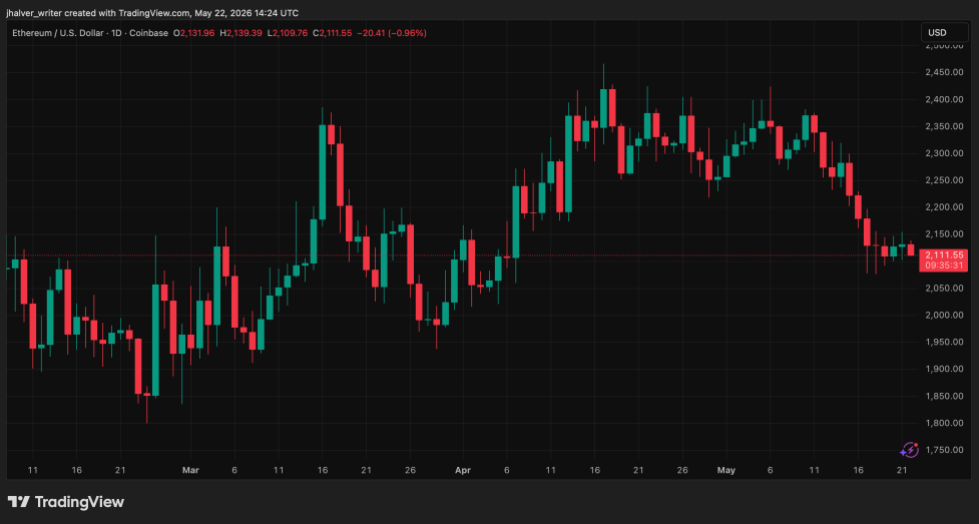
ETH's price trends to the downside on the daily chart. Source: ETHUSD on Tradingview 

The Evidence That Triggered The Probe

The specific trading patterns that prompted the investigation are difficult to dismiss as coincidence. A US special forces soldier was arrested for placing insider trades on Polymarket tied to the US military incursion into Venezuela that resulted in the capture of President Nicolás Maduro — bets placed hours before the operation became public knowledge, per The Hill’s reporting.

A separate trader accumulated nearly $1 million with a 93% success rate on wagers predicting unannounced US and Israeli operations against Iran, placing bets hours before strikes in October 2024, June 2025, and February 2026, according to a CNN report cited by Democratic lawmakers in a letter to Comer.

The February 28 incident is the most striking data point. A group of 38 accounts collectively netted more than $2 million on bets tied to that day’s Iran strikes — with the accounts preloaded with funds the preceding week, per the Democratic lawmakers’ letter. On April 7, at least 50 newly created accounts placed coordinated bets on a US-Iran ceasefire, some opened minutes before the announcement, per the same letter.

Polymarket separately reported suspicious activity across nearly 50 accounts in advance of the US-Iran ceasefire talks, per casino.org’s reporting of the congressional correspondence.

Both Platforms Push Back

Kalshi responded through its head of communications, Elisabeth Diana, who said the company looks forward to engaging with the committee and described its protections against insider trading as comprehensive, per CNBC. Polymarket did not immediately respond to a request for comment at the time of publication.

Both platforms announced updated rules and surveillance tools in March 2026, restricting politicians from trading on their own campaigns and barring athletes from sports-related contracts — moves that preceded but did not prevent the current congressional escalation.

The investigation lands at a moment of peak political sensitivity for prediction markets. Combined trading volumes on Kalshi and Polymarket reached tens of billions of dollars in March 2026 alone, per TipRanks. Both platforms count Donald Trump Jr. as an advisor. And both spent a combined nearly $1 million on federal lobbying in 2025, per CNBC — a Washington presence that may now complicate rather than protect their regulatory standing.

This development marks a pivotal and potentially consequential moment for the nascent prediction market sector. A formal congressional investigation with documented evidence of military-linked insider trading is a categorically different threat than a regulatory inquiry — and the outcome could reshape how these platforms operate, who can participate, and whether the CFTC’s current oversight framework survives intact.

Cover image from Grok, ETHUSD chart from Tradingview

İlgili Sorular

QWhat event prompted Representative James Comer to launch a congressional investigation into Polymarket and Kalshi?

AThe investigation was triggered by a series of suspicious trades tied to classified US military operations and geopolitical events, including bets placed by a US special forces soldier and other traders before the operations became public knowledge.

QWhat specific evidence of insider trading is cited in the article regarding the February 2026 Iran strikes?

AOn February 28, a group of 38 accounts collectively netted more than $2 million on bets tied to that day's Iran strikes. These accounts had been preloaded with funds the week before the event.

QWhat information did Representative Comer demand from the CEOs of Polymarket and Kalshi?

AHe demanded that the CEOs explain how their platforms detect and prevent insider trading, including their methods for verifying user identities, enforcing bans on users from restricted jurisdictions, and identifying unusual trading patterns.

QHow did the platforms of Polymarket and Kalshi attempt to address concerns before the investigation was launched?

ABoth platforms announced updated rules and surveillance tools in March 2026, which included restricting politicians from trading on their own campaigns and barring athletes from sports-related contracts.

QWhy is the current moment described as being of 'peak political sensitivity' for prediction markets like Polymarket and Kalshi?

AIt is a sensitive moment due to high trading volumes, the platforms' political connections (such as counting Donald Trump Jr. as an advisor), their significant spending on federal lobbying, and the formal congressional investigation into documented evidence of military-linked insider trading.

İlgili Okumalar

AI PC Battle: Bet on the Toll Booth, Not the Camp

**Title:** The AI PC Battle: Don't Bet on Sides, Bet on the Tollbooth **Summary:** The AI PC competition is moving beyond simple "x86 vs. Arm" narratives. The core investment thesis should focus on identifying which players can sustain margins, cash flow, and pricing power throughout the upgrade cycle, rather than backing a particular architecture. The opportunity is analyzed in three layers: 1. **The Advanced Foundry Tollbooth:** TSMC is positioned to collect "tolls" regardless of which chip designer wins, due to its dominant ~70% share in advanced semiconductor manufacturing, which is essential for high-end AI PC chips. 2. **Compute & Platform Spillover:** AMD represents an offensive in the x86 CPU+GPU space, while NVIDIA leverages its GPU and CUDA software stack dominance. Both benefit from the demand for increased local AI compute. 3. **Architecture Diffusion & Turnaround Plays:** ARM and Intel offer potential for significant upside (elasticity), but investments here require stricter discipline due to higher execution risks and competitive challenges. The industry is transitioning from concept to shipment validation. While short-term forecasts for AI PC adoption have been revised down slightly due to tariffs and procurement delays, the long-term trend towards AI becoming a standard PC feature remains intact. The key driver for upgrade cycles will be whether compelling enterprise applications (e.g., privacy-sensitive computing, low-latency inference) emerge beyond consumer-focused features like meeting summarization. Investment strategy should prioritize companies with platform-level advantages and recurring revenue streams. TSMC offers high certainty as the foundational tollbooth. AMD presents a strong offensive play within the established ecosystem. ARM and Intel are higher-risk, higher-potential-reward turnaround bets. The report cautions against chasing short-term hype and emphasizes a disciplined, long-term approach focused on buying ecosystem strength and cash-flow certainty after market enthusiasm subsides. **Key Risks:** Underwhelming AI PC applications slowing upgrade cycles; slow improvement in Windows on Arm compatibility; macro/tariff impacts on PC demand; potential advanced node supply-demand mismatches affecting TSMC; high overall AI sector valuations making stocks vulnerable to a risk-off shift in markets.

marsbit12 dk önce

AI PC Battle: Bet on the Toll Booth, Not the Camp

marsbit12 dk önce

Ten-Thousand-Word Analysis: From $10 to $290, MRVL Wins the Entire AI Era by 'Not Making GPUs'

Marvell Technology's stock price surged from under $10 in 2016 to a record $290 in June 2026, fueled not by making GPUs, but by dominating AI infrastructure connectivity. This analysis argues the market misvalues MRVL as merely a smaller Broadcom in custom AI chips, overlooking its true, unique position. Marvell's core strength lies in enabling high-speed data flow for AI clusters through three interconnected businesses. First, it holds a commanding ~70% market share in high-speed optical DSPs (essential for data center light modules), a deep-moat business with accelerating growth. Second, its custom AI chip design business serves hyperscalers like AWS, Microsoft, and Google, with a significant revenue pipeline despite lower margins. Third, stable cash flows come from Ethernet switch chips and enterprise storage controllers. Together, they form a full-stack "AI data movement" platform. CEO Matt Murphy's transformative leadership since 2016, involving strategic divestments, key acquisitions (like Inphi for optical DSPs), and securing long-term agreements with major cloud providers, repositioned the company. A pivotal $2 billion strategic investment from NVIDIA in 2026 underscored Marvell's critical role in the AI ecosystem, particularly through collaborations like NVLink Fusion. While Marvell faces risks—including client concentration (losing the Amazon Trainium3 design), lower-margin business mix, competitive threats, insider selling, and complex supply chains—its fundamentals remain strong. The optical interconnect moat is widening with the acquisition of Celestial AI (photonics fabric), and financial metrics show accelerating revenue growth and operating leverage. With a PEG ratio suggesting undervaluation relative to its growth, the thesis is that the market undervalues Marvell's monopolistic position in AI "plumbing" while overemphasizing its competitive custom chip segment. The story transcends investing, symbolizing how in any complex system—from the internet to AI—the value of "connection" ultimately surpasses that of individual "nodes."

marsbit41 dk önce

Ten-Thousand-Word Analysis: From $10 to $290, MRVL Wins the Entire AI Era by 'Not Making GPUs'

marsbit41 dk önce

AI Relay Stations Spark Heated Debate on Zhihu: Behind Cheap Tokens, What Are Users Really Worried About?

A discussion on Zhihu about "AI relay stations" shifted the niche developer topic of "cheap tokens" into broader user awareness. Users moved beyond simply questioning the legitimacy of these services to focus on practical concerns: Where do cheap tokens truly come from? Is the model being accessed the real one? Can relay stations see prompts, code, and API keys? For occasional users, are the risks worth it? The core debate centered less on price and more on trust. A primary worry is model authenticity—the risk of "model swapping," where users paying for a premium model might be routed to a cheaper one, creating an information asymmetry. Others argued that cost comparisons matter; while cheaper than official pay-as-you-go APIs, relay stations may not be the lowest-cost option versus subscriptions, domestic models, or free tiers, making user needs assessment crucial. Speculation about token sources ranged from legitimate bulk discounts to gray-area methods like account sharing or exploiting regional pricing. This opacity makes risk assessment difficult for users. Data security emerged as a critical concern, especially for enterprise use. When processing sensitive information like code, contracts, or client data, the inability to verify a relay station's data handling, retention, or access policies poses significant compliance and confidentiality risks. The evolving consensus suggests relay stations can be used cautiously for low-sensitivity, disposable tasks (e.g., summarizing public info, simple translation). However, they should not be the default for sensitive, professional, or production workflows involving proprietary data, Agents, or automated systems. Recommendations include avoiding large prepayments, not relying on a single service, using test prompts to monitor quality, anonymizing data where possible, and keeping official channels as backups. Ultimately, the discussion framed tokens not just as a billing unit but as a measure of real cost encompassing price, model integrity, data security, and service stability. The popularity of relay stations highlights user demand for affordable access, but the debate underscores a key trade-off: the savings from cheap tokens may come at the price of trust, transparency, and control over one's data and AI experience.

marsbit1 saat önce

AI Relay Stations Spark Heated Debate on Zhihu: Behind Cheap Tokens, What Are Users Really Worried About?

marsbit1 saat önce

In-Depth Research Report on TradFi: The Convergence Wave of Crypto and Traditional Finance

In 2026, the crypto industry is undergoing a profound infrastructure-level transformation—TradFi assets are migrating on-chain at an unprecedented pace. According to CoinGecko's Q1 2026 report, the total value locked (TVL) of tokenized real-world assets (RWA) has surpassed $31 billion, a nearly 4x increase from $7.8 billion at the beginning of 2025, with the sector’s aggregate market capitalization reaching $19.3 billion. Among these, the market cap of tokenized stocks surged from $2 million to $486 million, with Q1 spot trading volume reaching $15.1 billion—a single quarter already surpassing the entire second half of 2025. RWA perpetual contract Q1 trading volume reached a staggering $524.8 billion, far exceeding the $313 billion for all of 2025. Meanwhile, BlackRock's BUIDL fund has reached $2.3 billion in scale and has filed for two new tokenized funds, signaling that the world's largest asset manager's tokenization strategy is evolving from pilot to product suite expansion. HTX, as a core participant in the crypto exchange sector, officially launched TradFi perpetual futures products including NVDA, AAPL, MSFT, META, and SPY in 2026, enabling crypto users to gain 24/7 trading access to core U.S. equities. Boston Consulting Group predicts that global tokenized asset scale could reach $16 trillion by 2030, while McKinsey offers a conservative estimate of approximately $2 trillion. The on-chain migration of TradFi assets is no longer a "future narrative" but a structural transformation unfolding in real time, as crypto exchanges evolve from single crypto asset trading platforms toward "multi-asset-class trading infrastructure."

HTX Learn1 saat önce

In-Depth Research Report on TradFi: The Convergence Wave of Crypto and Traditional Finance

HTX Learn1 saat önce

İşlemler

Spot
Futures

Popüler Makaleler

HOUSE Nasıl Satın Alınır

HTX.com’a hoş geldiniz! Housecoin (HOUSE) satın alma işlemlerini basit ve kullanışlı bir hâle getirdik. Adım adım açıkladığımız rehberimizi takip ederek kripto yolculuğunuza başlayın. 1. Adım: HTX Hesabınızı OluşturunHTX'te ücretsiz bir hesap açmak için e-posta adresinizi veya telefon numaranızı kullanın. Sorunsuzca kaydolun ve tüm özelliklerin kilidini açın. Hesabımı Aç2. Adım: Kripto Satın Al Bölümüne Gidin ve Ödeme Yönteminizi SeçinKredi/Banka Kartı: Visa veya Mastercard'ınızı kullanarak anında Housecoin (HOUSE) satın alın.Bakiye: Sorunsuz bir şekilde işlem yapmak için HTX hesap bakiyenizdeki fonları kullanın.Üçüncü Taraflar: Kullanımı kolaylaştırmak için Google Pay ve Apple Pay gibi popüler ödeme yöntemlerini ekledik.P2P: HTX'teki diğer kullanıcılarla doğrudan işlem yapın.Borsa Dışı (OTC): Yatırımcılar için kişiye özel hizmetler ve rekabetçi döviz kurları sunuyoruz.3. Adım: Housecoin (HOUSE) Varlıklarınızı SaklayınHousecoin (HOUSE) satın aldıktan sonra HTX hesabınızda saklayın. Alternatif olarak, blok zinciri transferi yoluyla başka bir yere gönderebilir veya diğer kripto para birimlerini takas etmek için kullanabilirsiniz.4. Adım: Housecoin (HOUSE) Varlıklarınızla İşlem YapınHTX'in spot piyasasında Housecoin (HOUSE) ile kolayca işlemler yapın.Hesabınıza erişin, işlem çiftinizi seçin, işlemlerinizi gerçekleştirin ve gerçek zamanlı olarak izleyin. Hem yeni başlayanlar hem de deneyimli yatırımcılar için kullanıcı dostu bir deneyim sunuyoruz.

341 Toplam GörüntülenmeYayınlanma 2025.04.27Güncellenme 2026.06.02

HOUSE Nasıl Satın Alınır

Tartışmalar

HTX Topluluğuna hoş geldiniz. Burada, en son platform gelişmeleri hakkında bilgi sahibi olabilir ve profesyonel piyasa görüşlerine erişebilirsiniz. Kullanıcıların HOUSE (HOUSE) fiyatı hakkındaki görüşleri aşağıda sunulmaktadır.

活动图片













