Polygon vs. Ethereum: Why ‘micro’ AI agents are winning fee war on POL

ambcrypto2026-02-17 tarihinde yayınlandı2026-02-17 tarihinde güncellendi

Özet

Polygon has surpassed Ethereum in daily transaction fees, a significant milestone, with its daily fees exceeding $300,000. This surge reflects a notable increase in network activity, as daily transactions on Polygon also rose by approximately 50% over the past week. A key driver behind this growth is the rise of payment-focused AI agents, which have boosted micro-transaction volumes. Additionally, the adoption of more crypto card products and payment apps has contributed to increased activity in small and medium transfer categories. Data indicates that monthly payment transfers on Polygon nearly doubled to 2 million in January and could reach around 2.3 million in February if the current pace continues. The increased network usage is also positively impacting POL's price, which climbed roughly 15% in the past week, moving from around $0.09 to briefly test above $0.11 before settling near $0.107. While the token remains in a steady upward trend, some indicators suggest the rally may be slowing, though continued network growth could support further price stability and potential upside. Overall, Polygon's flipping of Ethereum in daily fees and its rising transaction volume signal strong momentum for the network.

Polygon has pulled ahead of Ethereum in daily transaction fees, and that doesn’t happen very often. If this pace continues, February could turn out to be a surprisingly strong month for Polygon!

Activity is picking up!

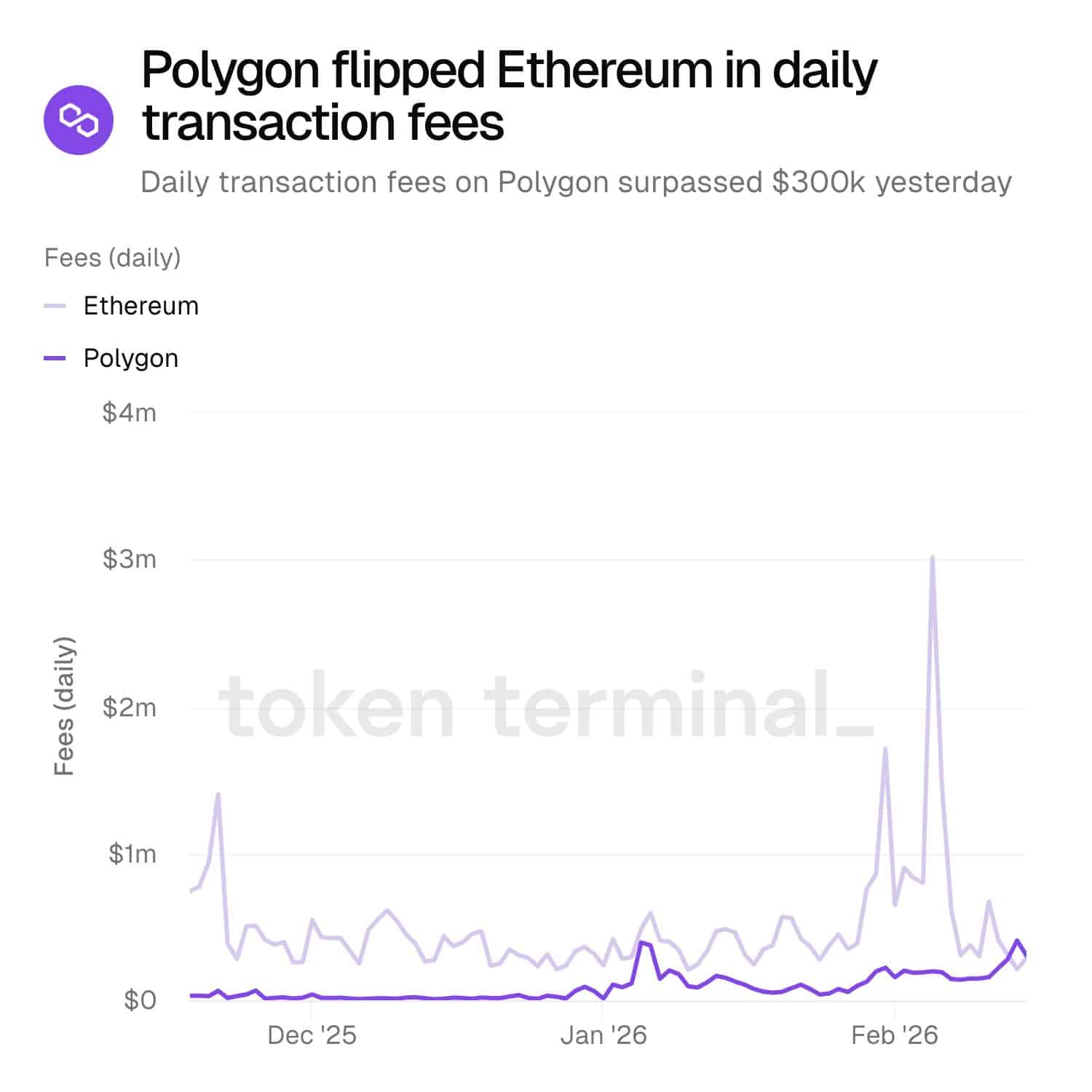
Polygon has pulled off a big win, overtaking Ethereum [ETH] in daily transaction fees! Recent data showed Polygon’s [POL] fees crossing $300K, a jump that proves rising network usage.

Source: X

This pace wasn’t limited to fees either.

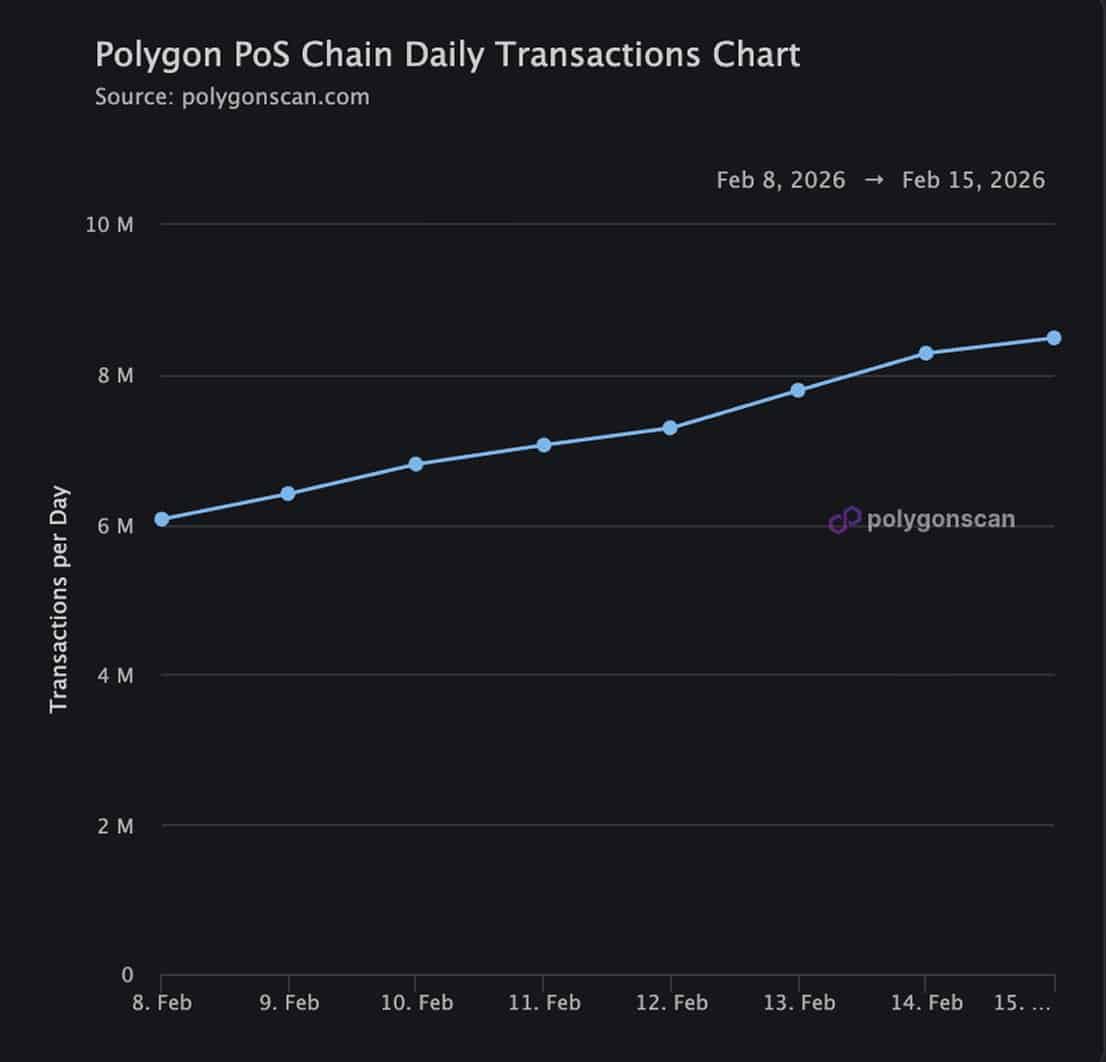
Source: X

Daily transactions on Polygon have climbed over the past week, rising about 50% in just seven days.

Payments play a big role

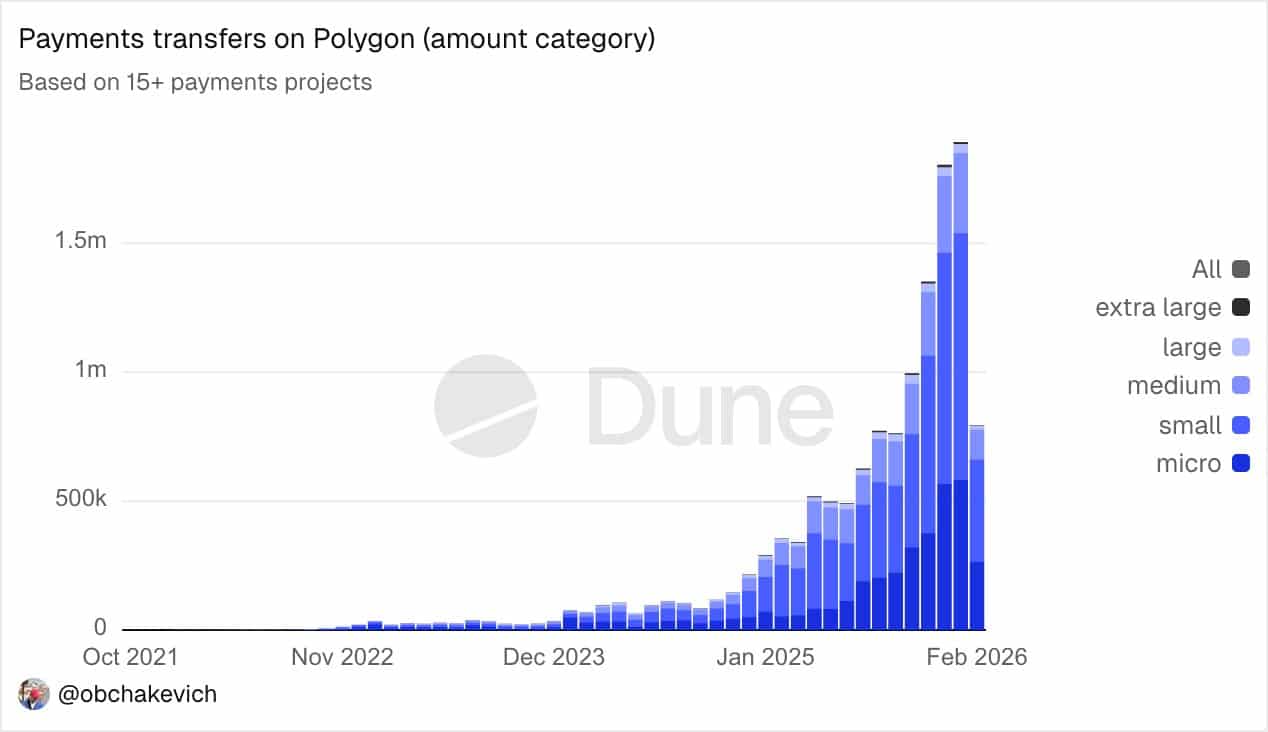
Data per Dune showed that monthly payment transfers on the network were close to 2 million in January, nearly doubling from under 1 million just two months earlier.

Source: X

A major cause seems to be the rise of payment-focused AI agents, which boosted smaller “micro” transactions. At the same time, more crypto card products and payment apps helped increase activity in the small and medium transfer categories.

At the current pace, February could see transfers reach around 2.3 million.

POL price holds gains

All this growth is showing up in the price charts too!

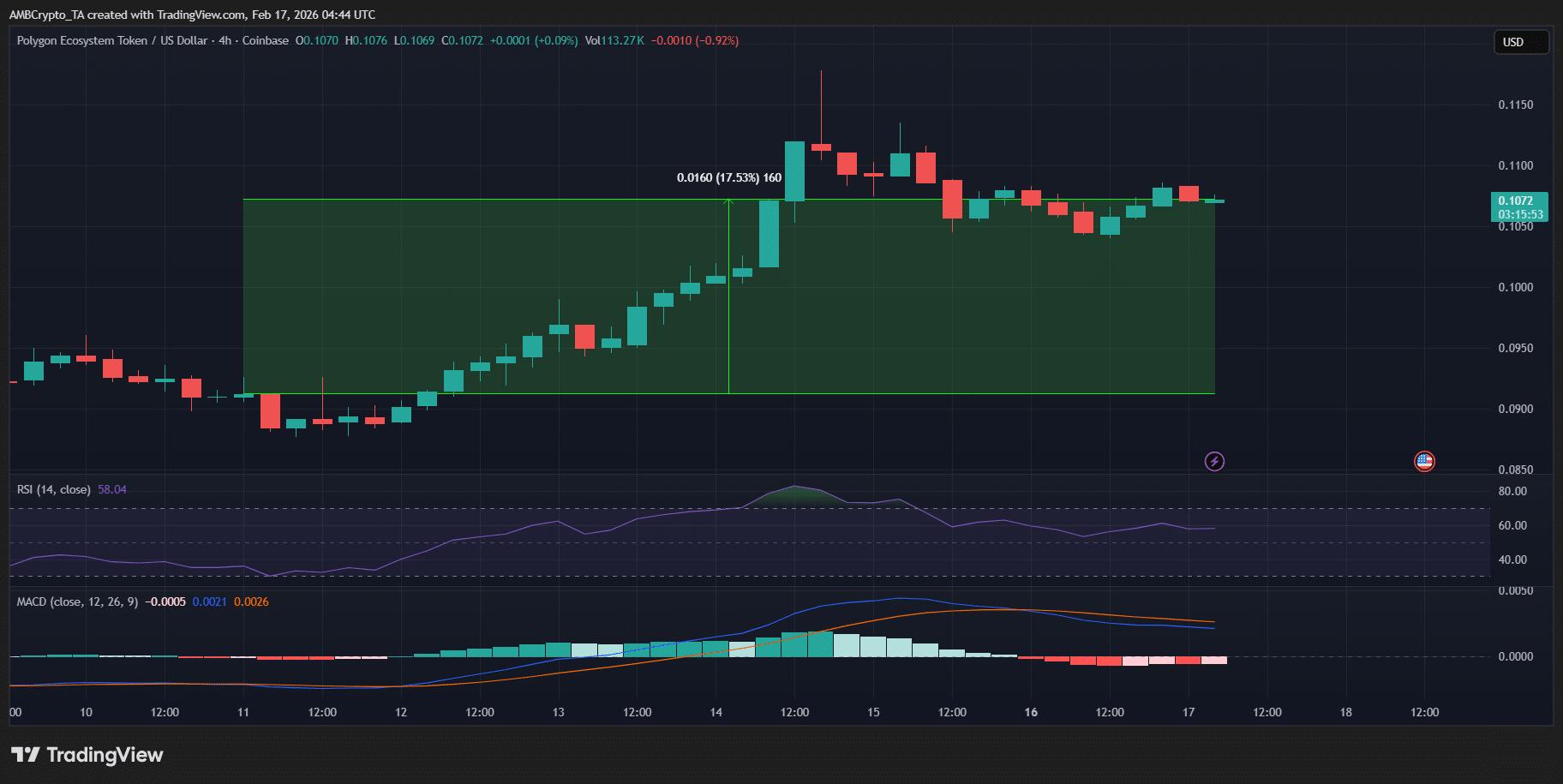
Over the past week, the token climbed roughly 15%, pushing from the $0.09 range to briefly test above $0.11. This was before it settled near $0.107 at press time.

Source: TradingView

POL moved within a steady upward range, which means buyers were still in control.

However, the rally may be slowing. The RSI was in a healthy zone, while the MACD showed lesser bullish strength after the recent push higher.

The trend is still positive, but the market may be taking a moment after a quick run-up. If network growth continues at the current pace, price stability above this range could cause further upside.


Final Summary

  • Polygon flipping Ethereum in daily fees above $300K is big news for the former.
  • If transactions keep rising, POL price momentum could see stronger upside!
Next: Worldcoin slips below $0.40 as whale dumps $5.7 mln WLD on Binance
Share
  • Share
  • Tweet

Trend Kriptolar

İlgili Sorular

QWhat recent achievement did Polygon accomplish in comparison to Ethereum?

APolygon overtook Ethereum in daily transaction fees, with its fees crossing $300K.

QBy what percentage did daily transactions on Polygon increase over the past week?

ADaily transactions on Polygon rose by about 50% in just seven days.

QWhat was a major factor contributing to the rise in small and medium transfers on Polygon?

AThe rise of payment-focused AI agents and more crypto card products and payment apps helped boost smaller 'micro' transactions.

QHow much did the POL token climb in price over the past week?

AThe POL token climbed roughly 15%, moving from the $0.09 range to briefly test above $0.11.

QWhat does the projected transfer volume for February indicate based on current trends?

AAt the current pace, February could see transfers reach around 2.3 million.

İlgili Okumalar

Ethereum Q1 2026 Report: Fees Decline, Users and Transaction Volume Hit New Highs

Ethereum Q1 2026 Report: Fees Down, Users & Transactions Hit New Highs Token Terminal's Q1 2026 report on Ethereum presents a pivotal development: the network achieved record highs in monthly active users (13.2M, +85.9% YoY), total transactions (200.4M, +81.5% YoY), and throughput (25.78 TPS), while transaction fees on the mainnet plummeted by 47.9% quarter-over-quarter. This shift is attributed to the network's strategic move into a "low fees for scale" phase, exemplified by the Fusaka upgrade which increased data capacity and lowered block space costs, releasing pent-up demand (a manifestation of Jevons's Paradox). The report highlights a core narrative shift for Ethereum: from a DeFi-centric blockchain to a global financial settlement layer. It maintains a dominant position in tokenized assets, holding majority market shares among top chains in stablecoins (61.8%), tokenized funds (73.0%), and tokenized commodities (84.0%). Growth in tokenized funds (+73.1% YoY) and commodities (+325.9% YoY) was particularly strong, driven by institutions like BlackRock and JPMorgan entering the space. Contrasting these usage gains, several USD-denominated value metrics declined in Q1: fully diluted market cap fell 30.3% QoQ, total value locked (TVL) dropped 11.0%, and ecosystem transaction volume decreased 24.0%. The report interprets this as Ethereum prioritizing long-term network expansion and cementing its role as the default settlement layer for finance over short-term fee capture. The commentary from Etherealize argues that, much like the early internet, Ethereum's open, permissionless model is poised to win over closed alternatives as institutional tokenization accelerates.

marsbit20 dk önce

Ethereum Q1 2026 Report: Fees Decline, Users and Transaction Volume Hit New Highs

marsbit20 dk önce

He Just Raised 2.7 Billion, and Li Fei-Fei Also Invested

Pete Florence, a former senior research scientist at Google DeepMind and a key contributor to the Vision-Language-Action (VLA) model architecture, is deliberately distancing his startup, Generalist AI, from the trendy "world model" label. He argues that the industry should prioritize concrete goals over buzzwords. His goal is to create robots that can perform a vast range of unseen tasks with high speed and success rates, without needing task-specific training data. Recently, his company raised $400 million (¥2.7 billion) at a $2 billion valuation. Notable investors include NVIDIA's NVentures, Bezos Expeditions, NFDG, as well as Xiaomi co-founder Lin Bin, Zoom founder Eric Yuan, and renowned AI scientist Fei-Fei Li. Florence's approach stems from his academic background at MIT under Professor Russ Tedrake, focusing on understanding the physical world. After joining DeepMind, he developed models like Transporter Network and co-created the VLA framework. He left in 2025 to found Generalist AI. The company has launched two models: GEN-0, which demonstrated that scaling laws apply to physical motion, and GEN-1. GEN-1 was trained on over 500,000 hours of physical interaction data collected via a specialized wearable device. It achieves a 99% success rate on precise mechanical tasks like folding boxes and maintains performance three times faster than its predecessor. Florence believes GEN-1 is reaching a commercial utility threshold similar to the GPT-3 inflection point. The substantial funding round, following GEN-1's release, signifies strong investor confidence in Generalist AI's practical, goal-driven path to creating versatile, useful robots, regardless of the "world model" terminology.

marsbit27 dk önce

He Just Raised 2.7 Billion, and Li Fei-Fei Also Invested

marsbit27 dk önce

Two Legends Lost in Three Days: Is Google's AI Talent Dam Cracking?

In three days, Google lost two AI legends. On June 18, Noam Shazeer, co-author of the seminal "Attention is All You Need" paper and Gemini co-lead, left for OpenAI. Just 48 hours later, John Jumper, 2024 Nobel laureate and AlphaFold lead, departed DeepMind for Anthropic. This follows Andrej Karpathy joining Anthropic in May. These moves highlight a structural trend: top AI talent is concentrating at mission-driven, pre-IPO firms like OpenAI and Anthropic, while Google becomes a primary source. The exodus stems from a core mission mismatch. Google's ad-centric model often subordinates AI research to product and revenue goals, creating friction for pioneers like Shazeer, who returned in 2024 only to leave again. In contrast, OpenAI and Anthropic offer singular focus on pushing AI boundaries, whether towards AGI or safety-aligned models, which deeply appeals to top researchers like Jumper. Financial incentives amplify the pull. With both OpenAI and Anthropic nearing IPO, employees stand to gain immensely from equity, an upside Google's mature stock cannot match. Furthermore, the 2023 merger of Google Brain and DeepMind, intended to consolidate strength, has instead created cultural tension and slowed the path from research to product, as evidenced by Gemini's pace. This talent redistribution is reshaping the AI landscape. While Google retains vast data and compute resources, its true crisis is the quiet, continuous loss of the people who define the field's future. The real moat in AI is not infrastructure, but the concentration of brilliant minds—a battle Google is currently losing.

marsbit2 saat önce
Two Legends Lost in Three Days: Is Google's AI Talent Dam Cracking?

marsbit2 saat önce

Behind the AI Report Card, Lies a Chinese 'Exam Setter'

Beyond the familiar performance charts like MMLU-Pro and MMMU, which major AI models strive to ace, stands a key "examiner": Chinese-Canadian researcher Wenhu Chen. An assistant professor at the University of Waterloo and founder of TIGERLab, Chen addresses the crucial need for more rigorous AI evaluation. As models like GPT-4 began scoring near-perfect results on older benchmarks like MMLU, it became difficult to distinguish their true capabilities. In response, Chen introduced MMLU-Pro in 2024, featuring harder, more reasoning-focused questions with more answer choices, successfully reintroducing meaningful performance gaps. His work extends to multi-modal evaluation with MMMU and its enhanced version, MMMU-Pro. These benchmarks test a model's ability to understand and reason with complex information from images, charts, and text across diverse academic subjects, exposing the significant challenges even top models face in genuine comprehension. Chen's background in complex QA, table reasoning, and his experience at Google DeepMind on projects like Gemini inform his approach. He understands that effective benchmarks must anticipate how models might "cheat" by memorizing data or avoiding visual analysis. His lab also actively researches video understanding and generation models (e.g., UniVideo, Vamba), ensuring his evaluation work is grounded in practical model-building challenges. Now at Meta's Super Intelligence Lab, Chen continues his focus on multi-modal data and evaluation, representing the deep yet often unseen contributions of Chinese talent in shaping the fundamental tools of the AI industry.

marsbit2 saat önce

Behind the AI Report Card, Lies a Chinese 'Exam Setter'

marsbit2 saat önce
İşlemler

Spot
Futures

Popüler Makaleler

POL Nasıl Satın Alınır

HTX.com’a hoş geldiniz! Polygon Ecosystem Token (POL) satın alma işlemlerini basit ve kullanışlı bir hâle getirdik. Adım adım açıkladığımız rehberimizi takip ederek kripto yolculuğunuza başlayın. 1. Adım: HTX Hesabınızı OluşturunHTX'te ücretsiz bir hesap açmak için e-posta adresinizi veya telefon numaranızı kullanın. Sorunsuzca kaydolun ve tüm özelliklerin kilidini açın. Hesabımı Aç2. Adım: Kripto Satın Al Bölümüne Gidin ve Ödeme Yönteminizi SeçinKredi/Banka Kartı: Visa veya Mastercard'ınızı kullanarak anında Polygon Ecosystem Token (POL) satın alın.Bakiye: Sorunsuz bir şekilde işlem yapmak için HTX hesap bakiyenizdeki fonları kullanın.Üçüncü Taraflar: Kullanımı kolaylaştırmak için Google Pay ve Apple Pay gibi popüler ödeme yöntemlerini ekledik.P2P: HTX'teki diğer kullanıcılarla doğrudan işlem yapın.Borsa Dışı (OTC): Yatırımcılar için kişiye özel hizmetler ve rekabetçi döviz kurları sunuyoruz.3. Adım: Polygon Ecosystem Token (POL) Varlıklarınızı SaklayınPolygon Ecosystem Token (POL) satın aldıktan sonra HTX hesabınızda saklayın. Alternatif olarak, blok zinciri transferi yoluyla başka bir yere gönderebilir veya diğer kripto para birimlerini takas etmek için kullanabilirsiniz.4. Adım: Polygon Ecosystem Token (POL) Varlıklarınızla İşlem YapınHTX'in spot piyasasında Polygon Ecosystem Token (POL) ile kolayca işlemler yapın.Hesabınıza erişin, işlem çiftinizi seçin, işlemlerinizi gerçekleştirin ve gerçek zamanlı olarak izleyin. Hem yeni başlayanlar hem de deneyimli yatırımcılar için kullanıcı dostu bir deneyim sunuyoruz.

278 Toplam GörüntülenmeYayınlanma 2024.12.11Güncellenme 2026.06.02

POL Nasıl Satın Alınır

Tartışmalar

HTX Topluluğuna hoş geldiniz. Burada, en son platform gelişmeleri hakkında bilgi sahibi olabilir ve profesyonel piyasa görüşlerine erişebilirsiniz. Kullanıcıların POL (POL) fiyatı hakkındaki görüşleri aşağıda sunulmaktadır.

活动图片