Plunging 10% Then Surging: Weekend Crude Oil Market Watch

marsbit2026-04-20 tarihinde yayınlandı2026-04-20 tarihinde güncellendi

Özet

Following a 10% plunge, oil prices surged over the weekend as geopolitical tensions in the Strait of Hormuz escalated dramatically. The initial market optimism, driven by the strait’s brief reopening on Friday, quickly reversed on Saturday when Iran reinstated restrictions and fired on vessels, halting nearly all traffic. In response, oil contracts rose approximately 4.52%, while S&P futures fell nearly 0.8%. U.S. President Trump alternated between diplomatic gestures—sending an envoy for talks—and threats to destroy Iranian infrastructure if no deal was reached. Iran rejected further negotiations, fearing a U.S. attack before the midweek ceasefire deadline. This triggered another spike in oil, surpassing Saturday’s highs, and further pressured equity markets. Crypto-related stocks underperformed significantly. Market optimism is expected to be punished, and the week ahead hinges on whether Iran maintains its refusal to negotiate.

Friday's reopening of the critical Hormuz Strait waterway triggered widespread risk-on sentiment in the markets: U.S. stocks soared, crude oil prices plummeted, U.S. Treasury yields fell, as the belief spread that the worst was over and the disruption to global energy supplies had eased.

However, these moves may prove to be premature.

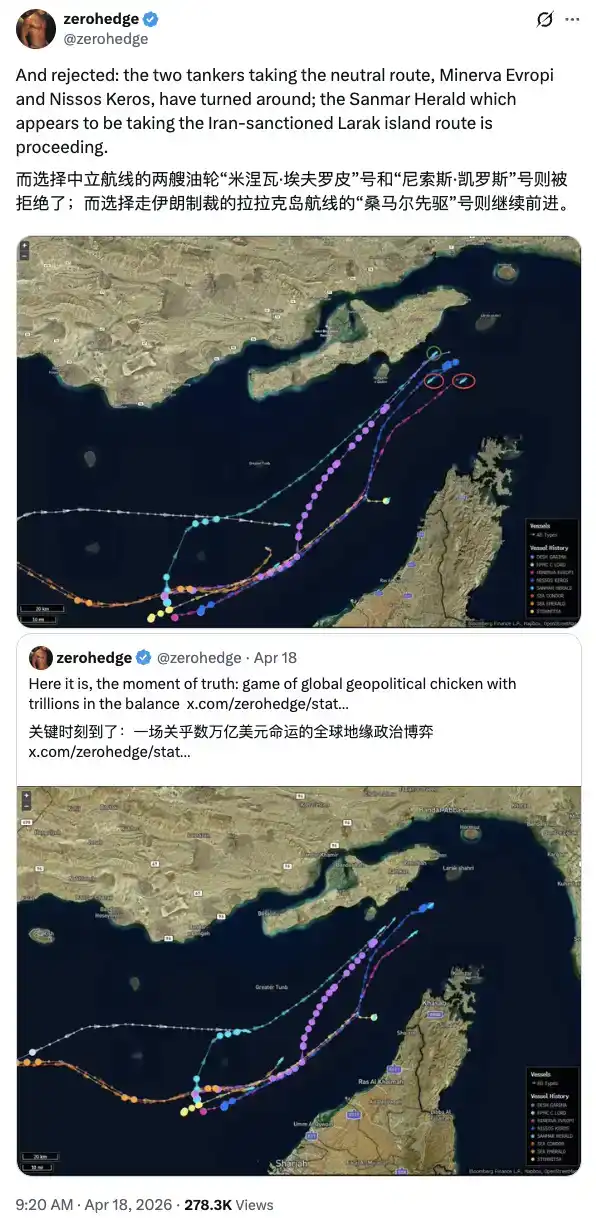
At 9:20 AM on the 18th (Saturday), reports broke that two oil tankers had been denied passage through the Strait of Hormuz. Trump immediately applied public pressure: if no deal was reached by Wednesday, the U.S. would continue blockading Iranian ports. At 16:00 that day, Iran announced the re-imposition of restrictions on the Strait and opened fire on vessels attempting to pass—two Indian ships turned back into the Persian Gulf after being shelled, bringing shipping traffic in the Strait to a near standstill.
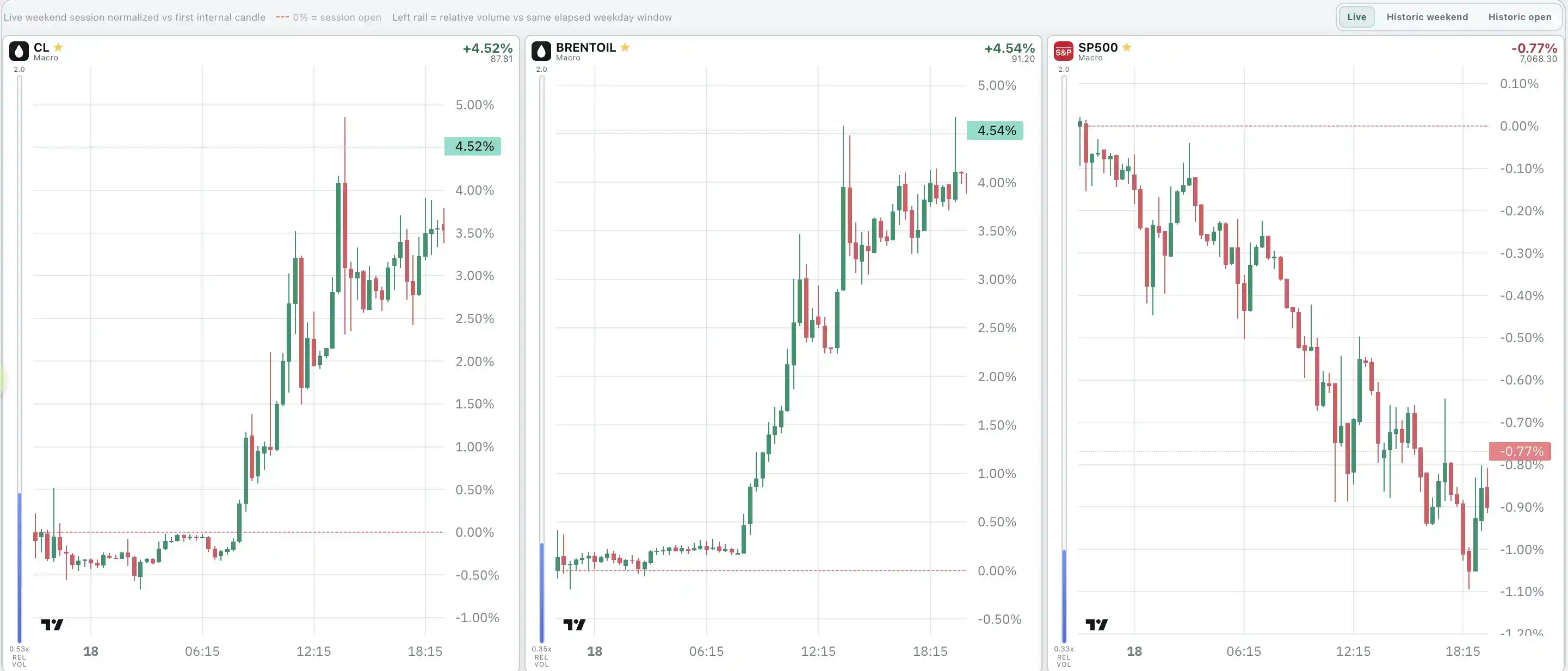
Traders reacted swiftly on TradeXYZ, with crude oil contracts gaining about 4.52% compared to the weekend closing price, and S&P index contracts falling nearly 0.8%.
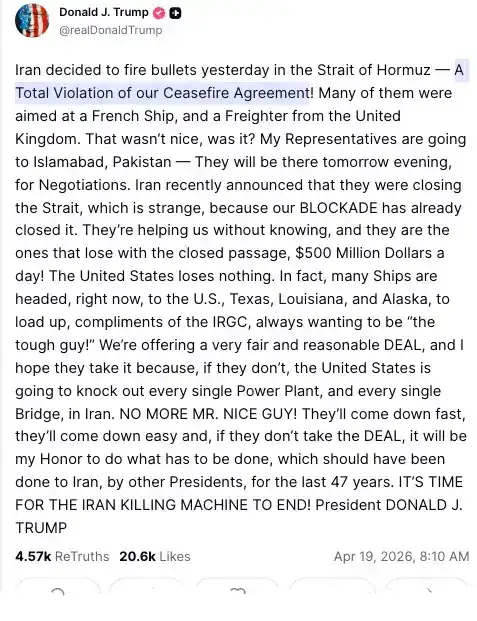
Trump then shifted his stance, revealing that envoy Steve Witkoff would travel to Pakistan for talks with the Iranian side on Tuesday, potentially extending the negotiation window until Wednesday.

He then turned around and posted on Truth Social, stating, "The deal we offered is very fair and reasonable, I hope they accept it, because if they don't, the U.S. will destroy every power plant and every bridge in Iran."
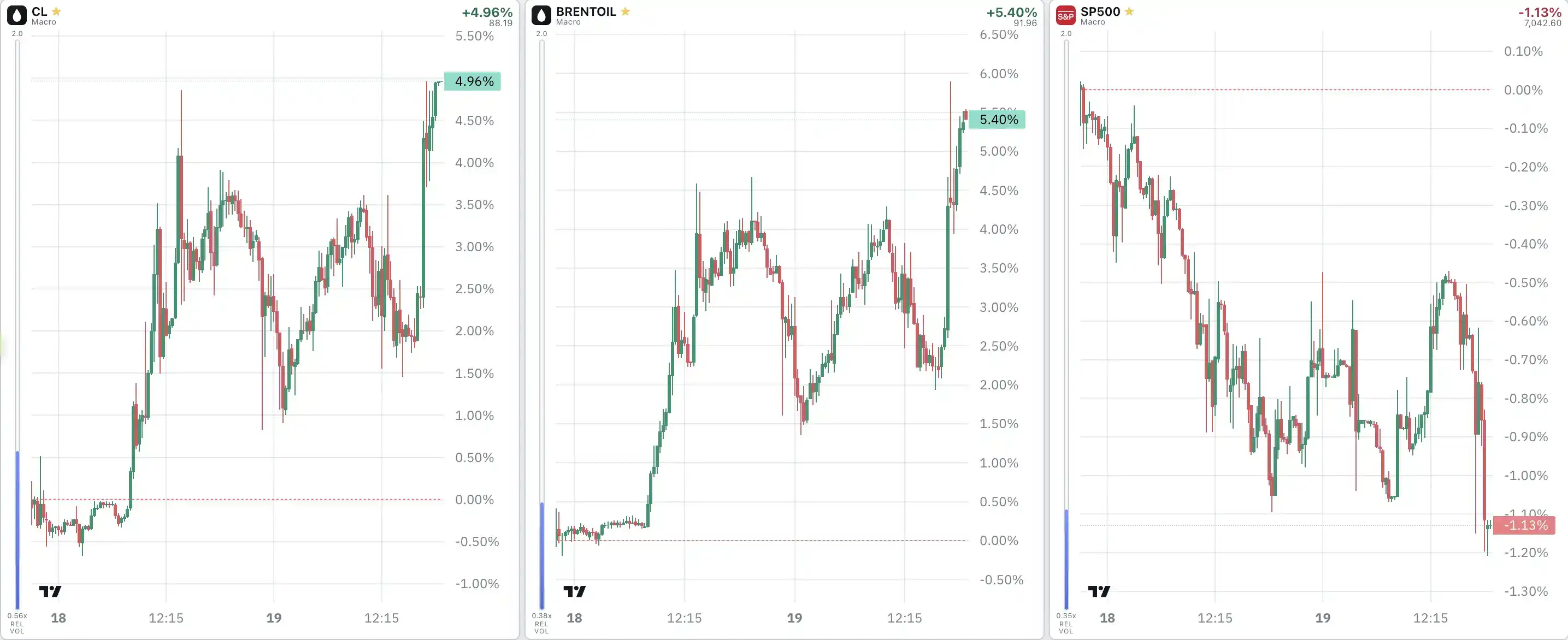
Iran was clearly not buying it. At 1:53 AM on the 20th, the Iranian side announced its refusal to participate in a second round of talks; according to Axios, Tehran's assessment was that the U.S. might launch an attack before the Tuesday night ceasefire expiration.

Driven by this news, crude oil surged again, clearing the highs from the 18th, while the S&P index correspondingly broke below the lows from the 18th.
On the individual stock front, three crypto-related stocks significantly underperformed others.
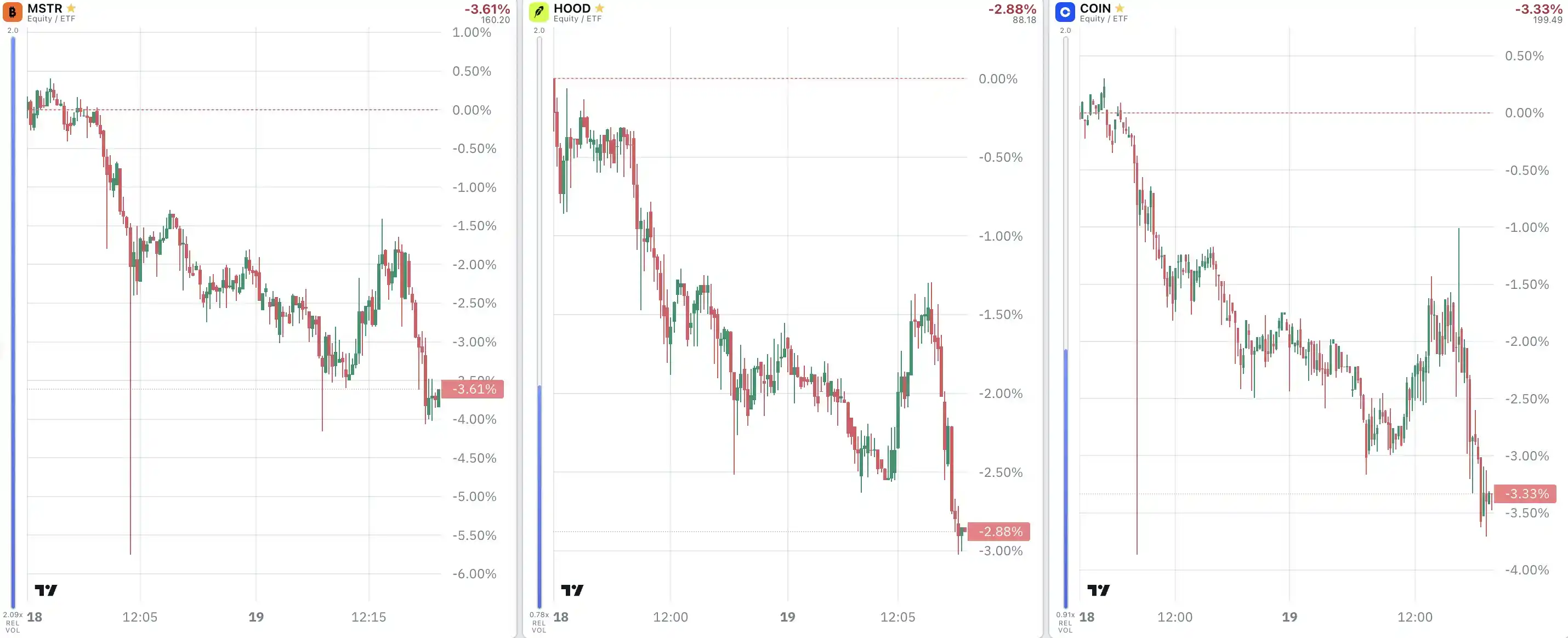
Predictably, the spreading optimism in the market last week will be punished. This week's market movements will largely depend on whether Iran can maintain its no-negotiation stance.


İlgili Sorular

QWhat event initially caused the surge in risk appetite in the markets on Friday?

AThe reopening of the Strait of Hormuz shipping lane.

QWhat specific action did Iran take on Saturday that reversed the initial market optimism?

AIran re-imposed restrictions on the Strait of Hormuz and fired on vessels attempting to pass through, causing shipping to nearly halt.

QHow did crude oil futures react on TradeXYZ following the news of the Strait of Hormuz incident?

ACrude oil contracts rose by approximately 4.52% compared to the weekend's closing price.

QWhat was the content of Donald Trump's threat on Truth Social if Iran did not accept the U.S. deal?

AHe stated that if Iran did not accept the deal, the U.S. would 'destroy every power plant and every bridge in Iran.'

QWhat was the final event that caused crude oil to surge again and erase the previous day's highs?

AIran's announcement that it would refuse to participate in the second round of negotiations, fueled by reports that the U.S. might launch an attack before the ceasefire expired.

İlgili Okumalar

Bloomberg Uncovered: How Do China's Wealthy Circumvent the Annual $50,000 Limit to Transfer Assets?

**Summary: How Wealthy Chinese Circumvent $50,000 Annual Foreign Exchange Limits** Despite China's strict capital controls, including an annual $50,000 per person foreign exchange quota, an estimated $150 billion in funds still leaves the country annually via various gray and underground channels. This report outlines the evolution of China's "capital wall" and the methods used to bypass it. **The Evolving Capital Controls:** * **Foundation (1994):** The system of "current account convertibility with strict capital account controls" was established. * **Quota Set (2007):** The $50,000 individual annual forex purchase limit was formalized. * **Crackdown Begins (2015-2017):** Following market volatility, enforcement tightened. Banks were required to scrutinize transactions, and channels like using UnionPay cards for Hong Kong insurance premiums or buying overseas property were blocked. * **Digital & Legal Upgrades (2024-2026):** Enhanced algorithms now flag suspicious patterns (e.g., "smurfing"). The Common Reporting Standard (CRS) provides Chinese tax authorities with data on citizens' offshore accounts. Unlicensed cross-border brokers have been targeted. **Five Primary Methods for Moving Capital:** 1. **Underground Banking / "Hawala" (Duiqiao):** The largest-scale method. No money crosses borders. Clients pay RMB to a domestic account; an overseas associate deposits equivalent foreign currency into the client's offshore account. Risks include high fees, account freezes, and legal penalties. 2. **"Smurfing" or "Ant Moving":** Using multiple individuals' $50,000 quotas to pool funds for one offshore recipient. Increasingly detected by anti-money laundering algorithms. 3. **Trade Invoice Manipulation:** Businesses over-invoice imports or under-invoice exports via offshore shell companies, creating a pretext to transfer excess funds abroad under the guise of trade. 4. **Channel Migration:** After a crackdown on internet brokers, funds flow toward more compliant but costly channels like major banks' cross-border wealth management services or Qualified Domestic Institutional Investor (QDII) quotas. 5. **Structural Arrangements:** High-net-worth individuals use complex, high-cost legal structures involving offshore trusts, insurance, and investment migration programs to transfer asset ownership. **Regulatory Response: Focusing on People, Not Just Money** The current strategy extends oversight from enterprises to **individual residents**. Tools like CRS allow retroactive visibility into offshore assets. Cryptocurrencies, once seen as a potential loophole, are now actively monitored and prosecuted as an illegal channel. The underlying driver remains: with significant wealth concentrated among millions of affluent households seeking diversification amid domestic economic shifts, the incentive to move assets offshore persists despite regulatory barriers.

marsbit21 dk önce

Bloomberg Uncovered: How Do China's Wealthy Circumvent the Annual $50,000 Limit to Transfer Assets?

marsbit21 dk önce

Ethereum's Ballmer Moment: As Everyone Is Bearish, the Circulating Supply Is Disappearing

"Ethereum's Ballmer Moment: Circulation Shrinks Amid Bearish Sentiment" Amid widespread bearish sentiment, with prominent figures like Bankless founder David Hoffman selling ETH and young developers flocking to Solana, some argue Ethereum is entering its "Ballmer era"—akin to Microsoft's perceived stagnation under Steve Ballmer. While surface-level criticisms about slow protocol development, cautious leadership, and competitive pressure are valid, underlying fundamentals tell a different story. Approximately 30% of ETH is staked, major holders like BitMine are accumulating, and spot ETFs continue to absorb supply. Regulatory clarity, including the SEC/CFTC's March ruling on staking rewards and the potential passage of the CLARITY Act, is transforming crypto from a regulatory threat into a legitimized framework. This institutionalization, alongside a shrinking circulating supply (with net issuance around 0.23% annually), creates significant buy-side pressure independent of fee-based value capture. The broader crypto total addressable market is expanding through regulated stablecoins, tokenized assets, and institutional adoption. While public chains face competition from permissioned alternatives, the winning model appears to be permissioned assets settling on public chains like Ethereum and Solana. The author advocates a non-maximalist, barbell strategy: holding ETH for its institutional role and supply squeeze, SOL for consumer/throughput trends, BTC as a macro hedge, and a basket of next-gen L1s. Key bullish drivers for ETH include rapid circulation shrinkage, potential Q2 staked ETF approvals, regulatory tailwinds solidifying its role as a default settlement layer, and the optionality of an eventual "Satya moment" leadership shift. Despite bearish consensus, the current setup—where crypto is "not hot" and regulatory groundwork is being laid—presents a compelling investment opportunity. The crypto cycle's focus may have shifted to AI, but blockchain infrastructure is gaining a legal and institutional foothold precisely while attention is elsewhere.

marsbit21 dk önce

Ethereum's Ballmer Moment: As Everyone Is Bearish, the Circulating Supply Is Disappearing

marsbit21 dk önce

Claude Code Introduces Dynamic Workflows: Enabling AI to Form Teams and Collaborate

Claude Code introduces dynamic workflows, enabling AI to coordinate teams of specialized agents for complex tasks. This transforms Claude from a code assistant into a programmable workbench. Workflows address key limitations of single-agent systems: agentic laziness (premature task completion), self-preferential bias (favoring own outputs), and goal drift (losing sight of original objectives). The system allows Claude to dynamically create execution frameworks using JavaScript. It can split tasks, dispatch parallel agents for isolated work (e.g., in separate worktrees), implement adversarial validation, run tournaments, and synthesize results. This multi-agent approach is valuable for tasks requiring deep research, factual verification, code migration, root cause analysis, large-scale triage, and qualitative sorting. Key patterns include: classify-and-route, fan-out-and-synthesize, adversarial verification, generate-and-filter, tournaments, and loop-until-done. While token usage is higher, workflows excel where tasks resemble programming—needing problem decomposition, isolated context, hypothesis testing, and handling many details. They extend Claude Code's utility beyond technical work to areas like business plan review, resume screening, and naming brainstorm. The feature is not a universal solution but points to a future where AI tool competitiveness depends on organizing reliable, reusable, and auditable execution flows for complex goals.

marsbit1 saat önce

Claude Code Introduces Dynamic Workflows: Enabling AI to Form Teams and Collaborate

marsbit1 saat önce

İşlemler

Spot
Futures
活动图片




