Plummeting Around 12%, Duan Yongping's Bottom-Fishing CoreWeave Turns into a Fierce Battlefield Between Bulls and Bears

marsbit2026-05-09 tarihinde yayınlandı2026-05-09 tarihinde güncellendi

Özet

On May 8th, AI cloud computing provider CoreWeave (CRWV) plunged 11.4% following its Q1 2026 earnings report, intensifying the polarized market view on the stock. While revenue doubled year-over-year to $2.08B and its Remaining Performance Obligations (RPO) surged to nearly $100B, its net loss also widened to $740M. The key trigger was a weaker-than-expected Q2 revenue forecast, coupled with rising costs that compressed adjusted operating margin to just 1%. The bull thesis centers on CoreWeave's massive order backlog, deep strategic ties with NVIDIA as a key customer and investor, and client diversification with major names like Anthropic and Meta. Supporters point to its 'hyperscale' status and over $20B in recent financing. Bears highlight the "growth at all costs" model: despite soaring revenue, losses are expanding, capital expenditures are massive (~$6.8B in Q1), and total debt has ballooned to around $25B. Significant insider selling by executives adds to skepticism. This contrast is embodied by investor Duan Yongping (known as "China's Buffett"), who initiated a small, exploratory position (~0.12% of his portfolio) in Q4 2025 near the stock's lows, viewing it as a speculative bet on the AI infrastructure chain. The upcoming Q2 report is seen as a critical test for management's promise of a profit margin rebound. CoreWeave remains a battleground stock where long-term narrative clashes with near-term financial reality.

Author: Deep Tide TechFlow

On May 8, AI cloud computing provider CoreWeave (CRWV) plummeted 11.4% in a single day, closing at $114.15. This marks another instance of "earnings day decline" for the company since its IPO in March of last year. However, unlike previous times, this sell-off is compounded by a more dramatic contrast: Duan Yongping, widely known in Chinese circles as a disciple of Warren Buffett, just established a new position in CoreWeave in Q4 2025, amounting to approximately $20 million. Based on the position size and the Q4 average price, his entry point was close to CoreWeave's lowest range for the year in December 2025.

CoreWeave is currently one of the most divisive AI assets in the US stock market. On one side is the narrative of being a "pick-and-shovel seller" deeply tied to Nvidia, backed by nearly $100 billion in order backlog; on the other side is the financial reality of expanding losses with scale, alongside continuous insider selling. The Q1 earnings report acted like a prism, refracting this divide with stark clarity.

Q1 Earnings: Revenue Doubles but Losses Widen, Q2 Guidance Punctures Valuation

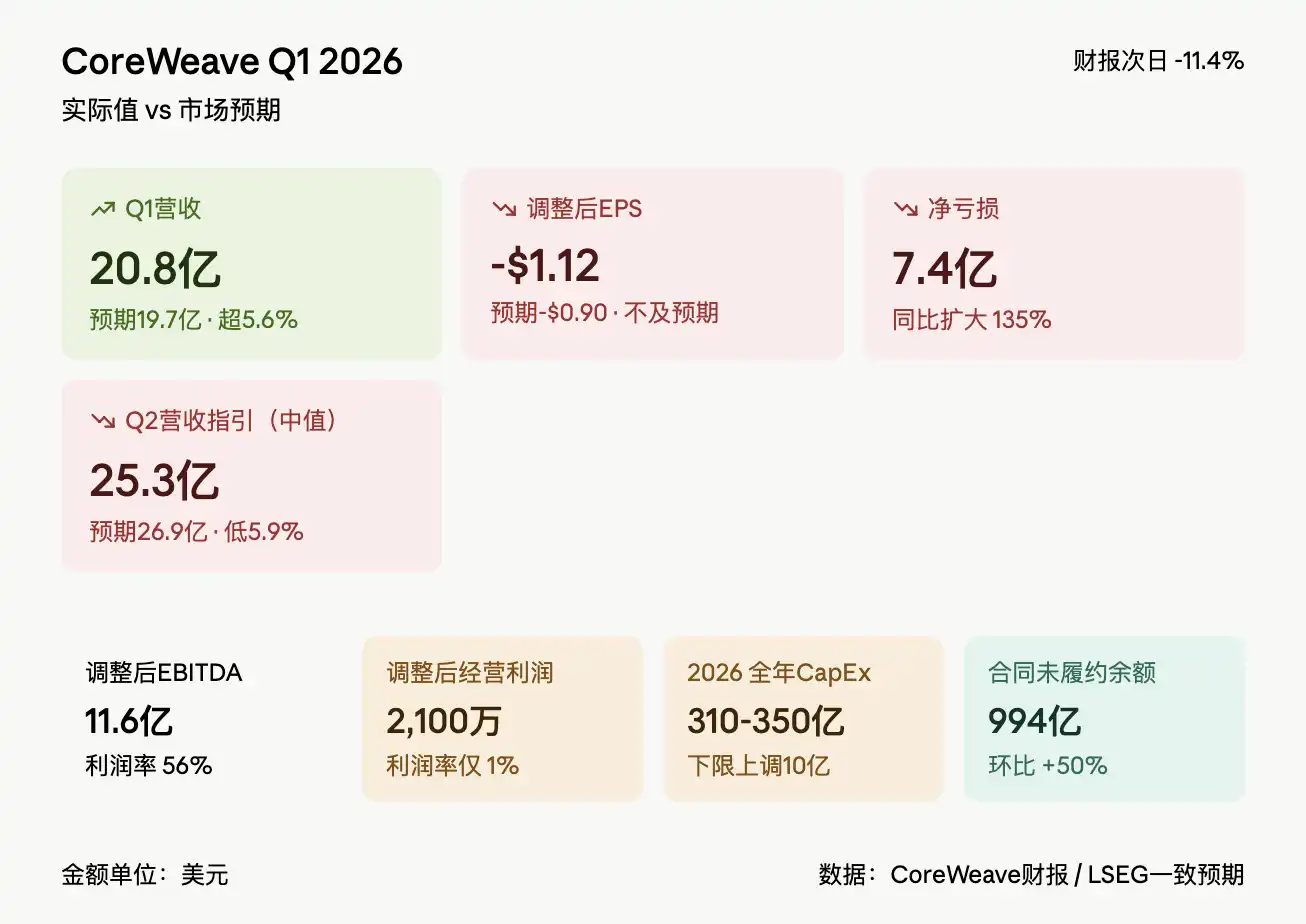
CoreWeave's Q1 revenue reached $2.08 billion, a 112% year-over-year increase and a 32% sequential increase, surpassing the LSEG market consensus of $1.97 billion. However, adjusted earnings per share loss was $1.12, worse than the expected loss of $0.90; the net loss widened to $740 million, more than doubling from $315 million a year ago.

The forward guidance is what truly ignited the sell-off. The company provided a Q2 revenue range of $2.45 billion to $2.6 billion, with a midpoint of $2.53 billion, significantly lower than the market expectation of $2.69 billion. Concurrently, the lower limit for the full-year 2026 capital expenditure was raised from $30 billion to $31 billion, with CFO Nitin Agrawal attributing the increase to rising component costs.

The fragility of the profit structure was laid bare. While Q1 adjusted EBITDA reached $1.16 billion (a 56% margin), which appeared impressive; adjusted operating profit was merely $21 million, compressing the operating margin to just 1%. The reason lies in the 127% year-over-year surge in technology and infrastructure costs to $1.27 billion, and sales and marketing expenses skyrocketing over sixfold to $69 million. Revenue is growing, but costs are growing faster.

CEO Michael Intrator emphasized on the earnings call: "We have reached hyperscale." He disclosed that the company now has 10 clients committed to spending over $1 billion each, a significant improvement in concentration risk compared to 2024 when 62% of revenue relied on a single customer, Microsoft. Intrator also projected that CoreWeave's annualized revenue should exceed $30 billion by the end of 2027.
The Bull Narrative: $100 Billion Order Backlog, Deep Ties with Nvidia

The core supporting the bull case is the order backlog. As of the end of Q1, CoreWeave's remaining performance obligations (RPO) stood at $99.4 billion, a net increase of approximately $33 billion sequentially and nearly quadrupling year-over-year. Intrator stated that new contracts signed in Q1 alone exceeded $40 billion.

The client roster is also reshaping market perception. In Q1, CoreWeave added Anthropic as a client, providing computing power for its Claude series models; signed a $2.1 billion AI cloud agreement with Meta; trading firm Jane Street committed to roughly $6 billion in orders and separately completed a $1 billion equity investment. Nvidia purchased an additional $2 billion worth of CoreWeave Class A common stock this quarter. This global largest GPU supplier is simultaneously an investor and a significant customer of CoreWeave, a tripartite relationship dubbed Nvidia's "favored son."

Regarding financing structure, CoreWeave completed an $8.5 billion investment-grade HPC (High-Performance Computing) secured delayed draw term loan (DDTL) in Q1, priced below 6%, hailed by management as "groundbreaking." Year-to-date, the company has raised over $20 billion in debt and equity financing, with the weighted average cost of debt decreasing by approximately 80 basis points. S&P Global Ratings concurrently upgraded CoreWeave's credit rating outlook from "stable" to "positive."

The Bear Logic: Bigger Scale, Less Profit, Debt Snowball Grows Larger

However, another set of numbers in the earnings report is causing anxiety. Q1 capital expenditure reached $6.8 billion, and the company expects Q2 capital expenditure to further climb to between $7 billion and $9 billion. The Q2 interest expense guidance range is $650 million to $730 million, reflecting the rapid expansion of the debt pile.

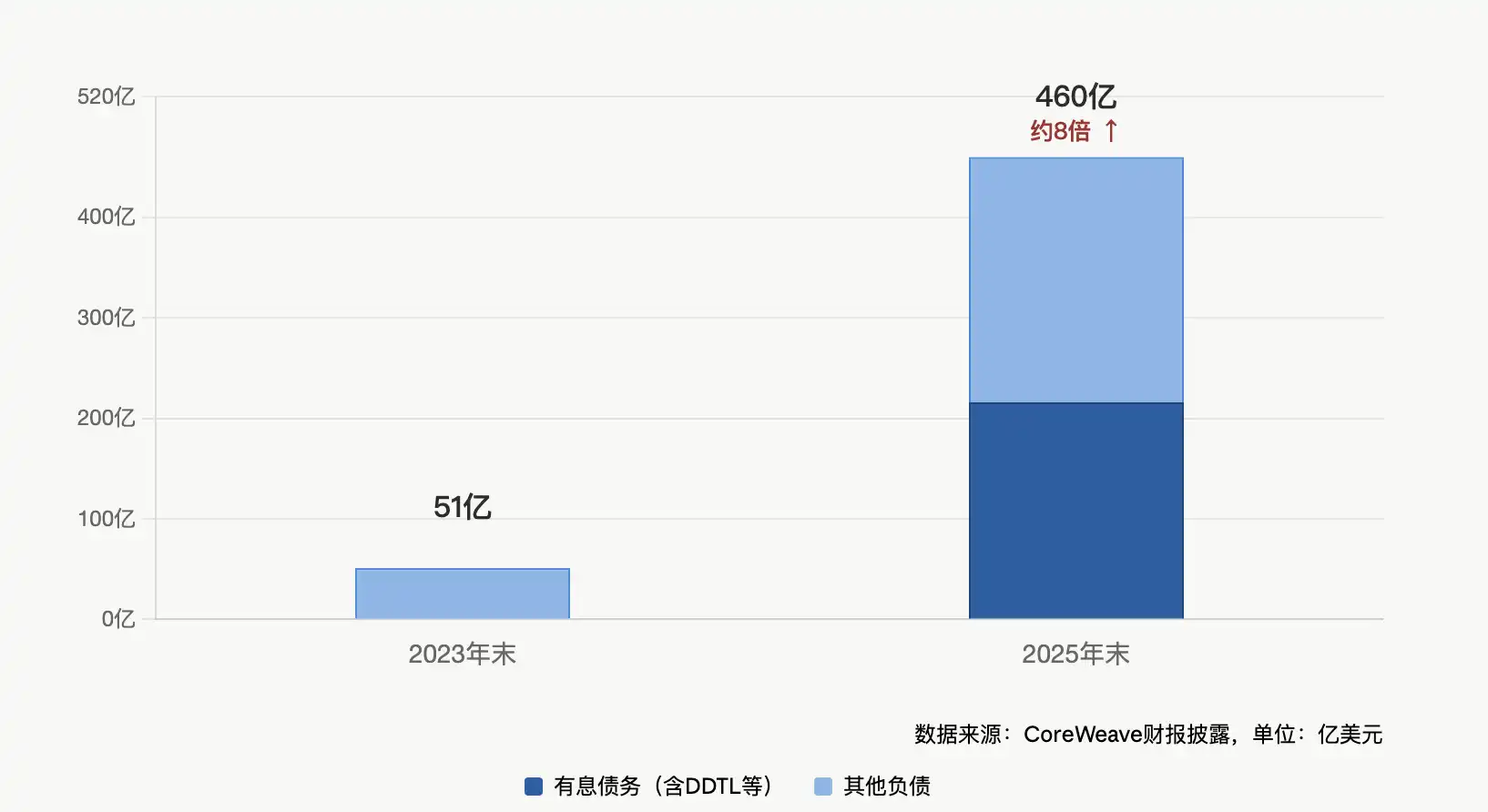
The total debt burden is already staggering. As of the end of Q1, CoreWeave's total debt was approximately $25 billion. Relative to the company's current annualized revenue scale, this leverage level is significantly higher than that of traditional cloud service providers. Morgan Stanley data shows that CoreWeave's debt financing for the full year 2025 reached about $11.8 billion, far exceeding the approximately $1.5 billion in equity financing during the same period. The company's core expansion tool is the DDTL, a "book-then-fund" model where it secures bank financing to purchase GPUs, using order contracts as collateral.

The sharpest criticism stems from profit quality. Although management repeatedly highlights the 56% EBITDA margin, the adjusted operating margin is only 1%, and the "real" gross margin after deducting technology and infrastructure costs is about 4%, showing compression both sequentially and against market expectations. On the call, Intrator attributed this to the phased effects of scaling, where the dilution effect on margins from adding new capacity is immense when expanding rapidly from a 1-gigawatt operational scale. He promised this was the "low point for margins," which would gradually rebound in future quarters.

However, the market is currently unwilling to pay for that promise. While analysts from Morgan Stanley and Jefferies issued positive evaluations, CoreWeave has experienced short-term pullbacks after every previous earnings report, with this decline being one of the steeper ones.
Ongoing Insider Selling, Mirroring Duan Yongping's Bottom Fishing

Around the earnings release, CoreWeave insiders continued their selling. CEO Mike Intrator sold 307,693 shares in late April; co-founders Brian Venturo and Chen Goldberg also recorded sales; institutional shareholder Magnetar Financial had previously offloaded over $300 million worth. The latest disclosures show another major shareholder recently sold approximately 1.2 million shares.

This forms a stark contrast with Duan Yongping's Q4 position building. According to a 13F filing by H&H International Investment in February 2026, Duan Yongping initiated a position in CoreWeave of 299,900 shares in Q4 2025, when the company's stock price had retreated over 65% from its highs, and market concern over its debt structure peaked.

It is noteworthy that CoreWeave constitutes only 0.12% of Duan Yongping's total H&H portfolio, a "light test" position. During the same period, Duan aggressively increased his Nvidia stake by over 1110% and initiated new positions in Credo Technology (high-speed connectivity) and Tempus AI (AI healthcare), with these three new AI positions combined accounting for less than 0.3%. This suggests Duan's real heavy bet is on Nvidia itself, with CoreWeave resembling a small, extended bet on the downstream AI computing supply chain.

The Key Question Now: Inflection Point or Trap?

During the Q&A session of the earnings call, Intrator posed an emotionally charged rhetorical question: "I've always felt like everyone is staring at the stock price tree and missing the whole forest."

This statement aptly summarizes the current bull-bear standoff. The bulls see the forest: the nearly $100 billion contract backlog, diversified customer base, tripartite Nvidia ties, and the credit rating upgrade. The bears see the tree: the 1% operating margin, widening net loss, aggressive capital expenditure, and continuously selling insiders.

CoreWeave's stock price is still up nearly 80% year-to-date and over 200% since its IPO. However, when a stock's bull case relies on long-term narratives while the bear case rests on current numbers, every earnings report becomes a battleground for these two narratives. In a previous interview with Fang Sanwen, Duan Yongping stated: "AI is a massive revolution brought about by qualitative changes in computing power, potentially exceeding the impact of the internet and industrial revolutions. There is a clear AI bubble currently; 90% of companies may be eliminated, but the survivors will become the next generation of giants." His 0.12% light position itself acknowledges the uncertainty of this gamble.

The next test point is already clear: the Q2 earnings report. If the operating margin fails to rebound as promised by management by then, the credibility of the "forest" narrative will face a real stress test.


İlgili Sorular

QWhy did CoreWeave's stock price drop sharply on May 8th?

ACoreWeave's stock price dropped 11.4% on May 8th primarily due to disappointing Q2 revenue guidance. The company forecast Q2 revenue between $2.45 and $2.6 billion, with a midpoint of $2.53 billion, which was significantly below market expectations of $2.69 billion. Additionally, the company's Q1 net loss widened to $740 million, more than double the loss from a year ago, and its adjusted operating margin was compressed to just 1%, fueling investor concerns about profitability despite rapid revenue growth.

QWhat are the main arguments of CoreWeave's bullish investors?

ABullish investors focus on CoreWeave's massive backlog of nearly $100 billion in Remaining Performance Obligations (RPO), which grew significantly in Q1. They highlight its deep ties with Nvidia, which is an investor, customer, and key GPU supplier. The company has diversified its client base, securing major agreements with companies like Meta and Anthropic, and improving its reliance on a single customer (previously Microsoft). Strong financing, including low-cost debt, and an 'investment-grade' credit rating upgrade from S&P also support the positive long-term narrative.

QWhat are the main concerns of CoreWeave's bearish investors?

ABearish investors point to CoreWeave's deteriorating profitability as scale increases. Key concerns include a net loss that more than doubled year-over-year, a razor-thin 1% adjusted operating margin, and capital expenditures that are soaring ($6.8B in Q1). The company's massive and growing debt load (approximately $25B) and high interest expense are seen as significant risks. Furthermore, the ongoing insider selling by executives and major shareholders contrasts with the bullish public narrative, raising questions about internal confidence.

QWhat was Duan Yongping's investment action regarding CoreWeave, and what does it signify?

ADuan Yongping, through his investment firm H&H International, initiated a position in CoreWeave in Q4 2025, purchasing approximately 299,900 shares worth around $20 million when the stock was near its yearly low. However, this position represents a very small 0.12% of his total portfolio. His much larger bet is on Nvidia itself. The CoreWeave investment is viewed as a minor, exploratory allocation to the downstream AI infrastructure sector, acknowledging both the sector's potential and its high uncertainty, rather than a strong conviction bet on the company.

QWhat is the key upcoming test for CoreWeave's investment thesis according to the article?

AThe next crucial test for CoreWeave will be its Q2 2026 earnings report. CEO Michael Intrator has promised that Q1 represented a 'low point' for margins and that profitability would improve in subsequent quarters. If the Q2 report fails to show a meaningful rebound in the operating margin from the current 1% level, the credibility of the company's long-term growth and profitability narrative ('the forest') will face severe pressure, potentially leading to further investor skepticism and stock price volatility.

İlgili Okumalar

Ten-Thousand-Word Analysis: From $10 to $290, MRVL Wins the Entire AI Era by 'Not Making GPUs'

Marvell Technology's stock price surged from under $10 in 2016 to a record $290 in June 2026, fueled not by making GPUs, but by dominating AI infrastructure connectivity. This analysis argues the market misvalues MRVL as merely a smaller Broadcom in custom AI chips, overlooking its true, unique position. Marvell's core strength lies in enabling high-speed data flow for AI clusters through three interconnected businesses. First, it holds a commanding ~70% market share in high-speed optical DSPs (essential for data center light modules), a deep-moat business with accelerating growth. Second, its custom AI chip design business serves hyperscalers like AWS, Microsoft, and Google, with a significant revenue pipeline despite lower margins. Third, stable cash flows come from Ethernet switch chips and enterprise storage controllers. Together, they form a full-stack "AI data movement" platform. CEO Matt Murphy's transformative leadership since 2016, involving strategic divestments, key acquisitions (like Inphi for optical DSPs), and securing long-term agreements with major cloud providers, repositioned the company. A pivotal $2 billion strategic investment from NVIDIA in 2026 underscored Marvell's critical role in the AI ecosystem, particularly through collaborations like NVLink Fusion. While Marvell faces risks—including client concentration (losing the Amazon Trainium3 design), lower-margin business mix, competitive threats, insider selling, and complex supply chains—its fundamentals remain strong. The optical interconnect moat is widening with the acquisition of Celestial AI (photonics fabric), and financial metrics show accelerating revenue growth and operating leverage. With a PEG ratio suggesting undervaluation relative to its growth, the thesis is that the market undervalues Marvell's monopolistic position in AI "plumbing" while overemphasizing its competitive custom chip segment. The story transcends investing, symbolizing how in any complex system—from the internet to AI—the value of "connection" ultimately surpasses that of individual "nodes."

marsbit22 dk önce

Ten-Thousand-Word Analysis: From $10 to $290, MRVL Wins the Entire AI Era by 'Not Making GPUs'

marsbit22 dk önce

AI Relay Stations Spark Heated Debate on Zhihu: Behind Cheap Tokens, What Are Users Really Worried About?

A discussion on Zhihu about "AI relay stations" shifted the niche developer topic of "cheap tokens" into broader user awareness. Users moved beyond simply questioning the legitimacy of these services to focus on practical concerns: Where do cheap tokens truly come from? Is the model being accessed the real one? Can relay stations see prompts, code, and API keys? For occasional users, are the risks worth it? The core debate centered less on price and more on trust. A primary worry is model authenticity—the risk of "model swapping," where users paying for a premium model might be routed to a cheaper one, creating an information asymmetry. Others argued that cost comparisons matter; while cheaper than official pay-as-you-go APIs, relay stations may not be the lowest-cost option versus subscriptions, domestic models, or free tiers, making user needs assessment crucial. Speculation about token sources ranged from legitimate bulk discounts to gray-area methods like account sharing or exploiting regional pricing. This opacity makes risk assessment difficult for users. Data security emerged as a critical concern, especially for enterprise use. When processing sensitive information like code, contracts, or client data, the inability to verify a relay station's data handling, retention, or access policies poses significant compliance and confidentiality risks. The evolving consensus suggests relay stations can be used cautiously for low-sensitivity, disposable tasks (e.g., summarizing public info, simple translation). However, they should not be the default for sensitive, professional, or production workflows involving proprietary data, Agents, or automated systems. Recommendations include avoiding large prepayments, not relying on a single service, using test prompts to monitor quality, anonymizing data where possible, and keeping official channels as backups. Ultimately, the discussion framed tokens not just as a billing unit but as a measure of real cost encompassing price, model integrity, data security, and service stability. The popularity of relay stations highlights user demand for affordable access, but the debate underscores a key trade-off: the savings from cheap tokens may come at the price of trust, transparency, and control over one's data and AI experience.

marsbit52 dk önce

AI Relay Stations Spark Heated Debate on Zhihu: Behind Cheap Tokens, What Are Users Really Worried About?

marsbit52 dk önce

In-Depth Research Report on TradFi: The Convergence Wave of Crypto and Traditional Finance

In 2026, the crypto industry is undergoing a profound infrastructure-level transformation—TradFi assets are migrating on-chain at an unprecedented pace. According to CoinGecko's Q1 2026 report, the total value locked (TVL) of tokenized real-world assets (RWA) has surpassed $31 billion, a nearly 4x increase from $7.8 billion at the beginning of 2025, with the sector’s aggregate market capitalization reaching $19.3 billion. Among these, the market cap of tokenized stocks surged from $2 million to $486 million, with Q1 spot trading volume reaching $15.1 billion—a single quarter already surpassing the entire second half of 2025. RWA perpetual contract Q1 trading volume reached a staggering $524.8 billion, far exceeding the $313 billion for all of 2025. Meanwhile, BlackRock's BUIDL fund has reached $2.3 billion in scale and has filed for two new tokenized funds, signaling that the world's largest asset manager's tokenization strategy is evolving from pilot to product suite expansion. HTX, as a core participant in the crypto exchange sector, officially launched TradFi perpetual futures products including NVDA, AAPL, MSFT, META, and SPY in 2026, enabling crypto users to gain 24/7 trading access to core U.S. equities. Boston Consulting Group predicts that global tokenized asset scale could reach $16 trillion by 2030, while McKinsey offers a conservative estimate of approximately $2 trillion. The on-chain migration of TradFi assets is no longer a "future narrative" but a structural transformation unfolding in real time, as crypto exchanges evolve from single crypto asset trading platforms toward "multi-asset-class trading infrastructure."

HTX Learn54 dk önce

In-Depth Research Report on TradFi: The Convergence Wave of Crypto and Traditional Finance

HTX Learn54 dk önce

İşlemler

Spot
Futures
活动图片