Plasma surges 12% – Can XPL break past THIS resistance?

ambcrypto2026-03-17 tarihinde yayınlandı2026-03-17 tarihinde güncellendi

Özet

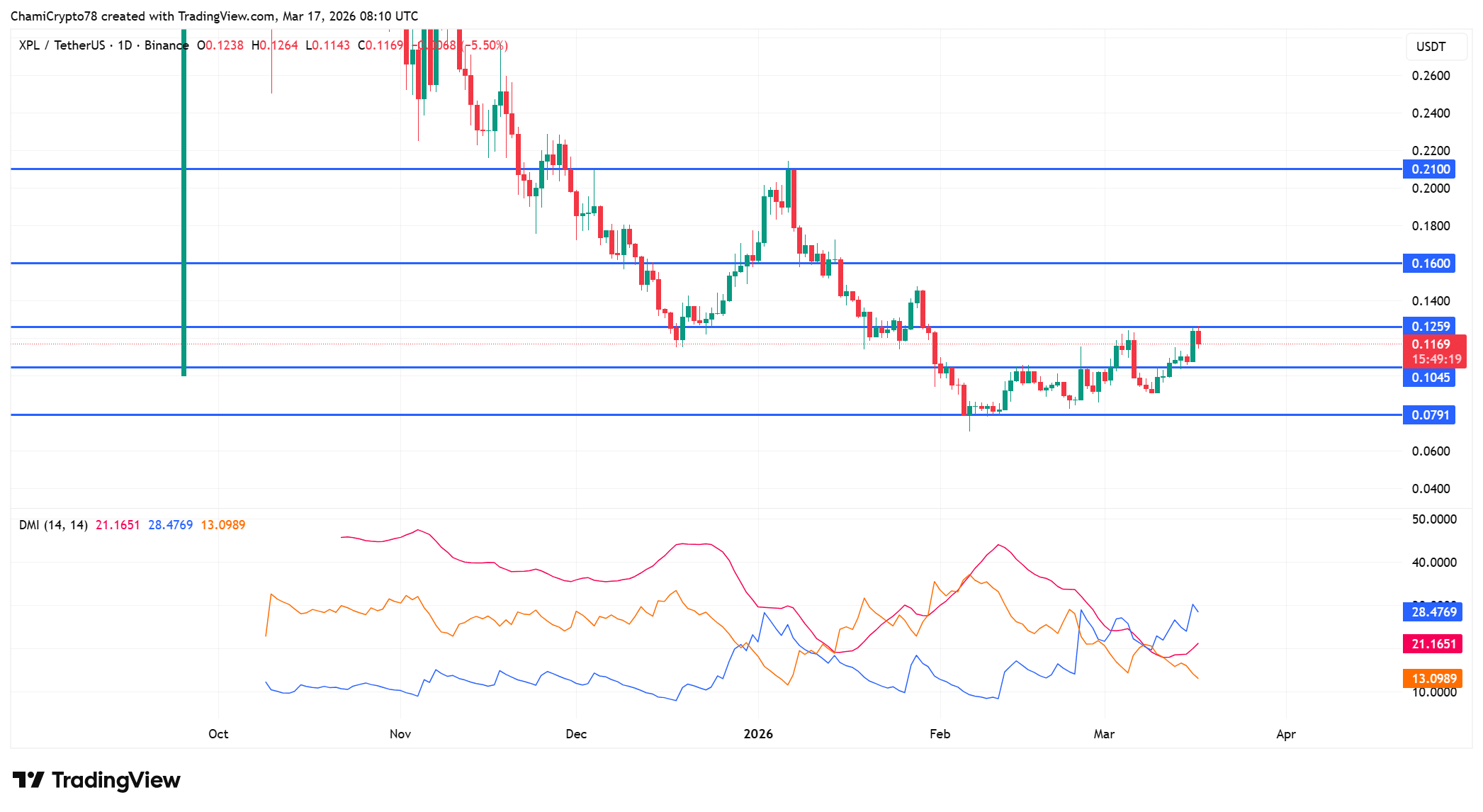
Plasma (XPL) surged 12.89% to $0.1238 on March 17, with trading volume up over 155%, signaling renewed buyer interest. The token rebounded from recent lows, reclaiming the $0.1045 support level and approaching the $0.1259 resistance. Technical indicators show buyers gaining dominance, with the +DI line above -DI and ADX around 21, indicating strengthening trend momentum. Exchange outflows of $664K suggest reduced selling pressure and accumulation behavior. Liquidity clusters above $0.128 could trigger a short squeeze if resistance is broken. Holding above $0.1045 is crucial for further upside, with a break above $0.1259 likely accelerating gains toward $0.128.

On the 17th of March, Plasma [XPL] surged 12.89% to $0.1238, while trading volume climbed over 155%, reflecting a sharp rise in participation.

The token has rebounded from recent lows, and buyers have stepped in aggressively during the latest sessions. This move suggests that interest has returned after a prolonged cooling phase.

However, the rally has not occurred in isolation, as both market structure and liquidity dynamics have started aligning with the upside.

The expansion in activity indicates that traders are repositioning rather than exiting.

As a result, this shift places XPL in a critical phase where continuation depends on how price interacts with nearby resistance zones and underlying demand strength.

Can XPL hold support and challenge resistance?

Price has reclaimed the $0.1045 level, which previously acted as a strong support base during consolidation.

Since then, XPL has pushed toward the $0.1259 resistance, where rejection has appeared before.

This area now serves as a key barrier that could define the next directional move.

However, the structure shows higher lows forming, which reflects strengthening buyer control. Each dip has attracted demand, preventing deeper retracements.

The DMI structure has shifted notably, as the +DI line has moved above the -DI line, signaling that buyers have started dominating recent price action.

At the same time, the ADX has hovered around 21, indicating that the trend strength has started building rather than fading.

This alignment reflects a transition from a neutral phase into a developing directional trend.

As the price compresses below the resistance, pressure continues building within this range.

A sustained hold above $0.1045 keeps the structure intact, while repeated tests of $0.1259 increase breakout probability.

This setup suggests that XPL is positioning for a decisive move rather than drifting sideways.
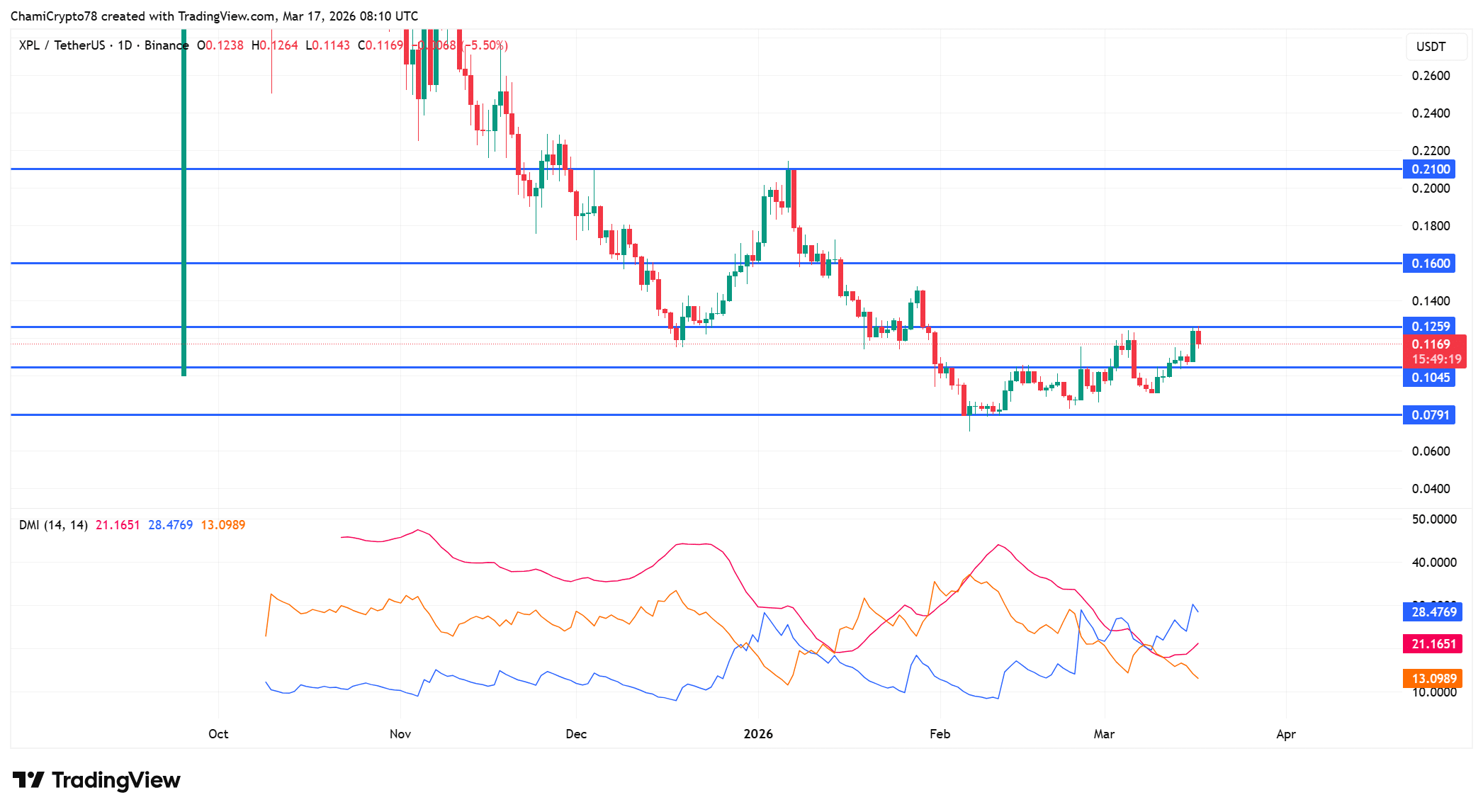
Source: TradingView

Exchange outflows tighten available supply

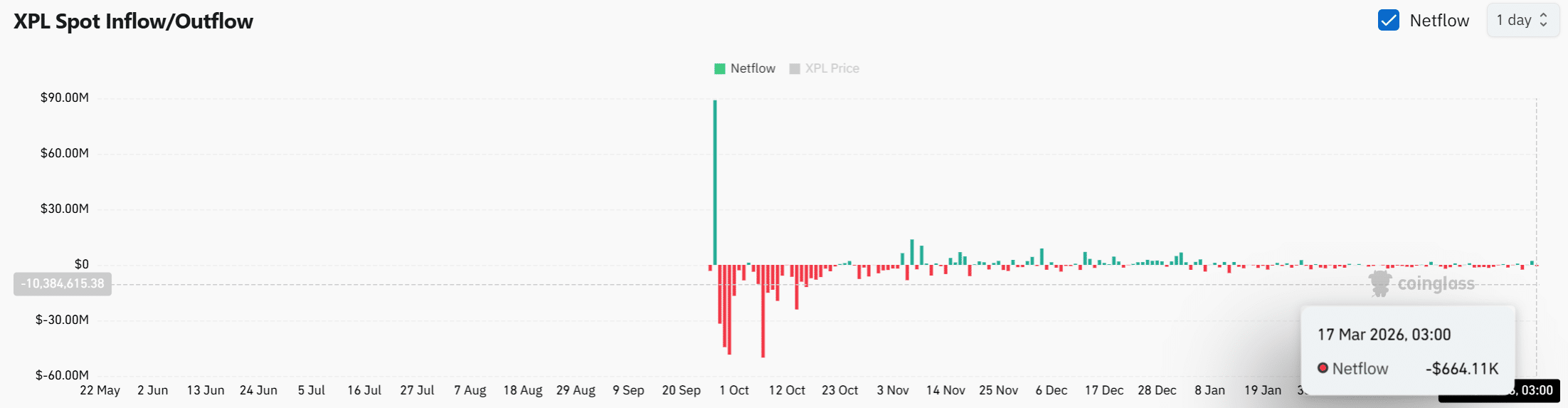
Spot Netflows have remained negative at press time, with recent outflows of approximately $664K from exchanges.

This shift indicates that tokens have been moving off trading platforms rather than preparing for immediate selling.

As supply on exchanges declines, available liquidity tightens, which can amplify price reactions during periods of strong demand.

Besides, reduced sell-side pressure creates conditions where upward moves face less resistance.

However, this dynamic also depends on whether demand continues to match the reduced supply.

As long as outflows persist, the market structure supports accumulation behavior rather than distribution.

This pattern reinforces the bullish context already visible in price action and technical indicators.
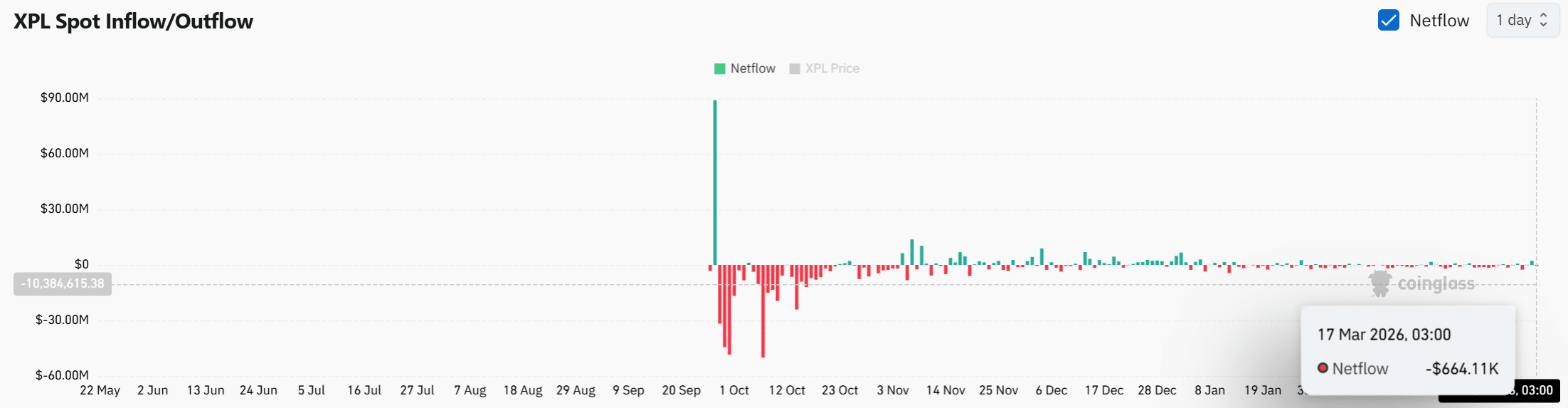
Source: CoinGlass

Liquidity clusters above price signal squeeze setup

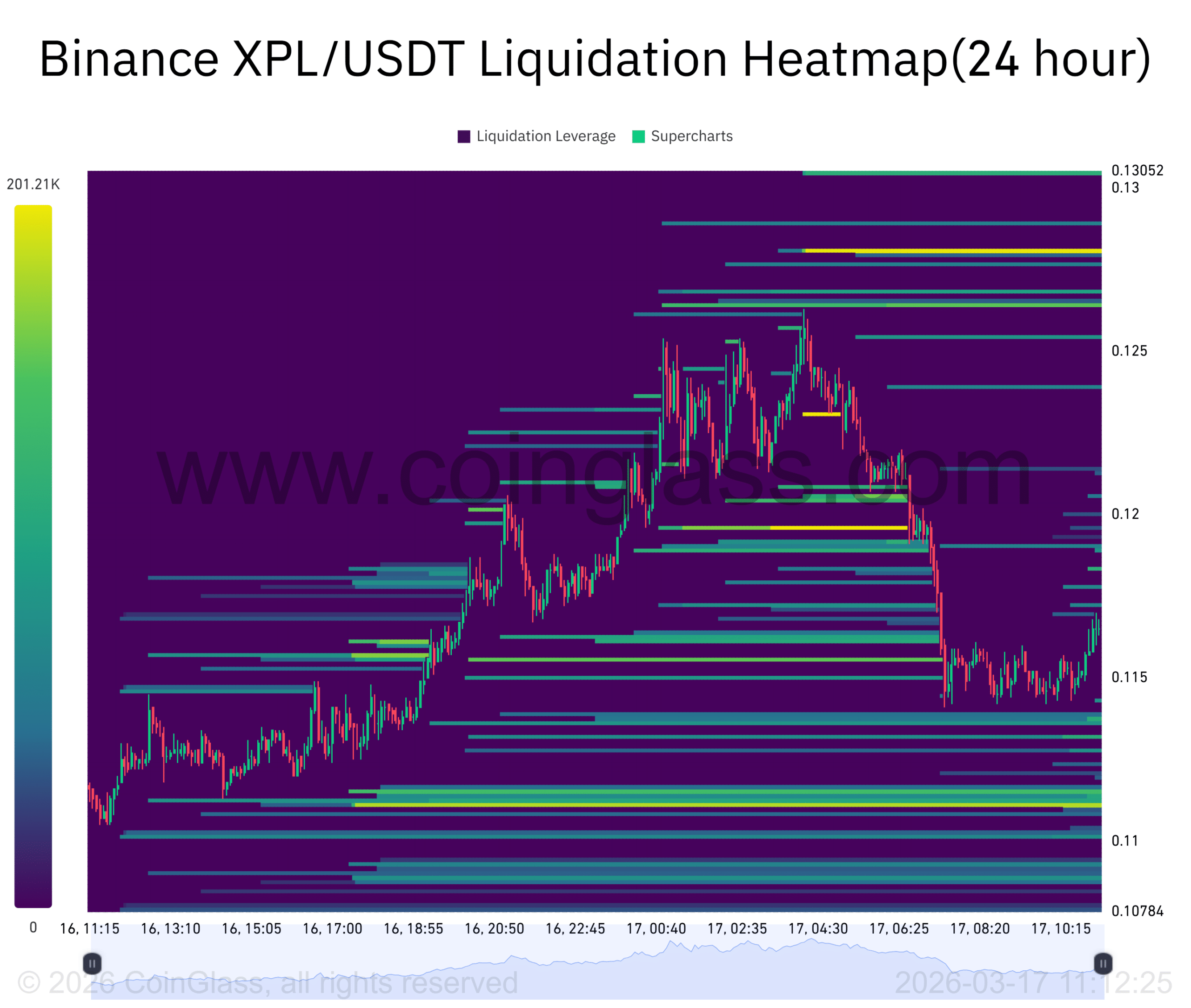
The Liquidation Heatmap has revealed dense liquidity clusters sitting above the current price, particularly around the $0.128 region.

These zones represent areas where short positions could face forced closures if the price moves higher. As XPL approaches these levels, upward pressure could accelerate due to cascading liquidations.

However, the price must first break through nearby resistance to trigger this effect.

The presence of stacked liquidity above current levels creates a magnet-like effect, drawing price toward those zones.
Source: CoinGlass

XPL appears positioned for continuation as strengthening structure, rising demand, and tightening supply align with bullish pressure.

A decisive move above $0.1259 would likely unlock liquidity around $0.128, accelerating the rally.

However, sustained strength depends on holding $0.1045 support. As long as buyers defend this base, the current setup favors further upside expansion.


Final Summary

  • XPL structure shows buyers stepping in early, building pressure that could drive continuation beyond nearby resistance levels.
  • Liquidity sitting above Plasma [XPL] price creates a path for rapid upside expansion if bullish strength remains sustained here.


Trend Kriptolar

İlgili Sorular

QWhat was the percentage increase in Plasma [XPL] price on March 17th, and what was the new price?

APlasma [XPL] surged 12.89% to $0.1238 on March 17th.

QWhat is the critical resistance level that XPL needs to break for a potential rally continuation?

AThe critical resistance level that XPL needs to break is $0.1259.

QWhat does the negative Spot Netflows value of approximately $664K indicate for XPL?

AThe negative Spot Netflows value of approximately $664K indicates that tokens are being moved off exchanges, suggesting accumulation behavior and a reduction in immediate selling pressure.

QAccording to the Liquidation Heatmap, what is the significance of the liquidity cluster around the $0.128 region?

AThe liquidity cluster around $0.128 represents a dense zone of short position liquidations. If the price reaches this level, it could trigger cascading liquidations, accelerating upward price movement.

QWhat key support level must XPL hold to maintain its current bullish structure?

AXPL must hold the key support level at $0.1045 to maintain its current bullish structure and favor further upside expansion.

İlgili Okumalar

Wall Street's Most Famous 'Cassandra' Now Has His Sights Set on Nvidia

Michael Burry, the famed "Big Short" investor, has once again captured Wall Street's attention with a series of short positions against major tech and semiconductor stocks, most notably Nvidia. In late June and July, through his "Cassandra Unchained" newsletter, Burry disclosed short bets against Nvidia, Tesla, Applied Materials, Caterpillar, the SOXX semiconductor ETF, and later, Micron Technology. His core thesis revolves around potential distortions in the AI infrastructure boom, specifically questioning whether extended depreciation schedules (e.g., 6 years vs. a realistic 2-3 years for AI chips) by cloud giants like Microsoft and Google artificially inflate profits. He also raises concerns about possible "off-balance-sheet circular financing," where chip demand might be propped up by vendor-backed funding to clients. Nvidia's stock experienced volatility following these disclosures, briefly dipping but largely holding near Burry's reported entry points, leaving his positions roughly flat or slightly underwater as of late July. This move is part of a pattern for Burry, whose track record since his legendary 2008 bet is mixed. He has faced notable losses, such as on Tesla in 2021, while scoring on broader market turns like the 2020 pandemic crash. His methodology focuses intensely on free cash flow and scrutinizing original financial documents to spot overvaluation and structural risks, but it often struggles with timing the market. The article contrasts Burry's stance with other prominent investors. Steve Eisman, another "Big Short" figure, is not shorting Nvidia, citing strong fundamentals but expressing nervousness about sustainability. Jim Chanos agrees with the broad "accounting mismatch" concern—comparing it to the dot-com bubble—but targets financial leverage in private equity firms rather than the chip stocks themselves. While Nvidia's short interest remains relatively low at 1.3-1.4% of float, the massive stock size means absolute short losses have been significant, exceeding $5 billion earlier this year. The piece concludes that for ordinary investors, the key takeaway is not replicating specific short bets but learning from the critical frameworks these investors use: questioning rosy accounting, identifying structural vulnerabilities, and maintaining skepticism during market euphoria, even if pinpointing the exact catalyst for a downturn remains elusive.

marsbit19 dk önce

Wall Street's Most Famous 'Cassandra' Now Has His Sights Set on Nvidia

marsbit19 dk önce

Weekly Selection丨Epic Stock Market Volatility, Changxin Tech's IPO Reshapes Storage Landscape, Saylor Aims to Re-Anchor STRC Around September 8th

PANews Weekly Digest: Market Turmoil, Tech Breakthroughs, and Crypto Developments. The week saw significant volatility across global markets. South Korea's KOSPI index experienced extreme turbulence, including multiple trading halts, largely driven by sharp declines in AI hardware stocks like SK Hynix. In contrast, China's Changxin Xinqiao (CXC) achieved a landmark IPO with a market cap surpassing 4 trillion yuan, marking a major success for the domestic DRAM industry after a decade of losses. In the crypto and Web3 space, several key narratives emerged. AI is driving demand for new infrastructure, with projects like AI agent wallets and programmable payments gaining traction, attracting interest from firms like Coinbase. The Bitcoin mining sector is pivoting, with companies like MARA focusing on energy management as electricity becomes a core AI-era asset. Meanwhile, the RWA (Real World Assets) sector faces a "utilization puzzle," with hundreds of billions in on-chain assets remaining dormant. Notable market movements included a historic single-day surge of over 17% for the KOSPI index and a significant migration of $16.5 billion in staked ETH within the Lido ecosystem. Michael Saylor announced a target to re-peg the STRC stablecoin around September 8th. Other highlights include discussions on Ethereum's ambitious 2030 roadmap for scaling and privacy, analysis showing high protocol revenues not always translating to token price gains, and warnings from Citi about potential extreme commodity price shocks by late 2026.

marsbit24 dk önce

Weekly Selection丨Epic Stock Market Volatility, Changxin Tech's IPO Reshapes Storage Landscape, Saylor Aims to Re-Anchor STRC Around September 8th

marsbit24 dk önce

When the Market Begins to Question AI Capex: A Full Analysis of Q2 Earnings Reports from Five Tech Giants

In late July 2026, five major US tech giants—Alphabet, Intel, Microsoft, Meta, and Apple—released their Q2 earnings reports. While all companies exceeded revenue and profit expectations, driven by strong AI-related business growth, investor reactions diverged sharply due to concerns over escalating AI capital expenditures (capex) and their impact on free cash flow. Alphabet reported strong revenue growth and a surging cloud business, but its stock fell after announcing a doubled year-on-year capex and negative quarterly free cash flow for the first time. Intel posted its strongest revenue growth in over 15 years, but its stock experienced volatile trading after significantly raising its full-year capex guidance. Microsoft saw its stock surge after beating estimates and, crucially, lowering its capex forecast while projecting positive free cash flow. Meta faced the most severe sell-off as its profits declined despite revenue beats, with free cash flow plunging over 90% and its capex guidance raised. Apple reported record June-quarter results, but its stock plummeted after providing Q4 revenue guidance that fell short of expectations, citing supply chain constraints and forex headwinds. The overall takeaway is that the market's focus has shifted from validating AI demand to scrutinizing the timeline for returns on massive AI investments. Companies demonstrating a clearer path to managing capex and preserving free cash flow, like Microsoft, were rewarded, while those signaling continued aggressive spending faced investor skepticism.

Odaily星球日报33 dk önce

When the Market Begins to Question AI Capex: A Full Analysis of Q2 Earnings Reports from Five Tech Giants

Odaily星球日报33 dk önce

a16z: From Companies to DAOs, DUNA May Become the Next Generation Organizational Form

This article, "From Companies to DAOs: How DUNA Could Become the Next Organizational Form," traces the 500-year evolution of business collaboration. It begins with medieval structures like the *commenda* and Florentine *compagnia*, which exposed partners to personal risk. The modern corporation, exemplified by the Dutch East India Company (VOC), was a revolutionary leap, enabling large-scale, capital-intensive ventures by offering limited liability and reducing coordination costs. However, corporations introduced new challenges like principal-agent problems and bureaucratic overhead. The piece argues that software and internet-native protocols are now reducing these traditional overheads. Decentralized Autonomous Organizations (DAOs) emerged as a new model for coordination without centralized management. Yet, DAOs face a significant legal vacuum: they lack legal recognition, leaving members exposed to unlimited personal liability, and their tokens are vulnerable to being classified as securities under unclear regulations (e.g., the Howey Test). This has forced projects into suboptimal workarounds like offshore foundations. The article identifies the Decentralized Unincorporated Nonprofit Association (DUNA) as a potential solution. Recently legalized in states like Wyoming, the DUNA provides a legal wrapper for decentralized networks. It grants key protections—legal personality, limited liability, and perpetual existence—to a group without imposing a traditional hierarchical management structure. This allows token-holder communities to govern, hold assets, and contract as a single legal entity, aligning with their decentralized nature. While DUNA doesn't solve all governance challenges or magically resolve securities law questions, it represents a crucial step. It fills the legal recognition gap, offering a native legal form for internet-scale, decentralized collaboration and extending the separation of personal risk from organizational venture into a new domain.

marsbit1 saat önce

a16z: From Companies to DAOs, DUNA May Become the Next Generation Organizational Form

marsbit1 saat önce

2026 Mid-Year Report On-Chain RWA: Tokenized Stock Market Cap Doubles in a Year, But 90% of Rights Are Hollow Shells

The 2026 Mid-Year Report on On-Chain RWA highlights a significant growth in tokenized stock market capitalization, which nearly doubled from $951 million in March to $1.89 billion by July. However, the report reveals a fundamental contradiction in this "layer 2.5" ecosystem: products with the strongest legal foundation (like regulated U.S. infrastructure) lack liquidity and distribution, while freely tradable offshored wrapper products often lack substantive ownership rights. The increase is driven largely by a few products (SECZ, FGRS, STRCx) and platforms (Ondo, xStocks, Securitize collectively hold over 85% share). While distributed value across networks like Ethereum, Solana, and BNB Chain has grown, the market remains fragmented. Products referencing the same underlying asset (e.g., Apple stock) are distinct legal liabilities with different intermediaries and jurisdictional rules, offering varying degrees of legal claim. The report cautions that headline numbers are misleading, as they reflect changes in distributed token value—driven by issuance, conversions, and price movements—not pure investor inflows. True "canonical shares" with legal ownership, wide wallet distribution, institutional liquidity, and independent on-chain price discovery do not yet exist at scale. Tokenized treasuries show stronger product-market fit, and ETFs may be easier to scale than single stocks. The core takeaway is a trade-off: legal certainty versus liquidity and composability.

marsbit2 saat önce

2026 Mid-Year Report On-Chain RWA: Tokenized Stock Market Cap Doubles in a Year, But 90% of Rights Are Hollow Shells

marsbit2 saat önce

İşlemler

Spot

Popüler Makaleler

PLASMA Nedir

Plasma: Blok Zinciri Ölçeklenebilirliği için Keskin Çözüm Plasma'ya Giriş Kripto para manzarası geliştikçe, blok zinciri ağları içinde artırılmış verimlilik ihtiyacı da artmaktadır. Plasma, bir Katman 2 ölçeklenebilirlik çözümü olarak bu alanda öncü bir oyuncu olarak ortaya çıkıyor, özellikle Web3 geliştirme alanında. Ana zincirden daha küçük zincirler dizisine önemli bir kısmı stratejik olarak kaydırarak, Plasma, Ethereum'un ölçeklenebilirliğini ve performansını önemli ölçüde artırmayı vaat ediyor—dağıtık uygulamaların öncüsü olan yaygın bir blok zinciri platformu. Plasma Nedir? Plasma, Ethereum blok zinciri için özellikle tasarlanmış yenilikçi bir off-chain ölçeklenebilirlik çözümüdür. Ağustos 2017'de Ethereum'un kurucu ortağı Vitalik Buterin ve Lightning Network gibi ölçeklenebilirlik çözümlerinin önde gelen savunucusu Joseph Poon tarafından tanıtılmıştır. Plasma, ana Ethereum zincirinin üzerinde bir çocuk zincirler hiyerarşisi oluşturarak ölçeklenebilir uygulamaların yaratımını sağlayan bir çerçeve olarak işlev görmektedir. Plasma'nın özünde, Ethereum ağına güvenlik ve mutabakat için bağımlı kalarak bağımsız olarak çalışabilen potansiyel olarak sonsuz yan zincirlerin geliştirilmesine olanak tanır. Bu mimari, işlemleri ve veri depolamayı verimli bir şekilde yöneten akıllı sözleşmeler ve Merkle Ağaçları ile desteklenmektedir. Plasma'nın Temel Hedefleri Plasma'nın birincil amacı, Ethereum ağının işlem hacmini artırmaktır. Yoğun ana zincirden önemli bir işlem hacmini saptırarak, Plasma'nın mimarisi daha yüksek işlem hızları, daha verimli veri işleme ve daha düşük işlem maliyetleri sunar. Bu, özellikle finans, oyun ve tedarik zinciri yönetiminde dağıtık uygulamalara olan talebin eşi benzeri görülmemiş seviyelere ulaştığı bir çağda hayati öneme sahiptir. Plasma'nın Yaratıcıları Plasma, blok zinciri topluluğunda tanınmış iki figürün eseridir: Vitalik Buterin ve Joseph Poon. Buterin, esas olarak Ethereum'un kurucu ortağı olması ve blok zinciri teknolojisinin ulaşabileceği sınırları zorlamasıyla tanınır. Poon ise, blok zinciri ağlarında daha hızlı ve maliyet etkin işlemlere olanak tanıyan ölçeklenebilir çözümleri savunmasıyla bilinir. Plasma çerçevesindeki işbirlikleri, ileri düzey teknik içgörülerle pratik uygulamaları bir araya getirerek, yenilikçi doğasına büyük katkı sağlamıştır. Plasma'nın Yatırımcıları Plasma'yı destekleyen özel yatırım vakıfları veya organizasyonları duyurulmamış olsa da, proje blok zinciri ve kripto para alanındaki çeşitli tanınmış figürlerden ve oyunculardan ilgi görmüştür. Ethereum içindeki ölçeklenebilirliği artırma potansiyeli ile, blok zinciri teknolojisinin sınırlarını zorlamaya çalışan çeşitli kuruluşların dikkatini çekmiştir. Plasma Nasıl Çalışır? Plasma'nın benzersiz işlevselliği, çocuk zincirlere ve bunların ana Ethereum ağı ile etkileşimine dayanan mimarisine atfedilmektedir. Plasma'nın yenilikçi yaklaşımına katkıda bulunan bazı ana faktörler şunlardır: Çocuk Zincirler: Plasma, ana Ethereum zincirinden bağımsız olarak işlemleri gerçekleştirebilen çok sayıda çocuk zincir kurar. Her bir çocuk zincir, belirli gereksinimler temelinde geliştiricilere özelleştirilmiş çözümler yaratabilme imkanı sunan ayrı bir akıllı sözleşme olarak çalışır. Akıllı Sözleşmeler ve Merkle Ağaçları: Çerçeve, önceden tanımlanmış koşullarla kendiliğinden yürütülen anlaşmalar olan akıllı sözleşmeleri kullanır ve verilerin verimli bir şekilde doğrulanmasını sağlamak için Merkle Ağaçları ile birleştirir. Bu teknoloji, Plasma'nın hem yüksek ölçeklenebilirlik hem de güvenlik elde etmesini sağlar. İşlem Sıkıştırma: Plasma, çocuk zincirlerdeki işlemleri bir araya getirerek, Ethereum ağı üzerindeki veri yükünü azaltır. Bu, ana zincirde daha az işlemin kaydedilmesi gerektiği anlamına gelir—bu da alanın açılmasını ve yoğunluğun azaltılmasını sağlar. Artırılmış Güvenlik: Off-chain olmasına rağmen, Plasma ana Ethereum ağının güvenlik önlemlerinden yararlanır ve çocuk zincirler üzerindeki tüm işlemlerin yüksek bir bütünlük ve güvenlik seviyesini korumasını sağlar. Plasma'nın Zaman Çizelgesi Plasma'nın gelişimini anlamak, önemli kilometre taşlarını izlemeyi içerir: Ağustos 2017: Plasma, Vitalik Buterin ve Joseph Poon tarafından Ethereum'un performans sorunlarını ele almak için ölçeklenebilir bir çözüm olarak ilk kez tanıtıldı. 2018: Plasma çerçevesi resmi olarak geliştirildi ve GitHub'da erişilebilir hale getirildi; bu, pratik uygulamalardaki uygulanabilirliğine doğru kritik bir adım oldu. 2019: Plasma hakkında farkındalık arttıkça, Ethereum uygulamalarını ölçeklendirmeye ilgi duyan geliştiricileri çekmeye başladı ve böylece benimsenmesi arttı. 2020: Plasma, mimarisi ve işlevselliğinde önemli iyileştirmeler yaparak evrimini sürdürdü—bu durum, geliştiriciler için daha da cazip hale getirdi. Plasma'nın Temel Özellikleri Plasma, blok zinciri alanında dönüştürücü bir çözüm olmasını sağlayan birkaç özelliğe sahiptir: Ölçeklenebilirlik: Birden fazla çocuk zincir oluşturarak, Plasma ana Ethereum zincirini daha fazla zorlamadan daha yüksek bir işlem hacmini işleyebilir. Hız: Her bir çocuk zincir, işlemleri daha hızlı işleyebilir ve kullanıcılara daha iyi bir deneyim ve hizmet sunar. Daha Düşük İşlem Maliyetleri: Plasma'nın yapısı, ana zincir üzerindeki yükü azaltarak işlemlerle bağlantılı maliyetleri etkili bir şekilde düşürür. İnteroperabilite: Mimari, Plasma'nın birden fazla blok zinciri ile sorunsuz bir şekilde etkileşim kurmasına olanak tanır, böylece ağlar arası işlevselliği artırır. Güvenlik: Ethereum'un ana zincirinin güvenliğinden yararlanarak, Plasma çocuk zincirlerini kullanırken operasyonlarının bütünlüğünü sağlar. Plasma'nın Kullanım Alanları Plasma'nın yenilikçi mimarisi, farklı sektörlerde çeşitli pratik uygulamalar için kapıyı aralar: Merkeziyetsiz Finans (DeFi): Plasma, DeFi uygulamalarının ölçeklenebilirliğini ve verimliliğini artırma kapasitesine sahiptir ve daha akıcı ve etkili ticaret süreçleri oluşturur. Oyun: Çerçeve, hızlı ve maliyet-etkin oyun deneyimlerinin geliştirilmesini kolaylaştırır ve bu durum oyun endüstrisindeki geliştiricilere cazip gelmektedir. Tedarik Zinciri Yönetimi: Etkili işlem işleme yeteneği ile Plasma, merkeziyetsiz tedarik zinciri yönetimi çözümlerinin geliştirilmesini teşvik edebilir. Sonuç Plasma, blok zinciri teknolojisinde öncü bir konumda bulunuyor ve Ethereum ağı ve ötesinde verimliliği artırmayı hedefleyen kritik bir Katman 2 ölçeklenebilirlik çözümü olarak konumlanıyor. Çocuk zincirler, akıllı sözleşmeler ve Merkle Ağaçları ile benzersiz yapısı sayesinde, Plasma uzun zamandır blok zinciri ağlarını rahatsız eden ölçeklenebilirlik krizine etkili bir çözüm sunuyor. Blok zinciri teknolojisi ilerlemeye devam ederken, Plasma gibi çözümler geliştiricilerin ölçeklenebilirlik zorluklarına yaklaşımını yeniden şekillendirme vaadi taşıyor ve merkeziyetsiz uygulamaların işleyişini potansiyel olarak devrim niteliğinde değiştirebilir. Yaratıcılarının sürekli çabaları ve çeşitli paydaşların ilgisi, Plasma'nın dijital alandaki blok zinciri yeteneklerini yeni zirvelere taşımayı hedeflediği parlak bir geleceği işaret ediyor.

197 Toplam GörüntülenmeYayınlanma 2024.12.03Güncellenme 2024.12.03

PLASMA Nedir

XPL Nasıl Satın Alınır

HTX.com’a hoş geldiniz! Plasma (XPL) satın alma işlemlerini basit ve kullanışlı bir hâle getirdik. Adım adım açıkladığımız rehberimizi takip ederek kripto yolculuğunuza başlayın. 1. Adım: HTX Hesabınızı OluşturunHTX'te ücretsiz bir hesap açmak için e-posta adresinizi veya telefon numaranızı kullanın. Sorunsuzca kaydolun ve tüm özelliklerin kilidini açın. Hesabımı Aç2. Adım: Kripto Satın Al Bölümüne Gidin ve Ödeme Yönteminizi SeçinKredi/Banka Kartı: Visa veya Mastercard'ınızı kullanarak anında Plasma (XPL) satın alın.Bakiye: Sorunsuz bir şekilde işlem yapmak için HTX hesap bakiyenizdeki fonları kullanın.Üçüncü Taraflar: Kullanımı kolaylaştırmak için Google Pay ve Apple Pay gibi popüler ödeme yöntemlerini ekledik.P2P: HTX'teki diğer kullanıcılarla doğrudan işlem yapın.Borsa Dışı (OTC): Yatırımcılar için kişiye özel hizmetler ve rekabetçi döviz kurları sunuyoruz.3. Adım: Plasma (XPL) Varlıklarınızı SaklayınPlasma (XPL) satın aldıktan sonra HTX hesabınızda saklayın. Alternatif olarak, blok zinciri transferi yoluyla başka bir yere gönderebilir veya diğer kripto para birimlerini takas etmek için kullanabilirsiniz.4. Adım: Plasma (XPL) Varlıklarınızla İşlem YapınHTX'in spot piyasasında Plasma (XPL) ile kolayca işlemler yapın.Hesabınıza erişin, işlem çiftinizi seçin, işlemlerinizi gerçekleştirin ve gerçek zamanlı olarak izleyin. Hem yeni başlayanlar hem de deneyimli yatırımcılar için kullanıcı dostu bir deneyim sunuyoruz.

339 Toplam GörüntülenmeYayınlanma 2025.09.26Güncellenme 2026.06.02

XPL Nasıl Satın Alınır

Tartışmalar

HTX Topluluğuna hoş geldiniz. Burada, en son platform gelişmeleri hakkında bilgi sahibi olabilir ve profesyonel piyasa görüşlerine erişebilirsiniz. Kullanıcıların XPL (XPL) fiyatı hakkındaki görüşleri aşağıda sunulmaktadır.

活动图片