Pi Network Temporarily Halts Wallet Payment Requests Amid Rising Scams

TheNewsCrypto2025-12-31 tarihinde yayınlandı2025-12-31 tarihinde güncellendi

Özet

Pi Network has temporarily disabled its wallet payment request feature due to widespread scams. Scammers were impersonating official accounts and targeting high-balance wallets, tricking users into approving fraudulent requests, resulting in irreversible losses. Over a million PI tokens have been stolen this year, with one wallet receiving more than 838,000 tokens. The Pi Core Team clarified that the issue stems from user approval, not a system vulnerability, and emphasized that this is a common risk across crypto wallets. The token’s value dropped 10% following the incident but has since shown slight recovery. Recent updates include standardized KYC and testnet DEX improvements to enhance security and liquidity.

The Pi network, which is the mobile-first Cryptocurrency and web3 blockchain, recently posted a tweet on DEC 30 that the team has warned that scammers are exploiting the Payment request feature to steal Pi tokens from users’ balances. In the Pi network, the wallet balances are publicly visible, and the attackers are targeting the high-balance wallets and sending the payment request to the wallet as an impersonation of official Pi accounts or community moderators.
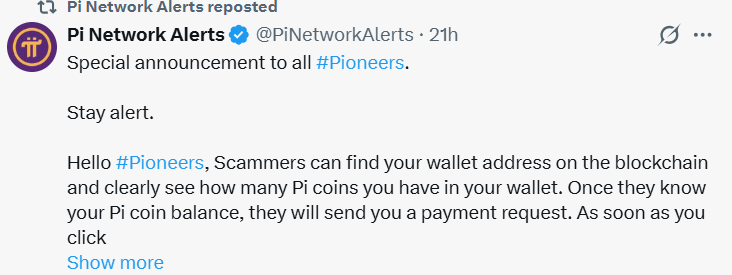
Once the user approves the payment request, the Tokens will be instantly transferred to the scammers’ account and will be gone forever. No reversal or recovery will be done. The Community reports indicate the scams are widespread, and one scammer’s wallet has received more than 838,000 PI tokens. Overall, more than a million PI tokens have been lost throughout the year. This created a panic situation among the users, and even the experienced users were tricked because the request looked legitimate.

Pi Core Team Denies System Vulnerability, Addresses Market and User Impact

After this incident happened, many users called it a wallet flaw, but the Core team clarified that the problem is from the human approval, not the protocol Flaw. They say that the wallet never sends funds on its own, and the transfer only happens after the user’s approval. This behavior exists in all major Crypto wallets. So to stop this scam, the PI network has disabled all payment requests network-wide. This stops the scams instantly and prevents further user losses. This makes the PI token safe, and it was the fastest way to contain the damage.

The token is currently trading at $0.204 with a market cap of 1.7 billion. The Token has dropped to 10% due to this issue. Recently, the token has updated its ecosystem by adding Standardized KYC to cut the verification backlogs by 50% and speed up mainnet migration for millions of users. Another update is from the testnet DEX, which makes the trading safer and easier by using Pi as the main trading Pair and improving the liquidity. This makes the token regain its momentum, and it has increased by 0.7% in 24 hours.

Highlighted Crypto News:

XDC Network Momentum Test: Will It Break Resistance or Slip Back to Lows?

TagsAltcoinCryptocurrencyPi Network

İlgili Sorular

QWhy did the Pi Network temporarily halt wallet payment requests?

AThe Pi Network temporarily halted wallet payment requests to stop scammers who were exploiting the feature to steal Pi tokens by impersonating official accounts, preventing further user losses.

QHow were the scammers able to steal Pi tokens from users?

AScammers targeted high-balance wallets, sent payment requests while impersonating official Pi accounts or community moderators, and stole tokens once users approved these deceptive transactions.

QWhat was the Pi Core Team's response to the incident being called a 'wallet flaw'?

AThe Pi Core Team clarified that the issue was due to human approval of fraudulent requests, not a protocol flaw, emphasizing that transfers only occur after user authorization, similar to other crypto wallets.

QHow much Pi token value was reported lost due to these scams?

ACommunity reports indicated that over a million Pi tokens were lost throughout the year, with one scammer's wallet receiving more than 838,000 Pi tokens.

QWhat recent updates has the Pi Network implemented to improve its ecosystem?

AThe Pi Network recently added Standardized KYC to reduce verification backlogs by 50% and introduced updates to the testnet DEX, using Pi as the main trading pair to enhance safety and liquidity.

İlgili Okumalar

Interview with Robinhood Executive: Meme + Tokenized US Stocks as "Barbell" Customer Acquisition Strategy, All Business Lines Achieve Hundreds of Millions in Revenue

Interview with Robinhood executive Johann Kerbrat reveals the company's "barbell" customer acquisition strategy for its new Robinhood Chain, combining meme tokens with tokenized stocks. Three weeks after mainnet launch, the chain has seen over $3B in weekly DEX volume and 105M transactions. Kerbrat explains the logic behind the permissionless chain: meme tokens attract DeFi users, while tokenized real-world assets (RWA), currently over 90 US stocks and ETFs accessible in 120+ countries, serve global users. The goal is to bring Robinhood's 27 million funded accounts on-chain by simplifying DeFi with a user-friendly interface, exemplified by features like Robinhood Earn which offers yield without requiring wallet management. Built on Arbitrum's technology stack for its speed, low cost, and Ethereum's security, the chain focuses on financial products like Earn, spot trading, and perpetuals. Kerbrat downplays direct competition with platforms like Base, emphasizing the goal of expanding the overall market for on-chain assets. He details selective partnerships (e.g., Morpho, Lighter) based on compliance, unique UX, and differentiation. While regulatory clarity is pending for US perpetuals, the expansion continues via Bitstamp in Europe. Finally, Kerbrat positions Robinhood as a "super app" integrating stocks, options, crypto, banking, and AI trading, with all major business lines generating hundreds of millions in revenue. For the chain, current priority is driving adoption over maximizing gas fee revenue.

marsbit1 saat önce

Interview with Robinhood Executive: Meme + Tokenized US Stocks as "Barbell" Customer Acquisition Strategy, All Business Lines Achieve Hundreds of Millions in Revenue

marsbit1 saat önce

Fidelity Q3 Report: BTC, ETH, and SOL Continue to Build Bottoms; How Much Further Will This Crypto Bear Market Go?

Fidelity's Q3 Crypto Signal Report analyzes the current bear market, noting Bitcoin (BTC), Ethereum (ETH), and Solana (SOL) are in a prolonged bottoming phase. Key indicators like the weighted Net Unrealized Profit/Loss (NUPL) have turned negative (-0.01), signaling the market is slightly below its aggregate cost basis, with BTC acting as the primary stabilizing asset. BTC's dominance has risen to 68%, indicating a lack of capital rotation to other digital assets. Performance has been weak across the board, with BTC, ETH, and SOL down significantly year-to-date. Market sentiment is depressed, exacerbated by substantial outflows from spot ETPs and a challenging macro environment. The report compares the current ~203-day downtrend to historical ~300-day bottoming cycles, suggesting the process may be two-thirds complete, with late 2026 as a potential timeframe to monitor. For Bitcoin, NUPL at 0.09 indicates cautious sentiment, while momentum signals remain negative. The Yardstick metric points to potential undervaluation relative to network security (hashrate). Ethereum's NUPL is deep in the "capitulation" zone at -0.43, a historically positive signal for future returns, though its momentum and network fee revenue are negative. Solana shows the deepest NUPL at -0.72 but demonstrates relative resilience in on-chain activity and stablecoin transfer volume. The report concludes that while several metrics are near historical capitulation levels, a definitive market bottom has not yet been established. The path forward likely involves continued consolidation, with BTC's relative strength and fundamental on-chain usage for ETH and SOL providing key areas for investor observation.

marsbit1 saat önce

Fidelity Q3 Report: BTC, ETH, and SOL Continue to Build Bottoms; How Much Further Will This Crypto Bear Market Go?

marsbit1 saat önce

İşlemler

Spot
活动图片