Phantom taps Kalshi to offer regulated prediction markets in wallet

cointelegraph2025-12-12 tarihinde yayınlandı2025-12-12 tarihinde güncellendi

Özet

Cryptocurrency wallet Phantom has partnered with regulated prediction market Kalshi to integrate event-based trading directly into its wallet interface. The new feature, Phantom Prediction Markets, will allow users to trade tokenized positions on real-world events in politics, economics, sports, and culture without leaving the app. This move aligns with a broader trend, as major crypto exchanges like Gemini and Coinbase are also entering the prediction market space. However, the industry faces regulatory challenges, exemplified by Connecticut's recent cease-and-desist orders against several platforms, including Kalshi, which is now legally challenging the state's actions.

Crypto wallet application Phantom has partnered with regulated prediction market Kalshi to bring event-based trading directly inside its wallet interface, signaling a deeper convergence between onchain finance and real-world outcome betting.

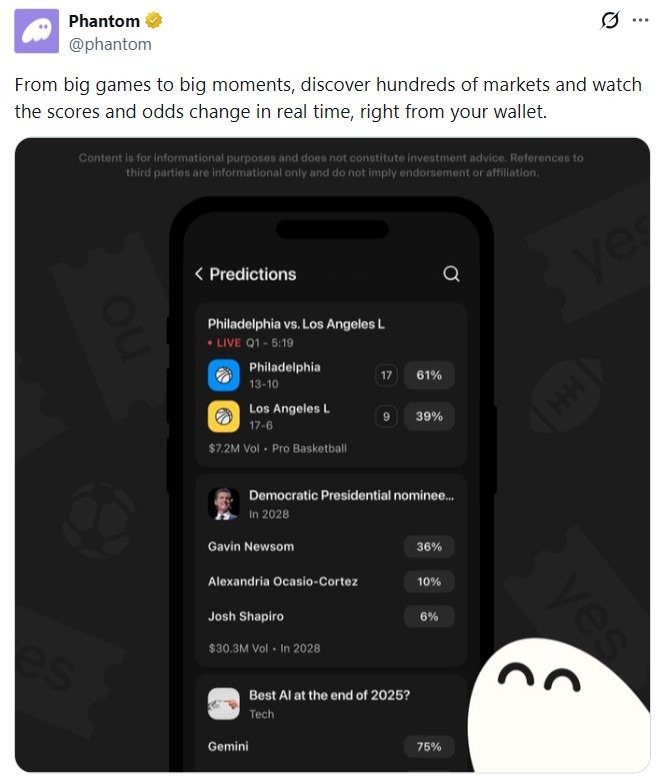
The companies said Friday that the integration would allow Phantom users to discover trending events, track live odds and place bets without leaving their wallets.

A new feature called Phantom Prediction Markets would allow users to trade tokenized positions that reference Kalshi’s event markets across politics, economics, sports and culture.

“By integrating a layer of tokenized positions referencing Kalshi’s regulated event markets with Phantom, users can trade what they care about in real time,” said Phantom CEO Brandon Millman.
Source: Phantom

Crypto exchanges eye US prediction markets

Phantom’s move comes as major crypto trading platforms race to enter the US prediction markets business.

On Thursday, Gemini Titan, an affiliate of the crypto exchange Gemini, received a designated contract market license from the US Commodity Futures Trading Commission (CFTC). Gemini said it plans to enter the prediction markets space.

The exchange said that it would allow users to access event contract trading on its web platform. Following its announcement, Gemini shares went up by nearly 14% in after-hours trading.

On Nov. 19, tech researcher Jane Manchun Wong, known for discovering in-development features on Big Tech websites, claimed that crypto exchange Coinbase is working on a prediction market. Wong shared screenshots apparently showing the unreleased platform.

Citing anonymous sources, Bloomberg reported that Coinbase plans to announce the launch of its prediction markets and tokenized equities.

A Coinbase spokesperson previously told Cointelegraph that they company will hold a livestream on Wednesday to showcase new products. However, the spokesperson did not mention prediction markets or tokenized stocks.

Related: Polymarket trading figures are being double-counted: Paradigm

Prediction markets face regulatory pushback

While prediction markets have gained popularity in the US, the state of Connecticut has recently taken a stance against certain platforms.

On Dec. 4, the Connecticut Department of Consumer Protection (DCP) sent cease and desist orders to Robinhood, Kalshi and Crypto.com, alleging that they were conducting unlicensed online gambling. However, Kalshi immediately took action a day later.

The prediction market platform sued the DCP, arguing that its event contracts are lawful under federal law.

Connecticut federal court judge Vernon Oliver stated in an order that the DCP must refrain from taking enforcement action against Kalshi. This temporarily stops the DCP’s cease and desist order against Kalshi.

Magazine: Koreans ‘pump’ alts after Upbit hack, China BTC mining surge: Asia Express

İlgili Okumalar

WEEX TradFi Trading Competition Kicks Off, 50,000 USDT Prize Pool First-Come, First-Served, Open a Position and Get 5 U

WEEX Exchange Launches "TradFi Trading Competition" with a 50,000 USDT Prize Pool Amidst a crypto market downturn, WEEX Exchange highlights the growth of tokenized traditional finance (TradFi) assets as a key trend, allowing users to trade stocks, ETFs, and commodities using crypto. The platform has launched a "TradFi Trading Competition" from July 9th to 23rd, featuring a 50,000 USDT prize pool. The campaign offers three reward tiers: 1. **New User Bonus (25,000 USDT pool):** New users depositing ≥100 USDT, completing a specified spot trade, and one TradFi contract trade (margin ≥10 USDT) receive 200 USDT. 2. **Volume-Based Rewards (20,000 USDT pool):** All users can earn tiered bonuses for achieving TradFi contract trading volumes of 5,000 USDT (3 USDT), 20,000 USDT (10 USDT), and 100,000 USDT (50 USDT). Rewards are stackable. 3. **Participation Reward:** Any user opening a TradFi contract trade during the event receives 5 USDT instantly. The article promotes WEEX's TradFi features, which include trading tokenized shares of companies like NVIDIA and Tesla using USDT, 24/7 trading, fractional share investing starting from $5, and high leverage up to 100x for hedging. It positions these features as solutions to traditional investing barriers like high fees, strict trading hours, and high share prices. The summary concludes by encouraging users to join the competition and leverage WEEX's platform to access global TradFi markets.

marsbit1 saat önce

WEEX TradFi Trading Competition Kicks Off, 50,000 USDT Prize Pool First-Come, First-Served, Open a Position and Get 5 U

marsbit1 saat önce

Switching Chains for Another Shot at Success: Can It Really 'Change One's Destiny'?

Recent months have witnessed a wave of established blockchain projects migrating to new public chains, notably Base and Arbitrum, coupled with strategic pivots in their business models—essentially "re-starting" elsewhere. Examples include Sophon (moving from ZKsync to Base to cut $3M+ annual costs and focus on consumer apps), Moonbeam (shifting from Polkadot to Base to pursue decentralized AI), and Secret Network (planning a move from Cosmos to Arbitrum to explore privacy-AI integrations, though its token price plunged 30% post-announcement). A common thread is that these migrating projects are primarily layer-1 or layer-2 chains now seeking relevance in AI and real-world consumer applications. This trend highlights the relative stagnation of ecosystems like Polkadot and Cosmos, which are seeing significant outflows. However, the community remains skeptical about whether such chain-hopping truly enables a turnaround. Historical cases like y00ts NFTs (which moved from Solana to Polygon and back to Ethereum) and Synthetix (which retreated from a multi-chain strategy) show that migration often fails to deliver expected benefits and can add complexity. In today's more rational market, devoid of easy narrative or airdrop红利, simply changing chains is unlikely to be a silver bullet. For both migrating projects and destination chains, the real challenge lies not in attracting projects but in developing actual use cases that retain users.

marsbit1 saat önce

Switching Chains for Another Shot at Success: Can It Really 'Change One's Destiny'?

marsbit1 saat önce

İşlemler

Spot
活动图片