Peter Thiel Dumps Ethereum Treasury Play ETHZilla, Exits Entire Stake

bitcoinist2026-02-19 tarihinde yayınlandı2026-02-19 tarihinde güncellendi

Özet

Peter Thiel and entities linked to Founders Fund have completely exited their position in ETHZilla, a publicly traded company that initially positioned itself as an Ethereum treasury play. A recent SEC filing shows the group held zero common shares as of Dec. 31, 2025, eliminating a stake that previously amounted to 5.6% of the class. This exit coincides with ETHZilla's strategic pivot away from holding ETH and toward tokenized real-world assets, such as aircraft engine leases. The timing raises questions about whether Thiel’s departure preceded the company’s shift in strategy. Commentators on social media have noted Thiel’s history of exiting positions ahead of market downturns. At the time of reporting, Ethereum was trading at $1,984.

Peter Thiel and entities tied to Founders Fund have fully exited ETHZilla, the publicly traded Ethereum treasury play that once marketed itself as a proxy bet on corporate ETH accumulation. A Schedule 13G/A filed Tuesday shows the reporting group finished 2025 with no remaining common shares, wiping out a position that had been closely watched across both crypto and small-cap equity circles.

Thiel Exists Ethereum Treasury Play

The amended filing, dated Feb. 17, 2026, is unusually blunt on the current footprint: “Aggregate amount... 0.00. Percent of class... 0.0%. Ownership of 5 percent or less of a class.” The positions are reported as of Dec. 31, 2025, meaning the exit was completed by year-end.

That zeroed-out line item is a sharp contrast to what Thiel-related vehicles disclosed just a quarter earlier. In a prior Schedule 13G/A reporting holdings as of Sept. 30, 2025, Thiel was listed with 928,389 shares beneficially owned, representing 5.6% of the class at that time, with additional blocks attributed to Founders Fund entities. The same filing noted the company’s 1-for-10 reverse stock split effective Oct. 20, 2025, with reported share counts adjusted accordingly.

ETHZilla’s story arc matters because it tried to translate the Bitcoin treasury template into an ETH-native wrapper at a moment when public-market vehicles were being pitched as liquid, leverable on-ramps to digital asset exposure. Thiel’s initial involvement, widely reported as a 7.5% stake disclosed in August 2025, helped legitimize that pitch, at least briefly.

More recently, ETHZilla has been signaling a pivot away from a pure ETH-treasury identity and toward tokenized real-world assets, including aviation. In an 8-K tied to a Feb. 12 press release, the company said its subsidiary launched “Eurus Aero Token I,” describing it as “a tokenized real-world asset instrument” that gives exposure to aircraft engines on lease “through tradable digital tokens representing contractual revenue rights.”

The sequencing leaves traders with an uncomfortable, unresolved question: did Founders Fund’s exit precede (and implicitly front-run) the strategy shift, or was it simply a portfolio cleanup after the initial “ETH treasury” narrative cooled?

On X, one commentator framed Thiel’s timing as part of a broader pattern, though several of the post’s claims go beyond what’s in the SEC filing. The account @treebook78 called Thiel a “master at sensing crises,” writing that he “dodged this current dip too,” and arguing he’s an “exit master” who gets out early when bubbles or stress build.

“Back in 2022, he posted diamond hands on SNS telling people to hold Bitcoin forever, but then he quietly sold everything and avoided the Luna crash and FTX collapse (as I recall),” @treebook78 wrote.

At press time, Ethereum traded at $1,984.
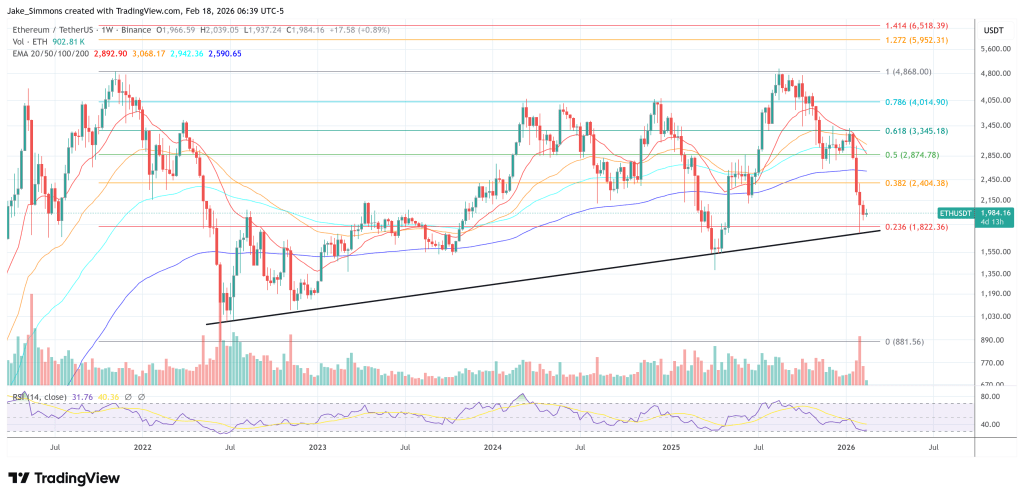
Ethereum remains below the 200-week EMA, 1-week chart | Source: ETHUSDT on TradingView.com

İlgili Sorular

QWhat action did Peter Thiel and Founders Fund take regarding their stake in ETHZilla by the end of 2025?

AThey fully exited their entire stake in ETHZilla, reducing their common share holdings to zero.

QWhat was the size of Peter Thiel's stake in ETHZilla as reported in the prior filing for September 30, 2025?

AThe prior filing reported that Peter Thiel beneficially owned 928,389 shares, representing 5.6% of the class.

QWhat new strategic direction has ETHZilla recently signaled it is pursuing?

AETHZilla is pivoting away from being a pure Ethereum treasury play and towards tokenized real-world assets, such as aviation, with the launch of its 'Eurus Aero Token I'.

QAccording to the article, what is one unresolved question that traders are left with regarding the fund's exit?

ATraders are questioning whether Founders Fund's exit preceded and front-ran the company's strategy shift, or if it was simply a portfolio cleanup after the initial 'ETH treasury' narrative cooled.

QHow does the commentator @treebook78 on X characterize Peter Thiel's investment timing?

AThe commentator characterizes Thiel as a 'master at sensing crises' and an 'exit master' who gets out early when bubbles or stress build, citing his past actions during the Luna crash and FTX collapse.

İlgili Okumalar

You Bet on the News, the Pros Read the Rules: The True Cognitive Gap in Losing Money on Polymarket

The article explains that the key to profiting on Polymarket, a prediction market platform, lies not just predicting real-world events correctly, but in meticulously understanding the specific rules that govern how each market will be resolved. It illustrates this with examples, such as a market on Venezuela's 2026 leader, where the official rules defining "officially holds" the office overruled the intuitive answer of who was in practical control. Other examples include debates over the definition of a "token" or what constitutes an "agreement." The core argument is that a "reality vs. rules" gap creates pricing discrepancies that savvy traders ("车头" or "whales") exploit. The platform has a formal dispute resolution process managed by UMA token holders to settle ambiguous outcomes. This process involves proposal submission, a challenge window, a discussion period, and a final vote. However, the article highlights a critical flaw in this system compared to a traditional court: the lack of separation between the arbiters (UMA voters) and the interested parties (traders with financial stakes in the outcome). This conflict of interest undermines the discussion phase, leads to herd mentality, and results in opaque final decisions without explanatory rulings. Consequently, the system lacks a body of precedent, making it difficult for users to learn from past disputes. The ultimate takeaway is that success on Polymarket requires a lawyer-like scrutiny of the rules to identify and capitalize on the cognitive gap between how events appear and how they are contractually defined for settlement.

marsbit22 dk önce

You Bet on the News, the Pros Read the Rules: The True Cognitive Gap in Losing Money on Polymarket

marsbit22 dk önce

Will the Fed Still Cut Interest Rates? Tonight's Data Is Crucial

The core debate surrounding the Federal Reserve's potential interest rate cuts is intensifying amid geopolitical conflict and rebounding inflation. The key question is whether high energy prices will cause persistent inflation or weaken consumer demand enough to force the Fed to cut rates. Citigroup presents a bullish case for cuts, arguing that oil supply disruptions from the Strait of Hormuz are temporary and will not lead to lasting inflationary pressure. They point to receding bond yields and oil prices as evidence the market is pricing in a short-lived shock. Citi's data also shows tightening financial conditions, a stabilizing labor market, and healthy tax returns, supporting their view that the path to lower rates remains open. Conversely, Deutsche Bank offers a starkly contrasting, more hawkish outlook. They argue the Fed's current policy is already neutral and expect rates to remain unchanged indefinitely. Their view is based on stalled disinflation progress and a shift toward more hawkish rhetoric from key Fed officials like Waller, who cited risks from prolonged Middle East conflict and tariffs. Other officials, including Williams and Hammack, signaled rates would likely stay on hold for a "considerable time." The market pricing has shifted dramatically, now forecasting zero cuts in 2026. The imminent release of the March retail sales "control group" data is highlighted as a critical test. This metric, which excludes gas station sales, will reveal if high gasoline prices are eroding consumer spending in other areas. A weak reading could support the case for imminent rate cuts, while a strong one would bolster the argument for the Fed to hold steady. This data is pivotal for determining the near-term policy path.

marsbit42 dk önce

Will the Fed Still Cut Interest Rates? Tonight's Data Is Crucial

marsbit42 dk önce

İşlemler

Spot
Futures
活动图片