Pentagon Pizza Index Soars 1250%: Who Will Be the Next Venezuela?

Odaily星球日报2026-01-08 tarihinde yayınlandı2026-01-08 tarihinde güncellendi

Özet

The Pentagon Pizza Index, an unconventional but historically telling indicator, has surged by 1250% in the past 48 hours, sparking global speculation about imminent U.S. military action. This surge, nearly double the 700% spike observed before the recent operation that captured Venezuelan President Maduro, tracks pizza delivery spikes near the Pentagon—often linked to extended staff hours during crises. Historical precedents include spikes before the 1990 Iraq-Kuwait conflict and 1998 Iraq operations. Current data shows increases ranging from 200% to 1250% at nearby pizzerias. The Trump administration’s “Don-roe Doctrine” suggests potential targets: Greenland (with prediction markets showing a 38% chance of U.S. control), Cuba (20% chance of U.S. strike by year-end), Colombia (15%), and Iran (54% chance of leadership change). Memes and prediction markets are already reacting, with the “Pentagon Pizza Watch” token rising 78% and significant betting activity on platforms like Polymarket. The index underscores how real-time, unconventional data can signal geopolitical shifts before official announcements.

Original | Odaily Planet Daily (@OdailyChina)

Author | jk
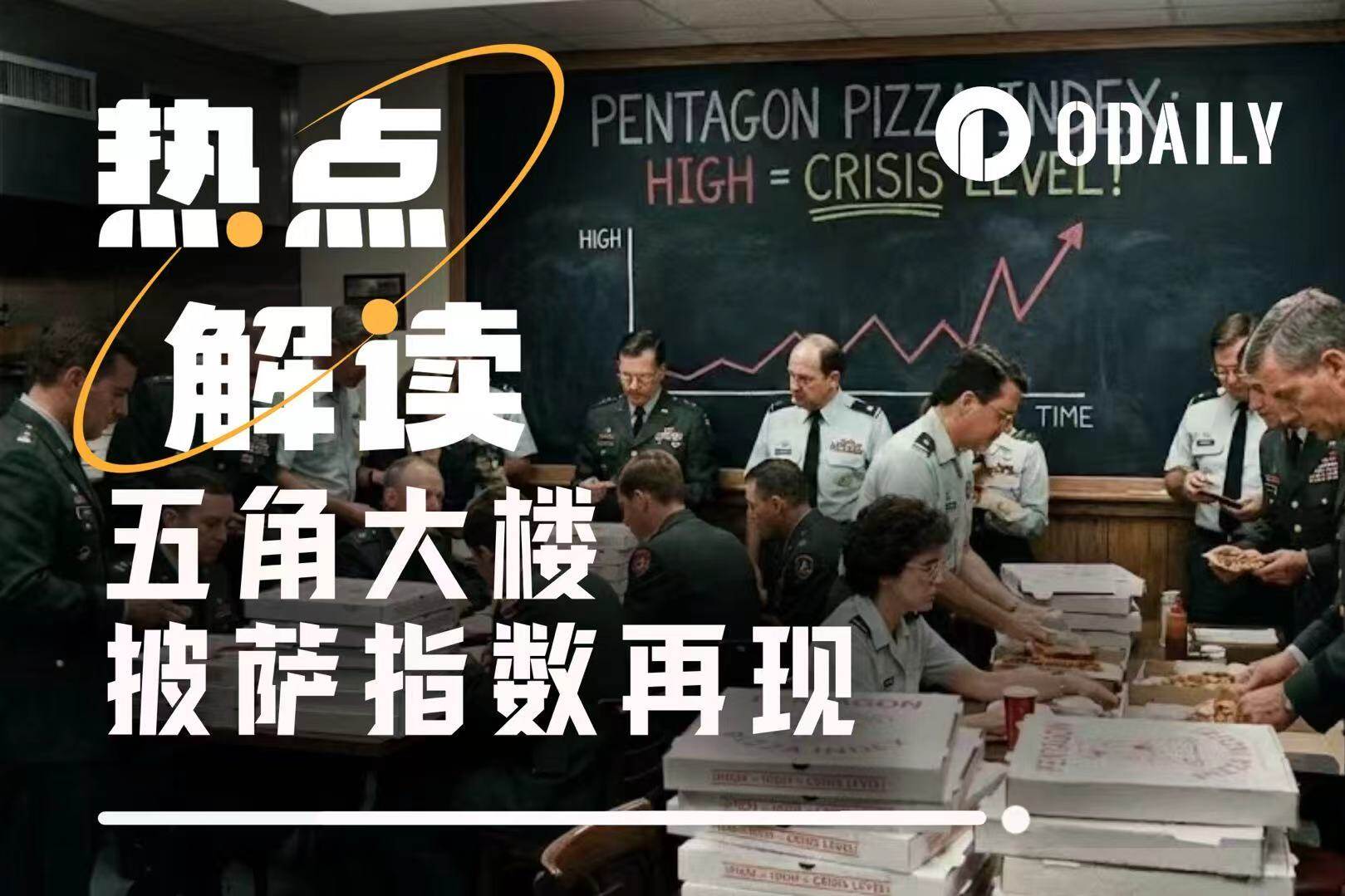
On January 7, 2026, a seemingly absurd but repeatedly effective intelligence indicator has drawn global attention. According to social media monitoring, pizza orders near the Pentagon have surged by 1250% in the past 48 hours, a figure nearly double the 700% increase seen just before the military action in Venezuela. This is the "Pentagon Pizza Index," a remarkable indicator, and its underlying implication is that the United States is brewing new military operations.

Pizza Orders and Military Intelligence?

The concept of the Pentagon Pizza Index dates back to 1990, when Frank Meeks, the owner of a Domino's Pizza in the Washington area, noticed a peculiar phenomenon: on the evening of August 1, 1990, the Central Intelligence Agency ordered a record 21 pizzas, and the next day, Iraq invaded Kuwait.

Moreover, this pattern has repeated:

  • Before the Panama operation in December 1989, orders surged from 30-35 to over 100;
  • During President Clinton's impeachment hearings and the "Desert Fox" operation in Iraq in December 1998, extra cheese pizza orders from the White House increased by 32%.

The logic behind this is very simple: during high-pressure crisis moments, Department of Defense (now the War Department, renamed by Trump) staff often need to work 16-20 hours consecutively, and pizza is cheap, filling, and easy to deliver, making it the go-to choice for overtime work.

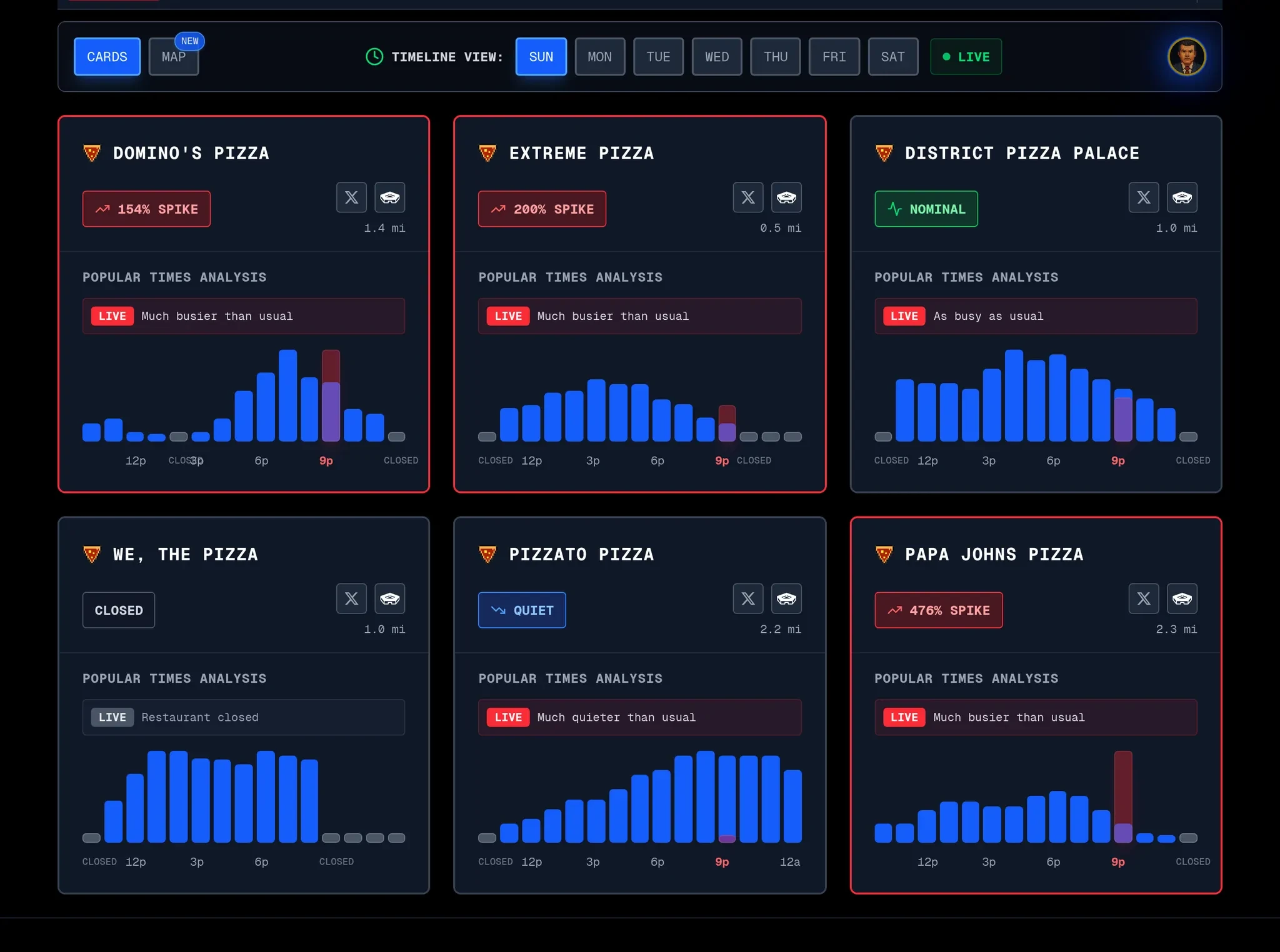
Today, there are dedicated websites monitoring six pizza shops near the Pentagon in real-time, including Papa John's and Domino's. Currently, these websites are all showing crazy multiples, ranging from 150% to 1250%.
What About Before the Venezuela Operation?

In the early hours of January 3, 2026, U.S. forces launched a raid in Caracas, the capital of Venezuela, successfully capturing President Maduro and his wife. Just hours before the operation, the Papa John's pizza shop near the Pentagon was unusually busy.

This was not a sudden military action either; the U.S. began a large-scale military buildup in the Caribbean region in August 2025: August: The USS Iwo Jima amphibious assault ship group arrived; November: The USS Ford aircraft carrier strike group arrived; Totaling about 15,000 U.S. military personnel, the largest military deployment in the region in generations. So, Pentagon staff worked overtime, causing all nearby pizza shops to work overtime as well.

A 1250% Increase: Who Is the Next Target?

Latest data from Sunday evening shows activity at the Papa John's pizza shop 2.3 miles from the Pentagon surged by 476%, while the closer Extreme Pizza saw a 200% increase. The peak increase of 1250% compared to the lowest point set a new historical record.

The Trump administration has stated this is part of its "Don-roe Doctrine." This is a metaphor for a modernized version of the 19th-century Monroe Doctrine, an advanced version of MAGA. Trump declared on Saturday: "American dominance in the Western Hemisphere will never be questioned again."

Based on the latest statements from Trump and his senior officials, the following countries and regions may be the next targets:

  • Greenland: Trump emphasized the U.S. needs Greenland to ensure national security. Prediction markets show the probability of the U.S. "controlling any part of Greenland" has risen from less than 20% last week to 38%. The Danish government is currently in "full crisis mode."
  • Cuba: Secretary of State Rubio warned that the Cuban government "is in big trouble." He pointed out that Maduro's bodyguards were Cuban, and 32 Cuban officers were killed in the Venezuela operation. Trump said: "Cuba looks like it's about to collapse."
  • Colombia: Trump directly threatened: "Colombia is also very sick, run by a sick man who likes to make cocaine and sell it to the United States, and he won't be doing that much longer." When asked if military action was considered, Trump replied: "Sounds good."
  • Iran: After Trump threatened to "hit Iran hard," prediction markets estimate a 54% probability that Iran's Supreme Leader Khamenei will step down before next year.

How Are These Countries Responding?

Colombian President Petro has shown a tough stance. He was reportedly quoted in November 2025 saying: "Brother, if you want to put me in jail, see if you can." Recently, he announced that any commander who prefers the American flag over the Colombian flag will be immediately dismissed from the army.

The Cuban government has held two days of national mourning for the 32 officers killed in the Venezuela operation, clearly remaining highly alert to Rubio's warnings.

Meme and Prediction Markets: Already One Step Ahead

When it comes to such events, meme markets and prediction markets are always the quickest to move.

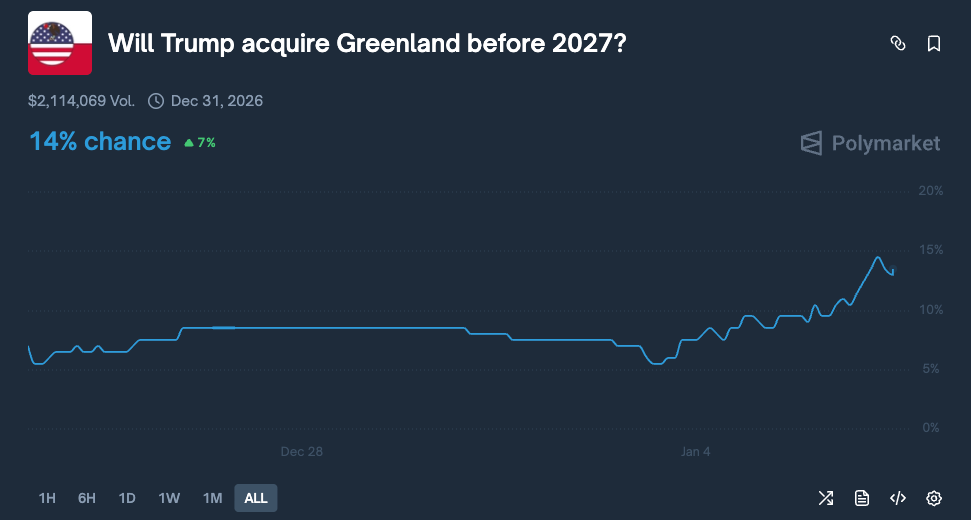
On Polymarket, the market for "Trump 'acquiring' Greenland by 2027" is highly sensitive. The probability in this market rose from about 7% on December 28 to the current 14%, a gain of 7 percentage points, with trading volume exceeding $2.1 million. This rise coincided with the timing of the Venezuela operation.

The "US strikes Cuba by xx date" market shows a阶梯式 probability distribution: only 2% by January 31, 8% by March 31, but jumps to 20% by the end of the year. The loss of 32 Cuban officers in the Venezuela operation could be the trigger for U.S. action.

The "US strikes Colombia by xx date" market shows a more aggressive probability curve: 3% by end of January, 7% by end of March, 15% by year-end.
Simultaneously, related memes have already appeared, such as Pentagon Pizza Watch (PPW); this is a logo featuring a glowing pizza hovering over a green pentagon, adorned with missile elements.
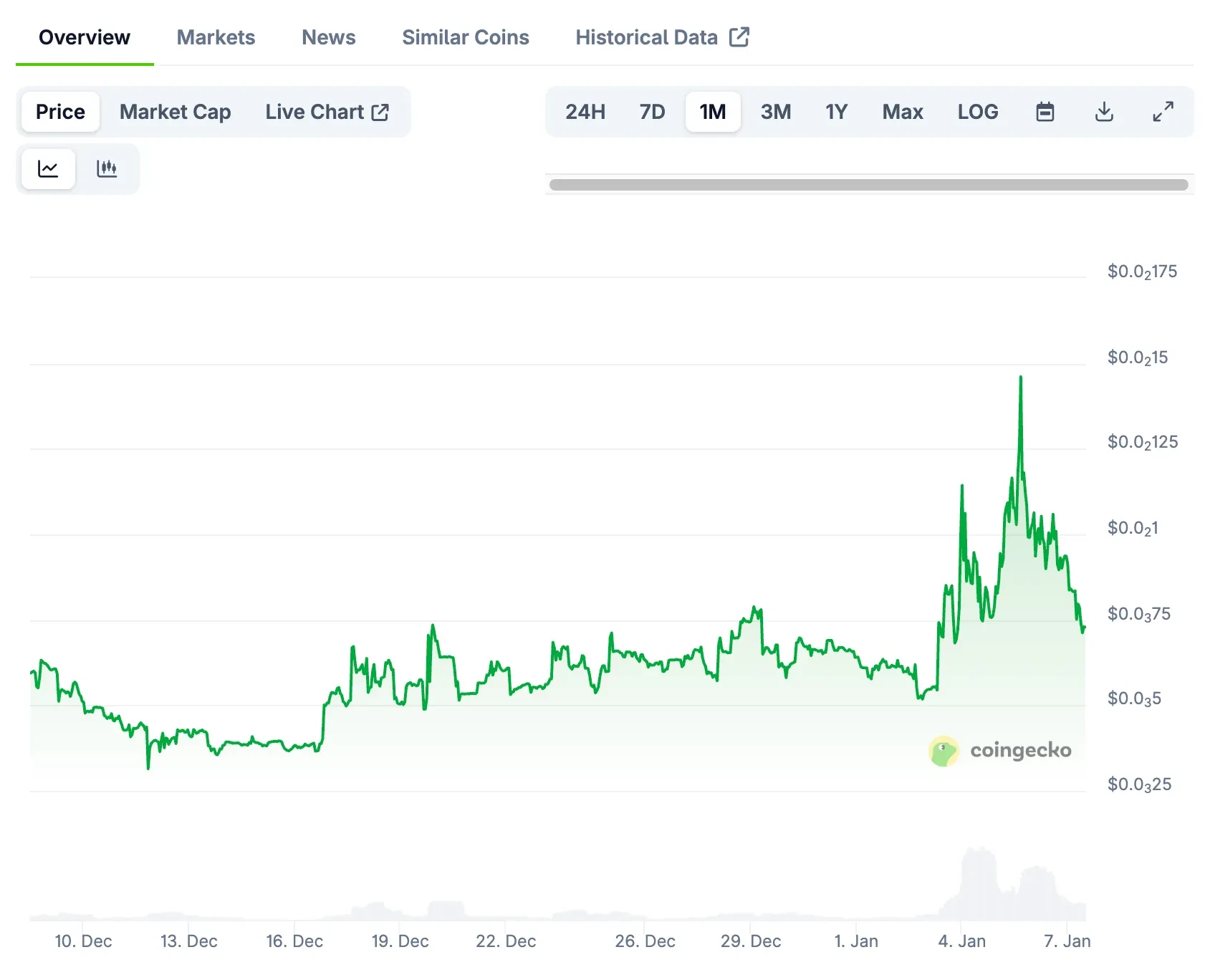
In terms of market performance, PPW saw a 78.20% gain in one week, with a 24-hour trading volume of $114,369, ranking 3689th in market capitalization.

Here, we strongly recommend reading this Odaily article: "When War is Settled Before the News: How Prediction Markets 'Priced' the Maduro Capture 6 Days Early."


İlgili Sorular

QWhat is the Pentagon Pizza Index and what does a 1250% surge indicate?

AThe Pentagon Pizza Index is an informal intelligence indicator that tracks pizza delivery orders near the Pentagon. A 1250% surge suggests a significant increase in military staff working long hours, often preceding major U.S. military operations, similar to patterns observed before historical events like the Iraq invasion of Kuwait.

QWhich countries are potential targets according to the article based on recent U.S. government statements?

APotential targets include Greenland, Cuba, Colombia, and Iran, as indicated by statements from Trump and officials, such as threats to 'hit Iran hard' and warnings about Cuba and Colombia's governments.

QHow did prediction markets react to the increased Pentagon Pizza Index and recent military actions?

APrediction markets showed heightened activity, with probabilities for U.S. 'acquisition' of Greenland rising from 7% to 14%, and markets for strikes on Cuba and Colombia seeing increased probabilities by year-end, reflecting speculative responses to military tensions.

QWhat historical events are cited as examples where pizza order spikes preceded military actions?

AHistorical examples include the 1990 Iraq invasion of Kuwait after a spike in CIA pizza orders, the 1989 Panama action with orders jumping from 30-35 to over 100, and the 1998 'Desert Fox' operation in Iraq during Clinton impeachment hearings.

QWhat is the 'Don-roe Doctrine' mentioned in the article and how does it relate to U.S. policy?

AThe 'Don-roe Doctrine' is described as a modernized version of the Monroe Doctrine, reflecting Trump's MAGA agenda, asserting U.S. dominance in the Western Hemisphere and justifying interventions, as seen in the recent Venezuela operation.

İlgili Okumalar

a16z: AI's 'Amnesia', Can Continuous Learning Cure It?

The article "a16z: AI's 'Amnesia' – Can Continual Learning Cure It?" explores the limitations of current large language models (LLMs), which, like the protagonist in the film *Memento*, are trapped in a perpetual present—unable to form new memories after training. While methods like in-context learning (ICL), retrieval-augmented generation (RAG), and external scaffolding (e.g., chat history, prompts) provide temporary solutions, they fail to enable true internalization of new knowledge. The authors argue that compression—the core of learning during training—is halted at deployment, preventing models from generalizing, discovering novel solutions (e.g., mathematical proofs), or handling adversarial scenarios. The piece introduces *continual learning* as a critical research direction to address this, categorizing approaches into three paths: 1. **Context**: Scaling external memory via longer context windows, multi-agent systems, and smarter retrieval. 2. **Modules**: Using pluggable adapters or external memory layers for specialization without full retraining. 3. **Weights**: Enabling parameter updates through sparse training, test-time training, meta-learning, distillation, and reinforcement learning from feedback. Challenges include catastrophic forgetting, safety risks, and auditability, but overcoming these could unlock models that learn iteratively from experience. The conclusion emphasizes that while context-based methods are effective, true breakthroughs require models to compress new information into weights post-deployment, moving from mere retrieval to genuine learning.

marsbit1 saat önce

a16z: AI's 'Amnesia', Can Continuous Learning Cure It?

marsbit1 saat önce

Can a Hair Dryer Earn $34,000? Deciphering the Reflexivity Paradox in Prediction Markets

An individual manipulated a weather sensor at Paris Charles de Gaulle Airport with a portable heat source, causing a Polymarket weather market to settle at 22°C and earning $34,000. This incident highlights a fundamental issue in prediction markets: when a market aims to reflect reality, it also incentivizes participants to influence that reality. Prediction markets operate on two layers: platform rules (what outcome counts as a win) and data sources (what actually happened). While most focus on rules, the real vulnerability lies in the data source. If reality is recorded through a specific source, influencing that source directly affects market settlement. The article categorizes markets by their vulnerability: 1. **Single-point physical data sources** (e.g., weather stations): Easily manipulated through physical interference. 2. **Insider information markets** (e.g., MrBeast video details): Insiders like team members use non-public information to trade. Kalshi fined a剪辑师 $20,000 for insider trading. 3. **Actor-manipulated markets** (e.g., Andrew Tate’s tweet counts): The subject of the market can control the outcome. Evidence suggests Tate’sociated accounts coordinated to profit. 4. **Individual-action markets** (e.g., WNBA disruptions): A single person can execute an event to profit from their pre-placed bets. Kalshi and Polymarket handle these issues differently. Kalshi enforces strict KYC, publicly penalizes insider trading, and reports to regulators. Polymarket, with its anonymous wallet-based system, has historically been more permissive, arguing that insider information improves market accuracy. However, it cooperated with authorities in the "Van Dyke case," where a user traded on classified government information. The core paradox is reflexivity: prediction markets are designed to discover truth, but their financial incentives can distort reality. The more valuable a prediction becomes, the more likely participants are to influence the event itself. The market ceases to be a mirror of reality and instead shapes it.

marsbit2 saat önce

Can a Hair Dryer Earn $34,000? Deciphering the Reflexivity Paradox in Prediction Markets

marsbit2 saat önce

İşlemler

Spot
Futures
活动图片




