Pendle Dismantles the 'Walls': From 'Locking' to 'Retaining' Users

比推2026-01-22 tarihinde yayınlandı2026-01-22 tarihinde güncellendi

Özet

Pendle, a leading DeFi protocol in the interest rate derivatives sector, has announced a major shift away from its long-standing veTokenomics model, transitioning to a more liquid sPENDLE system. This move sparked debate, with critics like Curve’s Michael Egorov calling it a mistake, while the token price rose 11% following the news. The vePENDLE model, which required long-term locking for governance and rewards, was deemed inefficient—concentrating power and yields among a small group of sophisticated users and creating imbalanced incentives across liquidity pools. Over 60% of pools were unprofitable, relying on a few high-performing ones like Ethena for subsidies. The new sPENDLE model introduces a 14-day unstaking period (with a 5% fee for instant exit), replacing indefinite locks. It also adopts algorithmic reward distribution—cutting emissions by ~30%—and directs 80% of protocol revenue to buy back and distribute PENDLE to stakers. Existing vePENDLE holders will receive up to 4x sPENDLE bonuses based on remaining lock-up time at the snapshot on January 29. This shift reflects a broader DeFi trend away from forced loyalty via locking and toward attracting users through real yields and flexibility, as seen in updates by PancakeSwap, Balancer, and Ethena. The industry is increasingly prioritizing product appeal and capital efficiency over locked value.

Recently, Pendle, the "long-distance runner" in the DeFi space, announced a major update: abolishing its long-standing veTokenomics (vote-escrowed economic model) and shifting to the more liquid sPENDLE.
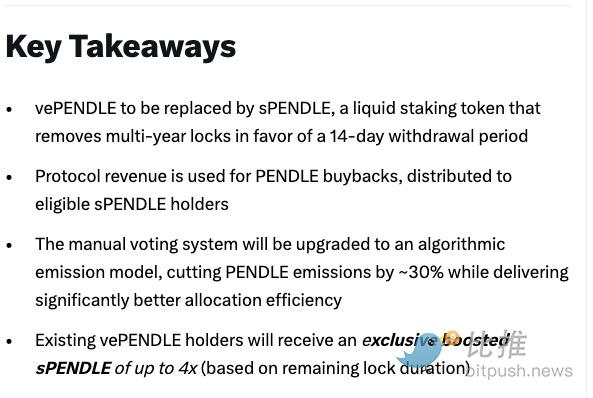
The news quickly sparked heated discussions in the community. Curve founder Michael Egorov promptly voiced his doubts, stating bluntly that 'abolishing the ve model is a mistake.' However, on the other side, the market voted with real money—the price of PENDLE rose by 11%.

As the absolute dominator in the interest rate derivatives track, Pendle's 'self-dismantling' reform not only concerns the growth of its $3.5 billion TVL but also seems like a public trial of DeFi's core narrative over the past three years: the model of exchanging 'lock-up periods' for 'loyalty' appears to be losing its effectiveness.

The Shackles of Locking: 20% 'Minority' Governance

Although Pendle's revenue growth has been significant over the past two years, the performance of its core governance asset, vePENDLE, has not fully kept pace with the protocol's explosive growth.
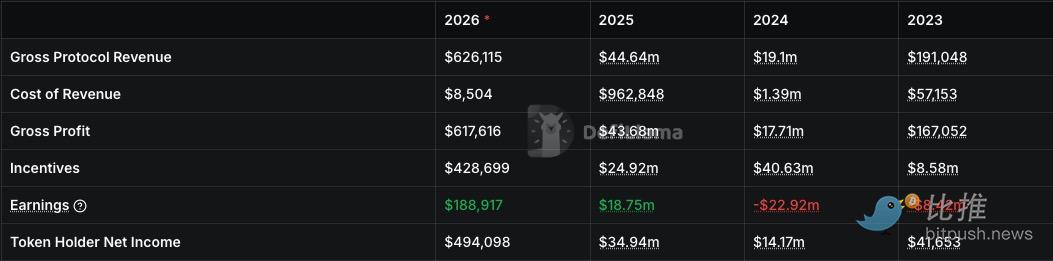
The harsher truth is:

  • Reward 'Wealth Gap': The complex weekly manual voting system is extremely unfriendly to ordinary users, causing rewards to be concentrated in the hands of a few professional players.

  • False Efficiency Boom: Although Pendle's annualized fee efficiency ratio is excellent—with annualized fees of approximately $13.99 million and annualized revenue of about $13.83 million—if broken down by specific pools, over 60% of the pools are actually operating at a loss. The protocol has long relied on profits from a few core high-quality pools (such as Ethena) to subsidize inefficient pools.

This non-transferability of 'lock-up equals disconnection' completely insulates holders from DeFi's most powerful feature: composability.

Algorithms and Buybacks: Shifting from 'Manual' to 'Autopilot'

Pendle's new solution, sPENDLE, essentially transforms the protocol from a 'power game' to an 'efficiency tool.'

The most significant change is the release of liquidity: users no longer face lock-ups of several years; instead, there is a 14-day exit period. If funds are urgently needed, paying a 5% fee allows instant redemption. This 'current account' style treatment provides higher flexibility for the approximately $127 million (35.51% of the market cap) of currently staked funds.

At the governance level, Pendle introduces two 'game-changers':

  1. Algorithm-Driven Emissions: Reward distribution, once determined by manual voting, is now handled by an algorithm. This model will automatically configure rewards based on the actual contribution of each pool, expected to reduce overall emissions by about 30%.

  2. Substantive Buybacks: Up to 80% of protocol revenue will be directly used to buy back PENDLE and distribute it to stakers. Current annualized holder revenue has reached $11.06 million, and cumulative total fees have exceeded $64.56 million. The buyback mechanism will make these earnings directly impact the token's value.

Change inevitably comes with interest restructuring. To appease those 'old contributors' who had locked for years, Pendle set a snapshot date for January 29th.

According to the plan, existing vePENDLE holders can receive up to a 4x sPENDLE multiplier upon conversion. This multiplier will linearly decay based on the original remaining lock-up period, ensuring that those who truly supported the protocol retain the strongest voice and profit rights in the early stages of the transition. This design cleverly alleviates old users' concerns about a 'collapse of long-term consistency.'

This change instantly made PENDLE more 'liquid.' The market clearly prefers liquid assets that allow easy exit while still sharing in buyback dividends, rather than a distant 'long-term meal ticket.'

III. Controversy: Consistency or Liquidity?

However, many industry insiders are not optimistic about this approach.
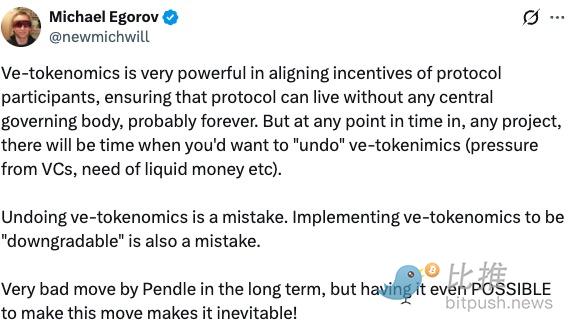
'Opposing' view from Curve founder Michael Egorov:

"Abolishing the vote-escrowed token economics is a mistake. Designing it as 'downgradable' from the start was also a mistake. In the long run, Pendle's move is very bad—but more critically, when such an operation becomes mechanically 'possible,' its occurrence was inevitable."

Maple co-founder and CEO Sid Powell believes that long-term lock-ups essentially 'forcibly retain capital,' which often masks the protocol's true risks and leads to excessive concentration of power. Pendle's approach is 'no longer forcing loyalty through locking, but attracting stay through yields.'

The essence of this debate is: should the moat of a mature DeFi protocol be 'lock-up scale' or 'the appeal of the product itself'?

In fact, Pendle is not alone.

Amid the bull and bear cycles of DeFi in recent years, a group of established protocols have率先 realized that loyalty bought with 'lock-up periods' essentially mortgages the protocol's future.

PancakeSwap was one of the pioneers of this change. As early as the end of 2023, it began reforming its old system that required users to lock CAKE for up to four years. By introducing a flexible Revenue Share mechanism for veCAKE, PancakeSwap directly distributed 5% of protocol fees to stakers, no longer mandating years of immobility. By the end of 2025, despite multi-chain competition, its TVL steadily recovered and remained around $2.3 billion, successfully attracting many retail users unwilling to be locked in long-term.

Balancer's trajectory is also highly illustrative. Its veBAL model long faced difficulties, with nearly 80% of tokens in a 'non-active governance state,' meaning the vast majority of holders only locked and did not vote. In 2025, the team彻底 adjusted the incentive structure in the v3 upgrade: introducing short lock-up options and automated fee adjustments, turning governance from a 'chore' into a flexible tool. Within half a year, the protocol's governance participation rate increased by about 40%.

A more radical experiment came from the stablecoin protocol Ethena. In September last year, it activated a 'fee switch,' directly distributing protocol revenue to holders of the liquidity token sENA, completely bypassing the complex vote-escrow model.

These cases point to a new consensus: DeFi protocols are shifting from 'forcing user binding' to 'retaining users with tangible benefits.' Locking was once a shortcut to maintain data stability but also led ecosystems into false prosperity. Now, protocols prefer to gain real activity by lowering participation barriers and improving capital efficiency.

The effectiveness of Pendle's reform will be tested after the official end of vePENDLE lock-ups on January 29th. But regardless of the outcome, it has sent a clear signal to the industry: in the future DeFi world, excellent products should not make users 'staking prisoners.'

Author: Bootly


Twitter:https://twitter.com/BitpushNewsCN

Bitpush TG Discussion Group:https://t.me/BitPushCommunity

Bitpush TG Subscription: https://t.me/bitpush

Original link:https://www.bitpush.news/articles/7604977

İlgili Sorular

QWhat major update did Pendle recently announce regarding its tokenomics model?

APendle announced the abolition of its veTokenomics (vote-escrowed tokenomics) model and transitioned to a more liquid sPENDLE model.

QWhat are the two key features introduced in Pendle's new sPENDLE model?

AThe two key features are algorithm-driven emissions for reward distribution and a substantial buyback mechanism where 80% of protocol revenue is used to repurchase PENDLE for stakers.

QHow did the market initially react to Pendle's announcement of abandoning veTokenomics?

AThe market reacted positively, with the price of PENDLE increasing by 11% following the announcement.

QWhat criticism did Curve founder Michael Egorov raise about Pendle's decision?

AMichael Egorov criticized the move, stating that撤销投票托管代币经济模型是一个错误 (revoking the vote-escrowed tokenomics model is a mistake) and that designing it as 'degradable' was also an error, predicting negative long-term consequences.

QWhat is the exit period for users in the new sPENDLE model, and what option is available for immediate withdrawal?

AThe exit period is 14 days, but users can withdraw immediately by paying a 5% fee for instant redemption.

İlgili Okumalar

Will the Fed Still Cut Interest Rates? Tonight's Data Is Crucial

The core debate surrounding the Federal Reserve's potential interest rate cuts is intensifying amid geopolitical conflict and rebounding inflation. The key question is whether high energy prices will cause persistent inflation or weaken consumer demand enough to force the Fed to cut rates. Citigroup presents a bullish case for cuts, arguing that oil supply disruptions from the Strait of Hormuz are temporary and will not lead to lasting inflationary pressure. They point to receding bond yields and oil prices as evidence the market is pricing in a short-lived shock. Citi's data also shows tightening financial conditions, a stabilizing labor market, and healthy tax returns, supporting their view that the path to lower rates remains open. Conversely, Deutsche Bank offers a starkly contrasting, more hawkish outlook. They argue the Fed's current policy is already neutral and expect rates to remain unchanged indefinitely. Their view is based on stalled disinflation progress and a shift toward more hawkish rhetoric from key Fed officials like Waller, who cited risks from prolonged Middle East conflict and tariffs. Other officials, including Williams and Hammack, signaled rates would likely stay on hold for a "considerable time." The market pricing has shifted dramatically, now forecasting zero cuts in 2026. The imminent release of the March retail sales "control group" data is highlighted as a critical test. This metric, which excludes gas station sales, will reveal if high gasoline prices are eroding consumer spending in other areas. A weak reading could support the case for imminent rate cuts, while a strong one would bolster the argument for the Fed to hold steady. This data is pivotal for determining the near-term policy path.

marsbit20 dk önce

Will the Fed Still Cut Interest Rates? Tonight's Data Is Crucial

marsbit20 dk önce

The Second Half of Macro Influencer Fu Peng's Career

Fu Peng, a prominent Chinese macroeconomist and former chief economist of Northeast Securities, has joined Hong Kong-based digital asset management firm Bitfire Group (formerly New Huo Group) as its chief economist. This move, announced in April 2026, triggered an 11% surge in Bitfire's stock price. Fu, known for his accessible macroeconomic commentary and large social media following, will focus on integrating digital assets into global asset allocation frameworks, particularly combining FICC (fixed income, currencies, and commodities) with cryptocurrencies for institutional clients. His career includes roles at Lehman Brothers and Solomon International, with significant influence gained through public communication. However, in late 2024, Fu faced temporary social media bans after a controversial private speech at HSBC on China's economic challenges, though he denied regulatory sanctions. He later left Northeast Securities citing health reasons. Bitfire, a licensed virtual asset manager serving high-net-worth clients, seeks to build trust and attract traditional capital through Fu’s expertise and credibility. The partnership represents a strategic shift for both: Fu enters the crypto sector after a traditional finance peak, while Bitfire aims to leverage his macro framework for institutional adoption. Outcomes remain uncertain regarding capital inflows and compatibility within corporate structure.

marsbit1 saat önce

The Second Half of Macro Influencer Fu Peng's Career

marsbit1 saat önce

İşlemler

Spot
Futures

Popüler Makaleler

PENDLE Nasıl Satın Alınır

HTX.com’a hoş geldiniz! Pendle (PENDLE) satın alma işlemlerini basit ve kullanışlı bir hâle getirdik. Adım adım açıkladığımız rehberimizi takip ederek kripto yolculuğunuza başlayın. 1. Adım: HTX Hesabınızı OluşturunHTX'te ücretsiz bir hesap açmak için e-posta adresinizi veya telefon numaranızı kullanın. Sorunsuzca kaydolun ve tüm özelliklerin kilidini açın. Hesabımı Aç2. Adım: Kripto Satın Al Bölümüne Gidin ve Ödeme Yönteminizi SeçinKredi/Banka Kartı: Visa veya Mastercard'ınızı kullanarak anında Pendle (PENDLE) satın alın.Bakiye: Sorunsuz bir şekilde işlem yapmak için HTX hesap bakiyenizdeki fonları kullanın.Üçüncü Taraflar: Kullanımı kolaylaştırmak için Google Pay ve Apple Pay gibi popüler ödeme yöntemlerini ekledik.P2P: HTX'teki diğer kullanıcılarla doğrudan işlem yapın.Borsa Dışı (OTC): Yatırımcılar için kişiye özel hizmetler ve rekabetçi döviz kurları sunuyoruz.3. Adım: Pendle (PENDLE) Varlıklarınızı SaklayınPendle (PENDLE) satın aldıktan sonra HTX hesabınızda saklayın. Alternatif olarak, blok zinciri transferi yoluyla başka bir yere gönderebilir veya diğer kripto para birimlerini takas etmek için kullanabilirsiniz.4. Adım: Pendle (PENDLE) Varlıklarınızla İşlem YapınHTX'in spot piyasasında Pendle (PENDLE) ile kolayca işlemler yapın.Hesabınıza erişin, işlem çiftinizi seçin, işlemlerinizi gerçekleştirin ve gerçek zamanlı olarak izleyin. Hem yeni başlayanlar hem de deneyimli yatırımcılar için kullanıcı dostu bir deneyim sunuyoruz.

352 Toplam GörüntülenmeYayınlanma 2024.12.12Güncellenme 2025.03.21

PENDLE Nasıl Satın Alınır

Tartışmalar

HTX Topluluğuna hoş geldiniz. Burada, en son platform gelişmeleri hakkında bilgi sahibi olabilir ve profesyonel piyasa görüşlerine erişebilirsiniz. Kullanıcıların PENDLE (PENDLE) fiyatı hakkındaki görüşleri aşağıda sunulmaktadır.

活动图片













