Payy Unveils Privacy-First L2 for Institutional Capital: Why $BMIC is the Missing Layer of Quantum Defense

bitcoinist2026-02-05 tarihinde yayınlandı2026-02-05 tarihinde güncellendi

Özet

Payy has launched a privacy-focused Ethereum Layer 2 solution using zero-knowledge proofs to enable institutions to settle transactions on-chain without exposing sensitive data to competitors. While this addresses transparency and front-running risks, it doesn’t protect against the long-term threat of quantum computing, which could decrypt current cryptographic systems. This vulnerability is where BMIC ($BMIC) positions itself as a critical security layer. It introduces a quantum-resistant financial stack using post-quantum cryptography (PQC) to safeguard private keys and assets from future quantum attacks. BMIC’s architecture includes AI-enhanced threat detection and integrates with ERC-4337 smart accounts for a user-friendly yet highly secure experience. The project has raised over $432K in its presale, with the token priced at $0.049474. $BMIC supports ecosystem operations through a "Burn-to-Compute" mechanism and enables quantum-secure staking. As institutional adoption of privacy L2s grows, BMIC aims to become an essential component in protecting high-value on-chain transactions from quantum decryption threats.

The friction between blockchain’s radical transparency and traditional finance’s need for discretion has long been a bottleneck for institutional adoption. Now, Payy is moving to break that deadlock.

With the launch of its privacy-enabled Ethereum Layer 2, the protocol uses zero-knowledge proofs to offer banks and fintechs a way to settle transactions on-chain without broadcasting their entire ledger to competitors.
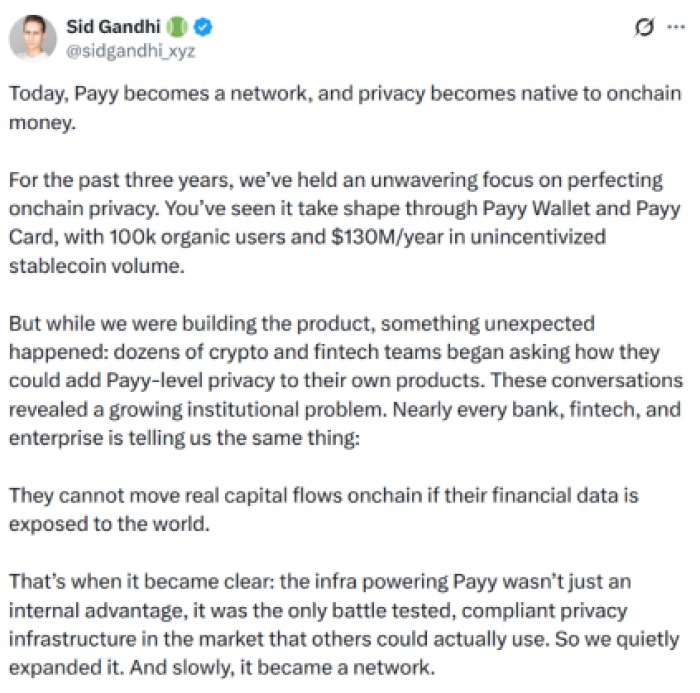
This isn’t just about masking transactions. For years, major financial institutions have hesitated to move proprietary trading algorithms or sensitive settlement layers onto public ledgers like Ethereum.

Why? The ‘dark forest’ of the mempool, where MEV bots and rivals front-run visible trades, is simply too risky. While Payy’s integration with MetaMask suggests a seamless bridge for Web3 natives, the real target is the massive institutional flow that demands regulatory compliance paired with on-chain finality.

But let’s be honest: privacy is only half the battle. While Payy obscures the flow of funds, the assets themselves remain vulnerable to a quieter, existential threat: quantum computing. As banks move billions onto these new rails, they face the ‘harvest now, decrypt later’ vector, where hostile actors collect encrypted data today to crack it once quantum processors mature.

This specific gap, protecting the vault rather than just the transaction, is driving smart money toward BMIC ($BMIC), a project building the first quantum-secure financial stack for the Ethereum ecosystem.

Quantum-Proofing the Institutional Ledger

If Payy secures the pipe, BMIC is engineering the steel plating for the vault. The current cryptographic standards securing the $2.5T crypto market (Elliptic Curve Cryptography) are notoriously vulnerable to Shor’s algorithm.

That’s the method quantum computers will eventually use to reverse-engineer private keys from public addresses. For a retail trader, it’s a risk. For a bank moving nine-figure sums on Payy’s L2? It’s an unacceptable systemic failure point.

BMIC addresses this with a full finance stack running on post-quantum cryptography (PQC). Unlike legacy wallets that expose public keys during signing, BMIC uses a zero public-key exposure protocol. That matters.
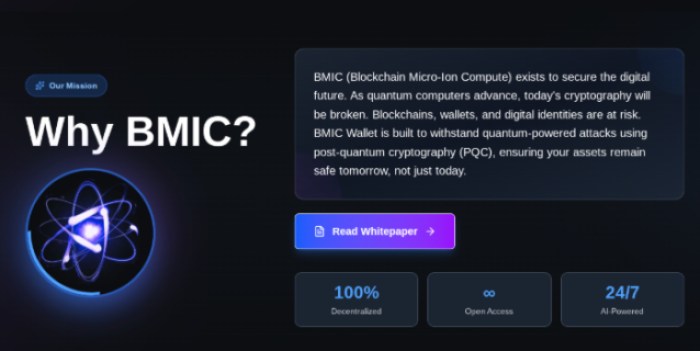
It neutralizes the primary vector for quantum attacks before they even begin. The platform’s ‘Quantum Meta-Cloud’ architecture insulates assets from underlying chain vulnerabilities, creating an environment where institutions can stake, store, and transact without fear of retrospective decryption.

The technological leap here is the integration of AI-enhanced threat detection within the wallet infrastructure itself. By combining quantum-resistant algorithms with ERC-4337 smart accounts, BMIC offers a user experience that mimics the ease of MetaMask, essential for Payy’s target demographic, while operating on a security standard that exceeds current military-grade requirements.

As the industry pivots toward privacy L2s, the infrastructure securing the keys themselves becomes the most critical, yet undervalued, layer of the stack.

LEARN MORE ABOUT THE BMIC’S QUANTUM SECURITY

$0.049474 Entry Point Attracts Defensive Capital

The market is waking up to the reality that privacy rails like Payy need quantum-resistant locks. BMIC has already raised over $432K in its ongoing presale, signaling growing awareness of the ‘quantum threat’ among sophisticated investors.

Currently priced at $0.049474, the token offers an entry point into a sector that many analysts predict will be mandatory for institutional volume by 2026. It’s easy to see why it could be the best new cryptocurrency.

Frankly, the token utility distinguishes the presale raise. $BMIC isn’t just for governance; it fuels the ecosystem’s computational power (via the ‘Burn-to-Compute’ mechanism) and is required for quantum-secure staking. In a market where yield often carries the risk of smart contract exploits or key exposure, BMIC offers a secure staking environment where cryptographic integrity beats complex, risky DeFi loops.

For investors watching the infrastructure narrative, the correlation is clear: as adoption of privacy L2s like Payy grows, the underlying security layer must scale to match the assets it protects. With the presale still under half a million dollars, the valuation hasn’t yet priced in the inevitable shift toward post-quantum standards.

As regulatory frameworks tighten around data security, protocols offering harvest-resistant encryption could decouple from the broader altcoin market.

CHECK OUT THE $BMIC PRESALE PAGE

This article is for informational purposes only and does not constitute financial advice. Cryptocurrencies are high-risk assets. The “harvest now, decrypt later” threat is a long-term projection. Always conduct your own due diligence before investing.


Trend Kriptolar

İlgili Sorular

QWhat is the primary purpose of Payy's new Ethereum Layer 2 solution?

APayy's privacy-enabled Ethereum Layer 2 uses zero-knowledge proofs to allow banks and fintech companies to settle transactions on-chain without broadcasting their entire ledger to competitors, addressing the friction between blockchain transparency and traditional finance's discretion.

QAccording to the article, what is the 'harvest now, decrypt later' threat?

AThe 'harvest now, decrypt later' threat is a vector where hostile actors collect encrypted data today with the intention of decrypting it once quantum processors become powerful enough, posing a risk to assets secured by current cryptographic standards.

QHow does BMIC ($BMIC) aim to protect against quantum computing threats?

ABMIC uses a full finance stack running on post-quantum cryptography (PQC) with a zero public-key exposure protocol. Its 'Quantum Meta-Cloud' architecture insulates assets from underlying chain vulnerabilities, preventing quantum computers from reverse-engineering private keys.

QWhat technological features does BMIC integrate to enhance its security and user experience?

ABMIC integrates AI-enhanced threat detection within its wallet infrastructure and combines quantum-resistant algorithms with ERC-4337 smart accounts. This provides a user experience similar to MetaMask while operating on a security standard that exceeds current military-grade requirements.

QWhat is the current price and key utility of the $BMIC token as mentioned in the article?

AThe $BMIC token is currently priced at $0.049474 in its presale. Its utility includes fueling the ecosystem's computational power via a 'Burn-to-Compute' mechanism and is required for participating in quantum-secure staking, offering a secure alternative to risky DeFi yield strategies.

İlgili Okumalar

Within Strategy's Framework, STRC's Dividend Yield Remains at 12% as Share Price Stays Below Par Value

Michael Saylor, Executive Chairman of Strategy (MSTR), confirmed that the dividend rate for its STRC perpetual preferred shares will remain at 12.00% through August 2026. The rate has increased from 9% at its July 2025 launch to the current high via a "ratchet" mechanism, which permanently raises the rate by 0.5% whenever the share price falls below $95. This mechanism is intended to push the price back toward its $100 par value and support Strategy's "at-the-market" (ATM) program for issuing new shares to fund Bitcoin purchases. However, the mechanism has not worked as intended. STRC shares closed at $89.46 on July 31, remaining about 10-11% below par value despite the record-high dividend. Competition from rival Strive's higher-yielding SATA securities has pressured demand. The persistent discount has forced Strategy to suspend new STRC issuances via its ATM program, limiting this funding channel for Bitcoin acquisitions. STRC's struggles reflect Bitcoin's own volatility, as the preferred shares historically move in tandem. Analysts have warned the ratchet structure carries long-term, one-way risk. A law firm is investigating Strategy's ability to maintain dividend payments if Bitcoin's price stays low. Retail investors own roughly 83% of outstanding STRC shares, a group seen as prone to panic selling during downturns. In response, Strategy has established financial reserves, including a liquidity cushion covering about 26 months of dividend/interest obligations, and a $2 billion share buyback program alongside a Bitcoin monetization framework, though the company emphasized it is not obligated to sell any Bitcoin.

cryptonews.ru37 dk önce

Within Strategy's Framework, STRC's Dividend Yield Remains at 12% as Share Price Stays Below Par Value

cryptonews.ru37 dk önce

Analyst: Bitcoin's Price Will Drop to $60k in August, Then Rebound to $70k

Financial analyst Andrey Poroshin has provided a new forecast for Bitcoin's price dynamics in August. Poroshin, an analyst at the Bitbanker exchange, expects the cryptocurrency market to experience a downturn this month, with prices retesting the $60,000 level due to a lack of supportive macroeconomic catalysts. He noted that the recent US Federal Reserve decision to hold interest rates did not significantly impact the market, while inflation remains above the 2% target. Poroshin stated that Bitcoin is ending July under pressure from moderate volatility and a lack of new macroeconomic stimuli, leading to continued market caution. According to his base scenario, Bitcoin will drop to a range of $60,000 to $62,000 before recovering to $70,000. He pointed out that even $70,000 remains below the cost of mining in the US, which has prompted some miners to shift towards AI data center operations. Poroshin cited the winding down of BitMEX's operations as a potential catalyst for a price rebound, suggesting the exit of weaker players often coincides with market reversals and reduced short-term selling pressure. He believes Bitcoin is currently less susceptible to geopolitical shocks, such as the Iran-US conflict, and does not expect significant market changes in August related to the pending CLARITY Act. Looking ahead, Poroshin forecasts that September will bring more active price fluctuations driven by potential Fed rate decisions and possible discussions or approval of the CLARITY Act.

cryptonews.ru37 dk önce

Analyst: Bitcoin's Price Will Drop to $60k in August, Then Rebound to $70k

cryptonews.ru37 dk önce

İşlemler

Spot

Popüler Makaleler

LAYER Nasıl Satın Alınır

HTX.com’a hoş geldiniz! Solayer (LAYER) satın alma işlemlerini basit ve kullanışlı bir hâle getirdik. Adım adım açıkladığımız rehberimizi takip ederek kripto yolculuğunuza başlayın. 1. Adım: HTX Hesabınızı OluşturunHTX'te ücretsiz bir hesap açmak için e-posta adresinizi veya telefon numaranızı kullanın. Sorunsuzca kaydolun ve tüm özelliklerin kilidini açın. Hesabımı Aç2. Adım: Kripto Satın Al Bölümüne Gidin ve Ödeme Yönteminizi SeçinKredi/Banka Kartı: Visa veya Mastercard'ınızı kullanarak anında Solayer (LAYER) satın alın.Bakiye: Sorunsuz bir şekilde işlem yapmak için HTX hesap bakiyenizdeki fonları kullanın.Üçüncü Taraflar: Kullanımı kolaylaştırmak için Google Pay ve Apple Pay gibi popüler ödeme yöntemlerini ekledik.P2P: HTX'teki diğer kullanıcılarla doğrudan işlem yapın.Borsa Dışı (OTC): Yatırımcılar için kişiye özel hizmetler ve rekabetçi döviz kurları sunuyoruz.3. Adım: Solayer (LAYER) Varlıklarınızı SaklayınSolayer (LAYER) satın aldıktan sonra HTX hesabınızda saklayın. Alternatif olarak, blok zinciri transferi yoluyla başka bir yere gönderebilir veya diğer kripto para birimlerini takas etmek için kullanabilirsiniz.4. Adım: Solayer (LAYER) Varlıklarınızla İşlem YapınHTX'in spot piyasasında Solayer (LAYER) ile kolayca işlemler yapın.Hesabınıza erişin, işlem çiftinizi seçin, işlemlerinizi gerçekleştirin ve gerçek zamanlı olarak izleyin. Hem yeni başlayanlar hem de deneyimli yatırımcılar için kullanıcı dostu bir deneyim sunuyoruz.

436 Toplam GörüntülenmeYayınlanma 2025.02.11Güncellenme 2026.06.02

LAYER Nasıl Satın Alınır

Tartışmalar

HTX Topluluğuna hoş geldiniz. Burada, en son platform gelişmeleri hakkında bilgi sahibi olabilir ve profesyonel piyasa görüşlerine erişebilirsiniz. Kullanıcıların LAYER (LAYER) fiyatı hakkındaki görüşleri aşağıda sunulmaktadır.

活动图片












