Payments giant Stripe acquires team from crypto wallet app Valora

cointelegraph2025-12-11 tarihinde yayınlandı2025-12-11 tarihinde güncellendi

Özet

Payments giant Stripe has acquired the team behind crypto wallet app Valora, a day after launching the testnet for its stablecoin-focused blockchain project, Tempo. Valora CEO Jackie Bona stated the team will join Stripe to contribute expertise in web3 and user-first experiences. Valora, which spun out of Celo development group cLabs in 2021, offers a mobile wallet supporting stablecoins across multiple blockchains. The Valora app will continue operating under cLabs. This move accelerates Stripe's growing blockchain initiatives, particularly Tempo network, which has a $5 billion pre-launch valuation and emphasizes easy stablecoin creation.

Payments giant Stripe has acquired the team from crypto wallet firm Valora, just a day after launching its testnet for its stablecoin-focused blockchain project Tempo.

According to Valora CEO Jackie Bona, the acquisition will see the Valora team join Stripe and work on the firm’s blockchain initiatives.

Valora was founded in mid-2021 after spinning out of Celo development group cLabs and raising $20 million in Series A funding in the process.

The Valora app is a mobile wallet that supports stablecoins and other assets across Celo, Ethereum, Base, Optimism and Arbitrum. Apart from the wallet, the team also developed an open protocol launchpad for Web3 apps geared toward a mobile-native experience.

“Stripe shares our conviction that stablecoins and crypto can dramatically expand who gets to participate in the global economy,” said Bona, adding that “by bringing Valora’s team to Stripe, we’ll be able to contribute our expertise in web3 and user-first experiences to a platform with unparalleled reach.”

It is not explicitly stated what the Valora team will work on; however, Stripe will be tapping a team that has had a strong focus on global payments, digital wallets and user-friendly smartphone-based Web3 apps.

“Through this work, we’ve seen firsthand how access to stablecoins and crypto rails can expand economic opportunity. In the past few months, it became clear that we could accelerate this mission by joining Stripe, one of the world’s leading financial infrastructure platforms,” Bona said.
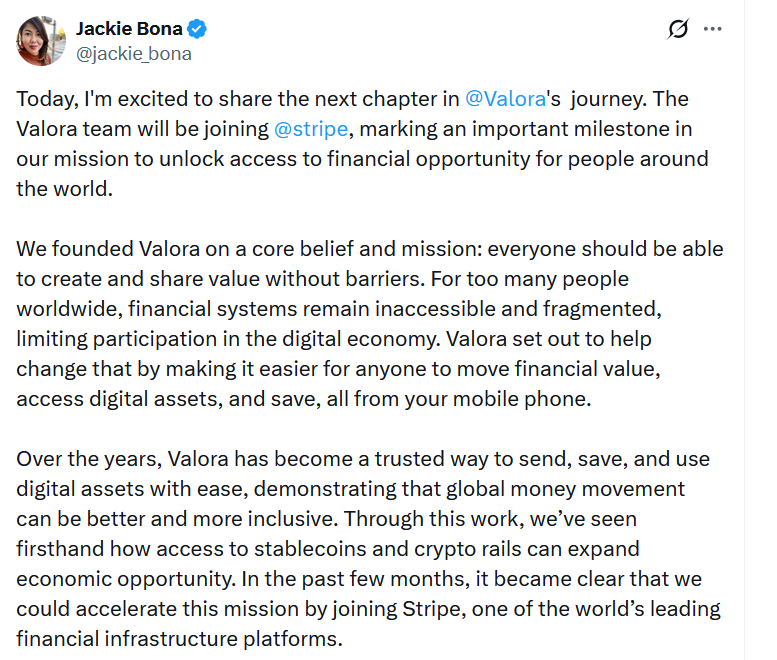
Source: Jackie Bona

Related: The easiest and safest methods for gifting crypto at Christmas in 2025

The Valora app will continue to function, but its operations and future development will be handed over to cLabs.

Momentum building for Stripe and Tempo

After an on-again-off-again relationship with crypto, Stripe has been making strides in the blockchain space over the past couple of years. Momentum has been building particularly since first unveiling Tempo four months ago in partnership with crypto VC firm Paradigm, with the network already having a $5 billion pre-launch.

The latest move from Stripe comes just a day after Stripe and Paradigm’s layer-1 blockchain project Tempo launched its open testnet.

One of the key features highlighted during the testnet launch was the ease and simplicity of creating stablecoins directly in the browser, among other benefits.

Magazine: 11 critical moments in Ethereum’s history that made it the No.2 blockchain

İlgili Okumalar

SpaceX IPO Rush: A Capital Feast That Could Reshape the Landscape of AI and Crypto

SpaceX's potential IPO is emerging as a pivotal event that could reshape the landscape for both AI and Crypto markets. Far more than a traditional aerospace offering, SpaceX represents the core of Musk's future-tech ecosystem, with its Starlink satellite network positioning it as a global digital infrastructure company. This shift could redefine the foundational layers of the internet, communication, and data flow. Historically, major tech capital market movements, like AI booms or Bitcoin ETF approvals, have profoundly influenced crypto cycles. The SpaceX IPO could trigger a similar "super-narrative" fusion, boosting investor sentiment toward future digital infrastructure. This is particularly relevant for Crypto, which aims to build decentralized versions of such global systems. Key crypto sectors likely to benefit include: * **DePIN (Decentralized Physical Infrastructure Networks):** Projects like Render, Filecoin, and Helium, which incentivize real-world infrastructure for compute, storage, and connectivity. * **AI Crypto:** Platforms such as Bittensor and Fetch.ai, which leverage blockchain for decentralized AI computation, data markets, and agent economies. * **On-chain Payments & SocialFi:** Ecosystems like Solana and Ton, which could gain traction if Musk's X platform integrates digital payments and stablecoins. Ultimately, the IPO symbolizes a broader capital re-evaluation of core digital-age assets—networks, AI, data, and decentralized systems—aligning closely with crypto's long-term vision. It may act as a catalyst, redirecting global tech investment flows toward the crypto space as the next chapter in digital infrastructure unfolds.

marsbit39 dk önce

SpaceX IPO Rush: A Capital Feast That Could Reshape the Landscape of AI and Crypto

marsbit39 dk önce

KUN and Pharos Network Forge Strategic Partnership to Jointly Drive Innovation in RealFi, RWA, and Cross-Border Payment Infrastructure

Hong Kong. Layer 1 infrastructure Pharos Network and licensed digital payment expert KUN have signed a strategic MoU. They will integrate Pharos's institutional blockchain with KUN's licensed global payment rails to drive the tokenization of supply chain credit assets and enable more efficient global settlement on-chain. **Background:** Emerging market SMEs face severe working capital challenges due to slow, costly traditional trade finance, often waiting 30-90 days for payment after delivery. While RWA tokenization is a focus, few projects effectively connect underlying infrastructure to real commerce and licensed payment networks. **Collaboration Focus:** The partnership aims to bridge this gap by bringing supply chain credit and B2B cross-border payments on-chain compliantly. Initial priorities include: * Tokenizing supply chain credit assets to unlock liquidity. * Enabling native on-chain settlement of digital assets. * Exploring enterprise virtual card solutions. * Providing compliant on-chain financial services for verticals like commodities, trade, B2B e-commerce, and Web3. **Executive Quotes:** * Wish Wu, Co-founder & CEO of Pharos Network, highlighted KUN's trusted, licensed payment network as a perfect fit for bringing supply chain assets and cross-border capital flows on-chain accessibly. * Dr. Louis Liu, Founder & CEO of KUN, stated that settlement certainty is RealFi's final hurdle. Bridging KUN's payment rails with Pharos's infrastructure will help convert on-chain assets into real-world liquidity with institutional-grade trust. They will also explore AI-driven optimization for global capital flows. Pharos mainnet is live with over 50 dApps. This partnership strengthens its position as RealFi infrastructure by linking licensed payment systems with on-chain finance.

marsbit40 dk önce

KUN and Pharos Network Forge Strategic Partnership to Jointly Drive Innovation in RealFi, RWA, and Cross-Border Payment Infrastructure

marsbit40 dk önce

Deconstructing Anthropic: The Best AI Company May Also Be an Organizational Invention

Anthropic has emerged as one of the most notable AI companies, distinguished by its strategic focus and unique organizational culture. Strategically, Anthropic demonstrated exceptional foresight by prioritizing coding early on, recognizing it as a critical path for model learning, commercial value, and accelerating AGI research. Unlike OpenAI's expansive, multi-front approach, Anthropic maintained rigorous focus on scaling language models and the coding vertical, avoiding distractions like multimodal development. This discipline stemmed partly from resource constraints but also from the conviction of its leadership, particularly co-founder Dario Amodei, who exhibits a strong, independent strategic vision. Organizationally, Anthropic’s culture is its “secret sauce.” It is characterized by a strong, mission-oriented focus on AI safety, high trust, low ego among employees, and a distinct humanistic ethos. This culture has resulted in remarkably low talent attrition and high retention rates. Key practices sustaining this culture include stringent cultural screening in hiring, high-context transparency and writing practices led by leadership, a founding structure of seven co-founders with equal equity to diffuse values, and a deliberate “one team” approach that minimizes internal silos and hierarchy. This culture is both a reaction to the political dynamics its founders experienced at previous companies and a functional necessity for the data-intensive, collaborative “dirty work” required to excel in coding and agentic AI. While OpenAI remains a formidable competitor with greater resources and exploration, Anthropic’s success illustrates how focus, cultural cohesion, and a steadfast mission can be powerful drivers in the AI race.

marsbit1 saat önce

Deconstructing Anthropic: The Best AI Company May Also Be an Organizational Invention

marsbit1 saat önce

Why Are the Most Believers in AGI Buying NVIDIA Put Options?

The article analyzes the significant, market-moving 13F filing for Q1 2026 by Situational Awareness LP (SALP), a fund managed by former OpenAI researcher Leopold Aschenbrenner. While Aschenbrenner is a prominent believer in the accelerated arrival of AGI and has built the fund as a focused bet on AI infrastructure, the filing revealed large new put option positions (totaling billions in notional value) on key AI/semiconductor names like Nvidia, SMH ETF, Broadcom, and AMD. The article argues this is not a bearish turn on AI but a sophisticated hedging strategy. Given the macro backdrop in late March (rising oil prices, inflation concerns, higher-for-longer interest rates), the fund is managing volatility in its high-beta, high-valuation portfolio of AI infrastructure plays (like Bloom Energy, CoreWeave, Core Scientific). The puts act as "insurance" against a potential systemic pullback in the AI trade. Simultaneously, SALP maintained or added to core long positions in companies tied to power, data centers, compute, and storage—the "bottlenecks" expected to capture AI capital spending. It trimmed or exited some Q1 winners (e.g., Lumentum) and reduced leverage (e.g., selling CoreWeave calls), suggesting a rotation from crowded, high-momentum trades towards assets with clearer long-term fundamental pathways. The key takeaway is an evolution in the AI investment theme: from a broad, linear rally to a more discerning, "show-me-the-money" phase. The focus shifts from simply buying the AI narrative to identifying companies that can convert capex into tangible revenue, while actively managing portfolio risk in a volatile macro environment. The strategy reflects a move from unilateral bullishness to "offense with defense."

marsbit1 saat önce

Why Are the Most Believers in AGI Buying NVIDIA Put Options?

marsbit1 saat önce

İşlemler

Spot
Futures
活动图片