Overseas Funds Accelerate Withdrawal, U.S. Bonds Face Largest Selling Pressure in Six Years

marsbit2026-03-25 tarihinde yayınlandı2026-03-25 tarihinde güncellendi

Özet

Overseas official investors are accelerating their withdrawal from U.S. Treasuries, with foreign official accounts at the New York Fed shedding $75 billion over the past four weeks—the largest monthly decline since the COVID-19 pandemic hit in March 2020. According to Deutsche Bank research, this implies net sales of approximately $60 billion, marking the most significant sell-off since the pandemic began. The sell-off is particularly concentrated in the mid-term segment of the yield curve, contributing to recent rapid yield rises. Unlike in March 2023, the drawdown was not offset by increased use of the Fed’s FIMA repo facility, indicating outright sales or non-reinvestment of maturing securities. The drop in custody holdings aligns with observed FX intervention by Asian central banks and a broader slowdown in foreign purchases of dollar assets. Historical correlation suggests custody data explains about 50% of the variation in official net flows reported in TIC data. Deutsche Bank warns that sustained foreign selling could erode the “convenience yield” advantage enjoyed by U.S. debt due to its reserve currency status. Estimates suggest the 10-year yield may be suppressed by 90–100 basis points due to dollar dominance. A continued retreat of foreign demand could push long-term yields significantly higher, increasing refinancing costs and affecting global financial conditions.

Author: Bu Shuqing

Source: Wall Street Insights

The U.S. bond market is facing potential selling pressure from overseas official investors, a development that has raised high alert in the market.

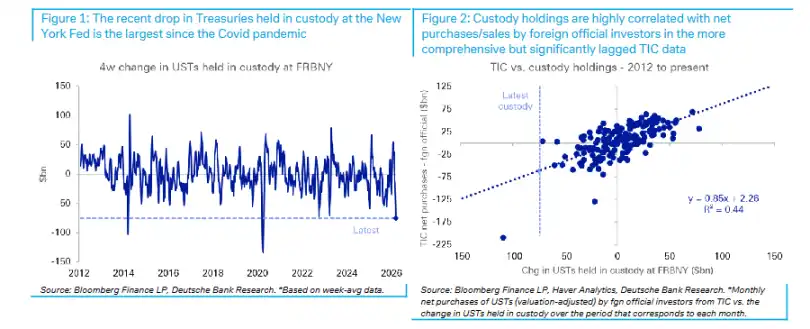
According to the Trading Desk, a research report released by Deutsche Bank on March 23 shows that the U.S. bond holdings of foreign official accounts custodied at the New York Fed plummeted by $75 billion over the past four weeks, marking the largest monthly decline since the impact of the COVID-19 pandemic in 2020. Based on historical data models, this change implies that foreign official investors actually net sold approximately $60 billion in U.S. bonds, also the largest since the pandemic.

This data aligns with the recent sharp rise in U.S. bond yields, particularly the abnormal upward movement in mid-term (belly) yields—a segment where foreign official investors' holdings are concentrated. Deutsche Bank warns that if overseas demand continues to shrink, the "convenience yield" advantage of U.S. bonds will be eroded, posing a substantive upside risk to long-term yields.
Custody Data Reveals Selling Signals

The most authoritative data source for tracking the movements of foreign official investors in U.S. bonds is the U.S. Treasury's TIC (International Capital Flows) report, but this data has significant lag—the March data will not be available until mid-May at the earliest.

As an alternative indicator, the New York Fed's weekly H.4.1 report includes a memorandum entry recording the face value of securities custodied for foreign official and international accounts, with a lag of only one day. Deutsche Bank strategists Matthew Raskin, Steven Zeng, and Andrew Fu noted in the report that the latest H.4.1 data shows, based on weekly averages, that the U.S. bond holdings of foreign official custodied accounts fell by $75 billion over the past four weeks, not only the largest decline since March 2020 but also the second-largest single-week drop in the past decade.

Notably, unlike a similar situation in March 2023, the scale of FIMA repo operations did not rise simultaneously this time, indicating that this round of reduction was due to direct sales or non-renewal at maturity, rather than liquidity financing through repo operations with the Fed. Foreign reverse repos, foreign official deposits, and FIMA securities lending also showed little change over the past month.

High Correlation Between Custody Data and TIC Data

To what extent can custody holding data represent the overall changes in U.S. bond holdings by foreign official investors? Deutsche Bank conducted a systematic verification.

The report shows that over the past 15 years, the correlation between changes in custody holdings and the net purchases by foreign officials in TIC data has been significant, with the former explaining about 50% of the latter's changes. Even when shortening the sample to post-2019 to eliminate potential interference from changes in reserve management models, this relationship remains robust.

Based on this historical relationship, a $75 billion decline in custody holdings corresponds to a net sale of approximately $60 billion by foreign official investors. Deutsche Bank pointed out that this would be the largest net sale by foreign official accounts since the COVID-19 pandemic; to find a comparable case, one would need to go back to December 2018.

Shift in Capital Flows Amid Foreign Exchange Intervention

The decline in U.S. bond custody holdings is highly consistent with recent market dynamics observed by Deutsche Bank's foreign exchange strategy team.

According to a previous report by Deutsche Bank's foreign exchange strategy team, despite the outbreak of the Iran war and soaring oil prices, the U.S. dollar failed to strengthen as expected, partly due to large-scale foreign exchange interventions by several Asian central banks. Meanwhile, the team's high-frequency ETF monitoring data also showed a significant slowdown in foreign investors' purchases of U.S. dollar assets.

The combination of these two clues leads to a conclusion: foreign official investors are reducing their allocation to U.S. dollar assets, and the sale of U.S. bonds is a direct manifestation of this trend.

Sustained Selling Could Push Long-Term Yields Up by Over 100 Basis Points

Deutsche Bank's analysis reveals a structural concern: U.S. bond yields have long benefited from the "convenience yield" brought by the U.S. dollar's reserve currency status, and this advantage is now being tested.

The report cites previous Deutsche Bank research, indicating that the current 10-year U.S. bond yield is more than 100 basis points lower than the reasonable level implied by the U.S. net international investment position (NIIP). Another recent academic working paper estimated that the U.S. dollar's reserve currency status keeps long-term U.S. interest rates about 90 basis points lower than "normal levels."

Deutsche Bank warns that if foreign demand continues to decline, this convenience yield will face regression pressure, and the term premium and overall yield of U.S. bonds will have substantive upside space, posing a direct impact on investors holding U.S. bonds.


İlgili Sorular

QWhat does the sharp decline in foreign official holdings of U.S. Treasuries at the New York Fed indicate, according to Deutsche Bank's report?

AIt indicates that foreign official investors have been net selling approximately $60 billion in U.S. Treasuries over the past four weeks, marking the largest net selling since the COVID-19 pandemic began.

QHow does the recent movement in U.S. Treasury yields, particularly in the belly of the curve, relate to the actions of foreign official investors?

AThe abnormal rise in mid-term (belly) Treasury yields is corroborated by the sell-off, as foreign official investors' holdings are concentrated in that specific maturity segment.

QWhy is the H.4.1 report from the New York Fed used as a proxy for tracking foreign official investor activity, and what is its key advantage?

AThe H.4.1 report is used because the official TIC (Treasury International Capital) data has a significant publication lag. The key advantage of the H.4.1 data is that it is updated weekly with only a one-day lag.

QWhat two key market dynamics observed by Deutsche Bank's FX strategy team point towards foreign official investors reducing their dollar asset allocations?

AThe two dynamics are: 1) Large-scale FX interventions by several Asian central banks, which prevented the dollar from strengthening as expected, and 2) A noticeable slowdown in foreign investors' purchases of U.S. dollar assets, as shown by high-frequency ETF flow data.

QWhat is the 'convenience yield' of U.S. Treasuries, and what is the potential impact if foreign demand continues to decline?

AThe 'convenience yield' is the advantage U.S. Treasuries enjoy due to the dollar's reserve currency status, which has been estimated to suppress long-term yields by over 100 basis points. If foreign demand declines persistently, this premium could erode, leading to a substantial rise in term premiums and overall yields.

İlgili Okumalar

From South Korea to the United States: Blue-Collar Jobs Are Becoming Increasingly Popular, Thanks to AI

AI is reshaping the labor market's value proposition. The traditional four-year college degree is losing its appeal as a guaranteed career path, while skilled blue-collar trades like electricians, welders, and plumbers are experiencing historic demand and wage premiums. This shift is driven by dual pressures: AI's displacement of certain white-collar roles and a booming need for physical infrastructure and data center construction. Data confirms the trend. In the U.S., vocational school revenue surged, and a significant portion of recent layoffs are AI-related. Surveys show a majority of Gen Z adults plan to pursue blue-collar work, citing better job security against AI automation. Vocational education interest has exploded recently. Experts cite a psychological shift as younger generations seek tangible, AI-resistant careers and avoid high student debt. In many cases, salaries for skilled trades now match or exceed those requiring a bachelor's degree. In South Korea, semiconductor vocational high schools boast near-total employment, with graduates securing high-paying roles at companies like Samsung. The shortage is structural, exacerbated by a retiring baby boomer workforce and massive infrastructure projects. Companies like JPMorgan Chase, Meta, and Lowe's are investing heavily in training programs. However, overcoming historical stigma and a "perception gap" around trade careers remains a key challenge to closing the talent gap.

marsbit23 dk önce

From South Korea to the United States: Blue-Collar Jobs Are Becoming Increasingly Popular, Thanks to AI

marsbit23 dk önce

Qualcomm: AI Hype Subsides, When Will Smartphones Emerge from the Gloom?

Qualcomm reported its Q3 FY2026 results (ending June 2026), with revenue of $9.95B, down 4% YoY but above expectations. Gross margin declined to 53.1%, pressured by rising costs across manufacturing and memory. Key business segments showed mixed performance: Handset revenue fell 19.6% YoY to $5.09B, dragged by an 11% decline in non-Apple Android shipments and weaker high-end mix. Conversely, Automotive revenue surged 61% to $1.59B, and IoT grew 9% to $1.83B. Core operating profit dropped 41% YoY due to margin compression and higher expenses. Management's Q4 FY2026 guidance projects revenue of $9.7B-$10.5B, in line with consensus, but Non-GAAP EPS guidance of $2.05-$2.25 fell short of expectations. Amidst persistent weakness in its core handset market, Qualcomm is pursuing growth in AI, focusing on Edge AI (smartphones, PCs, automotive) and Data Center AI. Its data center strategy includes four pillars: AI accelerators (e.g., AI200), commercial CPUs (Dragonfly C1000), custom silicon, and connectivity solutions. While these initiatives initially boosted its stock, concerns over AI capital expenditure sustainability have since erased those gains. The company targets $5B in data center revenue for FY2027 and $15B for FY2029. The report concludes that with the traditional handset business still under pressure, the data center opportunity is currently viewed as a longer-term option, and a more conservative valuation based on core operations may be warranted until AI contributions materialize.

marsbit27 dk önce

Qualcomm: AI Hype Subsides, When Will Smartphones Emerge from the Gloom?

marsbit27 dk önce

From TPU to Self-Evolving Agents: How Jeff Dean Predicts the Next Step in AI

At the 2026 YC Startup School, Jeff Dean outlined his vision for AI's next phase, shifting focus from simply scaling models to building intelligent, autonomous systems. He believes AI's progress is no longer just about creating smarter models, but about integrating them into systems capable of long-term, iterative work, automated experimentation, and continuous learning. This evolution moves the competition from "who has the bigger model" to "who can best organize intelligence." Dean suggests AI capabilities are now comparable to a junior engineer, enabling the automation of complex workflows. However, the true challenge and opportunity lie in managing these AI "workers" at scale. He emphasizes the importance of **context engineering**—structuring tools, memory, and feedback loops—over raw model power. For startups, this means building deep expertise in niche domains where general models currently fail (near 0-1% success rates), leveraging proprietary data, specialized tools, and domain-specific evaluators. A recurring theme is re-examining fundamental constraints. Dean's past work, like moving Google's search index to memory or creating the TPU, stemmed from questioning outdated assumptions about hardware and cost. He sees similar inflection points today, particularly in **specialized inference hardware** to drastically reduce latency and energy consumption for real-time Agent operation. Notably, he points out that in modern AI systems, the dominant cost is often not computation but **data movement**. Reliable, long-running Agents require robust system design, borrowing concepts from distributed computing like checkpointing, state management, and parallel exploration to handle failures and maintain progress over days or weeks. As AI automates execution, the scarcest human skills will shift to **defining clear specifications**, **judging what problems are worth solving** (taste), and designing effective feedback loops. Ultimately, Dean's framework prioritizes understanding the problem deeply, identifying the true bottlenecks, and systematically building closed-loop systems where AI can not only perform tasks but also improve AI itself.

marsbit27 dk önce

From TPU to Self-Evolving Agents: How Jeff Dean Predicts the Next Step in AI

marsbit27 dk önce

İşlemler

Spot
活动图片




