Over 80% of New Tokens Peak at TGE, The Root Cause and Cure for Web3's False Prosperity Lies Here

Odaily星球日报2025-12-23 tarihinde yayınlandı2025-12-23 tarihinde güncellendi

Özet

More than 80% of new tokens in 2025 have seen their Fully Diluted Valuation (FDV) fall below their initial TGE valuation, with a median decline of 71%. Only 15% of tokens performed better post-TGE. This trend indicates that for most projects, the token generation event (TGE) represents their peak valuation. Statistical analysis of 113 token launches reveals that common success metrics—such as high fundraising amounts, large social media followings, and listings on major exchanges—have little to no statistical correlation with token performance. Projects raising more capital (e.g., over $10 million) did not perform better than those raising less (e.g., $300k–$500k). In fact, lower-funded projects often delivered higher returns per dollar raised. Social community size proved irrelevant; most "communities" are speculative and disappear when token prices fall. Token pricing also matters: tokens priced between $0.01–$0.05 at launch had the highest survival rate, while those priced outside this range generally failed. AI-related tokens outperformed others in both peak and current returns, while Gaming and DeFi sectors struggled significantly. Launch platforms (IDOs/IEOs) did not ensure success—most tokens on these platforms fell 70–93% post-launch. The root issue is a market that prioritizes hype over substance, narrative over data, and promises over products. To survive in 2026, projects should focus on lean fundraising, realistic token pricing, product-market fit, and tangibl...

Original Author:Solus Group, Crypto Researcher

Compiled by: CryptoLeo(@LeoAndCrypto)

Editor's Note: Recently, analyst Ash stated in a popular post that among over 100 new tokens TGE'd in 2025, 84.7% had an FDV lower than at TGE. The median FDV of these tokens fell by 71% (median market cap fell by 67%). Only 15% of tokens saw an increase in FDV compared to their TGE FDV. Overall, for new tokens issued in 2025, most tokens fall into the category of "price peaking at TGE".

Extending from this data, I found a more interesting article (from Solus Group), which also starts from the project token TGE, analyzing the correlation between the post-TGE performance of 113 tokens in 2025 and their funding situation, community activity, and exchange listings. The research found that high funding, active communities, and exchange listings—common screening criteria for project quality—have little impact on token performance. We often used these conditions to filter for good projects, but in 2025, this project evaluation model has "failed". One set of data is particularly thought-provoking:

- Projects trading below their IDO price had an average revenue of $1.36 million.

- Projects trading above their IDO issuance price had an average revenue of $790,000.

But these projects all received venture capital support, indicating to some extent that the market values hype over actual performance, stories over data, promises over the product itself. Web3 can no longer pretend "everything is fine," nor call bot traffic "growth." Of course, this article draws some conclusions based on statistics and is not a standard suitable for all projects. Good projects and large funding rounds still represent the direction of the crypto industry's development. Odaily Planet Daily compiles it as follows:

$2 million in funding, top-tier VC participation, 500,000 community followers, listed on a major exchange, a spectacular first day, jubilation on Discord, and a celebratory atmosphere all over social media.

In a previous article, we revealed the reality of the 0.96x ROI: by 2025, the average token effectively died on day one, we proved the system is broken. Now, we've analyzed 113 token launch cases since 2025, proving it with hard data—data most founders dare not face.

The findings are shocking: large funding doesn't help, huge communities don't matter, every variable you optimize is statistically insignificant.

But something more twisted lies beneath the surface, still haunting many founders:

Currently, a project's revenue status is a bearish signal; tokens of profitable projects trade lower than those of unprofitable ones. This dynamic is a matter of life and death. If we continue to punish the profitable and reward the speculators, the entire industry cannot survive.

Odaily Planet Daily Note: Solus Group previously disclosed relevant data showing the average ROI for new project tokens TGE'd in 2025, calculated from the day after issuance, was 0.96, meaning their product launch was effectively losing money from day one.

The Founder's Data Trap: The Funding Paradox, High Funding ≠ Token Advantage
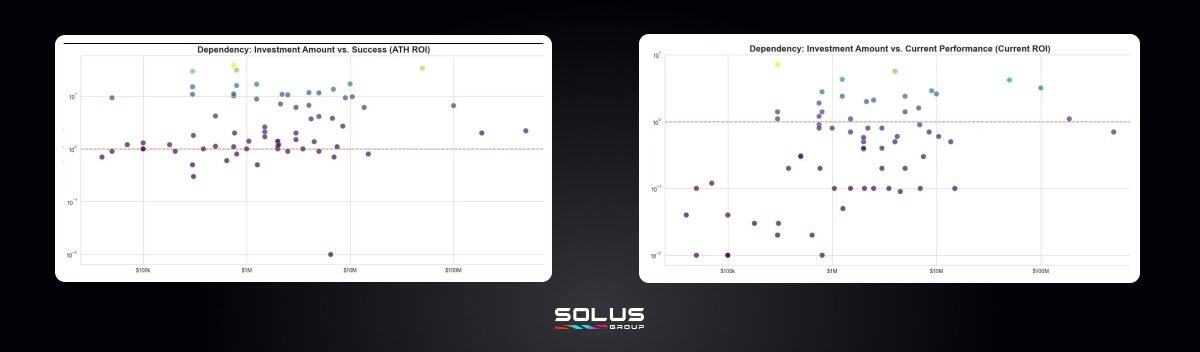
Correlation between funding and token performance: 0.04, statistically considered zero.

Tokens from projects that raised $10 million perform identically to those that raised $1 million. The chart above proves it—the distribution of token performance across the ROI range is random, regardless of funding amount. The best performers: Myshell, B2 Network, Bubblemaps, Mind Network, Particle Network, Creator.Bid (10x to 30x valuation at ATH) raised $300k to $3 million. Meanwhile, projects like Boundless and Analog that raised over $10 million have valuation multiples of around 1x.

Current token performance is even worse; most tokens have an ROI below 1x, regardless of funding size. For example, tokens that raised $5M to $100M have ROIs of 0.1x to 0.7x (e.g., Fleek, Pipe Network, Sahara AI), the same as tokens with little funding.

The truth is: Large funding accelerates token death spiral.

Projects with the least funding ($300k to $5M) have a higher ROI per dollar raised. They execute faster, pivot cheaper, and aren't drowned by quarterly VC token unlock schedules that destroy project gains.

If you chase $10M to "compete," you are preparing to fail.

The Community Myth: A Large Project Community is Also a "Paper Tiger"

500,000 social media followers vs. 50,000 followers, the statistical result is exactly the same.
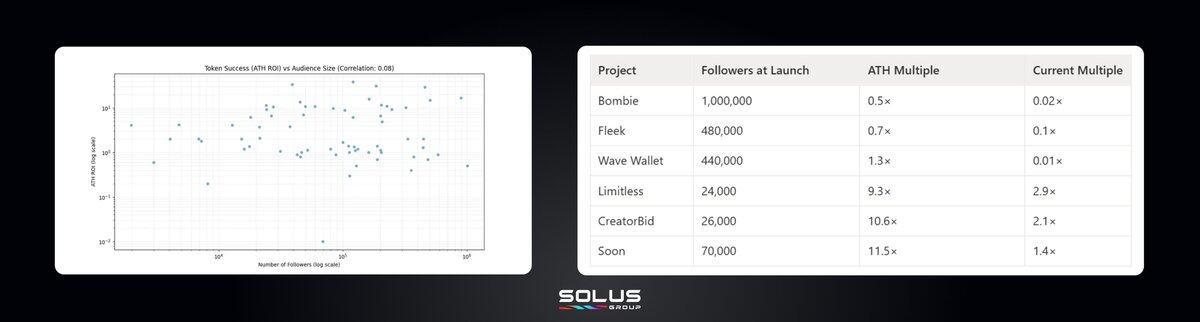
Correlation coefficients: 0.08 (Token ATH) and -0.06 (Token Current)

The data shows audience size has no predictive value for token performance. Projects with huge followings have mixed results—some surge, some crash. The same goes for projects with small audiences. No trend, no pattern, no correlation.

Your Discord group is not a community; it's a speculative audience waiting to leave.
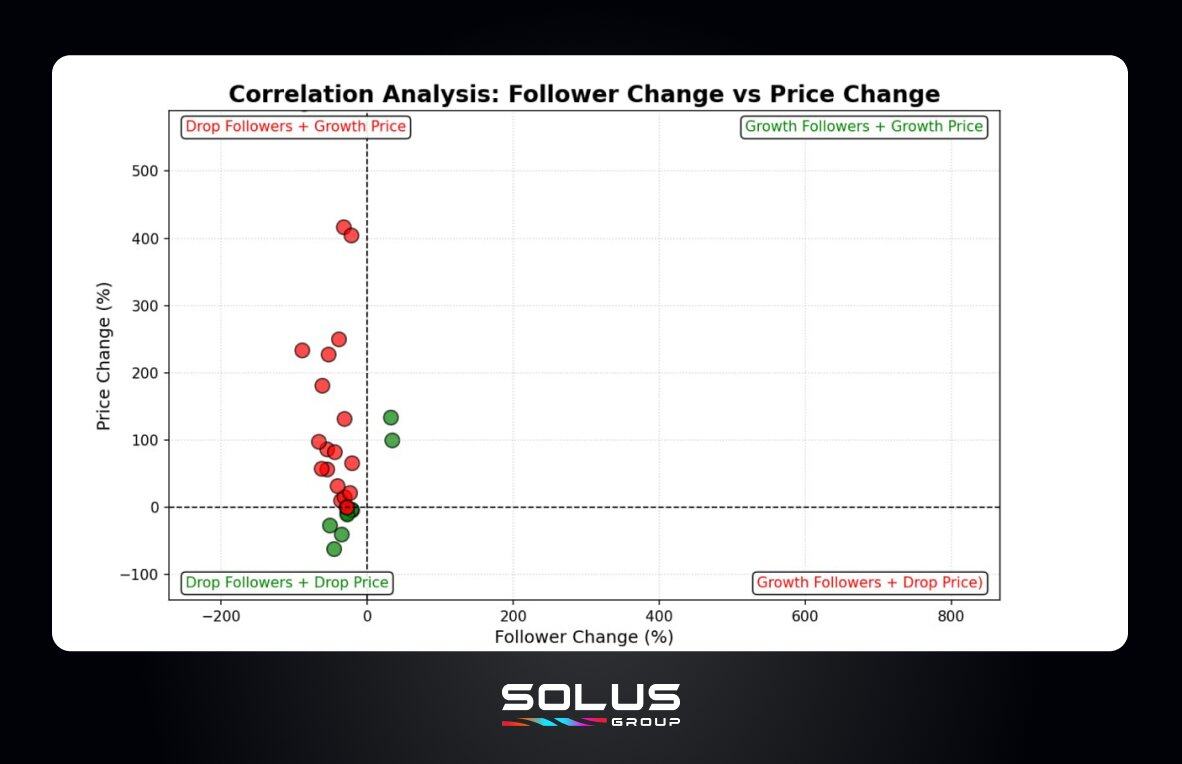
Reality: Price dictates community growth, not the other way around.

When price plummets, followers vanish. The chart proves this—the bottom-left quadrant (decreasing followers + falling price) is very dense. When price soars, followers sometimes grow, but it's not consistent.

This means:

Your "active community" never really cared about the product—they cared about the token price action. They disappear if the token underperforms. Community growth is a lagging indicator, not a leading one.

This isn't just theory; it's the stated view of @belizardd (Researcher & Trader/KOL):

Most people are here purely for speculation, not the product itself. We see very few protocols performing well post-TGE, mainly those with low initial FDV, not high fundraising, and generous airdrops. Honestly, I won't blindly ape into anything right now. The risk/reward isn't worth it; I'm just waiting for the market to improve.

Speculators know the game is broken. They are waiting on the sidelines. Meanwhile, founders keep burning 60% of their budget on Discord bots, Twitter giveaways, and KOL promotions—statistically insignificant metrics.

The real question is: "If the token dropped 50% tomorrow, how many would stay?"

Answer: Almost none.

Token Price Trap, Beware of Overpricing/Underpricing
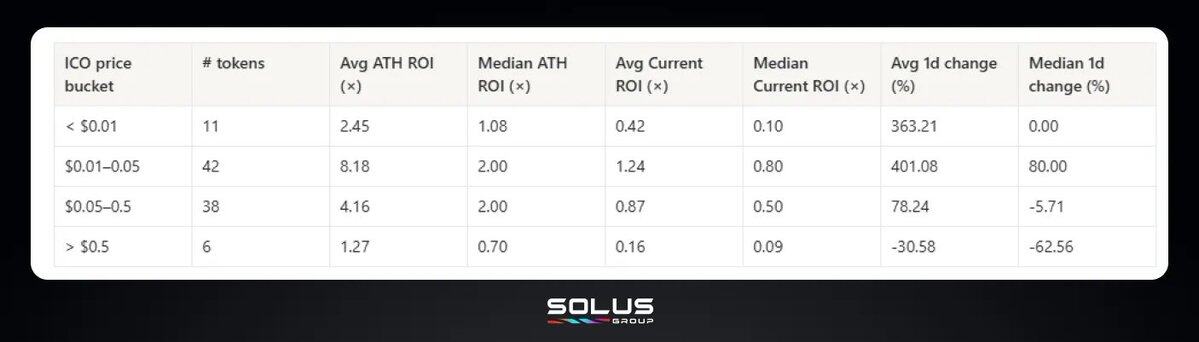
Median ROI by token listing price:

Below $0.01: 0.1x (90% loss)

$0.01 to $0.05: 0.8x (Viable zone)

$0.05 to $0.50: 0.5x (50% loss)

Above $0.50: 0.09x (91% loss)

Let me repeat that:

Pricing below $0.01 doesn't make your token "more accessible"; it makes you a low-priced coin attracting mercenary capital that pumps fast and dumps faster.

Pricing above $0.50 doesn't make your token a "premium token"; it makes it overpriced. Excessively high token prices kill retail markets, and whales won't bite either.

The $0.01 to $0.05 token price range is the only viable pricing zone. This price is high enough to signal legitimacy and low enough to leave room for upside. Within this price range, only 42 out of 97 tokens had a median positive performance.

If your tokenomics peg your valuation at $0.003 or $1.20, stop rebuilding the model; the data says it's already failed.

Industry Status: Stop Building Like It's 2021
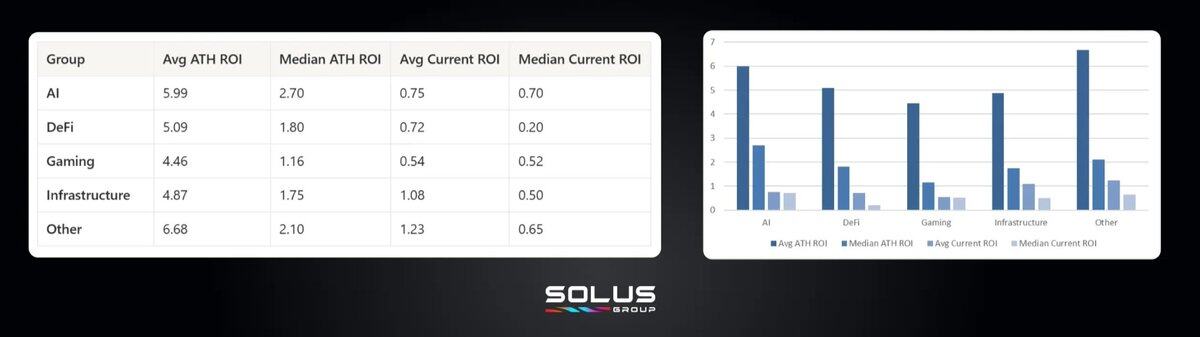
Loser: Gaming

Average ATH ROI: 4.46x (Lowest)

Median Current ROI: 0.52x

GameFi tokens are like lottery tickets; play once, forget forever.

Trap: DeFi

Average ATH ROI: 5.09x (Looks good)

Median Current ROI: 0.2x (Disastrous)

DeFi has early massive pumps followed by deeper crashes than any other sector. The gap between hype and reality is brutally stark.

Winner: AI

Average ATH ROI: 5.99x (Highest peak)

Median Current ROI: 0.70x (Best retention)

AI tokens pump and hold. The trend has staying power, and money follows.

If you're building GameFi, your execution needs to be 10x better than average to achieve an average result. If you're in DeFi, prepare for rapid pumps and violent dumps. If you're in AI, the market will give you a chance, but only if you deliver. Infrastructure is even more demanding: you burn more time and resources compared to standard dApps (like AI agents), yet your median current ROI is slightly lower than the universally frowned-upon GameFi sector.

The data doesn't care which project you find interesting.

IDO/IEO Data Overview: A Good Platform Cannot Save a Project
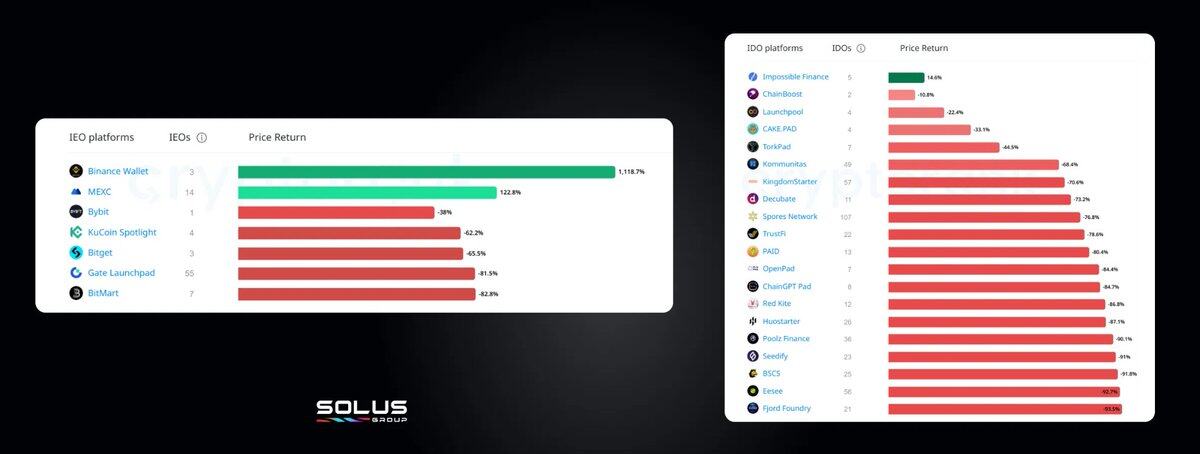
You spend months networking just to get a spot on Binance Launchpad or an allocation from a tier-1 IDO, thinking platform curation means protection. The data shows otherwise.

IDO Platforms: Almost all projects are in the red

Only one project on one of the 5 IDO platforms had a return of +14.6%. That's it. All others ranged from -70% to -93%.

So-called "premium Launchpads" don't protect buyers; they just offer a branded way to lose money.

IEO Platforms: Survivorship Bias at its Finest

Binance wallet shows an 11x return. Looks incredible, but it's only 3 launches, a tiny sample. MEXC shows +122.8% across 14 launches—a larger sample but still an outlier. Everyone else? Underwater. Bybit IEO tokens are down 38%, others are worse.

This proves:

Platform selection is a lottery with better branding. A few outlier wins skew the average, while the vast majority of launches trend downward. The "curation service" you pay for—whether through connections, listing fees, or token allocations—does not reliably protect token ROI.

Platforms cannot save garbage tokens, nor can they help good tokens.

Reflecting on 2025, Looking Ahead to 2026

Project development in 2025 failed at every level.

Layer Zero: Foundation

Problem: "Speculation-based tokenomics." Indiscriminate token dumping into illiquid markets without organic revenue models to absorb the shock.

First Layer: Funding

Problem: "Fake it in the PDF, fix it later."

Second Layer: Marketing

Problem: The KOL model, paid shills, rented users who vanish the moment payments stop.

Third Layer: Liquidity

Problem: Assuming liquidity follows hype; it doesn't. Institutional money waits for proof.

Fourth Layer: User Retention

Problem: Zero-retention infrastructure. The "project community" is 10,000 Telegram users who will abandon you within 90 days.

2026 shouldn't be about playing the old game. There's a deeper problem behind all this. Infrastructure does matter, but even with perfect infrastructure, timing is everything. As Ivan Paskar (Growth Lead at Altius Labs) said:

Tokens don't fix broken things—they amplify reality. Right timing = momentum multiplies. Wrong timing = years of work vanish instantly. Most teams don't fail on token design; they fail by misjudging their stage and the macro environment. Timing isn't a detail; it's everything.

What Should Projects Do in 2026

Survival isn't about following the old playbook; it's about building a new one.

1. Raise Wisely

Target $300k to $5M. The highest ROI per dollar is here. More money = more problems.

2. Price for Survival

Launch between $0.01 and $0.05. Everything else struggles. If your tokenomics don't fit this range, they are broken.

3. Product First, Token Second

If you can't explain why your token exists in one sentence, it doesn't. Revenue precedes speculation.

4. Ignore Vanity Metrics

Follower count is noise. Active wallets, retention, and revenue per user are signal.

5. Sector Realism

Know your sector's failure rate before writing code. GameFi needs 2x the execution just to break even. AI has tailwinds—if you can deliver.

6. Consolidate or Die

The era of M&A is coming. If you can't scale alone, find an acquirer. Acquisition isn't failure; it's strategy.

These six principles matter. But the truth is: The standard playbook is dead. There is no one-size-fits-all model anymore.

İlgili Sorular

QAccording to the article, what percentage of new tokens launched in 2025 had an FDV lower than their TGE FDV?

A84.7% of new tokens launched in 2025 had an FDV lower than their TGE FDV.

QWhat did the data reveal about the correlation between high fundraising amounts and token performance?

AThe data showed a correlation of 0.04 between fundraising amount and token performance, which is statistically zero. This means high fundraising amounts did not lead to better token performance.

QWhich token price range was identified as the only viable 'survival zone' for a TGE?

AThe token price range of $0.01 to $0.05 was identified as the only viable 'survival zone' for a TGE.

QWhich sector's tokens had the highest average ATH ROI and the best retention rate according to the study?

AThe AI sector's tokens had the highest average ATH ROI (5.99x) and the best current median ROI (0.70x), indicating the highest retention rate.

QWhat is one of the key recommendations for projects in 2026 regarding their community metrics?

AOne key recommendation is to ignore vanity metrics like follower count and instead focus on key metrics such as wallet activity, user retention rate, and revenue per user.

İlgili Okumalar

KOL's Perspective: Why Is SOL Set to Rise from This Point?

**Summary: Why SOL is Positioned for Growth at This Level** The article argues that SOL is poised for an upward move from its current price point, citing several key factors. Primarily, SOL has just broken out of a 4-month consolidation phase. This breakout signals a return of risk appetite to the broader crypto market, as SOL is seen as a key indicator of overall crypto health. The token's ownership has reportedly shifted from short-term traders and tourists to long-term accumulators, leading to low volume. Any meaningful increase in trading activity could thus trigger significant upward momentum. Fundamental strengths include strong institutional adoption, integration with DeFi and RWAs (Real-World Assets), and the potential benefits from the Clarity Act. Despite its high volatility—having dropped 70% from its all-time high but still up 12x from its bear market low—SOL is highlighted as one of the few tokens from the last cycle to reach new highs. It boasts a robust ecosystem of applications, users, and protocols. Future catalysts include the expected influx of AI developers following the Miami Accelerate conference, which focused on AI on Solana. Furthermore, Solana is positioned as the premier chain for memecoin activity, a trend expected to continue and drive network usage and fees. The article concludes that recent price action reflects a healthy transfer to long-term holders, setting the stage for growth.

marsbit33 dk önce

KOL's Perspective: Why Is SOL Set to Rise from This Point?

marsbit33 dk önce

Those Pre-Bitcoin PoW Protocols Have Recently Been Reimplemented

This article details a recent surge in replicating pre-Bitcoin Proof-of-Work (PoW) protocols, specifically focusing on Hal Finney's 2004 RPOW (Reusable Proofs of Work). Within five days in May 2026, multiple independent builders in the Bitcoin/cypherpunk community launched projects inspired by this early electronic cash proposal. The initiative began with Fred Krueger's `rpow2.com`, a centralized but auditable system that replaced RPOW's original IBM 4758 hardware with Ed25519 signatures. Initially a faithful replica, it later adopted Bitcoin-like features (21M supply cap, difficulty adjustment) and a controversial 5.24% founder allocation. This sparked rapid forks, including `rpow4.com` which incorporated full Bitcoin parameters, a prediction market (`rpowmarket.com`), and a DEX (`rpow2swap.com`). Concurrently, Mike In Space created a prototype of Wei Dai's 1998 b-money proposal (`b-money.replit.app`), pushing the historical exploration even further back. The article contrasts these centralized, server-dependent experiments with Bitcoin's core innovation of decentralized, trustless consensus. It also highlights a parallel development: the `HASH` project on Ethereum, which uses smart contract hooks to enable a purely fair-launch, browser-mineable PoW token with 0% allocations to team or VCs. The collective activity is framed as a meme-driven, educational exploration of cypherpunk history rather than a serious financial movement, with all projects heavily disclaiming any investment value.

marsbit38 dk önce

Those Pre-Bitcoin PoW Protocols Have Recently Been Reimplemented

marsbit38 dk önce

South Korean Exchanges 'Battle' Regulators, Challenging the Boundaries of Enforcement and Legislation

South Korea's cryptocurrency industry is engaged in a rare, direct confrontation with regulators. The Financial Intelligence Unit (FIU), the primary anti-money laundering (AML) watchdog, has recently imposed heavy penalties on major exchanges like Upbit and Bithumb for alleged violations involving unregistered overseas VASPs and AML procedures. However, exchanges are now actively challenging these actions in court and through industry associations. In a significant shift, the Seoul Administrative Court ruled in favor of Upbit's operator, Dunamu, overturning part of an FIU-ordered business suspension. The court found the FIU's penalty criteria and justification insufficiently clear. Similarly, the court suspended the enforcement of a six-month business suspension against Bithumb pending a final ruling, citing potential irreversible harm to the exchange. Beyond legal battles, the industry is contesting proposed legislative amendments. The Digital Asset eXchange Alliance (DAXA) strongly opposes a draft rule that would mandate Suspicious Transaction Reports (STRs) for all crypto transfers over 10 million KRW (~$6,800). DAXA argues this "poison pill" clause violates legal principles and would overwhelm the STR system, increasing reports from 63,000 to an estimated 5.45 million annually for major exchanges, thereby crippling effective AML monitoring. This conflict highlights a structural tension in South Korea's crypto governance: comprehensive digital asset laws are still developing, while regulators rely heavily on AML enforcement. The industry's move from passive compliance to active legal and legislative challenges signifies a new phase, pressing for clearer rules and more proportionate enforcement. While short-term disputes may intensify, this clash could ultimately lead to a more mature and sustainable regulatory framework for South Korea's vibrant crypto market.

marsbit1 saat önce

South Korean Exchanges 'Battle' Regulators, Challenging the Boundaries of Enforcement and Legislation

marsbit1 saat önce

After 50x Storage Surge, Justin Sun Always Looks to the Next Decade

Sun Yuchen, known for his controversial stunts like a $30 million lunch with Warren Buffett (canceled due to a kidney stone) and eating a $6.2 million duct-taped banana, is often overshadowed by a significant fact: his decade-long track record of spotting major investment trends. In 2016, he famously advised young people to invest in Bitcoin, Nvidia, Tesla, and Tencent instead of buying property. A hypothetical $20,000 investment in Nvidia and Tesla from that list would now be worth over 50 million RMB. His latest major call was on November 6, 2025, predicting a "50x storage opportunity" tied to the AI boom, which materialized with Sandisk's stock surging nearly 50-fold by 2026. Looking ahead, Sun now focuses on the next frontier: Physical AI. He identifies four key areas: 1. **Embodied AI/Robotics**: He sees this reaching its "iPhone moment," with companies like UBTech and Galaxy General leading in commercialization. 2. **Drones**: Viewed as the first commercially viable form of Physical AI, revolutionizing sectors from warfare (e.g., AeroVironment's Switchblade) to logistics. 3. **Spatial Computing**: Beyond VR, it's about AI understanding physical space, a foundational technology for robotics and autonomous systems, exemplified by Apple's Vision Pro. 4. **Space Exploration**: After a 2025 suborbital flight with Blue Origin, Sun advocates for space as the ultimate frontier, discussing blockchain's potential role in space asset management and data transactions. His investment philosophy involves betting on entire, inevitable trends rather than single companies. For robotics, he sees Tesla (the body/manufacturer) and Nvidia (the brain/AI platform) as complementary plays. In defense drones, he highlights companies making tanks obsolete (AeroVironment) and those augmenting fighter jets (Kratos). For space, he participated in Blue Origin's flight and anticipates SpaceX's potential IPO to redefine the sector's valuation. Sun Yuchen's vision frames the next two decades not as a revolution in information flow (like the internet), but in the fundamental operation of the physical world through AI-powered robots, autonomous systems, and spatial intelligence, ultimately extending human and AI activity into space. While many still focus on conventional assets, he continues to look toward the next technological horizon.

marsbit2 saat önce

After 50x Storage Surge, Justin Sun Always Looks to the Next Decade

marsbit2 saat önce

İşlemler

Spot
Futures

Popüler Makaleler

$S$ Nedir

SPERO'yu Anlamak: Kapsamlı Bir Genel Bakış SPERO'ya Giriş İnovasyonun manzarası gelişmeye devam ederken, web3 teknolojilerinin ve kripto para projelerinin ortaya çıkışı dijital geleceği şekillendirmede önemli bir rol oynamaktadır. Bu dinamik alanda dikkat çeken projelerden biri SPERO, $$s$$ olarak adlandırılmaktadır. Bu makale, SPERO hakkında ayrıntılı bilgi toplamak ve sunmak amacıyla, meraklılar ve yatırımcıların web3 ve kripto alanlarındaki temellerini, hedeflerini ve yeniliklerini anlamalarına yardımcı olmayı amaçlamaktadır. SPERO,$$s$$ Nedir? SPERO,$$s$$, kripto alanında merkeziyetsizlik ve blok zinciri teknolojisi ilkelerini kullanarak etkileşimi, faydayı ve finansal kapsayıcılığı teşvik eden bir ekosistem yaratmayı amaçlayan benzersiz bir projedir. Proje, kullanıcıların yenilikçi finansal çözümler ve hizmetler sunarak eşler arası etkileşimleri yeni yollarla kolaylaştırmayı hedeflemektedir. SPERO,$$s$$'nin temel amacı, bireyleri güçlendirmek ve kripto para alanındaki kullanıcı deneyimini artıran araçlar ve platformlar sağlamaktır. Bu, daha esnek işlem yöntemlerini mümkün kılmayı, topluluk odaklı girişimleri teşvik etmeyi ve merkeziyetsiz uygulamalar (dApp'ler) aracılığıyla finansal fırsatlar yaratmayı içermektedir. SPERO,$$s$$'nin temel vizyonu kapsayıcılık etrafında dönmekte olup, geleneksel finansal sistemlerdeki boşlukları kapatmayı ve blok zinciri teknolojisinin faydalarından yararlanmayı hedeflemektedir. SPERO,$$s$$'nin Yaratıcısı Kimdir? SPERO,$$s$$'nin yaratıcısının kimliği bir miktar belirsizdir, çünkü kurucusu(ları) hakkında ayrıntılı arka plan bilgisi sağlayan sınırlı kamuya açık kaynaklar bulunmaktadır. Bu şeffaflık eksikliği, projenin merkeziyetsizlik taahhüdünden kaynaklanabilir—birçok web3 projesinin paylaştığı bir etik anlayışı, bireysel tanınmanın yerine kolektif katkıları önceliklendirmektedir. Topluluk ve onun kolektif hedefleri etrafında tartışmaları merkezileştirerek, SPERO,$$s$$, belirli bireyleri öne çıkarmadan güçlendirme özünü taşımaktadır. Bu nedenle, SPERO'nun etik anlayışını ve misyonunu anlamak, tek bir yaratıcının kimliğini belirlemekten daha önemlidir. SPERO,$$s$$'nin Yatırımcıları Kimlerdir? SPERO,$$s$$, kripto sektöründe yeniliği teşvik etmeye adanmış girişim sermayedarlarından melek yatırımcılara kadar çeşitli yatırımcılar tarafından desteklenmektedir. Bu yatırımcıların odak noktası genellikle SPERO'nun misyonuyla uyumlu olup, toplumsal teknolojik ilerlemeyi, finansal kapsayıcılığı ve merkeziyetsiz yönetimi vaat eden projeleri önceliklendirmektedir. Bu yatırımcı temelleri, yalnızca yenilikçi ürünler sunan projelere değil, aynı zamanda blok zinciri topluluğuna ve ekosistemlerine olumlu katkılarda bulunan projelere de ilgi duymaktadır. Bu yatırımcıların desteği, SPERO,$$s$$'yi hızla gelişen kripto projeleri alanında dikkate değer bir rakip haline getirmektedir. SPERO,$$s$$ Nasıl Çalışır? SPERO,$$s$$, onu geleneksel kripto para projelerinden ayıran çok yönlü bir çerçeve kullanmaktadır. İşte benzersizliğini ve yeniliğini vurgulayan bazı temel özellikler: Merkeziyetsiz Yönetim: SPERO,$$s$$, kullanıcıların projenin geleceğiyle ilgili karar alma süreçlerine aktif olarak katılmalarını sağlayan merkeziyetsiz yönetim modellerini entegre etmektedir. Bu yaklaşım, topluluk üyeleri arasında sahiplik ve hesap verebilirlik duygusunu teşvik etmektedir. Token Kullanımı: SPERO,$$s$$, ekosistem içinde çeşitli işlevler sunmak üzere tasarlanmış kendi kripto para token'ını kullanmaktadır. Bu token'lar, işlemleri, ödülleri ve platformda sunulan hizmetlerin kolaylaştırılmasını sağlayarak genel etkileşimi ve faydayı artırmaktadır. Katmanlı Mimari: SPERO,$$s$$'nin teknik mimarisi, modülerlik ve ölçeklenebilirliği destekleyerek projenin evrimi sırasında ek özelliklerin ve uygulamaların sorunsuz bir şekilde entegrasyonuna olanak tanımaktadır. Bu uyum sağlama yeteneği, sürekli değişen kripto manzarasında geçerliliği sürdürmek için hayati öneme sahiptir. Topluluk Katılımı: Proje, işbirliği ve geri bildirim teşvik eden mekanizmalar kullanarak topluluk odaklı girişimlere vurgu yapmaktadır. Güçlü bir topluluk oluşturarak, SPERO,$$s$$, kullanıcı ihtiyaçlarını daha iyi karşılayabilir ve piyasa trendlerine uyum sağlayabilir. Kapsayıcılığa Odaklanma: Düşük işlem ücretleri ve kullanıcı dostu arayüzler sunarak, SPERO,$$s$$, daha önce kripto alanında yer almamış bireyler de dahil olmak üzere çeşitli bir kullanıcı tabanını çekmeyi hedeflemektedir. Bu kapsayıcılık taahhüdü, erişilebilirlik yoluyla güçlendirme misyonuyla uyumludur. SPERO,$$s$$ Zaman Çizelgesi Bir projenin tarihini anlamak, gelişim yolculuğu ve kilometre taşları hakkında kritik bilgiler sağlar. Aşağıda, SPERO,$$s$$'nin evriminde önemli olayları haritalayan önerilen bir zaman çizelgesi bulunmaktadır: Kavram Geliştirme ve Fikir Aşaması: SPERO,$$s$$'nin temelini oluşturan ilk fikirler, blok zinciri endüstrisindeki merkeziyetsizlik ve topluluk odaklılık ilkeleriyle yakından uyumlu olarak geliştirildi. Proje Beyaz Kağıdının Yayınlanması: Kavramsal aşamayı takiben, SPERO,$$s$$'nin vizyonunu, hedeflerini ve teknolojik altyapısını ayrıntılı bir şekilde açıklayan kapsamlı bir beyaz kağıt yayımlandı ve topluluk ilgisini ve geri bildirimini toplamak amacıyla sunuldu. Topluluk Oluşturma ve Erken Katılımlar: Projenin hedefleri etrafında tartışmalar yürüterek destek toplamak ve erken benimseyenler ile potansiyel yatırımcılar için bir topluluk oluşturmak amacıyla aktif iletişim çabaları gerçekleştirildi. Token Üretim Etkinliği: SPERO,$$s$$, yerel token'larını erken destekçilere dağıtmak ve ekosistem içinde başlangıç likiditesini sağlamak amacıyla bir token üretim etkinliği (TGE) gerçekleştirdi. İlk dApp'in Yayınlanması: SPERO,$$s$$ ile ilişkili ilk merkeziyetsiz uygulama (dApp) faaliyete geçti ve kullanıcıların platformun temel işlevleriyle etkileşimde bulunmalarını sağladı. Sürekli Gelişim ve Ortaklıklar: Projenin tekliflerine sürekli güncellemeler ve iyileştirmeler yapılmakta olup, blok zinciri alanındaki diğer oyuncularla stratejik ortaklıklar, SPERO,$$s$$'yi rekabetçi ve gelişen bir oyuncu haline getirmiştir. Sonuç SPERO,$$s$$, web3 ve kripto paranın finansal sistemleri devrim niteliğinde dönüştürme ve bireyleri güçlendirme potansiyelinin bir kanıtıdır. Merkeziyetsiz yönetime, topluluk katılımına ve yenilikçi tasarlanmış işlevselliğe olan bağlılığıyla, daha kapsayıcı bir finansal manzaraya doğru bir yol açmaktadır. Hızla gelişen kripto alanındaki herhangi bir yatırımda olduğu gibi, potansiyel yatırımcılar ve kullanıcılar, SPERO,$$s$$ içindeki devam eden gelişmelerle ilgili olarak kapsamlı bir araştırma yapmaları ve düşünceli bir şekilde katılmaları teşvik edilmektedir. Proje, kripto endüstrisinin yenilikçi ruhunu sergileyerek, sayısız olasılığını keşfetmeye davet etmektedir. SPERO,$$s$$'nin yolculuğu hala devam ederken, temel ilkeleri, teknoloji, finans ve birbirimizle etkileşim biçimimizi etkileyebilir.

89 Toplam GörüntülenmeYayınlanma 2024.12.17Güncellenme 2024.12.17

$S$ Nedir

AGENT S Nedir

Agent S: Web3'te Otonom Etkileşimin Geleceği Giriş Web3 ve kripto para dünyasında sürekli gelişen manzarada, yenilikler bireylerin dijital platformlarla etkileşim biçimlerini sürekli olarak yeniden tanımlıyor. Bu tür öncü projelerden biri olan Agent S, açık ajans çerçevesi aracılığıyla insan-bilgisayar etkileşimini devrim niteliğinde değiştirmeyi vaat ediyor. Otonom etkileşimlerin yolunu açarak, Agent S karmaşık görevleri basitleştirmeyi ve yapay zeka (AI) alanında dönüştürücü uygulamalar sunmayı hedefliyor. Bu detaylı inceleme, projenin karmaşıklıklarına, benzersiz özelliklerine ve kripto para alanındaki etkilerine dalacaktır. Agent S Nedir? Agent S, bilgisayar görevlerinin otomasyonunda üç temel zorluğu ele almak üzere özel olarak tasarlanmış çığır açıcı bir açık ajans çerçevesidir: Alan Spesifik Bilgi Edinimi: Çerçeve, çeşitli dış bilgi kaynaklarından ve iç deneyimlerden akıllıca öğrenir. Bu çift yönlü yaklaşım, alan spesifik bilgi açısından zengin bir veri havuzu oluşturmasını sağlar ve görev yürütmedeki performansını artırır. Uzun Görev Ufukları Üzerinde Planlama: Agent S, karmaşık görevlerin verimli bir şekilde parçalanmasını ve yürütülmesini kolaylaştıran deneyim artırımlı hiyerarşik planlama kullanır. Bu özellik, çoklu alt görevleri etkili ve verimli bir şekilde yönetme yeteneğini önemli ölçüde artırır. Dinamik, Homojen Olmayan Arayüzlerle Başlama: Proje, ajanlar ve kullanıcılar arasındaki etkileşimi geliştiren yenilikçi bir çözüm olan Ajan-Bilgisayar Arayüzü'ni (ACI) tanıtmaktadır. Çok Modlu Büyük Dil Modellerini (MLLM'ler) kullanarak, Agent S çeşitli grafik kullanıcı arayüzlerini sorunsuz bir şekilde gezinebilir ve manipüle edebilir. Bu öncü özellikler aracılığıyla, Agent S, makinelerle insan etkileşimini otomatikleştirmede karşılaşılan karmaşıklıkları ele alan sağlam bir çerçeve sunarak, AI ve ötesinde birçok uygulama için zemin hazırlıyor. Agent S'nin Yaratıcısı Kimdir? Agent S'nin kavramı temelde yenilikçi olsa da, yaratıcısı hakkında spesifik bilgiler belirsizliğini koruyor. Yaratıcı şu anda bilinmiyor, bu da projenin yeni aşamasını veya kurucu üyeleri gizli tutma stratejik tercihini vurguluyor. Anonimlikten bağımsız olarak, odak çerçevenin yetenekleri ve potansiyeli üzerinde kalıyor. Agent S'nin Yatırımcıları Kimlerdir? Agent S, kriptografik ekosistemde oldukça yeni olduğundan, yatırımcıları ve finansal destekçileri hakkında ayrıntılı bilgiler açıkça belgelenmemiştir. Projeyi destekleyen yatırım temelleri veya organizasyonları hakkında kamuya açık bilgilerdeki eksiklik, finansman yapısı ve gelişim yol haritası hakkında sorular doğuruyor. Destekleyicilerin anlaşılması, projenin sürdürülebilirliğini ve potansiyel pazar etkisini değerlendirmek için kritik öneme sahiptir. Agent S Nasıl Çalışır? Agent S'nin temelinde, çeşitli ortamlarda etkili bir şekilde çalışmasını sağlayan son teknoloji bir sistem yatmaktadır. İşleyiş modeli birkaç ana özellik etrafında inşa edilmiştir: İnsan Benzeri Bilgisayar Etkileşimi: Çerçeve, bilgisayarlarla etkileşimleri daha sezgisel hale getirmeyi amaçlayan gelişmiş AI planlaması sunar. Görev yürütmedeki insan davranışını taklit ederek, kullanıcı deneyimlerini yükseltmeyi vaat eder. Anlatı Belleği: Yüksek düzeyde deneyimlerden yararlanmak için kullanılan Agent S, görev geçmişlerini takip etmek amacıyla anlatı belleğini kullanarak karar verme süreçlerini geliştirir. Episodik Bellek: Bu özellik, kullanıcılara adım adım rehberlik sağlayarak, çerçevenin görevler gelişirken bağlamsal destek sunmasına olanak tanır. OpenACI Desteği: Yerel olarak çalışabilme yeteneği ile Agent S, kullanıcıların etkileşimleri ve iş akışları üzerinde kontrol sağlamasına olanak tanır ve Web3'ün merkeziyetsiz felsefesiyle uyumlu hale gelir. Dış API'lerle Kolay Entegrasyon: Çeşitli AI platformlarıyla uyumluluğu ve çok yönlülüğü, Agent S'nin mevcut teknolojik ekosistemlere sorunsuz bir şekilde entegre olmasını sağlar ve geliştiriciler ile organizasyonlar için cazip bir seçenek haline getirir. Bu işlevsellikler, Agent S'nin kripto alanındaki benzersiz konumuna katkıda bulunarak, karmaşık, çok aşamalı görevleri minimum insan müdahalesi ile otomatikleştirir. Proje geliştikçe, Web3'teki potansiyel uygulamaları dijital etkileşimlerin nasıl gelişeceğini yeniden tanımlayabilir. Agent S'nin Zaman Çizelgesi Agent S'nin gelişimi ve kilometre taşları, önemli olaylarını vurgulayan bir zaman çizelgesinde özetlenebilir: 27 Eylül 2024: Agent S'nin kavramı, “Bilgisayarları İnsan Gibi Kullanan Açık Bir Ajans Çerçevesi” başlıklı kapsamlı bir araştırma makalesi ile tanıtıldı ve projenin temelini sergiledi. 10 Ekim 2024: Araştırma makalesi arXiv'de kamuya açık olarak yayınlandı ve çerçevenin derinlemesine bir incelemesini ve OSWorld benchmark'ına dayalı performans değerlendirmesini sundu. 12 Ekim 2024: Agent S'nin yetenekleri ve özellikleri hakkında görsel bir içgörü sağlayan bir video sunumu yayımlandı ve potansiyel kullanıcılar ve yatırımcılarla daha fazla etkileşim sağlandı. Bu zaman çizelgesindeki işaretler, sadece Agent S'nin ilerlemesini değil, aynı zamanda şeffaflık ve topluluk katılımına olan bağlılığını da göstermektedir. Agent S Hakkında Ana Noktalar Agent S çerçevesi gelişmeye devam ederken, birkaç ana özellik öne çıkmakta ve yenilikçi doğasını ve potansiyelini vurgulamaktadır: Yenilikçi Çerçeve: İnsan etkileşimine benzer bir bilgisayar kullanımı sağlamak üzere tasarlanan Agent S, görev otomasyonuna yeni bir yaklaşım getiriyor. Otonom Etkileşim: GUI aracılığıyla bilgisayarlarla otonom olarak etkileşim kurabilme yeteneği, daha akıllı ve verimli hesaplama çözümlerine doğru bir sıçrama anlamına geliyor. Karmaşık Görev Otomasyonu: Sağlam metodolojisi ile karmaşık, çok aşamalı görevleri otomatikleştirerek süreçleri daha hızlı ve daha az hata payı ile gerçekleştirebilir. Sürekli İyileştirme: Öğrenme mekanizmaları, Agent S'nin geçmiş deneyimlerden öğrenmesini sağlar ve sürekli olarak performansını ve etkinliğini artırır. Çok Yönlülük: OSWorld ve WindowsAgentArena gibi farklı işletim ortamlarında uyumlu olması, geniş bir uygulama yelpazesine hizmet edebilmesini sağlar. Agent S, Web3 ve kripto alanında kendini konumlandırırken, etkileşim yeteneklerini artırma ve süreçleri otomatikleştirme potansiyeli, AI teknolojilerinde önemli bir ilerlemeyi temsil etmektedir. Yenilikçi çerçevesi aracılığıyla, Agent S dijital etkileşimlerin geleceğini örneklemekte ve çeşitli sektörlerde kullanıcılar için daha sorunsuz ve verimli bir deneyim vaat etmektedir. Sonuç Agent S, AI ve Web3'ün birleşiminde cesur bir sıçramayı temsil ediyor ve teknoloji ile etkileşim biçimimizi yeniden tanımlama kapasitesine sahip. Henüz erken aşamalarında olmasına rağmen, uygulama olanakları geniş ve çekici. Kritik zorlukları ele alan kapsamlı çerçevesi ile Agent S, otonom etkileşimleri dijital deneyimin ön plana çıkmasına taşımayı hedefliyor. Kripto para ve merkeziyetsizlik alanlarına daha derinlemesine girdikçe, Agent S gibi projelerin teknoloji ve insan-bilgisayar işbirliğinin geleceğini şekillendirmede önemli bir rol oynayacağı kesin.

475 Toplam GörüntülenmeYayınlanma 2025.01.14Güncellenme 2025.01.14

AGENT S Nedir

S Nasıl Satın Alınır

HTX.com’a hoş geldiniz! Sonic (S) satın alma işlemlerini basit ve kullanışlı bir hâle getirdik. Adım adım açıkladığımız rehberimizi takip ederek kripto yolculuğunuza başlayın. 1. Adım: HTX Hesabınızı OluşturunHTX'te ücretsiz bir hesap açmak için e-posta adresinizi veya telefon numaranızı kullanın. Sorunsuzca kaydolun ve tüm özelliklerin kilidini açın. Hesabımı Aç2. Adım: Kripto Satın Al Bölümüne Gidin ve Ödeme Yönteminizi SeçinKredi/Banka Kartı: Visa veya Mastercard'ınızı kullanarak anında Sonic (S) satın alın.Bakiye: Sorunsuz bir şekilde işlem yapmak için HTX hesap bakiyenizdeki fonları kullanın.Üçüncü Taraflar: Kullanımı kolaylaştırmak için Google Pay ve Apple Pay gibi popüler ödeme yöntemlerini ekledik.P2P: HTX'teki diğer kullanıcılarla doğrudan işlem yapın.Borsa Dışı (OTC): Yatırımcılar için kişiye özel hizmetler ve rekabetçi döviz kurları sunuyoruz.3. Adım: Sonic (S) Varlıklarınızı SaklayınSonic (S) satın aldıktan sonra HTX hesabınızda saklayın. Alternatif olarak, blok zinciri transferi yoluyla başka bir yere gönderebilir veya diğer kripto para birimlerini takas etmek için kullanabilirsiniz.4. Adım: Sonic (S) Varlıklarınızla İşlem YapınHTX'in spot piyasasında Sonic (S) ile kolayca işlemler yapın.Hesabınıza erişin, işlem çiftinizi seçin, işlemlerinizi gerçekleştirin ve gerçek zamanlı olarak izleyin. Hem yeni başlayanlar hem de deneyimli yatırımcılar için kullanıcı dostu bir deneyim sunuyoruz.

1.4k Toplam GörüntülenmeYayınlanma 2025.01.15Güncellenme 2025.03.21

S Nasıl Satın Alınır

Tartışmalar

HTX Topluluğuna hoş geldiniz. Burada, en son platform gelişmeleri hakkında bilgi sahibi olabilir ve profesyonel piyasa görüşlerine erişebilirsiniz. Kullanıcıların S (S) fiyatı hakkındaki görüşleri aşağıda sunulmaktadır.

活动图片