Oracle Posts Its Strongest Ever Financial Report, So Why Did the Stock Fall?

链捕手2026-06-11 tarihinde yayınlandı2026-06-11 tarihinde güncellendi

Özet

Oracle reported its strongest-ever fiscal results for Q4 FY2026 and the full year, with revenue hitting a record $67.4 billion (up 17% YoY). Cloud revenue surged 39% to $34 billion, now comprising over half of total sales, driven by a 93% jump in infrastructure (IaaS) revenue. Despite beating top-line expectations, the stock fell in after-hours trading. Investor concerns centered on the financial implications of massive AI-driven growth. The company's remaining performance obligations (RPO) ballooned to $638 billion, over half tied to OpenAI, signaling heavy future AI cloud demand. To meet this, capital expenditures soared to $55.7 billion for the year, turning annual free cash flow negative (-$23.7 billion). Oracle raised $48 billion in new financing in FY2026 and plans to raise another $40 billion in FY2027, highlighting the significant ongoing investment required. For FY2027, Oracle reaffirmed its $90 billion revenue target and raised its adjusted EPS guidance. The company is also expanding its AI focus into verticals like healthcare, launching new AI-powered clinical and drug discovery systems. In summary, while Oracle's AI-fueled cloud transition is accelerating top-line growth, the associated heavy capital spending and increased leverage are weighing on investor sentiment in the near term.

Original Text by Li Hailun, Tencent Technology

Oracle delivered a record-breaking financial report. However, behind the data growth, AI cloud orders are driving up the company's data center investments and capital expenditures, turning its annual free cash flow negative.

On June 10th, U.S. time, Oracle released its financial report for the fourth quarter of fiscal year 2026 (corresponding to February 2025 to May 2026) and the full fiscal year ended May 31, 2026.

The report shows that Oracle's total revenue for Q4 was $19.2 billion, a year-on-year increase of 21%. Excluding the impact of exchange rate changes, the growth was 20%, exceeding market expectations. According to data from LSEG, analysts had on average expected Oracle's Q4 revenue to be $19.1 billion.
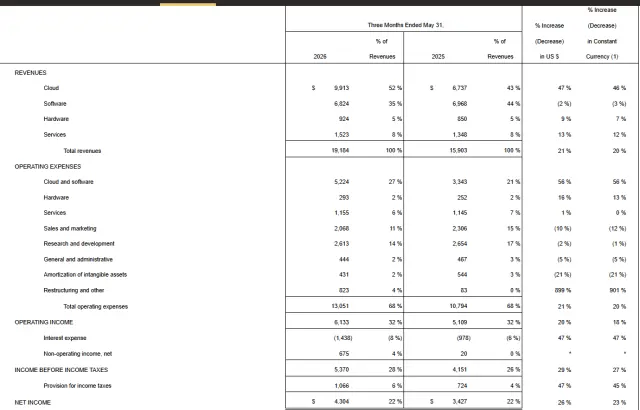
Oracle Q4 Financial Data

Operating profit was $6.1 billion, a 20% increase compared to $5.1 billion in the same period last year; on a non-GAAP basis, adjusted operating profit for Q4 was $8.6 billion, compared to $7.0 billion in the same period last year.

Operating margin was 32%, compared to 33% in the same period last year. On a non-GAAP basis, Oracle's Q4 operating margin was 45%, compared to 44% last year.

Net profit was $4.22 billion, a 23% increase compared to $3.43 billion last year. On a non-GAAP basis, net profit for Q4 was $6.2 billion, a 26% increase compared to $4.9 billion last year.

Diluted earnings per share were $1.45, a 21% increase compared to $1.19 per diluted share last year. On a non-GAAP basis, diluted earnings per share were $2.11, a 24% increase compared to $1.70 last year.

For the full year, Oracle's total revenue reached $67.4 billion, a 17% year-on-year increase, hitting a new historical high. Cloud business revenue for the full year was $34.0 billion, up 39%, while software revenue was $24.5 billion, down 1% year-on-year.
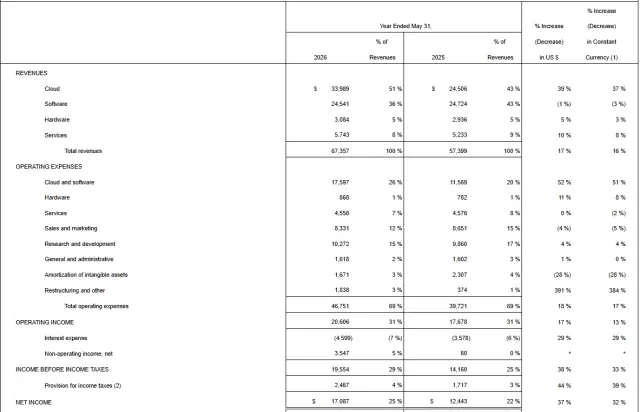
Oracle Full Year FY2026 Financial Data

Net profit for the year was $17.0 billion, a 36% increase. On a non-GAAP basis, net profit was $22.2 billion, up 29%. Earnings per share were $5.83, a 34% increase. On a non-GAAP basis, earnings per share were $7.63, a 27% increase.

Behind the record revenue, AI is pushing up Oracle's revenue ceiling, while also increasing its capital expenditure pressure.

Oracle's full-year operating cash flow for FY2026 was $32.0 billion, a year-on-year increase of 54%. Free cash flow was negative $23.7 billion, with capital expenditures of $55.7 billion.

Oracle also announced a quarterly dividend of $0.50 per share, payable on July 24, 2026, to shareholders of record at the close of business on July 10, 2026.

Following the earnings release, Oracle's stock fell by up to 5% in after-hours trading. Previously, Oracle's stock had risen by 3% year-to-date, underperforming the S&P 500 index, which gained 6% over the same period.

01 Cloud Business Now Constitutes Half of Oracle

Oracle's cloud business (IaaS plus SaaS) contributed $9.9 billion in revenue in the fourth quarter, a year-on-year increase of 47%, now accounting for half of the company's total revenue.

The true growth driver was the cloud infrastructure business (IaaS), with quarterly revenue of $5.8 billion, a year-on-year increase of 93%. This pace slightly exceeded market expectations of 91% and is considered top-tier within the entire cloud computing industry. The company's annual IaaS revenue reached $18.1 billion, growing by 77%.
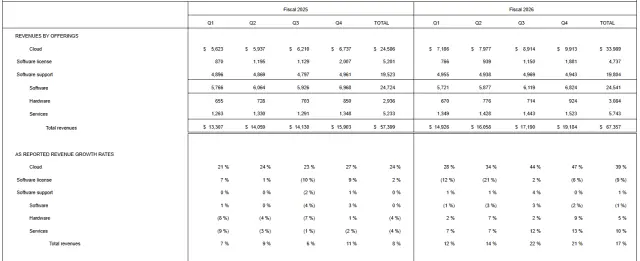
Financial Data for Oracle's Business Segments

In comparison, cloud application business (SaaS) revenue in Q4 was $4.1 billion, with a growth rate of 10%, steady but not spectacular.

Meanwhile, the traditional software licensing and support business continued to shrink, with quarterly revenue of $6.8 billion, a 2% year-on-year decline, indicating that the trend of customer migration to the cloud has not stopped. Service and hardware businesses grew by 13% and 9% respectively, but their smaller scale limits their impact on the company's overall trajectory.

Both database and application businesses benefited from Oracle's early adoption of AI. Oracle's multi-cloud AI database revenue grew 404% in Q4, with order volume up 325% year-on-year, becoming the company's fastest-growing business ever. This growth rate, from a product perspective, confirms that AI-related demand is not limited to the infrastructure layer but is also penetrating upstream data management layers.

In the earnings report, Oracle attributed the growth to broad market demand for its cloud technology and application suite. Judging from the changes in revenue structure, Oracle has largely completed its transformation from a database software company to a cloud infrastructure provider, with the computing demand driven by AI being the biggest force behind this shift.

02 The AI Bet Behind the $638 Billion Order Backlog

The most striking number in the report is the Remaining Performance Obligation (RPO), which is the total value of signed contracts not yet recognized as revenue.

As of the end of Q4, this number reached $638 billion, compared to $553 billion a quarter ago, meaning a net increase of $85 billion in three months, with a year-on-year increase of 363%. Wall Street analysts had previously forecasted this number to be around $590-$600 billion, with the actual data far exceeding expectations.

Analysts at Bank of America pointed out a key detail: over half of this $638 billion comes from OpenAI. This means Oracle's largest customer currently is an AI startup that itself is still burning significant cash.

Oracle explained the composition of these orders in its statement. Most of the new RPO comes from large-scale AI contracts, where either the customer prepays for GPU procurement, or the customer purchases GPUs themselves and hands them over to Oracle for deployment. The cumulative value of such contracts where customers bear the hardware cost currently stands at $75 billion. Oracle explained that this arrangement significantly reduces the funding pressure the company would face to build AI data centers itself.

This structure mitigates some of Oracle's financial risks. However, the issue is that if the largest customer itself faces funding pressure, or if overall AI industry demand fluctuates, the highly concentrated order structure itself becomes a risk point.

Reuters analysis suggests that the software industry is facing investor concerns that AI tools might replace traditional software products, which could potentially lure enterprise customers away from traditional software, posing an additional challenge for Oracle.

03 Behind the Massive Orders Lie Heavier Capital Expenditures

Supporting Oracle's $638 billion order backlog is a massive capital investment. Capital expenditures in Q4 were $15.9 billion, totaling $55.7 billion for the full year, significantly higher than Oracle's previous guidance of $50 billion.
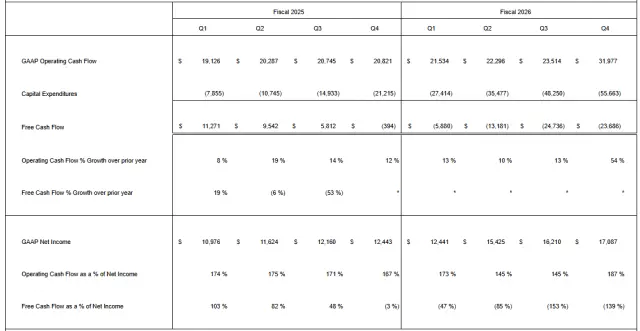
Oracle's Free Cash Flow Turned Negative $23.7 Billion

This directly led to a deterioration in free cash flow. Although full-year operating cash flow of $32.0 billion set a new record, after deducting capital expenditures, free cash flow turned negative $23.7 billion.

To fill the funding gap, Oracle raised $43.0 billion through debt financing and $5.0 billion through equity financing in FY2026.

The company also announced plans to raise another $40 billion in FY2027, including the previously disclosed $20 billion in equity financing. Oracle stated that it will not issue new debt in the second half of 2026, but this news did not stabilize market sentiment.

CNBC believes that previous financing moves have already raised investor concerns because of uncertainty about whether market demand for AI can absorb such massive new capital. When the company announced an increased fundraising plan again, these concerns intensified.

Reuters further analyzed that Oracle's performance may intensify investor concerns on two fronts: first, the potential for AI-driven disruption of traditional software demand, which could pull enterprise customers away from the traditional software space; second, the financial risk posed by the high level of debt on Oracle's balance sheet itself.

TD Cowen analyst Derrick Wood pointed out that Oracle's stock price rise prior to the earnings release might be due to investors being more optimistic about the prospects of computing service providers and OpenAI, Oracle's most important customer.

In other words, the market had already accumulated certain gains and optimistic expectations before the earnings release. When the new financing plans and higher-than-expected capital expenditures were made public, some investors chose to reassess risks or take profits, which amplified the stock price correction.

04 FY2027 Revenue Target: $90 Billion

Oracle provided clear expectations for the next phase of growth.

For the first quarter of FY2027, total revenue growth is expected to be between 27% and 29%, with adjusted earnings per share between $1.72 and $1.76. The midpoints of both these guidance figures are above analyst expectations. Additionally, cloud business revenue growth guidance is 57% to 63%, maintaining a high-growth trajectory.

For the entire FY2027, Oracle reiterated its $90 billion revenue target and raised its adjusted earnings per share guidance to $8.05.

The company clarified in its statement that this growth rate is calculated after excluding one-time items from FY2026, such as the sale of the Ampere chip business and Bloom Energy warrant. The actual year-on-year growth rate is about 18%. Analysts had previously expected earnings per share of $8.01 and revenue of $88.9 billion.

05 Focusing on AI Healthcare

Beyond cloud infrastructure and AI computing power orders, Oracle is attempting to extend its AI capabilities into more specific industry applications, with healthcare being one of its emphasized directions.

The Oracle Health application suite will launch an AI-based Cerner hospital and clinic patient care management system, and it is expected that this product will drive the overall growth rate of the health business to double digits in FY2027. Oracle emphasized in its statement that this is just the beginning of the health business expansion.

In its longer-term technological outlook, Oracle believes AI is about to revolutionize healthcare. The company outlined three specific directions: the Oracle Health AI system will reduce doctors' time facing computers, allowing more time for patients; AI molecular design models are expected to enable researchers to accelerate the development of life-saving drugs; a new AI clinical trial system aims to enable regulatory agencies to quickly review and approve clinical trial results, thereby allowing patients to access new drugs faster.

Oracle does not want to be just an AI computing power supplier; it also hopes to embed AI capabilities into specific processes such as medical software, drug R&D, and clinical trials. However, compared to cloud infrastructure orders, this part of the business is still in a much earlier stage, and whether it can truly translate into scaled revenue still requires time for validation.


İlgili Sorular

QOracle reported record-breaking revenue for the fiscal year, but why did its stock price fall?

AThe stock price fell primarily due to investor concerns over the significant capital expenditures required to support the massive AI cloud order backlog. This led to a negative free cash flow of -$23.7 billion for the year and substantial new debt and equity financing plans for the coming year.

QWhat is the main driver behind the surge in Oracle's remaining performance obligations (RPO) to $638 billion?

AThe surge in RPO to $638 billion is driven by large-scale AI contracts, with over half of this amount reportedly coming from its major customer, OpenAI. Many of these contracts involve customers prepaying for GPU procurement or providing their own GPUs for Oracle to deploy.

QWhich business segment has become the primary growth engine for Oracle, and what was its growth rate?

AOracle's cloud infrastructure business (IaaS) is the primary growth engine. In Q4, IaaS revenue grew by 93% year-over-year, reaching $5.8 billion. For the full year, IaaS revenue was $18.1 billion, up 77%.

QWhat is Oracle's revenue target for fiscal year 2027, and how does it compare to analyst expectations?

AOracle reiterated its revenue target of $90 billion for fiscal year 2027. This target is higher than the analyst expectation of $88.9 billion. The company also raised its adjusted EPS guidance for FY2027 to $8.05.

QBesides cloud infrastructure, what specific industry is Oracle targeting for its AI applications, and what are some of its goals?

AOracle is targeting the healthcare industry for its AI applications. Its goals include using AI to reduce administrative time for doctors, accelerate drug discovery through AI molecular design models, and speed up clinical trial reviews and drug approvals with new AI systems.

İlgili Okumalar

After Three Consecutive Quarters of Decline, Can the Crypto Market Find a Window for Stabilization in Q3?

The cryptocurrency market has just concluded its worst-performing quarter since 2022, with total capitalization dropping 12.6% to $2.1 trillion. All core metrics indicate capital is leaving the sector, not just rotating within it. Bitcoin fell 14.2% and Ethereum dropped 25.4% in Q2, breaking their previous correlation with US tech stocks. A key driver is the reversal in US spot Bitcoin ETF flows, which saw a net outflow of approximately $4.67 billion in Q2, including a record monthly outflow near $4.5 billion in June. While recent data suggests long-term holders are accumulating again, sustained ETF outflows mean continued selling pressure. Market focus is now singularly on the Federal Reserve. The upcoming July FOMC meeting is seen as the most critical event for Q3. A dovish signal could support Bitcoin reclaiming a $68,000-$84,000 range, while a hawkish stance might establish a new trading band around $50,000-$56,000. Additionally, regulatory uncertainty persists, with the progress of the crucial *CLARITY Act* stalling in the Senate, reducing its perceived 2026 passage probability to 40-45%. Despite the broad downturn, a few sectors showed growth. Prediction markets saw nominal volume surge 48.7% year-over-year to $113.8 billion, and tokenized collectibles transaction volume rose 143% quarterly to $1.4 billion. The Real-World Asset (RWA) tokenization sector also continued steady growth, now representing ~$28.1 billion in on-chain value. The market's foundation for an extreme crash appears limited, with Bitcoin price hovering near its 200-week moving average. However, the trading paradigm has shifted from narrative-driven speculation to decisions based on price action, policy developments, and interest rate expectations, making a broad sentiment-driven rally unlikely in the near term.

marsbit2 saat önce

After Three Consecutive Quarters of Decline, Can the Crypto Market Find a Window for Stabilization in Q3?

marsbit2 saat önce

BIT Trading Moment: BTC Still Suppressed by Weekly 200 EMA, Rejection May Restart Decline; Storage and Semiconductors that Surged Last Night Begin Falling in Evening Trading

**Crypto & Stock Market Wrap: Bitcoin Tests Resistance, Stocks Retreat After AI Surge** Bitcoin consolidates around $66,000, facing key resistance near $68,000—an area seen as a major psychological and technical hurdle where previous rallies have failed. Analysts note the cryptocurrency is caught between its 200-week moving average (~$63,333) and 200-week EMA (~$68,328). A clear break above $68k is needed to signal a stronger bullish trend, while a rejection could lead to a retest of $63k support. Market sentiment remains cautious, with low futures open interest pointing to a low-liquidity rebound rather than a full bull market. Bitcoin spot ETFs saw another $203 million inflow. US stock futures pointed lower after a strong Tuesday session led by a massive rebound in semiconductors and memory stocks. The rally was fueled by renewed optimism about AI-driven hardware demand, with Micron, SanDisk, and SK Hynix surging. However, those gains reversed in pre-market trading. Super Micro Computer (SMCI) soared over 20% after hours on strong guidance and a record backlog. Other standouts included Rocket Lab and nuclear energy plays Oklo and X-Energy. Rising oil prices (Brent above $91) and climbing Treasury yields (10-year near 4.64%), however, are reigniting inflation concerns and acting as a headwind for equities. In Asia, markets were mixed. South Korea's KOSPI pared early gains to close slightly higher as semiconductor stocks like SK Hynix gave back initial surges. Japan's Nikkei edged lower as the yen hit a fresh 38-year low against the dollar, raising fears of potential market intervention. Key events to watch include the Samsung Galaxy launch, AMD's AI event, and a slew of major tech earnings from Alphabet, Tesla, and IBM after the close on Wednesday, followed by the ECB meeting and Intel's earnings on Thursday.

marsbit2 saat önce

BIT Trading Moment: BTC Still Suppressed by Weekly 200 EMA, Rejection May Restart Decline; Storage and Semiconductors that Surged Last Night Begin Falling in Evening Trading

marsbit2 saat önce

Former CFTC Chairman, Circle President Tarbert: Preaching Long-Termism While Cashing Out $30 Million Himself

Former CFTC Chairman and Circle President Heath Tarbert has consistently advocated for a long-term vision in public, urging patience from investors as Circle’s stock price has fallen significantly from its peak. However, it has been revealed that since Circle’s IPO, Tarbert has continuously sold his CRCL shares through pre-arranged trading plans, cashing out approximately $30 million, without making any public market purchases. This contrast between his public messaging and personal actions has drawn criticism. Tarbert joined Circle in July 2023 as Chief Legal Officer, leveraging his regulatory experience to help guide the company through its IPO and expansion. Despite promoting stablecoins as long-term infrastructure, he established a 10b5-1 trading plan just before Circle went public, leading to substantial stock sales over the following year. In March 2026, he initiated another plan to sell more shares. His career trajectory highlights a pattern of moving between high-level regulatory roles and influential positions in the financial sector. After resigning as CFTC Chairman in early 2021, he joined Citadel Securities as Chief Legal Officer just 27 days later, during a period of intense regulatory scrutiny for the firm. He later joined Circle, aiding its efforts to navigate regulatory challenges for its public listing. While Tarbert's expertise in policy and compliance is valuable to companies like Circle, his actions—advocating long-term confidence while personally divesting—raise questions about the alignment between his public statements and his private financial decisions, leaving investors who followed his advice to bear the market risks.

marsbit3 saat önce

Former CFTC Chairman, Circle President Tarbert: Preaching Long-Termism While Cashing Out $30 Million Himself

marsbit3 saat önce

Gate Research Institute: The 'Wall Street-ization' Wave of Crypto Financial Products – Competition or Integration?

The article titled "Gate Research Institute: Are Crypto Financial Products Sparking a 'Wall Street' Wave—Competition or Convergence?" explores the evolving relationship between the crypto ecosystem and traditional finance (TradFi). The piece begins by reflecting on Bitcoin's original 2009 vision of decentralization, disintermediation, and moving away from banks. It then contrasts this with the 2024 landscape, where key crypto assets like Bitcoin are increasingly held through Wall Street products like ETFs issued by giants like BlackRock. The article questions whether this signifies that TradFi is systematically taking over the rights to issue, price, custody, and distribute crypto financial assets. The core argument is that this is not a zero-sum takeover but rather a bidirectional convergence where each side addresses the other's weaknesses. Crypto offers 24/7 global markets, programmable settlement, and open access but lacks compliant channels, institutional-grade custody, deep fiat liquidity, and mainstream distribution. TradFi possesses these but is constrained by legacy systems, limited operating hours, and slow settlement. Two primary convergence paths are highlighted: * **Path A (CEX to TradFi):** Exemplified by Gate, which has progressed from offering tokenized stocks and CFDs to providing direct, real stock trading (US, Hong Kong, South Korea) within its platform, using USDT. * **Path B (TradFi to Crypto):** Exemplified by Robinhood, which has integrated crypto trading, acquired exchanges like Bitstamp, and is moving traditional assets like stocks onto the blockchain via tokenization and its own Layer 2. Both paths are ultimately competing to become the next-generation, unified financial account—a "super account" where users can seamlessly trade cryptocurrencies, stocks, ETFs, RWA (Real World Assets), and tokenized treasury products in one interface. The growth of RWA and tokenized treasuries (e.g., BlackRock's BUIDL) is presented as the asset-layer fusion, providing stable, yield-bearing assets on-chain and acting as a bridge between the two worlds. In conclusion, the "Wall Street-ization" of crypto is framed as a mutual transformation. Decentralized ideals persist in the protocol layer, while at the application layer, a more efficient, global, and accessible unified capital market is emerging from this convergence. The future competition lies not between crypto exchanges and stockbrokers, but between platforms vying to offer the most comprehensive asset coverage, liquidity, and user experience within a single account.

marsbit3 saat önce

Gate Research Institute: The 'Wall Street-ization' Wave of Crypto Financial Products – Competition or Integration?

marsbit3 saat önce

İşlemler

Spot
活动图片




