Opinion: Most Tokenized Assets Are Still Traditional Finance Wrapped On-Chain

marsbit2026-05-25 tarihinde yayınlandı2026-05-25 tarihinde güncellendi

Özet

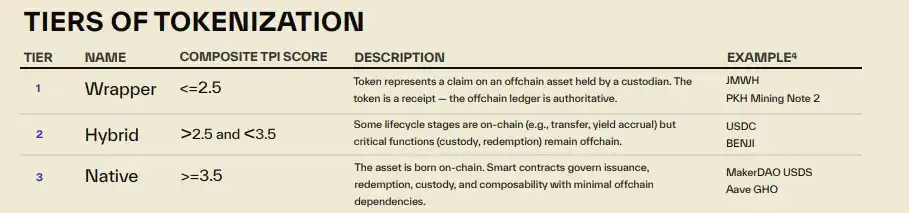
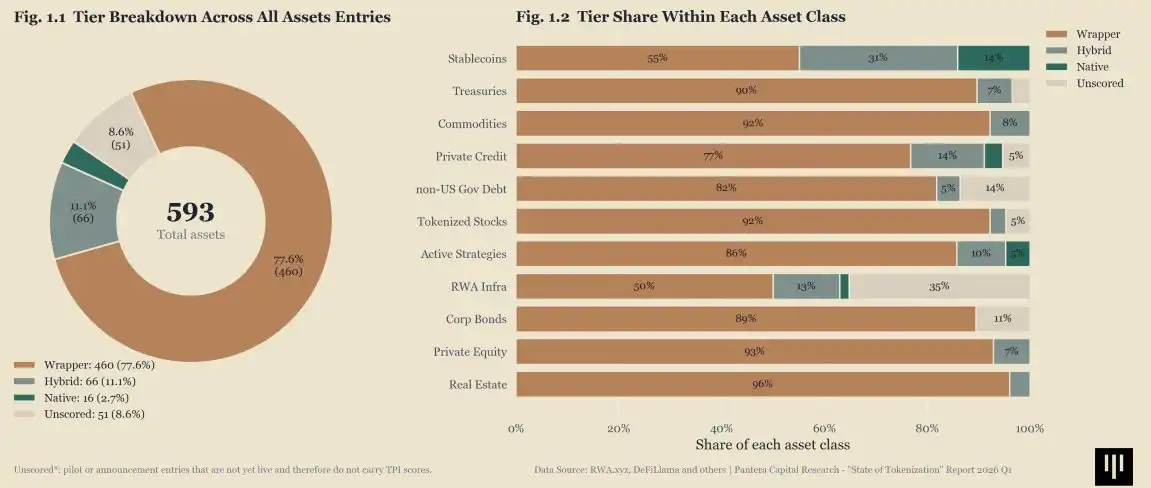
**Summary:** A market analysis reveals that the vast majority of tokenized assets remain mere "wrappers" for traditional finance on-chain. Of 593 surveyed assets, 77.6% are "Wrapped" assets where the token exists on-chain but key lifecycle functions (issuance, redemption, custody, access) remain off-chain. Only 11.1% are "Hybrid" assets, where some operational logic (transfers, settlement, yield accrual) is migrating on-chain, representing the true beginning of transformation. A mere 2.7% are "Native" assets built with a fully on-chain operational model. This explains why stablecoins feel structurally advanced compared to other RWA—they are true on-chain financial primitives, not just digitized traditional processes. The key future distinction won't be between tokenized and non-tokenized assets, but between those that are merely distributed on-chain and those that begin to *operate* on-chain.

Author: Yaroslav Writtle

Compiled by: Deep Tide TechFlow

Deep Tide Guide: The RWA sector has been discussed for so long, yet 77.6% of tokenized assets are still just "on-chain wrapping paper" — the token is on-chain, but issuance, redemption, and custody are entirely off-chain. What's truly worth attention are the 11.1% of "hybrid" assets, which are moving part of their lifecycle on-chain. This explains why stablecoins feel far ahead of other RWAs: they are genuine on-chain financial primitives, not just digital shells for traditional processes.

Market Size Growing Faster Than Market Maturity

An effective way to understand this market is not to look at whether it's tokenized or not.

Instead, look at:

  • Wrapped
  • Hybrid
  • Native

A 2026 market survey covering 593 tokenized assets showed that 460 assets, or 77.6%, were still classified as wrapped. Only 66 assets, or 11.1%, were hybrid, and a mere 16 assets, or 2.7%, had reached a native state.

This is the true shape of the market.

Wrapped Remains the Default Form
Most tokenized assets improve distribution, not infrastructure.

The token exists on-chain.

Most of its lifecycle does not.

Issuance, redemption, custody, transfer permissions, pricing, and investor access still heavily rely on off-chain systems.

So surface growth may be real, but on-chain autonomy remains low.

Hybrid Is Where Real Transformation Begins

Hybrid is the part of the market worth watching.

This is where certain parts of the lifecycle begin migrating on-chain:

  • Transfer logic
  • Settlement processes
  • Yield accrual
  • Partial compliance or access controls

Not fully native.

But no longer just wrapping paper.

This middle category is still small, which is why the market feels like it's moving faster than it actually is.

Native Is Rare for a Reason

Native assets are rare because the bar is high.

To reach that level, it's not just about the token being on-chain.

The operating model must also be on-chain.

This includes:

  • Issuance and redemption
  • Transfer execution
  • Custody assumptions
  • Composability with other systems

Very few assets truly meet this standard today.

Stablecoins Still Feel Ahead of Other Assets

This also helps explain why stablecoins still feel structurally ahead of most RWAs.
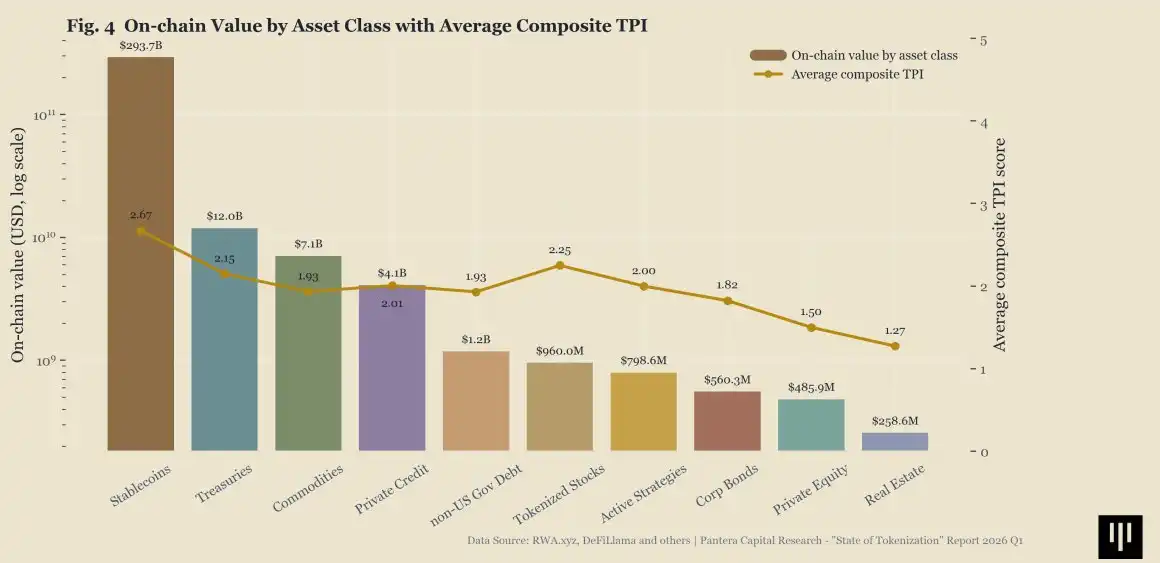
They are closer to being true on-chain financial primitives.

Many other tokenized assets still resemble digital wrapping paper for traditional processes, rather than assets that genuinely operate within an on-chain financial system.

What Matters Next

The market doesn't need more proof that assets can be tokenized.

A more useful question now is: which parts of the lifecycle have truly migrated along with it?

This is where the next round of differentiation will occur.

Not between tokenized and non-tokenized.

But between assets that are still distributed on-chain, and assets that are beginning to operate on-chain.

İlgili Sorular

QAccording to the article, what percentage of tokenized assets are considered 'wrapped' and what does this category mean?

A77.6% of tokenized assets are considered 'wrapped'. This means the token exists on-chain, but key lifecycle functions like issuance, redemption, custody, transfer permissions, pricing, and investor access remain heavily dependent on off-chain systems.

QWhat is the 'hybrid' category of tokenized assets, and why does the article suggest it's the important one to watch?

AThe 'hybrid' category refers to assets where some parts of their lifecycle, like transfer logic, settlement, yield accrual, or compliance controls, are beginning to move on-chain. The article suggests this is the important category because it represents the real start of infrastructure transformation, moving beyond just being a digital wrapper for traditional processes.

QWhy are truly 'native' on-chain assets still so rare according to the analysis?

ATruly 'native' on-chain assets are rare because the bar is very high. It requires not just the token to be on-chain, but the entire operational model—including issuance, redemption, transfer execution, custody assumptions, and composability with other systems—to be fundamentally built on-chain.

QHow does the article explain the perceived structural lead of stablecoins over most other Real World Assets (RWAs)?

AThe article explains that stablecoins feel structurally ahead because they are closer to being genuine on-chain financial primitives. In contrast, many other tokenized RWAs still resemble digital wrappers for traditional financial processes, not assets operating within an on-chain financial system.

QWhat does the article propose as the key question for the next phase of development in tokenized assets?

AThe article proposes that the key question is no longer whether assets can be put on-chain, but which parts of their lifecycle are genuinely migrating on-chain. The next phase of differentiation will occur between assets that are merely distributed on-chain and those that are beginning to operate on-chain.

İlgili Okumalar

STRC Breaks Below $95: Why Does It Continue to Depeg? Is There Default Risk?

"STRC Falls Below $95: Why the Persistent Depegging and Is There Default Risk?" The article discusses the recent decline in the price of STRC, a perpetual preferred stock issued by Strategy (MSTR) designed to trade around a $100 par value. As of publication, STRC traded at $94.65, raising market concerns. STRC is described as a high-yield cash flow product, offering an 11.50% annual dividend paid monthly. Its "preferred" status grants it priority over common stock for dividends and in liquidation. Key reasons cited for the price depegging include: 1. **Bitcoin's Price Drop:** MSTR's assets are heavily tied to Bitcoin (BTC), which fell over 21% from its recent high, pressuring all Strategy-related products. 2. **Competitive Pressure:** Rival Strive Asset Management's similar product, SATA, offers daily dividends and has maintained its $100 par value with a ~13% yield. In response, Strategy has proposed changing STRC's dividend frequency from monthly to bi-weekly, pending shareholder vote. 3. **Technical Selling:** A break below $100 may have triggered algorithmic selling and stop-losses, exacerbating the decline. Regarding default risk, the analysis suggests it is currently low. Strategy founder Michael Saylor confirmed the June 2026 dividend rate remains at 11.50% with no cuts or suspensions. The company's massive reserve of 843,706 BTC provides a significant backstop for its obligations. Industry opinions are mixed. Some analysts view the BTC holdings as reliable support for dividends, while critics like Peter Schiff warn of potential dividend cuts leading to price crashes and lawsuits. Others highlight inflation risk and the company's ability to reduce dividends without a formal default. In summary, STRC's drop is attributed to BTC volatility, competition, and technical factors. While immediate default risk appears contained, the product faces challenges from market conditions and competitive dynamics.

marsbit1 saat önce

STRC Breaks Below $95: Why Does It Continue to Depeg? Is There Default Risk?

marsbit1 saat önce

AI Trading Cools, South Korean Stocks Plunge 1.8%, Spot Gold Rises 1%, Bitcoin Dives

A sell-off in AI-related stocks, triggered by Broadcom's disappointing earnings forecast, sent shockwaves through global markets. South Korea's KOSPI led Asia's decline, plunging 1.8% as the risks from concentrated chip stock gains and surging leveraged investments came to the fore. The tech-heavy Nasdaq 100 futures fell 0.5% following Broadcom's 14% after-hours plunge, which signaled a slower-than-expected transition to AI clients. This pullback extended Wall Street's weakness, halting the S&P 500's nine-day rally amid hawkish Fed signals and renewed Middle East tensions. South Korean authorities convened an emergency meeting, pledging "immediate measures" against market volatility and warning of record-high stock margin debt. The adjustment rippled across assets: Bitcoin fell to around $64,000, its lowest since February, while safe-haven gold rose 1% on bargain hunting. Oil prices dipped on Middle East ceasefire news. Market analysts noted the sell-off was driven by profit-taking after massive gains, particularly in chip stocks like Samsung and SK Hynix, which now dominate the KOSPI. Wall Street banks are divided on Korea's outlook, with Goldman Sachs raising its target while Citigroup and others warn of overvaluation and a potential bubble. Bridgewater's Ray Dalio noted that great technological shifts often create bubbles. Meanwhile, Fed officials' hints at potential future rate hikes added to the cautious mood ahead of key U.S. jobs data.

华尔街日报1 saat önce

AI Trading Cools, South Korean Stocks Plunge 1.8%, Spot Gold Rises 1%, Bitcoin Dives

华尔街日报1 saat önce

İşlemler

Spot
Futures
活动图片