OpenSea Launches ERC-8257: A Tool Store for AI Agents, Unlock APIs by Buying an NFT

marsbit2026-05-27 tarihinde yayınlandı2026-05-27 tarihinde güncellendi

Özet

OpenSea has merged the ERC-8257 standard, an on-chain "Agent Tool Registry" that enables AI Agents to autonomously discover, pay for, and access tools. This standard allows developers to publish tools with programmable access rules (e.g., NFT ownership, subscriptions) and pricing directly on-chain. For example, an AI Agent needing a premium API can buy the required NFT itself and gain access without human intervention, turning NFTs into keys for the agent economy. The system works with complementary standards like ERC-8004 for agent identity and x402 for payments. A live demo shows an NFT appraisal tool offering discounted rates to holders of a specific NFT collection. ERC-8257 aims to decentralize tool distribution and access control, allowing any on-chain asset to grant utility to AI agents. The SDK is available for building on Ethereum and Base.

Author: OpenSea

Compiled by: TechFlow

TechFlow Introduction: When an AI Agent is denied by an API due to insufficient permissions, it goes and buys an NFT on-chain, then retries and succeeds — this is not science fiction; OpenSea's newly merged ERC-8257 standard makes this a reality. For NFT holders, the JPGs you own might suddenly become keys to the Agent economy. For developers, tool publishing, pricing, and access control are all placed on-chain, no longer requiring endorsement from centralized platforms.

App Store provides developers with a place to publish tools, users with a place to browse, and built-in access control and payment. The AI Agent tool ecosystem requires similar infrastructure.

But today, Agent tools are scattered across documentation, GitHub repositories, and centralized directories. There is no open tool registry, no standardized access control, and Agents cannot browse available tools and acquire them as needed.

Watching a software pay another software autonomously for access, with no human intervention — it feels a bit strange indeed. But that's precisely the point.

ERC-8257: Agent Tool Registry is the foundational layer that makes all this work. This is the newly merged open Ethereum standard: an on-chain registry where anyone can publish tools, declare access rules and pricing, allowing Agents to autonomously meet these requirements.

For Tool Developers: Publish once, set access thresholds for your NFT holders, offer subscription packages, limit seat counts, let them trade in open markets. Your rules, executed on-chain.

For Agents: Browse the registry, see what's required, then handle it. Purchase an NFT, mint a subscription, sign a payment. No human intervention needed.

Imagine This Scenario

An AI Agent is helping you evaluate NFT prices. It tries to call a professional pricing tool. The tool responds: Access denied, you need to hold a specific NFT for a discounted price. The Agent immediately buys one on-chain, retries, and gets the answer.

Seconds, not days. No human involvement throughout.

This is the world ERC-8257 makes possible. Not five years from now. Today.

Why On-Chain?

Crypto is the only infrastructure that allows access rules to be both rich and self-service. x402 proved it: pay-per-call, immediate access. But pay-per-call is just one form of access. Trading signals might need limited seats. Partner APIs might be open only to holders. Research subscriptions might require tiered pricing. ERC-8257 handles it all.

How It Works

You register a tool with a manifest (tool functions, invocation methods, fees) and an "access predicate." The access predicate is a smart contract that answers one question: Does this address have access?

A predicate can check any condition: NFT ownership, active subscription (ERC-5643), whitelist, ZK proof, DAO vote, staking amount. Predicates are pluggable, following the same pattern as Seaport zones and Uniswap v4 hooks: an extension point, an open design space.

ERC-8257 handles discovery and access control. Payment is handled by the most suitable protocol: x402 for micropayments, MPP for metered billing, others join as needed. These layers are composable.

What This Means for NFTs

Every NFT collection just gained new potential utility.

Hold the right token, and your Agent gets cheaper API packages. Mint a limited seat, and your Agent gains access that others can't buy at any price. PFP collections, membership passes, CC0 artwork — any on-chain asset can become a key to tools your Agent needs to do its job.

Projects built around community identity now have a way to extend membership into the Agent economy.

Its Place in the Tech Stack
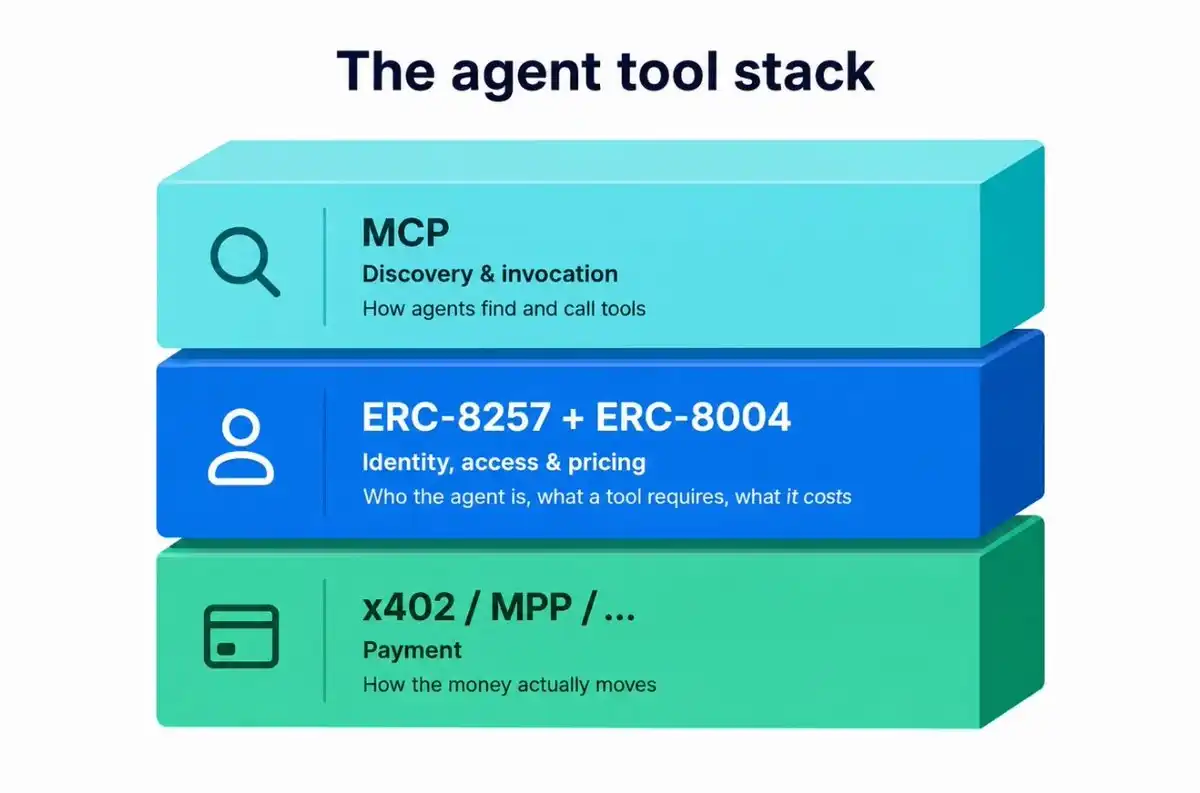
MCP tells your Agent what tools exist. ERC-8004 defines your Agent's identity. ERC-8257 explains how to actually use a tool. x402 handles payment. Each layer is composable.

An Agent registered via ERC-8004 can link to restricted tools from the ERC-8257 registry in its services array. You don't need to choose between them. They are different layers of the same tech stack.

See It in Action

nft-appraisal-tool: Point it to any NFT, it returns a price appraisal including low/mid/high ranges, confidence, recent trades, and comparable cases. Two tiers: 0.05 USD/call for anyone, 0.01 USD/call for CHONK holders on Base.

An Agent without CHONK calls the holder endpoint. Response: 403 — predicate gate denied. You need CHONK on Base.

The Agent buys one, retries, and the same call returns success.

$ npx @opensea/tool-sdk pay https://nft-appraisal-tool.vercel.app/api/holder --auth siwe \

--body '{"chain":"ethereum","contractAddress":"0x79fcdef22feed20eddacbb2587640e45491b757f","tokenId":"4707"}'

Wallet: 0x3184...0465

Response (403):

{"error":"Predicate gate: access predicate denied","toolId":"2","predicate":"0xc872..."}

The predicate explicitly tells it what's needed: CHONK on Base. The Agent buys one on OpenSea and retries, the call goes through.

$ npx @opensea/tool-sdk pay https://nft-appraisal-tool.vercel.app/api/holder --auth siwe \
--body '{"chain":"ethereum","contractAddress":"0x79fcdef22feed20eddacbb2587640e45491b757f","tokenId":"4707"}'
Wallet: 0x5eca...e2a8

Response (200):
{
"low": {"amount": "1.8", "currency": "ETH", "usd": 5460},
"mid": {"amount": "2.3", "currency": "ETH", "usd": 6970},
"high": {"amount": "3.1", "currency": "ETH", "usd": 9400},
"confidence": "medium",
"reasoning": "Comparable Squiggles in this color band sold between 1.9 and 2.6 ETH...",
...
}

No human between the 403 and the 200. Whoever holds the access NFT has the access.

What Can Be Built Next?

Professional pricing oracles. On-chain analytics subscriptions. Research subscriptions. Partner whitelist APIs. Limited-seat tools traded in open markets like any other asset.

None of these needed to exist a year ago. The moment the registry goes live, they all become possible.

Start Building

Live on Ethereum and Base.

@opensea/tool-sdk handles the low-level details, providing scaffolding, gating, registration, deployment to Vercel, Cloudflare, or Express. Includes usable examples.

npx @opensea/tool-sdk init my-tool

Full specification at 8257.ai.

Get Involved

ERC-8257 is still in draft. Help us improve the spec before we launch Registry 1.0. Publish a tool, even a small one. We'll promote interesting projects.

Join the Telegram group t.me/ERC8257 to discuss ERC, tool SDK, and more with the authors @CodinCowboy and @ralxz.

Disclaimer: This content is for informational purposes only and does not constitute financial or trading advice. Mention of specific projects, products, services, or tokens does not constitute endorsement, sponsorship, or recommendation by OpenSea. OpenSea does not guarantee the accuracy or completeness of the information presented, and readers should independently verify any statements before taking action. Readers should conduct their own due diligence and assume full responsibility for any decisions made.

İlgili Sorular

QWhat is the main purpose of ERC-8257 introduced by OpenSea?

AThe main purpose of ERC-8257 is to serve as an on-chain registry for AI agent tools. It allows developers to publish tools, set access rules (like requiring a specific NFT for access), define pricing, and manage subscriptions. This enables AI agents to autonomously discover, pay for, and use these tools without human intervention.

QHow does an AI agent gain access to a restricted tool according to the article's example?

AIn the article's example, an AI agent is initially denied access (403 error) to an NFT appraisal tool because it lacks the required CHONK NFT on Base. The agent autonomously purchases the necessary NFT on-chain and retries the request. With the NFT now in its possession, the access predicate grants permission, and the tool call succeeds (200 response), providing the price assessment.

QWhat is an 'access predicate' in the context of ERC-8257?

AAn 'access predicate' in ERC-8257 is a smart contract that defines the conditions for accessing a tool. Its sole function is to answer the question: 'Does this address have access?' It can check for various conditions such as NFT ownership, active subscriptions (e.g., ERC-5643), inclusion in a whitelist, ZK proofs, DAO votes, or staking amounts, making the access control system flexible and pluggable.

QHow does ERC-8257 potentially change the utility of existing NFTs?

AERC-8257 gives existing NFT collections new potential utility by allowing them to act as keys or passes for AI agent tool access. Holding a specific NFT could grant an agent discounted API rates, exclusive tool access, or membership privileges. This extends the value of PFP collections, membership passes, and other on-chain assets into the emerging agent economy.

QWhat role does the x402 protocol play in the ERC-8257 ecosystem?

AThe x402 protocol handles the payment layer within the ERC-8257 ecosystem. It is designed for micro-payments, enabling per-use, immediate payment for tool access. While ERC-8257 manages tool discovery and access control, x402 (alongside other protocols like MPP for metered billing) provides the financial infrastructure for agents to autonomously pay for the services they consume.

İlgili Okumalar

Samsung Relies on Technology Cycles, SK Hynix on HBM, How Did Micron Win a Trillion-Dollar Market Cap?

Micron Technology, the third-largest memory chip maker alongside Samsung and SK Hynix, recently saw its market cap surpass $1 trillion. Founded in 1978 in Boise, Idaho, Micron survived brutal industry cycles while American peers and Japan's memory sector faltered. Its survival is attributed to a dual strategy: leveraging political and legal avenues for critical breathing room, coupled with relentless manufacturing cost control. Historically, Micron sought U.S. government intervention three times. In 1985, it filed an anti-dumping complaint against Japanese firms, leading to the U.S.-Japan Semiconductor Agreement. Ironically, this created an opening for Samsung, which later became its toughest competitor. In 2002, Micron turned "whistleblower" in a DRAM price-fixing investigation, escaping penalties while rivals were fined. In 2017, it sued China's Fujian Jinhua, contributing to its placement on a U.S. entity list, stifling a nascent competitor. However, a major strategic misstep occurred in 2013 with the acquisition of bankrupt Japanese firm Elpida. Integrating Elpida's mobile-DRAM-focused technology diverted resources, causing Micron to miss the critical early decade of development for High Bandwidth Memory (HBM)—the high-performance memory essential for AI chips like NVIDIA GPUs. By the time AI demand exploded in 2022, SK Hynix, which launched the first HBM in 2013, held about 85% of the HBM3 market, leaving Micron with roughly 3%. Micron now faces a triple squeeze. In the high-end HBM market, it lags significantly behind SK Hynix and Samsung. In the mid-to-low end DRAM market, it faces aggressive price competition from China's CXMT. Furthermore, a 2023 Chinese cybersecurity ban on its products slashed its revenue from China, a once-core market, from over 10% to just 7.1% by FY2025, causing it to exit China's data center server business. Beneath its political maneuvering lies Micron's core strength: exceptional manufacturing efficiency and cost control. Decades of engineering have yielded DRAM chips with a smaller cell area than rivals, meaning more chips per wafer and lower unit costs. This efficiency, not subsidies, has allowed it to withstand price wars. While political leverage bought time, Micron is now paying a "time debt" in the HBM race. It is racing to ramp up HBM3E production and develop HBM4, but catching up to competitors who started a decade earlier is a monumental challenge. Its future hinges on whether its expertise in cost control and political strategy can compensate for the lost time in a technology race where early-mover advantage is decisive.

链捕手23 dk önce

Samsung Relies on Technology Cycles, SK Hynix on HBM, How Did Micron Win a Trillion-Dollar Market Cap?

链捕手23 dk önce

New AMD Paper Overturns Conventional Wisdom: FP4 Training Instability's Cause Is Not Insufficient Randomness

AMD's new research challenges the conventional understanding of FP4 training instability. While reducing precision from FP8 to FP4 promises doubled computational throughput and is supported by new hardware like NVIDIA Blackwell and AMD MI350 series, training large language models natively with FP4 has been notoriously unstable, often attributed to insufficient stochasticity. The paper "Pretraining large language models with MXFP4 on Native FP4 Hardware" demonstrates successful end-to-end FP4 pre-training of Llama 3.1-8B on AMD MI355X GPUs using the MXFP4 format, achieving a 9-10% overall speedup over FP8. Crucially, it identifies the root cause of instability: not randomness, but the accumulation of *structural micro-scaling errors* along the sensitive weight gradient (Wgrad) path. Through controlled experiments, researchers found that quantizing the Wgrad operation to FP4 caused significant convergence degradation. Counterintuitively, common stochasticity-based mitigation techniques like stochastic rounding and randomized Hadamard transforms worsened performance. In contrast, applying a *deterministic* Hadamard transform successfully stabilized training by ensuring consistent error patterns, reducing the extra token cost from 26-27% to just 8-9%. This work has significant implications: 1) It provides a clear diagnostic for low-precision training instability, steering focus towards structural errors. 2) It pushes FP4 from a primarily inference-focused format into the realm of viable training. 3) It leverages the open OCP Microscaling (MX) standard, promoting cross-vendor compatibility. The research marks a critical step towards more economical large model training by further pushing the boundaries of low-precision computation.

marsbit43 dk önce

New AMD Paper Overturns Conventional Wisdom: FP4 Training Instability's Cause Is Not Insufficient Randomness

marsbit43 dk önce

Will ONDO's 'Tokenization Narrative' Change After Its CEO's Unexpected Passing?

Ondo Finance founder and CEO Nathan Allman has passed away unexpectedly. Allman, a Brown University graduate with a background in private credit and Goldman Sachs' digital asset team, was a key architect of Ondo's pivot from DeFi structured yield products to becoming a leading Real-World Asset (RWA) protocol. He drove the strategy to tokenize traditional financial assets like US Treasuries (OUSG), yield-generating dollar assets (USDY), and US stocks/ETFs (Ondo Global Markets) for on-chain accessibility. The company announced that President Ian De Bode, a former McKinsey partner with a strong institutional strategy and operations background, will succeed Allman as CEO. While Allman's sudden departure presents a near-term challenge, testing market confidence and Ondo's continuity, the project is seen as more than a founder-driven narrative. It has an established product suite and a management team with deep traditional finance experience. The long-term impact hinges on the new leadership's ability to execute. De Bode's expertise in compliance, distribution, and institutional partnerships aligns with RWA's next phase of scaling infrastructure. The core question is whether Ondo can maintain its product momentum and institutional relationships. Ondo's native ONDO token represents governance and RWA narrative value, not direct revenue from the underlying assets. Its future as a "top tokenization play" will depend on the team's continued delivery of product growth, asset scale, and real-world demand, moving beyond the initial emotional shock.

marsbit1 saat önce

Will ONDO's 'Tokenization Narrative' Change After Its CEO's Unexpected Passing?

marsbit1 saat önce

Bankless Co-founder's Confession on Selling Off ETH: Ethereum Did the Right Thing, but 'ETH as Money' Has No Future

Bankless co-founder David Hoffman recently sold his remaining ETH holdings, sparking debate within the Ethereum community. In a detailed explanation, Hoffman clarifies that his decision was not based on bearish sentiment towards Ethereum itself, which he remains highly optimistic about, but rather on the conclusion that the "ETH is Money" narrative has largely run its course. Hoffman argues that for ETH to achieve its envisioned status as global money, Ethereum needed to execute flawlessly across multiple layers—governance, technology, and market dominance—in a highly coordinated manner. He acknowledges Ethereum's significant successes and current justified valuation but suggests the window for a major revaluation based on this monetary narrative is closing. The post examines several challenges: the strong correlation between L1 chain activity/fees and native token value; the perceived failure of the "strong version" of crypto (user-owned, egalitarian systems) versus the rise of a "weak version" (efficient ledger technology for traditional finance); and the possibility that ETH's momentum as money was uniquely tied to the distorted conditions of the 2020-2021 period. Crucially, Hoffman highlights a structural tension: Ethereum is architected as a "giver, not a taker," providing critical infrastructure like secure block space and tokenization at cost. This ethos benefits the broader ecosystem (applications, L2s) but doesn't prioritize extracting maximum value for ETH itself. The "ETH is Money" thesis required Ethereum to win a war of overwhelming market dominance—a war its design philosophy refuses to explicitly fight. Therefore, while he sees continued immense success for the Ethereum network and its ecosystem (following a "fat application" theory where value accrues to apps and L2s), Hoffman finds it increasingly difficult to foresee a structural upward revaluation for the ETH asset based on the monetary narrative. His capital reallocation reflects a belief that this particular investment thesis has played out.

Odaily星球日报1 saat önce

Bankless Co-founder's Confession on Selling Off ETH: Ethereum Did the Right Thing, but 'ETH as Money' Has No Future

Odaily星球日报1 saat önce

İşlemler

Spot
Futures

Popüler Makaleler

NFT Nasıl Satın Alınır

HTX.com’a hoş geldiniz! APENFT (NFT) satın alma işlemlerini basit ve kullanışlı bir hâle getirdik. Adım adım açıkladığımız rehberimizi takip ederek kripto yolculuğunuza başlayın. 1. Adım: HTX Hesabınızı OluşturunHTX'te ücretsiz bir hesap açmak için e-posta adresinizi veya telefon numaranızı kullanın. Sorunsuzca kaydolun ve tüm özelliklerin kilidini açın. Hesabımı Aç2. Adım: Kripto Satın Al Bölümüne Gidin ve Ödeme Yönteminizi SeçinKredi/Banka Kartı: Visa veya Mastercard'ınızı kullanarak anında APENFT (NFT) satın alın.Bakiye: Sorunsuz bir şekilde işlem yapmak için HTX hesap bakiyenizdeki fonları kullanın.Üçüncü Taraflar: Kullanımı kolaylaştırmak için Google Pay ve Apple Pay gibi popüler ödeme yöntemlerini ekledik.P2P: HTX'teki diğer kullanıcılarla doğrudan işlem yapın.Borsa Dışı (OTC): Yatırımcılar için kişiye özel hizmetler ve rekabetçi döviz kurları sunuyoruz.3. Adım: APENFT (NFT) Varlıklarınızı SaklayınAPENFT (NFT) satın aldıktan sonra HTX hesabınızda saklayın. Alternatif olarak, blok zinciri transferi yoluyla başka bir yere gönderebilir veya diğer kripto para birimlerini takas etmek için kullanabilirsiniz.4. Adım: APENFT (NFT) Varlıklarınızla İşlem YapınHTX'in spot piyasasında APENFT (NFT) ile kolayca işlemler yapın.Hesabınıza erişin, işlem çiftinizi seçin, işlemlerinizi gerçekleştirin ve gerçek zamanlı olarak izleyin. Hem yeni başlayanlar hem de deneyimli yatırımcılar için kullanıcı dostu bir deneyim sunuyoruz.

416 Toplam GörüntülenmeYayınlanma 2024.12.10Güncellenme 2025.03.21

NFT Nasıl Satın Alınır

AINFT Nedir

EternaFi Ajanları ve $AINFT: Web3 Ekosisteminde AI Destekli NFT Altyapısının Kapsamlı Analizi Yapay zeka (AI) ve blok zinciri teknolojisinin kesişimi hızla evrim geçiriyor ve mülkiyet modellerini ve ekonomik katılımı yeniden tanımlayan yenilikçi platformlar oluşturuyor. EternaFi Ajanları, yerel token'ı $AINFT ile birlikte, AI altyapılarının tokenizasyonuna yönelik çığır açan bir yaklaşımı temsil ediyor ve bunu değiştirilemez tokenlar (NFT'ler) aracılığıyla gerçekleştiriyor. 2025 Temmuz'unda Nova Club geliştirme ekibi tarafından başlatılan EternaFi, AI'nın ilerlemelerini blok zincirinin merkeziyetsiz finansal mekanizmalarıyla birleştirerek web3 ekosistemindeki katılımcılar için benzersiz bir yatırım fırsatı sunuyor. Bu makale, EternaFi Ajanları'nın derinlemesine bir değerlendirmesini sunmayı, temel bileşenlerini, işlevselliğini ve kripto manzarasındaki önemini kapsamayı amaçlamaktadır. Giriş ve Proje Genel Bakışı EternaFi Ajanları, blok zinciri teknolojisinin gelişmiş AI yeteneklerine erişimi nasıl demokratikleştirebileceğinin belirgin bir örneğidir. Proje, ekonomik katılımı çeşitlendirerek AI mülkiyetinin paradigmasını yeniden şekillendirmeyi amaçlamakta ve karmaşık AI sistemlerini daha geniş bir paydaş havuzuna erişilebilir hale getirmektedir. Projenin özünde, Nova Club tarafından geliştirilen özel bir büyük dil modeli (LLM) tokenleştirilmektedir ve NFT sahiplerinin modelin ekonomik performansına kısmi erişim elde etmesine olanak tanımaktadır. LLM'deki payları temsil eden NFT'leri kullanarak, EternaFi Ajanları paydaşların yalnızca AI hizmet tüketimine katılmalarını sağlamakla kalmaz, aynı zamanda platform tarafından üretilen ekonomik ödülleri paylaşmalarını da sağlar. Bu dönüştürücü yaklaşım, AI hizmetleri için sürdürülebilir gelir modellerinin geliştirilmesini sağlarken, geniş topluluk katılımını teşvik eder ve şeffaf yönetişimi kolaylaştırır. EternaFi Ajanları Nedir? EternaFi Ajanları, AI'nın yeteneklerini blok zinciri teknolojisiyle uyumlu bir ekosistemde birleştirmeyi amaçlayan bir AI-NFT altyapı projesidir. Bu projenin temel özelliği, Nova Club'ın özel AI altyapısında mülkiyetin paylarını temsil eden finansal araçlar olarak hizmet eden NFT'lerin oluşturulmasıdır. Her NFT, temel AI sisteminin ekonomik performansına doğrudan maruz kalmayı simgeler ve yatırımcılar için kazançlı bir fırsat sunar. Proje, ölçeklenebilirliği ve verimliliği ile tanınan Base blok zinciri üzerinde çalışmakta, böylece yönetilebilir işlem maliyetleri sağlarken kesintisiz bir operasyon deneyimi sunmaktadır. Dikkate değer özelliklerden biri, NFT sahiplerinin platformda sağlanan AI hizmetlerinden elde edilen abonelik gelirinin bir kısmını alabileceği bir gelir paylaşım mekanizmasıdır. Bu yenilikçi yaklaşım, AI hizmetlerinin başarısı ile sahipler arasında dağıtılan ekonomik temettülerin bağlantısını kurarak topluluk içinde çıkarların uyumunu sağlar. EternaFi Ajanları'nın Yaratıcısı Kimdir? EternaFi Ajanları'nın arkasındaki yaratıcı güç, Singapur merkezli, AI ve blok zinciri teknolojisinin birleştirilmesinde yetkin olan Nova Club geliştirme ekibidir. AI geliştirme ve kripto para analizi konusundaki önceki deneyimleri, projeye güvenilirlik kazandırmakta ve EternaFi Ajanları'nın yaratımına geniş bir uzmanlık katkısı sağlamaktadır. Nova Club'ın misyonu, keskin AI teknolojilerine erişimi demokratikleştirmek ve kullanıcılar ile geliştiriciler arasında fayda sağlayan sürdürülebilir ekonomik modeller inşa etmeye odaklanmaktadır. Şeffaflık, topluluk yönetimi ve yenilik konusundaki taahhütleri, EternaFi platformunun tasarımında ve uygulanmasında yansıtılmakta, olumlu katılımı ve uzun vadeli değer yaratımını teşvik eden benzersiz bir ekosistem oluşturmayı hedeflemektedir. EternaFi Ajanları'nın Yatırımcıları Kimlerdir? EternaFi Ajanları'nı destekleyen yatırımcılar veya yatırım organizasyonlarıyla ilgili özel bilgiler kamuya açık değildir. Ancak, EternaFi, geliştirmesini finanse etmek için NFT'lerin halka satışı yoluyla kapsayıcı bir yaklaşım benimsemiştir ve böylece geniş bir katılımcı yelpazesinin ekosisteme yatırım yapmasına olanak tanımaktadır. Projenin mimarisi, temel altyapının sorumlu bir şekilde finanse edilmesini sağlarken, topluluk üyelerinin AI hizmetlerinden elde edilen mülkiyet ve ekonomik getirilerden yararlanmalarına olanak tanımaktadır. Bu model, yatırımcılar ve proje geliştiricileri arasındaki çıkarları uyumlu hale getirerek topluluk katılımını vurgular ve uzun vadeli katılımı teşvik eden işbirlikçi bir ortam yaratır. EternaFi Ajanları Nasıl Çalışır? EternaFi Ajanları, NFT'lerin projedeki mülkiyet temsilinin birincil aracı olarak hizmet ettiği çok yönlü bir ekosistem aracılığıyla çalışmaktadır. Her NFT sahibi, temel AI destekli platform tarafından üretilen aylık abonelik gelirinin bir payına hak kazanır ve böylece NFT mülkiyetini kazançlı bir yatırım aracı olarak konumlandırır. Gelir Üretim Mekanizması EternaFi platformunun gelir üretiminin ana kaynağı, sağlanan AI hizmetleriyle ilgili abonelik ücretlerinden kaynaklanmaktadır. Kullanıcılar, temel piyasa analiz araçlarından kapsamlı AI destekli ticaret çözümlerine kadar çeşitli katmanlı hizmetlere erişebilirler. Bu hizmetler gelir elde etmekte ve otomatik akıllı sözleşmeler aracılığıyla NFT sahiplerine kâr dağıtan gelir paylaşım çerçevesinin temelini oluşturmaktadır. EternaFi ekosisteminin yenilikçi bir özelliği, şeffaf bir şekilde çalışan gelir paylaşım mekanizmasıdır; bu, ödüllerin AI platformunun operasyonlarından elde edilen doğrulanabilir metriklere dayalı olarak tahsis edilmesini sağlar. Bu durum, AI hizmetlerinin performansı ile topluluk yatırımcılarına sunulan getiriler arasında doğrudan bir bağlantı kurarak sürdürülebilir bir ekonomik model oluşturur. Staking ve Vesting Mekanizmaları EternaFi içindeki katılımcılar, ek ekonomik faydaları açığa çıkarmak için NFT'lerini stake edebilirler. Vesting takvimi, katılımcılar arasında uzun vadeli bağlılığı teşvik etmek üzere tasarlanmıştır ve projeye sürekli destek gösterenleri ödüllendirir. Bu, çıkarların güçlü bir şekilde uyumlu olmasını sağlar ve projenin uzun vadeli hedeflerine ulaşmak için gerekli olan topluluk katılımı hissini besler. Şeffaf Yönetim EternaFi Ajanları, NFT sahiplerinin platformun geliştirilmesi ve gelecekteki yönleri hakkında karar verme süreçlerinde aktif bir rol oynamalarına olanak tanıyan merkeziyetsiz yönetişimi benimsemektedir. Yönetim yapısı, NFT sahiplerine önemli kararları etkileme fırsatı sunan topluluk oylama mekanizmalarını içermekte ve proje büyümesine yönelik işbirlikçi bir yaklaşım sağlamaktadır. EternaFi Ajanları'nın Zaman Çizelgesi EternaFi Ajanları'nın geliştirme süreci, sürdürülebilir bir AI altyapısı inşa etme konusundaki sistematik bir yaklaşımı sergilemektedir. Aşağıda projenin tarihindeki önemli kilometre taşlarının bir zaman çizelgesi bulunmaktadır: Temmuz 2025: EternaFi Ajanları'nın lansmanı, NFT'lerin halka satışı ve $AINFT token'ının Base blok zincirinde dağıtımı. 2025 Q4: Likidite havuzları dahil olmak üzere piyasa altyapısının kurulması ve NFT sahipleri için staking panellerinin başlatılması. 2026: Topluluk katılım programlarının başlatılması, AI yeteneklerinin genişletilmesi ve çapraz zincir teknolojileri ile entegrasyon. 2026 Q4: NFT sahiplerinin yatırımlarından ekonomik faydalar elde etmelerini sağlayan temettü dağıtım sisteminin uygulanması. Bu kilometre taşları, işlevsel ve katılımcı bir ekosistem oluşturma konusundaki odaklanmayı ve piyasa taleplerini karşılamak için sürekli evrimi sağlamaktadır. Teknolojik Altyapı ve Blok Zinciri Entegrasyonu EternaFi Ajanları, AI sistemlerini blok zinciri yetenekleri ile birleştiren gelişmiş bir teknolojik çerçeveye dayanmaktadır. Base blok zinciri üzerinde çalışan proje, ölçeklenebilirlik ve düşük işlem maliyetlerinin avantajlarından yararlanmaktadır. Temel akıllı sözleşme mimarisi, NFT mülkiyeti, gelir paylaşımı ve topluluk yönetimi özelliklerini yöneterek verimlilik ve şeffaflık sağlamaktadır. AI Sistemi Geliştirme EternaFi Ajanları'nın temelini oluşturan özel büyük dil modeli, bağımsız olarak geliştirilmiş ve özel dış çerçevelere bağımlı olmadan gelir üreten uygulamalara yönelik tasarlanmıştır. Bu çaba, kullanıcılara anlamlı hizmetler sunma yeteneğine sahip, çok yönlü ve uyumlu bir AI altyapısı oluşturma taahhüdünü yansıtmaktadır ve böylece yatırımcılar için ekonomik değer üretmektedir. Güvenlik Önlemleri EternaFi'nin güvenlik altyapısının sağlamlığı son derece önemlidir. Düzenli denetimler ve sıkı güvenlik önlemleri, AI sistemlerinin ve blok zinciri mekanizmalarının bütünlüğünü sağlamakta, potansiyel zayıflıklara karşı koruma sağlamakta ve katılımcılar arasında güven oluşturmaktadır. Sonuç EternaFi Ajanları, yapay zeka ve blok zinciri teknolojisi alanında bir dönüm noktası niteliğinde bir yeniliği temsil etmekte ve topluluk mülkiyeti ile gelişmiş AI yeteneklerinde ekonomik katılım için yeni yollar açmaktadır. Projenin, AI altyapısını NFT'ler aracılığıyla tokenleştirme konusundaki kapsamlı stratejisi, gelecekteki merkeziyetsiz ekosistemler için bir emsal oluşturmaktadır. Teknik karmaşıklığı kullanıcı odaklı ekonomik modellerle birleştirerek, EternaFi yalnızca katılımı teşvik etmekle kalmaz, aynı zamanda topluluk katılımcıları için sürdürülebilir bir gelir paylaşım çerçevesi oluşturur. EternaFi'nin önemi, operasyonel başarısının ötesine geçmekte ve blok zincirinin keskin AI teknolojilerini demokratikleştirebileceğini örneklemekte, bu kesişim alanındaki gelecekteki girişimler için bir yol açmaktadır. EternaFi Ajanları'nın evrimi, katılımcı odaklı yönetişim, sürdürülebilir ekonomik modeller ve şeffaf doğrulama ile karakterize edilen yeni bir AI geliştirme dönemini müjdeleyebilir ve nihayetinde AI ve teknoloji erişilebilirliğinin daha geniş bir demokratikleşmesine katkıda bulunabilir.

531 Toplam GörüntülenmeYayınlanma 2025.08.14Güncellenme 2025.08.14

AINFT Nedir

Tartışmalar

HTX Topluluğuna hoş geldiniz. Burada, en son platform gelişmeleri hakkında bilgi sahibi olabilir ve profesyonel piyasa görüşlerine erişebilirsiniz. Kullanıcıların NFT (NFT) fiyatı hakkındaki görüşleri aşağıda sunulmaktadır.

活动图片