OpenAI Official Plugin Strongly Integrated into Claude Code

marsbit2026-03-31 tarihinde yayınlandı2026-03-31 tarihinde güncellendi

Özet

OpenAI has officially released the "codex-plugin-cc" on GitHub, enabling developers to integrate OpenAI’s Codex model capabilities directly into Anthropic’s command-line development tool, Claude Code. This cross-platform integration breaks down ecosystem barriers between major AI tools, allowing developers to leverage the strengths of both models without switching environments. With simple configuration, Claude Code becomes a versatile programming assistant combining the advantages of both companies. Key features include: - Standard code review via the `/codex:review` command, providing expert improvement recommendations and double-checking for logic errors. - Adversarial review using `/codex:adversarial-review`, which challenges design decisions to identify potential performance bottlenecks or security risks. - Task delegation through `/codex:rescue`, allowing complex debugging or repair tasks to be handed off to a Codex sub-agent for collaborative problem-solving. This integration enhances code quality and development efficiency through multi-model collaboration.

Recently, the AI developer community welcomed a major update: OpenAI officially released an open-source project named codex-plugin-cc on GitHub. This plugin allows developers to directly utilize the capabilities of OpenAI's Codex model within the command-line development tool Claude Code, introduced by Anthropic.

This "cross-brand" integration breaks down the ecosystem barriers that previously existed between major AI model tools, enabling developers to leverage the technical strengths of both industry giants without switching environments. With simple command configurations, Claude Code instantly transforms into an all-in-one programming assistant that combines the best of both.
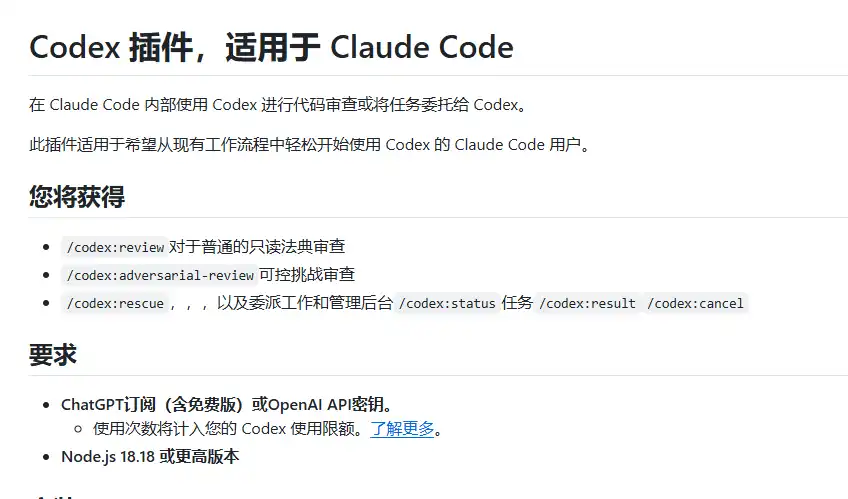
Empowered by this plugin, users can initiate a standard read-only code review using the /codex:review command to receive professional improvement suggestions from Codex. This dual verification mechanism effectively catches logical vulnerabilities that a single model might miss, adding a "double insurance" for code quality.

More uniquely, its "adversarial review" feature allows developers to use /codex:adversarial-review to actively request Codex to challenge existing design decisions. This mode is specifically designed to stress-test the rationality of system architecture, uncovering potential performance bottlenecks or security risks from a "fault-finding" perspective.

Additionally, the plugin introduces a task delegation mechanism, enabling users to transfer complex debugging or repair tasks to a Codex sub-agent via /codex:rescue. This collaborative model achieves automatic task distribution, allowing the primary model and auxiliary models to each focus on their respective areas of expertise.

github:https://github.com/openai/codex-plugin-cc

İlgili Sorular

QWhat is the name of the official OpenAI plugin that integrates with Claude Code?

AThe plugin is called codex-plugin-cc.

QWhat is the primary function of the /codex:review command in the new plugin?

AThe /codex:review command is used to initiate a standard read-only code review to get professional improvement suggestions from the Codex model.

QWhat unique feature does the /codex:adversarial-review command provide?

AThe /codex:adversarial-review command enables an 'adversarial review' function, which actively challenges existing design decisions to stress-test the system architecture and uncover potential performance bottlenecks or security risks.

QHow does the /codex:rescue command facilitate task management?

AThe /codex:rescue command allows users to delegate complex debugging or repair tasks to a Codex sub-agent, enabling a collaborative model where the main and auxiliary models work in their respective areas of expertise.

QWhere was the codex-plugin-cc project officially released?

AThe project was officially released by OpenAI on GitHub.

İlgili Okumalar

Breaking: GPT-5.6 Prices Slashed Effective Today

OpenAI has announced significant price cuts for its GPT-5.6 model API, effective immediately. The entry-level **GPT-5.6 Luna** sees the most drastic reduction, with input prices dropping 80% to $0.20 per million tokens and output prices falling to $1.20 per million tokens. The mid-tier **GPT-5.6 Terra** is reduced by 20%, now costing $2.00 (input) and $12.00 (output) per million tokens. The flagship **GPT-5.6 Sol** maintains its original price but introduces a new **Fast mode**, offering speeds up to 2.5 times faster for double the cost. The company attributes these price reductions to efficiency gains achieved through **GPT-5.6 Sol's own involvement in optimizing its production systems**. The model assisted in rewriting GPU kernels and improving speculative decoding, leading to a 20% reduction in end-to-end service costs and over 15% improvement in token generation efficiency. OpenAI emphasizes this process remained human-led. A key focus of the降价 is to lower the barrier for running **AI agent workflows**. By making the capable, tool-calling Luna model significantly cheaper, OpenAI aims to enable more frequent use in cost-sensitive, high-volume tasks like code review and monitoring. This creates a potential feedback loop: model-assisted efficiency gains lead to lower costs, which enables broader agent deployment, which in turn drives further optimization. The new pricing and features will also apply to Codex and ChatGPT Work subscriptions. The changes intensify competition in the large language model market, with OpenAI directly challenging rivals like Anthropic to respond.

marsbit3 dk önce

Breaking: GPT-5.6 Prices Slashed Effective Today

marsbit3 dk önce

South Koreans' 'Gambling Nature' is Actually Forced by Life

This article explores how systemic pressures in South Korea, rather than inherent "gambling" tendencies, drive widespread speculative financial behavior. It begins by noting the high frequency of flights from South Korea to Macau, symbolizing the search for outlets beyond domestic restrictions. The core argument is that ordinary life goals—stable employment, home ownership, and financial security—have become increasingly tied to asset markets due to structural economic factors. South Korea's development model, historically reliant on corporate leverage (chaebols), has evolved into a society where household debt and personal leverage are normalized as pathways to social mobility. Key mechanisms discussed include: * **Housing Policy:** Government measures to improve affordability, like extending mortgage terms to 50 years and the unique *jeonse* (key money) rental system, embed high leverage into the housing market. * **Financial Products:** The recent approval and explosive popularity of single-stock 2x leveraged ETFs (e.g., on Samsung and SK Hynix), easily accessed via mobile apps, lowered barriers to high-risk trading. * **Social Pressure:** Media narratives around soaring corporate profits (e.g., SK Hynix) and employee bonuses create a fear of missing out, pushing individuals to use leverage to "catch up." The article concludes that this "leveraged life" is a product of institutional history and policy choices. When traditional paths to success feel constrained, and policy facilitates debt-based solutions for housing and investment, speculative behavior becomes a rational, if risky, strategy for many. The rapid cycle of regulatory approval for leveraged ETFs followed by a market crash and official apology in mid-2026 exemplifies the system's inherent contradictions. Ultimately, the "bet" is not just on assets, but on using future earnings to secure a place in the present society.

marsbit3 dk önce

South Koreans' 'Gambling Nature' is Actually Forced by Life

marsbit3 dk önce

İşlemler

Spot
活动图片