Open Interest in Options Exceeds Futures for the First Time: How Are On-Chain Derivatives Approaching the Eve of an Explosion?

比推2026-03-12 tarihinde yayınlandı2026-03-12 tarihinde güncellendi

Özet

The cryptocurrency options market is experiencing significant growth, with Bitcoin options open interest reaching $65 billion in mid-2025, surpassing futures open interest for the first time. This shift highlights increasing institutional demand for defined-risk tools like options over pure leverage instruments. While centralized platforms like Deribit (acquired by Coinbase) and CME’s IBIT options dominate, on-chain derivatives are gaining traction but remain nascent. DeriveXYZ leads in on-chain options with over $700 million in notional trading volume, having evolved from an AMM to a gas-free central limit order book on its own Layer 2. Its portfolio margin system and cross-margin support appeal to institutional users. Similarly, KyanExchange combines order book matching with on-chain portfolio margins and partial liquidation mechanisms. Structured products and hedging needs are driving adoption, as evidenced by the success of options-based yield strategies in TradFi. Regulatory clarity is improving, with recent SEC-CFTC joint statements and legislative progress reducing uncertainty. CME’s planned 24/7 crypto options trading further signals maturation. Though on-chain options are still early, infrastructure and regulatory developments suggest potential for expansion.

Author: Delphi Digital

Compiled by: AididiaoJP, Foresight News

Original title: The Eve of the On-Chain Options Explosion


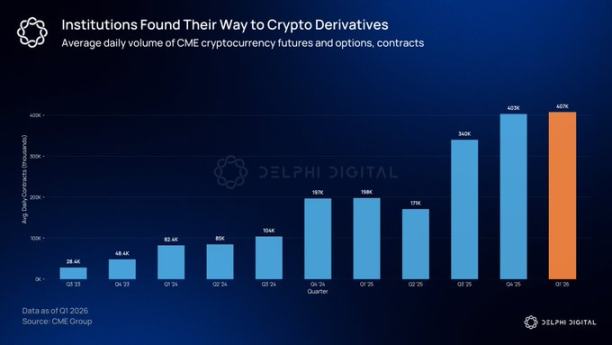
The scale of the cryptocurrency options market far exceeds most people's perceptions. The trading volume of cryptocurrency derivatives on the Chicago Mercantile Exchange (CME) is 46% higher than the historical record set last year. Institutional investors need clear risk management tools to hedge large positions, and options are the only cryptocurrency instrument that provides this function.
Reshaping the Landscape

By mid-2025, the total open interest in Bitcoin options reached $65 billion, surpassing futures open interest for the first time. Futures are leverage tools, while options allow funds to set a cap on losses for their $500 million Bitcoin holdings by paying a premium. This turning point indicates that tools with defined risk functions are gradually replacing pure leverage tools.

This growth has been concentrated on two platforms. Deribit has been the mainstream platform for cryptocurrency options trading for years, and after being acquired by Coinbase for $2.9 billion in 2025, it gained institutional-level endorsement. Meanwhile, IBIT options, launched in late 2024, brought traditional financial capital into this field. The options market is expanding rapidly, but the vast majority of trading still requires intermediaries.

On-Chain Options Are Still in Their Infancy

The market share of decentralized derivatives has climbed from 2% to over 10% in two years. Hyperliquid has proven that decentralized exchanges (DEXs) can rival centralized exchanges in speed and transparency. However, no similar representative project has emerged for on-chain options yet.

@DeriveXYZ remains the leading on-chain options protocol, with a nominal options trading volume exceeding $700 million in the past 30 days. The protocol was launched in August 2021 under the name Lyra as an options automated market maker (AMM). After weathering the bear market, it was completely restructured in 2023 and now features a gas-free central limit order book built on its own OP Stack Layer 2.
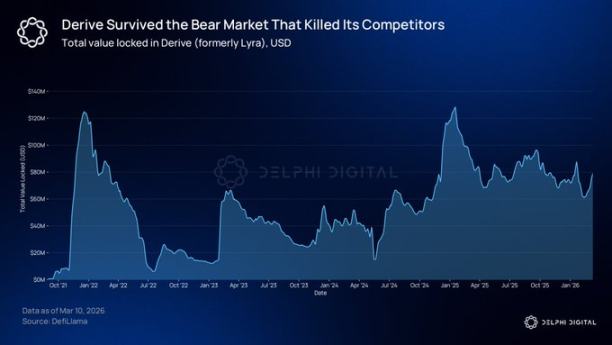
This restructuring completely changed the pricing mechanism. Market makers quote directly on the order book, narrowing spreads, enabling more precise pricing, and supporting larger-scale trades. Traders enjoy zero gas fees and sub-second execution speeds.

Its portfolio margin system has also attracted institutional attention. The system assesses overall position risk through scenario analysis. For example, if a trader holds both long call options and short put options on the same underlying asset, the system does not charge margin for each leg separately.

The collateral required for a hedged position is lower than the simple sum of the individual parts, which is the common logic in traditional financial derivatives trading desks. Derive also offers perpetual contracts and lending services on the same Layer 2, supporting cross-product cross-margining.

@KyanExchange is moving in the same direction but with a different approach. This platform combines an order book matching engine with on-chain portfolio margining, supporting multi-leg operations in a single atomic transaction. Traders can deploy an iron condor strategy with just a few clicks.

Kyan's liquidation mechanism also differs from most DeFi protocols. When a margin threshold is breached, the platform does not liquidate the entire account but executes a partial close-out, only closing the minimum position necessary to restore the account to the margin requirement. Kyan is currently in the testing phase on Arbitrum, with a mainnet launch imminent.

Who Needs Options?

Asset management companies building structured products urgently need the clearly defined risk-return profiles that options provide. Take J.P. Morgan's Equity Premium Income ETF as an example. This fund, built on a covered call strategy, is one of the largest actively managed funds globally. The overall assets under management for yield products based on derivatives exceed one hundred billion dollars. As more institutional funds move on-chain, the corresponding hedging needs will migrate as well.

Currently, an increasing number of institutional investors already hold or plan to allocate to digital assets in the short term. The open interest in IBIT options has surpassed that of the gold ETF GLD. In 2025, the CME handled a nominal trading volume of $3 trillion in cryptocurrency derivatives.

The Timing Is Ripening

Most early on-chain options protocols failed to survive, primarily due to regulatory uncertainty. For instance, Opyn was penalized by the CFTC for operating an unlicensed derivatives exchange. At that time, teams developing products could not predict whether their product would be deemed illegal the next quarter.

This situation is now improving. In September 2025, the U.S. Securities and Exchange Commission (SEC) and the Commodity Futures Trading Commission (CFTC) jointly issued a statement allowing regulated exchanges to conduct spot crypto asset trading. The CLARITY Act has passed the House of Representatives, proposing to place the spot market for digital commodities under CFTC oversight. The Senate version is still under negotiation and is currently stalled. CME Group will launch 24/7 cryptocurrency options trading on May 29. While this does not guarantee that on-chain protocols will necessarily succeed, the overall environment has undergone a substantive shift.


Twitter:https://twitter.com/BitpushNewsCN

Bitpush TG Discussion Group:https://t.me/BitPushCommunity

Bitpush TG Subscription: https://t.me/bitpush

Original article link:https://www.bitpush.news/articles/7619181

Trend Kriptolar

İlgili Sorular

QWhat significant shift occurred in the Bitcoin derivatives market in mid-2025?

AIn mid-2025, the total open interest for Bitcoin options reached $65 billion, surpassing that of futures for the first time.

QWhich two platforms are primarily driving the growth in the cryptocurrency options market?

AThe growth is mainly concentrated on Deribit, which was acquired by Coinbase in 2025, and IBIT options, which introduced traditional financial capital to the space.

QWhat is the current market share of decentralized derivatives, and which protocol is a leading on-chain options platform?

AThe market share of decentralized derivatives has climbed from 2% to over 10% in two years. @DeriveXYZ is currently the leading on-chain options protocol, with over $700 million in nominal option volume in the past 30 days.

QHow has the regulatory environment for on-chain derivatives changed recently?

AThe regulatory environment has improved. In September 2025, the SEC and CFTC issued a joint statement allowing regulated exchanges to trade spot crypto assets. The CLARITY Act has passed the House and aims to place spot digital commodity markets under CFTC oversight.

QWhat is a key feature of @KyanExchange's liquidation mechanism that differs from most DeFi protocols?

A@KyanExchange's liquidation mechanism does not liquidate the entire account when a margin threshold is breached. Instead, it executes a partial liquidation, closing only the minimum number of positions necessary to bring the account back to the margin requirement.

İlgili Okumalar

Only 153 Venture Capital Firms Invested in July: Is the Crypto VC Industry Experiencing a 'Mass Extinction'?

In July 2026, only 153 unique venture capital firms participated in disclosed crypto funding rounds, marking the lowest monthly count since November 2020. This figure represents an 87% decline from the peak of 1,177 firms in 2022. Overall, the first seven months of 2026 saw crypto projects raise approximately $11.78 billion across 481 rounds. This crypto VC contraction contrasts sharply with the broader venture capital landscape, where global VC investment reached a record $560.4 billion in H1 2026, heavily fueled by major AI company financings. This shift in capital allocation has drawn funds away from the crypto sector. Within crypto, funding is highly concentrated. Trading platforms, prediction markets, and payment sectors absorbed 53% of the total capital. While early-stage deals remain frequent, the largest sums flow to a few late-stage rounds and mergers & acquisitions, which surged to $7.23 billion in Q2 2026. The market is consolidating around top funds like a16z crypto and Dragonfly, which successfully raised new multi-billion dollar funds, while many smaller firms have retreated. Analysts describe this as a "great extinction" for crypto VCs, where capital is becoming more selective, favoring proven business models and assets over early-stage speculation. This raises the bar for project quality, funding efficiency, and viable exit paths.

marsbit17 dk önce

Only 153 Venture Capital Firms Invested in July: Is the Crypto VC Industry Experiencing a 'Mass Extinction'?

marsbit17 dk önce

Strategy's Loss in the Second Quarter Reaches $8.22 Billion Amid Bitcoin Decline

Strategy, the largest corporate holder of Bitcoin, reported a net loss of $8.22 billion for the second quarter. This loss was primarily driven by an $8.32 billion unrealized loss on its Bitcoin holdings due to a decline in the asset's price during the period. Despite these paper losses, the company increased its Bitcoin holdings to 843,775 BTC, a 25% growth since the start of the year. As part of a new monetization strategy, Strategy sold approximately $218.4 million worth of Bitcoin, mainly to fund dividends for preferred shareholders, with $216 million of that sold after Q2 ended. The company also built a $3.75 billion cash reserve, which it claims is sufficient to cover over two years of dividend and interest payments, aiming to insulate itself from Bitcoin's volatility while meeting obligations. Following the earnings release, Strategy's stock (MSTR) rose 4.7% in regular trading but corrected slightly after-hours. This pattern reflects how the company's accounting results are heavily tied to Bitcoin's price swings, even as its long-term strategy remains unchanged. The report indicates that Strategy is maintaining its core strategy of accumulating Bitcoin while building a financial buffer. This quarterly loss follows a recognizable pattern, with the company posting significant unrealized losses in previous quarters (e.g., $12.4 billion in Q4 2025 and ~$12.5 billion in Q1 2026) due to fair-value accounting. A key technical shift is its new monetization program, which introduces periodic selling pressure on the market, transitioning Strategy from a pure accumulator to a participant that occasionally adds supply. A critical question remains: how long can the cash reserve cover dividend obligations if a Bitcoin price downturn persists beyond two years?

cryptonews.ru37 dk önce

Strategy's Loss in the Second Quarter Reaches $8.22 Billion Amid Bitcoin Decline

cryptonews.ru37 dk önce

Will Terrorist Durov Ban Russian Officials?

Telegram founder Pavel Durov publicly reacted to being labeled a "terrorist" by Russian authorities, stating the designation came after he refused demands for mass surveillance and censorship on the platform. In a Telegram post, he highlighted that this status formally bans him from "publishing information online." Durov concluded with a statement widely circulated: Russian officials "clearly don't understand who can ban whom on the internet." This remark suggests Durov could potentially restrict official Russian government and officials' channels on Telegram, which continue to operate on the platform despite its formal blocking in Russia. The situation parallels previous, slow-moving state directives, like switching officials to domestic cars, contrasted with the current push to migrate all government communication to the Russian-made messenger MAX by 2030. However, reports indicate many officials still use Telegram via workarounds, fearing surveillance on MAX, while alternatives like BiP and KakaoTalk recently became inaccessible in Russia without a VPN. Durov has not specified any immediate actions against state channels. His statement is an initial response, with further developments depending on the authorities' reaction. The dynamic differs from 2020 when Russian regulators lifted a block on Telegram; now, Durov implies control from within the platform itself over the official accounts that persisted through that earlier blockade.

cryptonews.ru37 dk önce

Will Terrorist Durov Ban Russian Officials?

cryptonews.ru37 dk önce

DeepSeek V4 Official Version Arrives, New Capabilities Emerge, Value-for-Money King Enters the Fray

On July 31st, DeepSeek officially launched the public API beta for its DeepSeek-V4-Flash model. A key highlight is its performance on multiple Agent benchmark tests, reportedly nearing or even surpassing the level of the V4-Pro preview version from three months ago. Notably, the Flash model achieves this with significantly smaller scale (130B active parameters vs. Pro's 490B), suggesting that post-training optimization and data quality may be as crucial as raw model size. DeepSeek emphasized that the V4-Flash-0731 uses the same model architecture and size as its preview version, with improvements attributed solely to "re-trained post-training." The update also marks the official debut of DeepSeek's self-developed Agent framework, "Harness." The move signals DeepSeek's strategic push to position its cost-effective Flash model as a competitive base for Agent applications—scenarios requiring autonomous planning, tool usage, and complex task execution—where inference speed and cost are critical. By natively supporting OpenAI's Responses API format and adapting for code-generation scenarios, DeepSeek aims not just to be a cheaper alternative but to establish its own ecosystem in the Agent era. This release follows DeepSeek's record-breaking ~$50 billion fundraising round roughly two months prior, underscoring market confidence in its technology and commercialization prospects. The company is reportedly preparing for another funding round at a valuation of approximately $71 billion. The Flash model's advancement represents a step in fulfilling the high expectations that come with this valuation, setting the stage for the impending release of the V4-Pro official version and intensifying competition in the global Agent landscape.

marsbit41 dk önce

DeepSeek V4 Official Version Arrives, New Capabilities Emerge, Value-for-Money King Enters the Fray

marsbit41 dk önce

İşlemler

Spot

Popüler Makaleler

T Nasıl Satın Alınır

HTX.com’a hoş geldiniz! Threshold Network Token (T) satın alma işlemlerini basit ve kullanışlı bir hâle getirdik. Adım adım açıkladığımız rehberimizi takip ederek kripto yolculuğunuza başlayın. 1. Adım: HTX Hesabınızı OluşturunHTX'te ücretsiz bir hesap açmak için e-posta adresinizi veya telefon numaranızı kullanın. Sorunsuzca kaydolun ve tüm özelliklerin kilidini açın. Hesabımı Aç2. Adım: Kripto Satın Al Bölümüne Gidin ve Ödeme Yönteminizi SeçinKredi/Banka Kartı: Visa veya Mastercard'ınızı kullanarak anında Threshold Network Token (T) satın alın.Bakiye: Sorunsuz bir şekilde işlem yapmak için HTX hesap bakiyenizdeki fonları kullanın.Üçüncü Taraflar: Kullanımı kolaylaştırmak için Google Pay ve Apple Pay gibi popüler ödeme yöntemlerini ekledik.P2P: HTX'teki diğer kullanıcılarla doğrudan işlem yapın.Borsa Dışı (OTC): Yatırımcılar için kişiye özel hizmetler ve rekabetçi döviz kurları sunuyoruz.3. Adım: Threshold Network Token (T) Varlıklarınızı SaklayınThreshold Network Token (T) satın aldıktan sonra HTX hesabınızda saklayın. Alternatif olarak, blok zinciri transferi yoluyla başka bir yere gönderebilir veya diğer kripto para birimlerini takas etmek için kullanabilirsiniz.4. Adım: Threshold Network Token (T) Varlıklarınızla İşlem YapınHTX'in spot piyasasında Threshold Network Token (T) ile kolayca işlemler yapın.Hesabınıza erişin, işlem çiftinizi seçin, işlemlerinizi gerçekleştirin ve gerçek zamanlı olarak izleyin. Hem yeni başlayanlar hem de deneyimli yatırımcılar için kullanıcı dostu bir deneyim sunuyoruz.

645 Toplam GörüntülenmeYayınlanma 2024.12.10Güncellenme 2026.06.02

T Nasıl Satın Alınır

Tartışmalar

HTX Topluluğuna hoş geldiniz. Burada, en son platform gelişmeleri hakkında bilgi sahibi olabilir ve profesyonel piyasa görüşlerine erişebilirsiniz. Kullanıcıların T (T) fiyatı hakkındaki görüşleri aşağıda sunulmaktadır.

活动图片