Only 60% Real Win Rate: Data Reveals the Truth Behind ICO Predictions on Polymarket

marsbit2026-01-31 tarihinde yayınlandı2026-01-31 tarihinde güncellendi

Özet

Polymarket's TokenSale markets have processed nearly $250 million in volume, boasting impressive accuracy rates—100% for fundraising amounts and over 90% for fully diluted valuations (FDV). However, an analysis of 231 prediction markets across 29 token sales reveals these figures are misleading. The platform functions more as a sentiment indicator, often acting as a contrarian signal. Key findings show that the true prediction accuracy one week before market close is only 66.7%, meaning the crowd is wrong one-third of the time, with errors consistently skewing toward over-optimism. FDV predictions averaged a 35% overestimation. Analysis of 24-hour post-launch volatility showed an average price swing of ±23%, with 75% of tokens facing sell-offs. Only 62.5% of 24-hour FDV predictions were accurate. The 100% accuracy claim is meaningless because markets close after results are known. High trading volume on Polymarket often serves as a reverse indicator—more optimism typically leads to greater inaccuracy. Tokens with conservative predictions (e.g., Monad, Football.fun) saw smaller declines. Actionable signals: High volume (>$50M) and high optimism (>50% FDV overestimation) are bearish. Low volume (<$5M) and accurate predictions (within 20% of actual FDV) are relatively bullish. In a market where most tokens fall below ICO price, "less bad" is the best outcome. Polymarket’s token sales market is essentially a hype meter—extreme confidence often signals maximum investor pain.

Author: @WazzCrypto, Legion

Compiled by: Frank, PANews

Observations on Prediction Markets in the Token World

Polymarket's Token Sale market has processed nearly $250 million in trading volume. The platform's advertised accuracy data is impressive: 100% accuracy in fundraising amount predictions and over 90% for FDV (Fully Diluted Valuation). However, a deeper analysis reveals that these numbers are misleading. The real signal is not what the crowd predicts, but how wrong they are.

By analyzing 231 prediction markets across 29 token sale events and cross-referencing Polymarket's historical probability data with actual token performance on CoinGecko, we found that "prediction markets are not reliable forecasting tools. Instead, they are actually sentiment indicators, and often a contrarian signal.

Key Finding: One week before market close, the real prediction accuracy was only 66.7%. At critical moments, the crowd is wrong one-third of the time, and incorrect predictions often show systematic over-optimism.

24-Hour Volatility Issue: Using CoinGecko's hourly data, we found that Polymarket's markets for "FDV above X 24 hours after launch" are essentially bets on extreme volatility. The average 24-hour price change was ±23% (e.g., Best performer: Monad +54.8%; Worst performer: Trove -38.7%). 75% of tokens faced selling pressure within 24 hours of launch. In this context, Polymarket's accuracy for 24-hour FDV predictions was only 62.5%.

The Fallacy of Accuracy: The Market is Wrong One-Third of the Time

When we track how market probabilities evolve over time, rather than just looking at static data at settlement, a completely different picture emerges. The fundraising amount prediction markets appear "100% accurate" because the final figures are inevitably leaked gradually as the sale progresses. Insiders and observers update prices accordingly; this is merely ex-post price discovery.
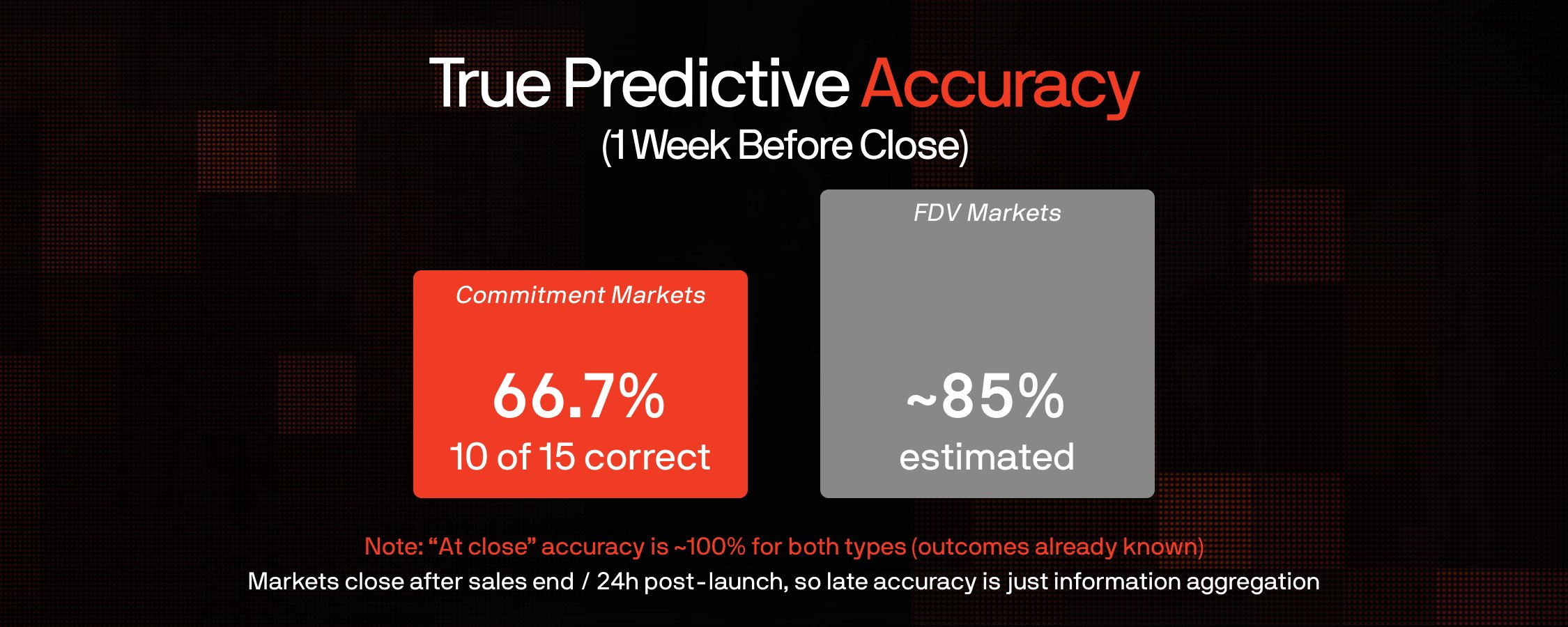
Key Insight: The reason fundraising and FDV markets tend towards 100% accuracy at close is because they settle *after* the outcome is largely certain. Fundraising markets close after the sale ends; FDV markets close 24 hours after launch. The only meaningful predictive metric is the accuracy one week before close, when genuine uncertainty exists. The 66.7% accuracy rate for fundraising predictions shows that, at the critical moment, the market is wrong 1/3 of the time.

Crowd Predictions Err on the Side of Excessive Optimism

We reviewed every prediction market where "crowd confidence exceeded 60% but ultimately failed to materialize." In every case, the error was consistent: over-optimism. The crowd consistently believed the raise would be higher and the valuation more expensive than reality.
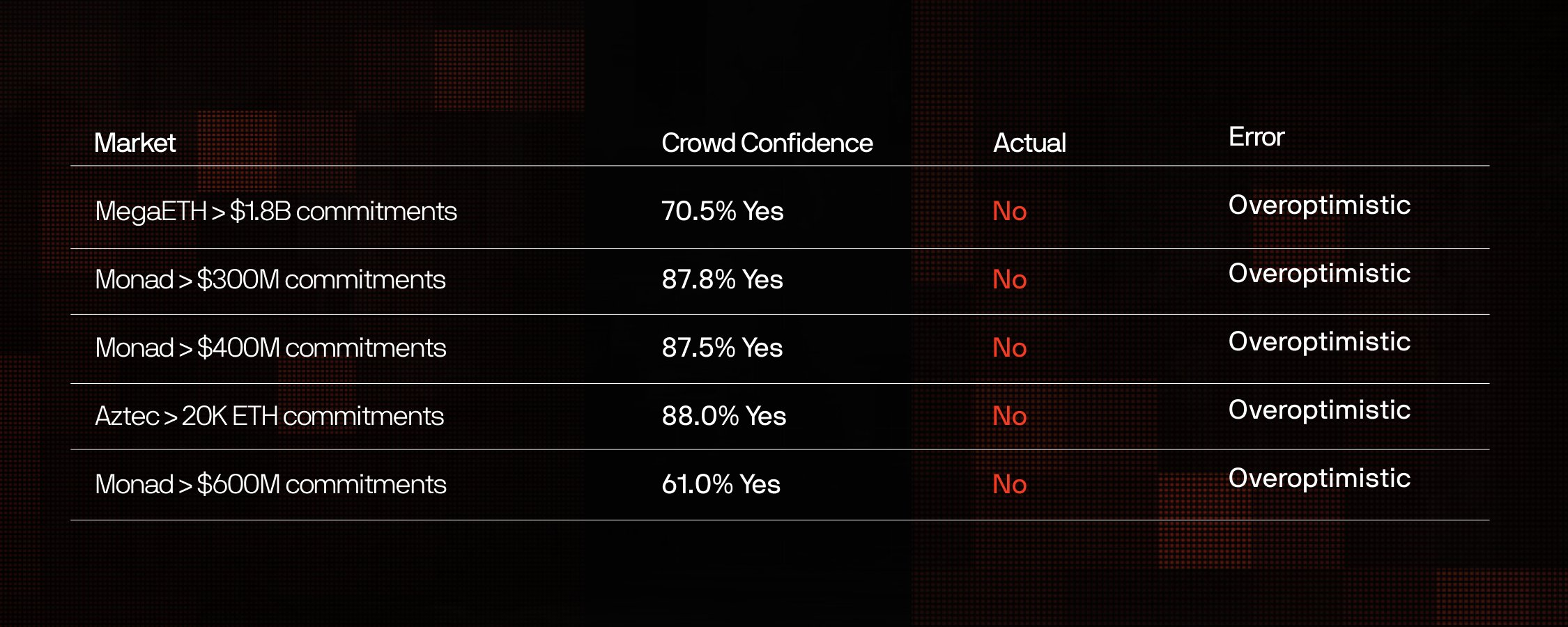
This systematic bias suggests the participants in these markets are optimistic speculators, attracted to token sales precisely because they are bullish.

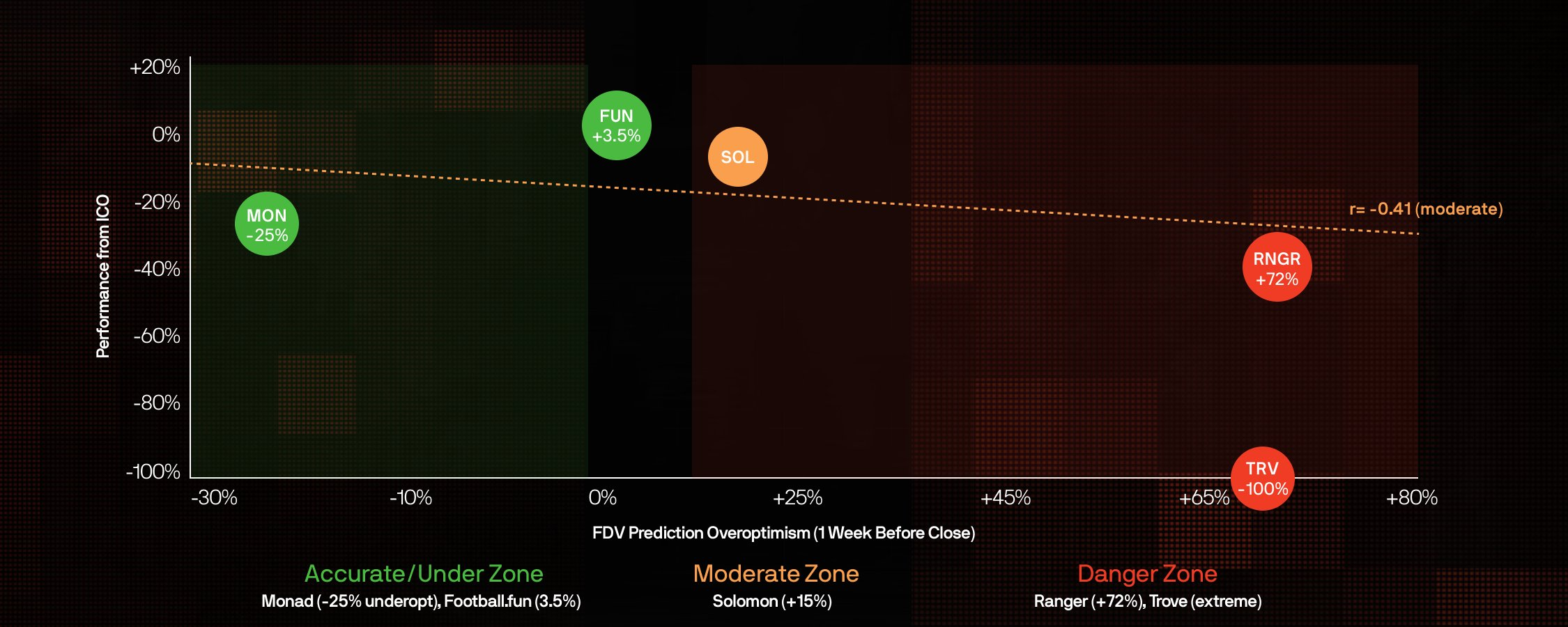
Over-Optimism vs. Token Performance (Based on ICO Data)

Methodology: This analysis only includes markets for projects that conducted a public ICO and have issued a token, using Polymarket odds from one week before market close.

Degree of Over-Optimism = (Polymarket Predicted FDV - Actual 24h FDV) / Actual 24h FDV.

The Y-axis shows price performance from ICO to current.

The data shows a moderate negative correlation (r=-0.41) between the degree of over-optimism and ICO returns. Monad was "underestimated/pessimistic" by the market (-25%), yet its price is still down 24% from ICO. Ranger was the most "over-optimistic" (+72%) and is currently down 32% from its ICO price. Only Football.fun remains above its ICO price (+1%).
Token Performance Ranking: 40% Launch Below Valuation

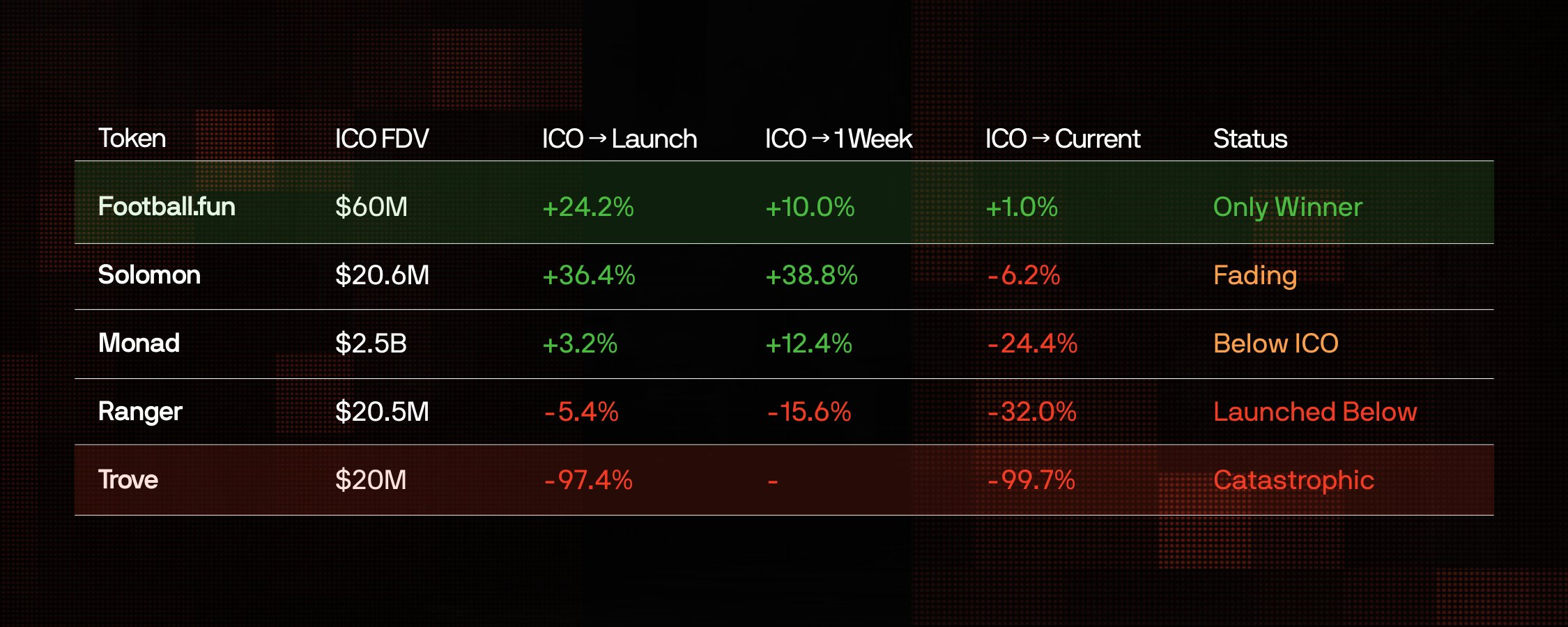
The table below, using historical Polymarket odds from one week before close, reveals the true prediction accuracy. The pattern is clear: extreme over-optimism预示 disaster, and high trading volume on Polymarket, even when predictions are correct, is often a contrarian signal.
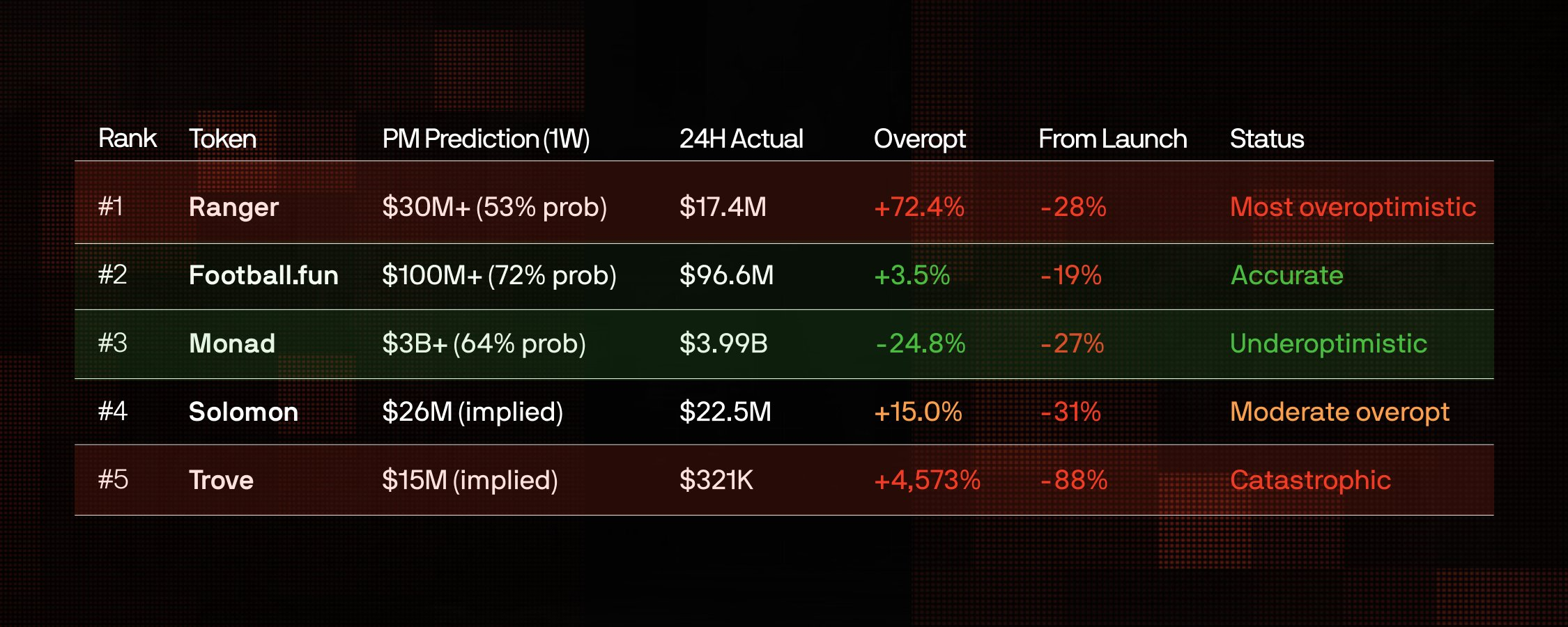
Key Finding: Among tokens with ICO data, 40% launched at a price below their ICO valuation. The average return from ICO to current is -32.2%. Only Football.fun is trading above its ICO price.
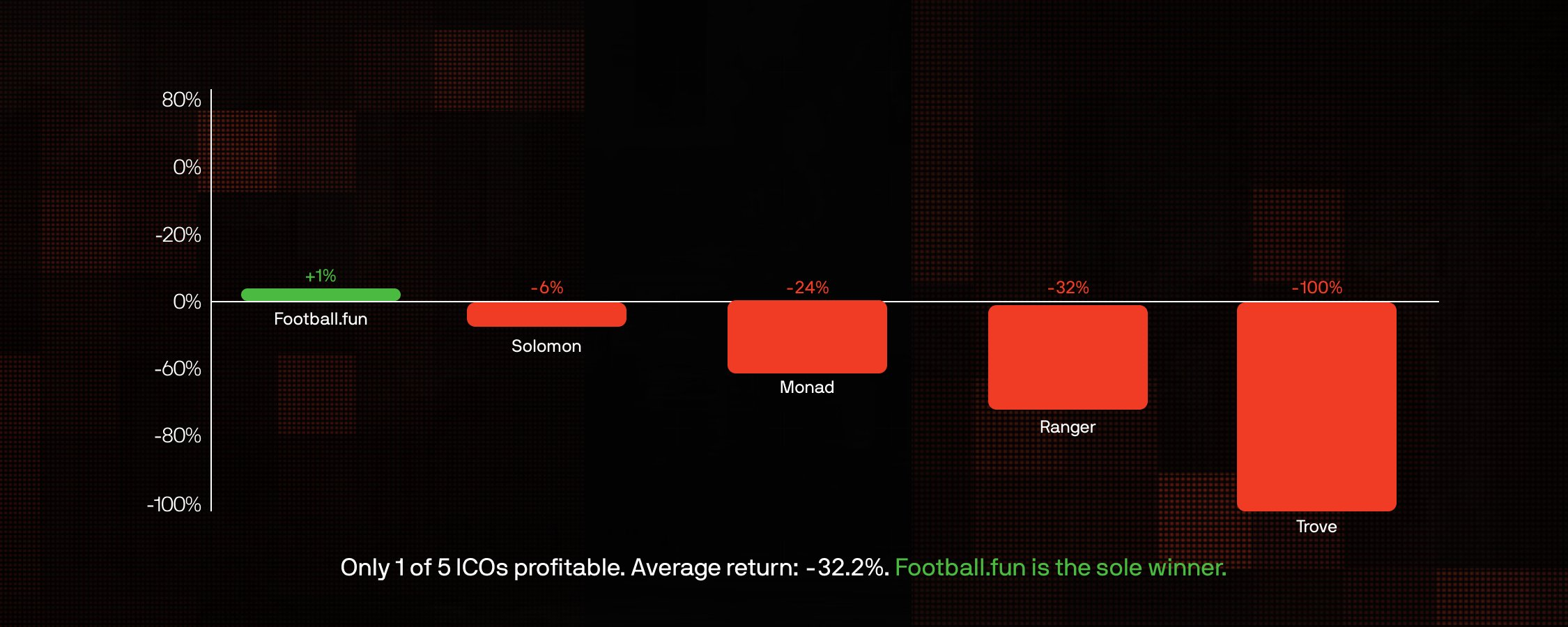
The pattern is brutal: Even tokens that launched above their ICO valuation (e.g., Monad, Solomon) eventually fell below the issue price. Football.fun is the only winner among the 5 ICO tokens in this dataset, currently just 1% above its ICO price.
Core Conclusions:

After analyzing 231 markets, $241.5 million in trading volume, and 8 tokens with verified 24-hour FDV data, several conclusions are clear:

  1. "100% Accuracy" is meaningless. Markets close for settlement *after* the outcome is known (fundraising markets post-sale, FDV markets 24 hours later), so late-stage accuracy unsurprisingly nears 100%. But the real predictive accuracy one week before close is only 66.7%. At the critical moment, the crowd guesses wrong 1/3 of the time.

  2. Systematic Over-Optimism. Among the top 15 markets, 5 markets showed over 60% confidence in thresholds that were never reached. FDV was overestimated by an average of +35%.

  3. High prediction market volume is a contrarian signal. Monad ($89M) and MegaETH ($67M) had the highest degrees of over-optimism. The more money the crowd bets, the more confident they are, and the more wrong they tend to be.

  4. Conservative Predictions = Better Outcomes. Tokens with relatively accurate predictions (Monad, Football.fun) fell less. Low hype and accurate predictions appear to be bullish signals.

Trading Signals:

Based on the analysis, we can distill actionable signals for evaluating future token sales. These are not absolute guarantees but represent patterns that held consistently within the dataset.
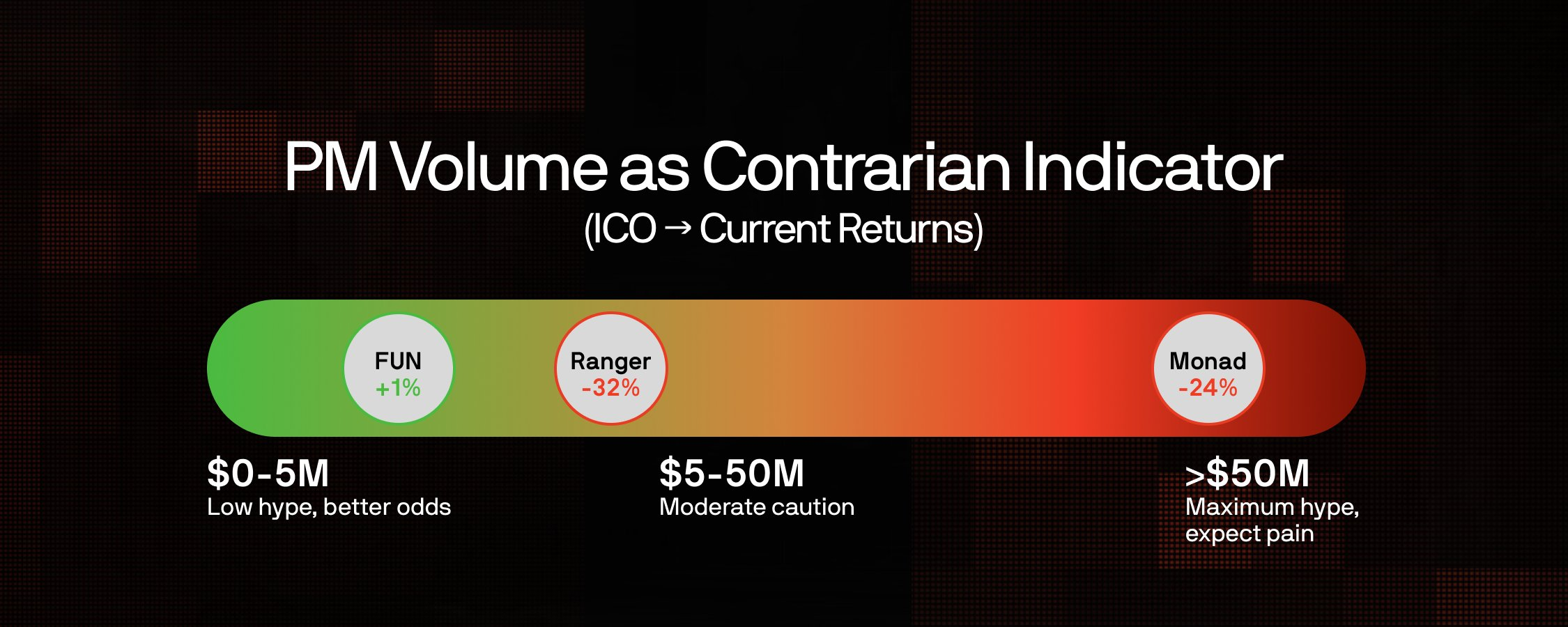
Bearish Signals:

  • Polymarket trading volume > $50 Million

  • FDV Over-Optimism degree > 50%

  • All FDV prediction thresholds are likely to fail

  • Fundraising amount Over-Optimism degree > 30%

Bullish Signals (Relatively)

  • Polymarket trading volume < $5 Million

  • FDV prediction偏差 within 20%

  • Multiple FDV prediction thresholds are met

  • Crowd expectations are relatively conservative

This asymmetry is important. Bearish signals are strong indicators of poor outcomes. Bullish signals are weaker, only suggesting the token might perform "less badly" than over-hyped alternatives. In a market where all tokens are down from their all-time highs (ATH), "losing less" is the best-case scenario.

Summary

Polymarket's token sale section is effectively a Hype Meter. The signal is not in the prediction itself, but in how much it deviates. When the crowd piles money into bets for higher valuations, caution is warranted. Historically, "extreme confidence" from the masses has often meant "maximum pain" for investors.


İlgili Sorular

QWhat is the actual prediction accuracy rate of Polymarket's ICO markets one week before closing, according to the analysis?

AThe actual prediction accuracy rate one week before closing is 66.7%, meaning the crowd is wrong one-third of the time.

QWhat systematic bias was identified in the predictions where the crowd had over 60% confidence but was ultimately wrong?

AThe systematic bias identified was consistent over-optimism. The crowd consistently predicted higher fundraising amounts and more expensive valuations than what occurred in reality.

QWhat percentage of tokens analyzed experienced selling pressure within 24 hours of their launch?

A75% of the tokens analyzed experienced selling pressure (were sold off) within 24 hours of their launch.

QAccording to the article, what is a key 'Bearish Signal' for a token sale based on Polymarket data?

AA key bearish signal is Polymarket trading volume exceeding $50 million, which often indicates extreme over-optimism that historically leads to poor outcomes.

QThe article suggests that Polymarket's TokenSale markets are not reliable prediction tools but are instead a measure of what?

AThey are not reliable prediction tools but are instead indicators of market sentiment, or 'Hype Meters,' and often act as a contrarian signal.

İlgili Okumalar

Unlocking $100 Million in Liquidity? Pump.fun's New Policy Tests the 5-Minute Pump Technique

Pump.fun, a popular meme coin launchpad, has introduced a new standard mechanism called BOOST. It aims to address a significant capital efficiency issue: when a newly launched token graduates from its initial bonding curve to a liquidity pool (LP), roughly 20% of its liquidity becomes permanently locked as "dead liquidity," estimated to waste over $100 million annually. Instead of locking these funds permanently, BOOST repurposes them. Upon a token's migration, approximately 20% of the settlement funds (e.g., 17.6 SOL or ~$2516 USDC) are used to buy back the token on the open market over a 5-minute period via a Time-Weighted Average Price (TWAP) mechanism. All purchased tokens are immediately burned. This creates a brief, systematic buy pressure immediately after migration, potentially generating a short-term price surge ("pump") while permanently reducing the token's circulating supply. The goal is to enhance the immediate post-launch trading experience, potentially increasing trader retention and sustainable protocol revenue, which funds ongoing token buybacks. However, concerns exist that this artificial 5-minute boost could lower the barrier for launching low-quality tokens and lead to steeper price crashes once the buy pressure stops, if followed by large sell-offs. The feature automatically applies to tokens migrating after July 21, 2024, but not to previously migrated tokens or those launched via the Mayhem AI Agent lab.

marsbit3 dk önce

Unlocking $100 Million in Liquidity? Pump.fun's New Policy Tests the 5-Minute Pump Technique

marsbit3 dk önce

Podcast Notes | Conversation with GSR Asset Management Head: To Determine if This Crypto Rally is Real, Just Watch the Lending Rates on Aave

Podcast Summary: Dialogue with GSR's Head of Asset Management: To Determine if This Crypto Rally is Real, Just Check Lending Rates on Aave Andy Baehr, Managing Director of Asset Management at GSR, discusses the current crypto market, characterizing it as stuck in a state of "ambivalence" with short-lived, unsustainable rallies. He outlines a simple framework: the market moves between "ambivalence" and "conviction" (sustained upward momentum). Currently, every rally resembles a single-stage rocket booster that quickly fizzles out. Baehr identifies three key signals to watch: 1) DeFi lending rates, 2) the potential passage of the CLARITY Act, and 3) the market forming a consensus on the "Fed hawkish peak." He emphasizes that the most immediate indicator for the sustainability of the recent CPI-triggered rally is the USDC borrowing rate on Aave, currently around 3.75%—close to U.S. Treasury yields. The absence of a credit spread indicates low leverage demand and a lack of market energy. He explains that a healthy, sustained rally requires layered buying pressure. Last year's rally progressed from an ETH short squeeze to crypto-native trader influx and finally to ETF inflows. Currently, this structure is missing. Other potential structural buyers like Digital Asset Treasury (DAT) companies are absent, and ETF flows have proven transient. Baehr notes that while small-cap crypto tokens outperformed large caps in Q2—a potential sign of capitation in major assets—capital is also flowing to more exciting opportunities like AI stocks and tech IPOs, leaving crypto sidelined. Regarding DeFi, he highlights that platforms like Aave provide a clear, real-time signal of leverage demand through their supply/demand-driven interest rates. A significant, sustained rate increase would signal genuine market conviction. He also observes the quiet emergence of fixed-income-like products and vaults in DeFi. On regulation, the probability of the CLARITY Act passing before the August 7th deadline has dropped linearly from 75% to below 40% on Polymarket. Baehr suggests its passage would be treated as a bullish surprise, a potent driver for price movement. However, political hurdles, including ethical clause debates and disclosures about the First Family's crypto profits, remain significant obstacles. Ultimately, the market awaits clarity on the Fed's terminal rate under Chair Warsh. Until the "Fed Solstice"—the point where the market collectively understands the peak of hawkish policy—sustained conviction will be difficult to achieve.

marsbit34 dk önce

Podcast Notes | Conversation with GSR Asset Management Head: To Determine if This Crypto Rally is Real, Just Watch the Lending Rates on Aave

marsbit34 dk önce

İşlemler

Spot
活动图片




