On the Eve of the Explosion of On-Chain Options

marsbit2026-03-12 tarihinde yayınlandı2026-03-12 tarihinde güncellendi

Özet

On-Chain Options on the Brink of Breakout The cryptocurrency options market is larger than most realize, with CME's crypto derivatives volume up 46% year-over-year. Institutional investors require defined-risk tools like options for hedging large positions. A pivotal shift occurred in mid-2025 when Bitcoin options open interest reached $65 billion, surpassing futures for the first time, indicating a move from pure leverage to risk-defined instruments. Growth is concentrated on Deribit (now backed by Coinbase after its acquisition) and traditional finance capital via IBIT options. While decentralized derivatives have grown from 2% to over 10% market share in two years, on-chain options remain nascent. @DeriveXYZ leads with over $700 million in notional options volume over 30 days. It has evolved from an AMM to a gas-free central limit order book on its own L2, featuring portfolio margin and cross-margin. @KyanExchange is approaching similarly with on-chain portfolio margining and partial liquidation mechanics. Structured products and asset managers urgently need options for their defined risk/return profiles. Institutional demand is clear, with IBIT options OI surpassing the gold ETF GLD and CME handling $3 trillion in crypto derivatives notional volume in 2025. Regulatory clarity is improving. A joint statement from the SEC and CFTC in 2025 allows regulated exchanges to trade spot crypto assets, and the CLARITY Act has passed the House. This improved environment, alongsid...

Author: Delphi Digital

Compiled by: AididiaoJP, Foresight News

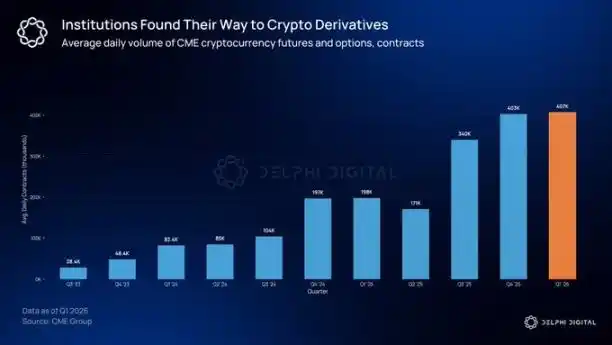
The size of the cryptocurrency options market far exceeds most people's perceptions. Trading volume for cryptocurrency derivatives on the Chicago Mercantile Exchange (CME) is 46% higher than the record high set last year. Institutional investors need clear risk management tools to hedge large positions, and options are the only cryptocurrency instrument that provides this functionality.
Reshaping the Landscape

By mid-2025, the total open interest in Bitcoin options reached $65 billion, surpassing futures open interest for the first time. Futures are leverage tools, while options allow funds to set a cap on losses for their $500 million Bitcoin holdings by paying a premium. This turning point indicates that tools with defined risk functions are gradually replacing pure leverage tools.

This growth has been concentrated on two platforms. Deribit has been the mainstream platform for cryptocurrency options trading for years. After being acquired by Coinbase for $2.9 billion in 2025, it gained institutional-grade endorsement. Meanwhile, IBIT options, launched in late 2024, brought traditional financial capital into this field. The options market is expanding rapidly, but the vast majority of trading still requires intermediaries.

On-Chain Options Are Still in Their Infancy

The market share of decentralized derivatives has climbed from 2% to over 10% in two years. Hyperliquid has proven that decentralized exchanges (DEXs) can rival centralized exchanges in speed and transparency. However, no similar representative project has emerged for on-chain options yet.

@DeriveXYZ remains the leading on-chain options protocol, with a nominal options trading volume exceeding $700 million in the past 30 days. The protocol was launched in August 2021 under the name Lyra as an options automated market maker (AMM). After weathering the bear market, it was completely rebuilt in 2023 and is now built on its own OP Stack Layer 2 with a gas-free central limit order book.
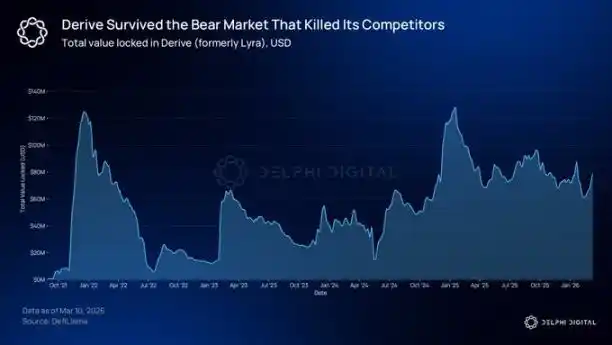
This rebuild fundamentally changed the pricing mechanism. Market makers quote prices directly on the order book, leading to narrower spreads, more precise pricing, and support for larger trades. Traders enjoy zero gas fees and sub-second execution speeds.

Its portfolio margin system has also attracted institutional attention. The system assesses overall position risk through scenario analysis. For example, if a trader holds both a long call option and a short put option on the same underlying asset, the system does not charge margin for each leg separately.

The collateral required for a hedged position is lower than the simple sum of the individual parts, which is the common logic in traditional financial derivatives trading desks. Derive also offers perpetual contracts and lending services on the same Layer 2, supporting cross-product cross-margining.

@KyanExchange is moving in the same direction but in a different way. This platform combines an order book matching engine with on-chain portfolio margining, supporting multi-leg operations in a single atomic transaction. Traders can deploy an iron condor strategy with just a few clicks.

Kyan's liquidation mechanism also differs from most DeFi protocols. When a margin threshold is breached, the platform does not liquidate the entire account but executes a partial close-out, only closing the minimum number of positions necessary to bring the account back to the margin requirement. Kyan is currently in the Arbitrum test phase, with a mainnet launch imminent.

Who Needs Options?

Asset management companies building structured products urgently need the clearly defined risk-return profiles provided by options. Take J.P. Morgan's Equity Premium Income ETF as an example. This fund is built on a covered call strategy and is one of the largest actively managed funds globally. The total assets under management for yield products based on derivatives exceed one hundred billion dollars. As more institutional capital moves on-chain, the corresponding hedging needs will migrate as well.

Currently, more and more institutional investors already hold or plan to allocate to digital assets in the short term. The open interest for IBIT options has surpassed that of the gold ETF GLD. In 2025, the CME processed a nominal trading volume of $3 trillion in cryptocurrency derivatives.

The Timing is Ripening

Most early on-chain options protocols failed to survive, primarily due to regulatory uncertainty. For instance, Opyn was fined by the CFTC for operating an unlicensed derivatives exchange. At that time, teams developing products could not predict whether their product would be deemed illegal the next quarter.

This situation is now improving. In September 2025, the U.S. Securities and Exchange Commission (SEC) and the Commodity Futures Trading Commission (CFTC) jointly issued a statement allowing regulated exchanges to conduct spot crypto asset trading. The CLARITY Act has passed the House of Representatives, proposing to place spot markets for digital commodities under CFTC oversight. The Senate version is still under negotiation and is currently stalled. CME Group will launch 24/7 cryptocurrency options trading on May 29th. While this does not guarantee that on-chain protocols will necessarily succeed, the overall environment has undergone a fundamental shift.


İlgili Sorular

QWhat major shift occurred in the Bitcoin derivatives market in mid-2025, and what does it signify?

AIn mid-2025, the total open interest for Bitcoin options reached $65 billion, surpassing that of futures for the first time. This signifies a shift is underway from purely leveraged tools (futures) to instruments with defined risk (options), as institutions seek better risk management tools for their large holdings.

QWhich two platforms are highlighted as the main drivers of growth in the cryptocurrency options market?

AThe growth is concentrated on two platforms: Deribit, which gained institutional credibility after its acquisition by Coinbase, and IBIT options, which introduced TradFi capital into the space starting in late 2024.

QWhat is the current state of on-chain options, and which protocol is mentioned as the current leader?

AOn-chain options are described as being in their infancy. The leading on-chain options protocol mentioned is @DeriveXYZ, which has processed over $700 million in notional options volume in the past 30 days.

QHow did the protocol @DeriveXYZ (formerly Lyra) improve its system after a 2023 overhaul?

AThe 2023 overhaul replaced its AMM model with a gas-free central limit order book (CLOB) built on its own OP Stack Layer 2. This allowed market makers to quote prices directly, leading to tighter spreads, more precise pricing, support for larger trades, and sub-second execution speeds for traders.

QWhat are two key reasons mentioned for why the environment for on-chain options is now more favorable than before?

ATwo key reasons are: 1) Improved regulatory clarity, exemplified by a joint SEC-CFTC statement allowing regulated exchanges to trade spot crypto assets and the progress of the CLARITY Act. 2) The growing institutional demand for defined-risk tools, as seen with the massive success of CME's crypto derivatives and IBIT options.

İlgili Okumalar

The King of Blind Date Attire in Korea: How SK Hynix Made a Comeback Against Samsung?

In South Korea's dating scene, SK Hynix employees are now highly sought after, a status shift fueled by the company's astronomical profits and employee bonuses, projected to reach up to 6.1 million RMB per person by 2027. This marks a dramatic reversal for the long-time second-place player in memory semiconductors, which has now surpassed its rival Samsung in annual operating profit. The turnaround story began in 2008 when a struggling Hynix, emerging from bankruptcy restructuring, took a risky bet by agreeing to develop High Bandwidth Memory (HBM) with AMD. At the time, HBM had no clear market beyond high-end graphics cards and was a costly, complex technology. Major players like Samsung, pursuing its own HMC technology, declined. For Hynix, with only memory as its core business, it was a gamble born of necessity. The pivotal moment came in 2012 when SK Group Chairman Chey Tae-won acquired Hynix. Defying industry downturns, he invested heavily in R&D and fabrication, sustaining the HBM project through over a decade of commercial uncertainty and internal challenges. A key break occurred around 2016-2017 when Samsung faced production issues supplying HBM2 for Google's TPU, allowing SK Hynix to gain a crucial foothold in the data center market. The AI explosion post-ChatGPT in 2022 was the catalyst, turning HBM into a critical bottleneck for AI accelerators like NVIDIA's GPUs. By 2025, SK Hynix captured 62% of the global HBM market, leaving Samsung at 17%. For the first time, its annual operating profit exceeded Samsung's. Analysts point to the "innovator's dilemma" to explain Samsung's miss: its vast, successful business portfolio made it risk-averse, preventing an all-in bet on the initially niche HBM technology. In contrast, SK Hynix, as a challenger with its back against the wall, had no choice but to commit fully. The story highlights how Korea's chaebol system allows for ultra-long-term bets beyond quarterly pressures. However, SK Hynix's lead isn't guaranteed. Samsung is aggressively catching up on HBM4, and challenges like customer concentration (heavy reliance on NVIDIA) and technical hurdles in advanced packaging remain. The narrative underscores a market truth: the greatest alpha often comes from betting on uncertain, long-term directions others dismiss, much like HBM in 2008.

marsbit9 dk önce

The King of Blind Date Attire in Korea: How SK Hynix Made a Comeback Against Samsung?

marsbit9 dk önce

Understanding Hash in One Article: The "Browser Miner" on Ethereum

Hash is an Ethereum-based ERC-20 token described as a "browser-minable post-quantum token." Its key features include enabling browser-based GPU mining without specialized hardware, a fixed supply cap of 21 million tokens, immutable and permissionless smart contracts with no team allocation or pre-mining, and an emphasis on post-quantum security using Keccak256 hashing. The mining mechanism is a simplified on-chain proof-of-work where miners solve unique challenges tied to their wallet address. Key design elements prevent answer theft, with epochs resetting every 100 blocks (~20 minutes) and a per-block minting limit. Emission follows a Bitcoin-like halving schedule every 100,000 mints, starting at 100 tokens per mint. Projections suggest all tokens could be mined within approximately 294 days if a target rate of one mint per minute is sustained. Hash emphasizes "post-quantum" security by leveraging hash-based primitives like Keccak256, which are considered more resistant to quantum attacks compared to elliptic-curve cryptography. While not a fully post-quantum asset, it aligns with Ethereum's broader post-quantum research narrative. The project completed its Genesis sale at $0.03 and began trading on Uniswap, with its price reaching around $0.19. The initial circulating supply is small, with 5% sold in Genesis and 5% allocated to liquidity. The majority (47.6% of total supply) is allocated to early-stage mining, leading to a front-loaded emission schedule. This structure, combined with low initial liquidity, makes Hash a high-volatility, high-risk project dependent on sustained miner participation and market demand to absorb new supply.

marsbit23 dk önce

Understanding Hash in One Article: The "Browser Miner" on Ethereum

marsbit23 dk önce

OpenAI's Largest Internal Wealth Creation: 600 People Cash Out a Total of $6.6 Billion, 75 Take Home the Maximum $30 Million Each

A Wall Street Journal report reveals OpenAI's unprecedented pre-IPO wealth creation. In a single employee stock sale last October, over 600 current and former employees sold shares, collectively cashing out approximately $6.6 billion. Due to high investor demand, the company tripled the individual sale cap to $30 million, with about 75 employees selling the maximum amount. This event represents the largest such transaction in tech industry history for a private company. OpenAI's valuation was $500 billion for this tender offer. Employees with over two years of tenure were eligible, allowing many post-ChatGPT hires their first liquidity event. The company's stock has reportedly grown over 100-fold in seven years. Following a restructuring, employees collectively hold about 26% of OpenAI. The scale of executive wealth is also staggering. In court testimony related to Elon Musk's lawsuit, President and co-founder Greg Brockman confirmed his OpenAI stake is worth around $30 billion. Analysis indicates about 165 current and former employees hold a combined ~$164.9 billion in equity, averaging nearly $1 billion per person in paper wealth. OpenAI's per-employee stock-based compensation is estimated to be 34 times the average of major tech firms before their IPOs. OpenAI continues its rapid ascent, closing a $122 billion funding round at an $852 billion valuation in March. With monthly revenue hitting $2 billion, over 900 million weekly ChatGPT users, and plans for a potential trillion-dollar IPO in late 2026, this wealth-creation engine shows no signs of stopping.

链捕手45 dk önce

OpenAI's Largest Internal Wealth Creation: 600 People Cash Out a Total of $6.6 Billion, 75 Take Home the Maximum $30 Million Each

链捕手45 dk önce

İşlemler

Spot
Futures
活动图片