On the Eve of Its U.S. Journey, SK Hynix Plummets Sharply

Odaily星球日报2026-07-02 tarihinde yayınlandı2026-07-02 tarihinde güncellendi

Özet

Just before its highly anticipated U.S. listing, SK Hynix saw its share price plummet dramatically, losing over 14% in a single day. The sell-off was triggered by market fears of a potential slowdown in AI capital expenditure. This followed a news report suggesting Meta might sell "excess AI compute," which was later amended to remove the word "excess." The initial phrasing sparked a chain reaction in investor sentiment, linking it to a potential peak in AI demand. Despite the sharp downturn, the article argues this is likely an overreaction driven by market sentiment and structural de-leveraging, rather than a fundamental reversal of the AI trend. The author points out that even if Meta proceeds, it could be an optimization of existing assets, not a systemic demand contraction. SK Hynix is in the final stages of its U.S. IPO via an ADR listing on Nasdaq, aiming to raise approximately $29.4 billion—one of the largest such offerings ever. The funds are earmarked for expanding domestic Korean production capacity for HBM (High Bandwidth Memory) and advanced packaging. A key motivation for the U.S. listing is to achieve a valuation re-rating, escaping the so-called "Korea discount" and tapping into the higher valuation multiples typically given to AI-related semiconductor stocks in the U.S. market. In conclusion, the article views the current price drop as a potential buying opportunity, suggesting the long-term industry fundamentals for SK Hynix—particularly its leading posit...

Original | Odaily Planet Daily(@OdailyChina)

Author|Azuma(@azuma_eth)

SK Hynix's process for listing in the U.S. has entered its final stage. However, just as this South Korean memory giant is about to debut on the Nasdaq, the narrative surrounding the AI and semiconductor industries has taken a sharp emotional turn in a remarkably short period.

On the evening of July 1, news that "Meta might release excess computing power" sparked speculation that major tech companies could cut back on capital expenditures, leading to significant market volatility. As the narrative of AI computing power's "absolute scarcity" began to loosen, the semiconductor memory chip sector was directly impacted, causing a substantial collective correction in related stocks in the secondary market — SK Hynix's South Korean stock closed down 14.57%, wiping out over a hundred billion dollars in market value in a single day.

  • Odaily Note: For reference, see "Has the 'Biggest Headwind' for Chip Stocks Finally Arrived? Could Meta Be the First Major Company to Cut Capital Expenditure?".

Countdown to SK Hynix's U.S. Listing

On June 30, SK Hynix submitted its F-1 registration statement to the U.S. Securities and Exchange Commission (SEC), planning to list on the Nasdaq via the issuance of "American Depositary Receipts" (ADRs). The planned fundraising scale is approximately 45.45 trillion Korean won (about $29.4 billion USD), potentially becoming one of the largest ADR issuances in history. The proceeds from this offering will be entirely used for expanding domestic production capacity in South Korea, including the Yongin wafer fab, the Cheongju advanced packaging line, and investments in EUV and related equipment.

  • Odaily Note: An ADR (American Depositary Receipt) is essentially a trading vehicle for non-U.S. companies in the U.S. stock market. An ADR is not a stock directly issued by the company on the U.S. exchange; instead, it is a "substitute security" issued by a custodian bank in the U.S., with the underlying asset being the ordinary shares of the foreign company. Through ADRs, investors can directly trade the shares of overseas companies in the U.S. market in U.S. dollars without the need to open cross-border accounts or handle foreign exchange and settlement processes.

This transaction is jointly underwritten by Bank of America, Citi, Goldman Sachs, and JPMorgan. A total of 17.79 million new shares will be issued (representing 2.5% of its total issued shares), with the stock ticker SKHY. In terms of timing, the ADRs are expected to begin trading on the Nasdaq on July 10.

The fundamental reasons why SK Hynix is actively pursuing its U.S. listing at this point in the cycle are the convergence of three factors: the industry cycle, the capital window, and competitive dynamics.

First, SK Hynix is currently experiencing a historically strong business cycle. Driven by AI server demand, High Bandwidth Memory (HBM) has become the most critical supply bottleneck. The company holds over a 50% market share in this segment, which has simultaneously propelled its overall DRAM business into a high-profit phase. This has also led its performance and stock price into an upward trajectory, creating a typical "financing window at the peak of the cycle" — raising funds for large-scale capacity expansion during the period of strongest fundamentals.

Second, from a capital market structure perspective, the U.S. market remains the primary pricing center for global AI assets. Whether it's NVIDIA, AMD, or memory chip companies like Micron, the U.S. stock market generally assigns significantly higher valuation multiples and liquidity premiums to AI industry chains. In contrast, the South Korean market has long suffered from the so-called "Korea discount," with similar semiconductor assets generally valued lower than their U.S. counterparts. Therefore, one of the core purposes of SK Hynix's U.S. ADR listing is to seek a re-rating within a higher valuation framework.

Lastly, memory giants are currently engaged in fierce competition for capacity expansion, which heavily relies on continuous massive capital investment. SK Hynix's nearly $30 billion USD fundraising will be entirely used for wafer fab expansion, advanced packaging, and equipment capacity increases, essentially aiming to translate capital advantage into capacity advantage.

Falling So Sharply, Is SK Hynix Still Worth Buying?

Initially, SK Hynix's U.S. listing could have been viewed as a historic moment for the memory industry. However, the significant correction that began last night has injected immense uncertainty into its near-term outlook. Is this an opportunity to buy the dip, waiting for a takeoff post-U.S. listing? Or should one decisively reduce positions to avoid a potential bubble burst?

Disclaimer upfront: The following section is purely based on personal opinion and does not constitute investment advice.

In my personal view, this sharp decline of SK Hynix, including the substantial sector-wide correction, resembles a liquidity-driven stampede amplified by sentiment, rather than a fundamental reversal of industry trends.

First, focusing on the news catalyst — "Meta might release excess computing power" — this report itself appears to be overinterpreted.

Bloomberg's original headline when first publishing this news was "Meta Is Building a Cloud Business to Sell Excess AI Compute," but it was later changed to "Meta Is Planning a Cloud Business Sell AI Computing Power." However, other media outlets, including Reuters, had already forwarded and reported using the first headline.
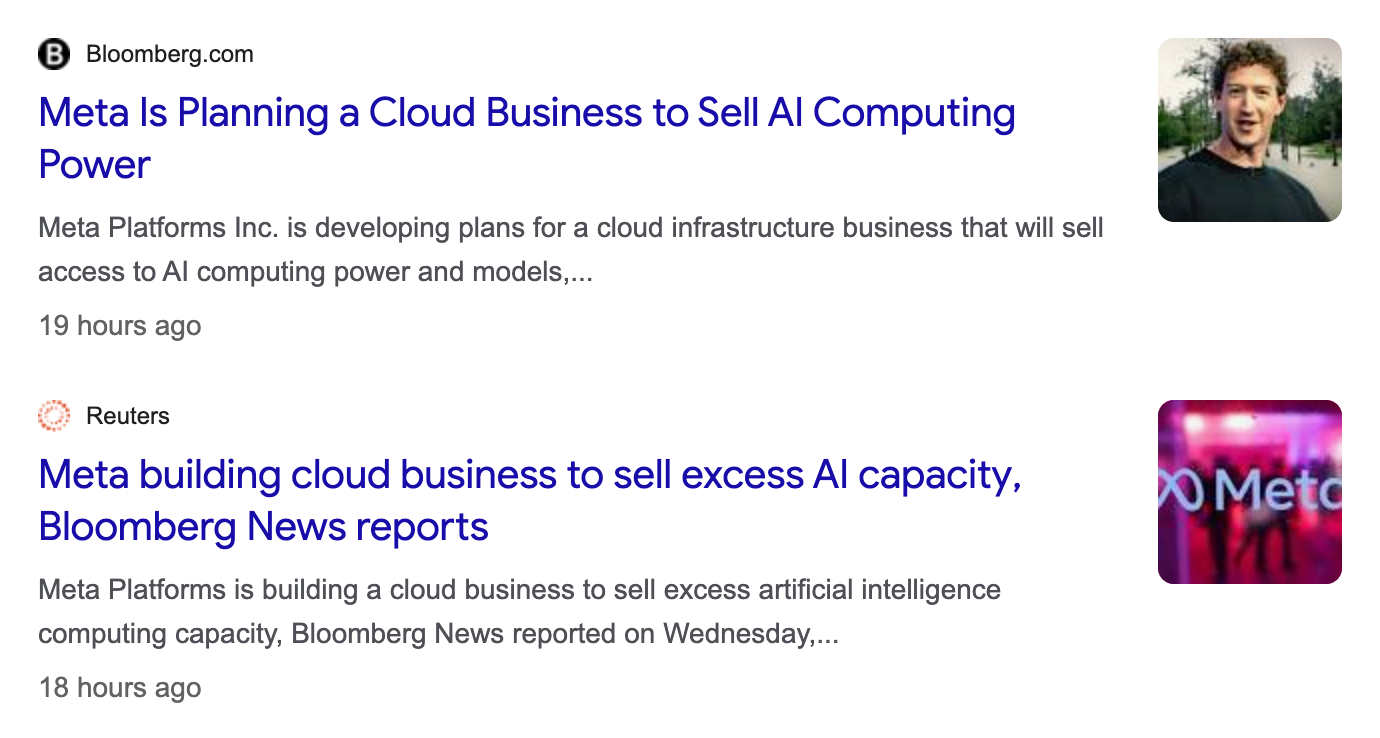
There are two key changes between the two headlines. Firstly, "is building" was changed to "is planning to build," which directly reduces the certainty and timeliness of the report. Secondly, the term "excess" was removed. However, this initial term easily led the market to interpret it as "computing power is already in excess," triggering a chain of reasoning: "excess computing power → capital expenditure peaking → weakening AI demand," ultimately causing market panic.

Taking a step back, even if it's confirmed that Meta intends to sell computing power, it's difficult to constitute sufficient grounds to conclude that the "AI capital expenditure cycle" has ended. From an industrial logic perspective, Meta itself is relatively behind in the AI race. The pressure it faces in foundational models and computing efficiency objectively determines that Meta has some degree of need for computing power scheduling and asset optimization. Against this backdrop, externalizing or commercializing part of its computing resources resembles an act of optimizing asset utilization rather than a systematic contraction on the demand side.

Such "computing power reallocation" is not uncommon in the AI industry chain. Two months ago, SpaceX also commercialized part of its computing resources (e.g., leasing to Anthropic). Essentially, this is a rebalancing act for cost and resource efficiency, not a negation of AI demand itself. Therefore, extrapolating the computing scheduling behavior of a single company, of an uncertain scale, directly to imply "industry-wide excess" represents a clear logical leap.

As for why the impact of this news was so severe, another crucial reason lies in the market structure. Prior to this round of decline, the semiconductor memory chip sector was already at relatively high levels, with concentrated holdings from trend-following funds and leveraged ETFs. Under such a structure, market sensitivity to marginal information significantly increases. Once a narrative shock occurs, it easily triggers amplified deleveraging and passive selling, transforming what might have been a "level of expectation adjustment" volatility into a "price stampede-level" correction.

Therefore, this correction more closely resembles a typical outcome of "sentiment panic + structural deleveraging" superimposed. Personally, I am also inclined to take the opportunity to add positions during this decline.

After all, SK Hynix itself is in the critical window for its U.S. listing. With a fundraising size nearing $30 billion USD, whether it's the underwriters or the institutional funds participating in the subscription, they likely wouldn't want the stock price to perform too poorly after the listing.

İlgili Sorular

QWhat is the main reason for the sharp drop in SK Hynix's stock price right before its U.S. listing?

AThe sharp drop was triggered by market speculation that 'Meta might release excess computing power,' which led to concerns that major tech companies might reduce capital expenditures. This caused a panic and a liquidity crunch, particularly affecting the semiconductor and memory chip sectors, including SK Hynix, whose Korean shares fell 14.57% in a single day.

QWhat is the purpose and scale of SK Hynix's upcoming ADR issuance in the U.S.?

ASK Hynix plans to issue American Depositary Receipts (ADRs) on Nasdaq to raise approximately 45.45 trillion Korean won (about $29.4 billion). The funds will be used entirely for expanding production capacity in South Korea, including the Yongin wafer fab, Cheongju advanced packaging lines, and investments in EUV and related equipment.

QWhy does the article suggest that the news about Meta's potential cloud business was likely overinterpreted by the market?

AThe article argues that the news was overinterpreted because Bloomberg initially used a headline stating 'Meta is building a cloud business to sell excess AI compute,' which was later changed to 'Meta is planning a cloud business to sell AI computing power.' The removal of the word 'excess' and the shift from 'is building' to 'is planning' reduced the certainty and immediacy of the report. The market's leap from this news to assuming an 'AI capital expenditure cycle' had ended was an exaggerated logical jump.

QAccording to the article, what are the three main reasons behind SK Hynix's decision to list in the U.S. at this time?

AThe three main reasons are: 1) SK Hynix is in a historically strong business cycle, driven by high demand for HBM (High Bandwidth Memory) in AI servers, creating an ideal 'cycle high financing window.' 2) The U.S. market offers higher valuation multiples and liquidity for AI-related assets compared to the 'Korea discount' prevalent in its home market. 3) The company needs massive capital to compete in the intense expansion race within the memory chip industry, aiming to convert capital advantage into production capacity advantage.

QWhat is the author's personal investment view on the recent decline of SK Hynix and the semiconductor memory sector?

AThe author personally views the sharp decline as more of an emotional panic and a structural deleveraging event (involving leveraged ETFs and trend-following funds) rather than a fundamental reversal of the industry trend. The author is inclined to see it as a buying opportunity, partly because the large-scale U.S. listing involves major underwriters and institutional investors who would not want the stock to perform poorly post-listing.

İlgili Okumalar

Ray Dalio's Latest Macro Analysis Full Text: Buy More Gold, Add Some Bitcoin

In his latest macro analysis, Ray Dalio applies his framework from "How Countries Go Broke: The Big Cycle" to the current global debt environment. He highlights recent events like Japan selling U.S. Treasuries and rising U.S. long-term yields as signs of an unsustainable debt dynamic. Dalio explains that excessive government debt leads to either unacceptably high interest rates, severe economic downturns, or significant currency debasement through central bank money printing. He summarizes the U.S. fiscal situation: with $5.5 trillion in revenue, $7.5 trillion in spending, a $2 trillion deficit, and total debt at six times annual revenue, debt servicing costs are immense. Without correction, U.S. debt could reach $55-$60 trillion in a decade. Dalio proposes a "3% Three-Way" solution: reducing the budget deficit to 3% of GDP through balanced spending cuts, tax increases, and interest rate reductions to avoid a traumatic adjustment. In response to FAQs, he argues that the risk of a U.S. debt crisis is high and could materialize within a few years if the current path continues. He dismisses the notion that the dollar's reserve status makes the U.S. immune, citing historical precedents of reserve currency declines. He is also unconvinced by Japan's high-debt stability, noting poor returns for yen-denominated assets. For investors, Dalio recommends diversifying globally, underweighting bonds, and overweighting assets like gold and a small allocation to Bitcoin (around 10-15% to gold) to hedge against currency debasement and poor debt returns.

marsbit16 dk önce

Ray Dalio's Latest Macro Analysis Full Text: Buy More Gold, Add Some Bitcoin

marsbit16 dk önce

Stripe’s 16-Year Chronicle: From 7 Lines of Code to a $100 Billion Valuation

Stripe's 16-year journey began with a simple promise: "7 lines of code to accept payments." Founded by Patrick and John Collison, the company started by hiding the complexity of bank integrations and merchant accounts behind a clean API, initially targeting developers at startups. This early focus on user experience and technical simplicity fueled rapid adoption. A key early milestone was establishing vital bank partnerships, a challenge overcome by hiring Billy Alvarado, who brought crucial institutional relationship skills. From this foundation, Stripe systematically expanded its product boundaries. It launched Connect for platform payments, Atlas for company formation, Radar for fraud prevention, and Billing for subscriptions. This transformed Stripe from a payment processor into a broader financial infrastructure suite for internet businesses. The COVID-19 pandemic accelerated growth but also led to over-hiring. A 14% layoff in 2022 marked a period of organizational correction. Subsequently, Stripe shifted its growth strategy towards strategic acquisitions to enter new domains quickly. It acquired Bridge (stablecoin infrastructure), Privy (wallet infrastructure), Metronome (usage-based billing), and agreed to buy OpenRouter (AI model routing). These moves signal Stripe's ambition to build a "programmable money system" for the emerging AI and agent-based economy, managing not just currency flows but also the measurement and pricing of computational resources like AI tokens. Internally, Stripe leverages AI agents (like "Minions") to boost engineering productivity. Despite scaling to nearly 8,000 employees and processing $1.9 trillion in payment volume annually, the company remains private. A recent employee tender offer valued it at $159 billion. The core question for Stripe's future is whether it can successfully integrate its expanding product matrix—spanning payments, crypto, and AI infrastructure—into a cohesive platform, positioning itself as the foundational economic layer for autonomous software agents.

marsbit45 dk önce

Stripe’s 16-Year Chronicle: From 7 Lines of Code to a $100 Billion Valuation

marsbit45 dk önce

Treasury Secretary's Move to Suppress Treasury Yields Ignites 'Currency Debasement Trade'! Gold Hits Three-Month High, Bitcoin Surges Over 25% in a Single Week

US Treasury Secretary Besant's efforts to lower long-term Treasury yields by announcing expanded buybacks had only a brief market impact. However, this move fueled a "currency devaluation trade," weakening the US dollar while boosting both gold (to a three-month high) and Bitcoin (up over 25% for the week). Analysts attribute this reaction to deepening market concerns over the massive US fiscal deficit and structural pressures keeping long-term rates elevated, including fierce competition for capital from global government borrowing and massive AI sector financing. Despite the Treasury's actions, fundamental forces like growth, inflation, and capital demand are seen as limiting its ability to sustainably suppress yields. Bitcoin's strong positive correlation with gold has reinforced its narrative as a hedge against devaluation. While equity markets have shown resilience, some strategists warn that Treasury yields nearing 5% increase pressure on the dollar and high-leverage assets. Figures like Ray Dalio have advised reducing bond exposure in favor of gold and some Bitcoin, citing US debt risks. Market opinions are divided on the sustainability of the devaluation trade, with some noting the lack of a near-term catalyst for its next leg higher. The underlying tension between the Treasury's desire for lower borrowing costs and the Federal Reserve's focus on inflation and reducing market intervention remains a key theme. Upcoming events like Nvidia's earnings and the Jackson Hole symposium will test whether AI profits can continue supporting stocks and if the Fed aligns more with Washington's preference for easier financial conditions.

华尔街日报2 saat önce

Treasury Secretary's Move to Suppress Treasury Yields Ignites 'Currency Debasement Trade'! Gold Hits Three-Month High, Bitcoin Surges Over 25% in a Single Week

华尔街日报2 saat önce

Alexander Shokhin: Business Needs an Interest Rate Below 10% and the Dollar at 90-95 Rubles

Alexander Shokhin, head of the Russian Union of Industrialists and Entrepreneurs (RSPP), has advocated for potentially using "non-market" tools to keep the ruble within a target exchange rate corridor. This, he argues on August 21, would help avoid excessive volatility, though he called the topic a separate discussion. Shokhin had previously raised the idea of a currency corridor in late May, noting the ruble's current exchange rate is not fully market-driven due to a limited currency segment and reduced foreign currency demand. He stated that many business community colleagues propose fixing a corridor, even through non-market methods, to ensure predictability. The business community's key targets, as outlined by Shokhin in late December 2025, are a Central Bank key rate of 12%, inflation of 4–5%, and a US dollar exchange rate of 90–95 rubles by the end of 2026. A turning point for investment, he said, would be lowering the rate to 12% with 6% inflation, though truly comfortable business conditions would require a rate below 10%. He stressed the critical importance of currency predictability for corporate investment decisions. From a data analysis perspective, the idea of a ruble corridor is not new. A similar mechanism was used in Russia from 1995 to 1998, where the central bank held the dollar within fixed boundaries through regular interventions. This regime lasted three years before ending abruptly during the 1998 default, illustrating the fragility of rigid targets under external shocks. The macro-economic link is clear: stricter corridors require more reserves to defend against currency pressure. The key unresolved technical aspect is the specific sources and volume of such interventions given the current market's limited liquidity. Whether this discussion remains theoretical or leads to concrete corridor parameters will be seen in the coming months.

cryptonews.ru4 saat önce

Alexander Shokhin: Business Needs an Interest Rate Below 10% and the Dollar at 90-95 Rubles

cryptonews.ru4 saat önce

İşlemler

Spot
活动图片