On-Chain Metrics Practical Guide: Identifying Real Signals, Avoiding Data Traps

比推2025-12-25 tarihinde yayınlandı2025-12-25 tarihinde güncellendi

Özet

A practical guide to on-chain metrics for traders, focusing on identifying genuine signals and avoiding data traps. Key concepts include distinguishing between transaction fees (user-paid costs), protocol revenue (actual earnings), and MEV (maximal extractable value), emphasizing that sustainable revenue matters more than high fees. Total Value Locked (TVL) is often misleading due to double-counting, incentive-driven "mercenary capital," and idle stablecoins. Traders should analyze TVL alongside transaction volume and incentives. Daily Active Addresses (DAA) can be inflated by bots and airdrop farmers; it’s only meaningful when correlated with fees and real activity. Cross-chain bridges enable asset transfers but carry risks like smart contract vulnerabilities and centralization. Monitor bridge volumes for liquidity flow insights. Stablecoin supply acts as crypto’s money supply (M2); increasing supply suggests market liquidity, while decreases may signal withdrawals. Token unlocks and emissions create sell pressure; avoid tokens nearing large unlocks unless trading short-term. The ratio of transaction volume to TVL indicates capital efficiency—high ratios reflect active usage, while low ratios suggest "ghost liquidity." In summary, on-chain metrics are analytical tools, not absolute truths. Cross-verify signals and interpret data contextually for informed decisions.

Written by: Dami-Defi

Compiled by: AididaoJP, Foresight News

Original title: A Practical Guide to On-Chain Metrics for Traders


On-chain metrics are something everyone talks about, but few truly understand. This guide will explain their true meaning in a simple and clear way, and how traders should use them.

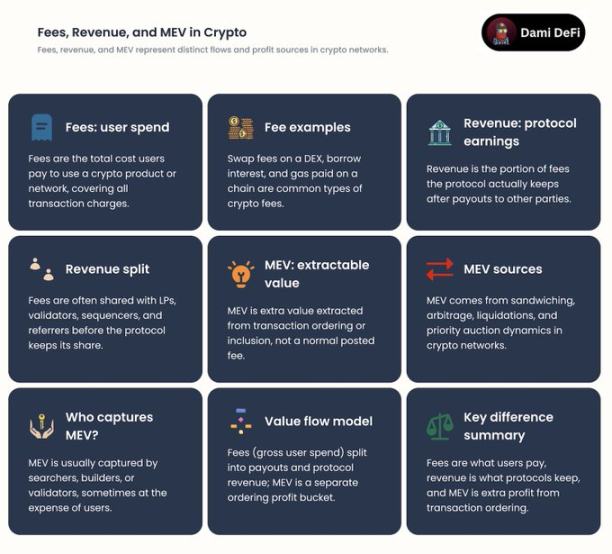
Fees vs. Revenue vs. MEV: The Real Earnings of a Chain

First, clarify a few concepts:

  • Fees: The cost users pay to conduct transactions.

  • Revenue: The portion ultimately kept by the protocol or validators.

MEV (Maximal Extractable Value): Additional profit validators gain by optimizing transaction ordering.

Key Point: High fees do not equal success. The real key is sustainable revenue. If users are driven away by $50 fees, this model is difficult to sustain.

Trader's Perspective:

Focus on public chains where real revenue is growing and the token model is reasonable. Models overly reliant on MEV are fragile; once trading volume declines or competition intensifies, prosperity can quickly fade.
TVL: The Three "Lies" of Total Value Locked

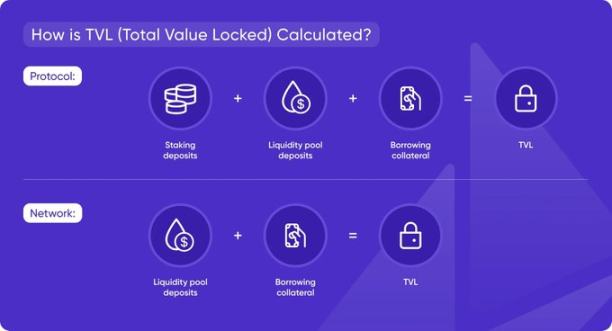
Total Value Locked represents the total capital locked in a protocol or chain. It shows market trust but can also be very misleading.

The Three "Lies" of TVL:

  • Double Counting: The same capital is collateralized across different protocols, inflating the total.

  • Incentive-Driven TVL: "Mercenary capital" arrives for short-term incentives and leaves quickly once rewards end.

  • Idle Stablecoins: Large amounts of funds sit in wallets, counted in TVL but never used.

Trader's Perspective:

Never look at TVL alone; it must be analyzed alongside trading volume and incentive programs. Real usage is far more important than vanity metrics.
DAA / Daily Active Addresses: Real Users or Market Noise?

Daily Active Addresses count the number of addresses that have performed operations on the chain. It is often used as a proxy for real users but is also easily manipulated.

Common Issues:

  • Bulk operations by bots.

  • Airdrop farmers creating massive numbers of addresses.

  • Protocol internal transfers inflating data.

Key Point: DAA is meaningful only when it grows in sync with fees, trading volume, and real activity. If the number of addresses surges while revenue stagnates, it's likely a manufactured metric.

Trader's Perspective:

Treat DAA as a secondary confirmation signal, not a primary buy indicator. It only serves to validate growth when supported by other fundamentals.
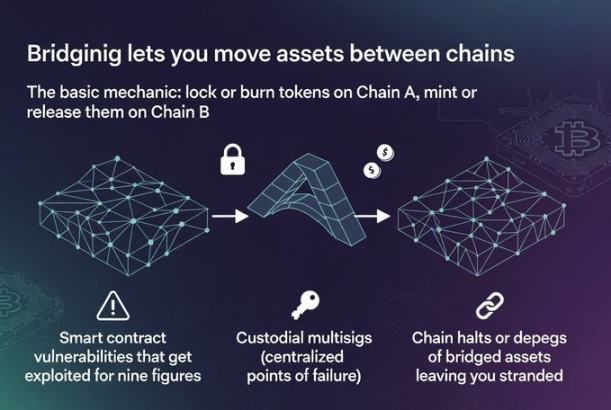
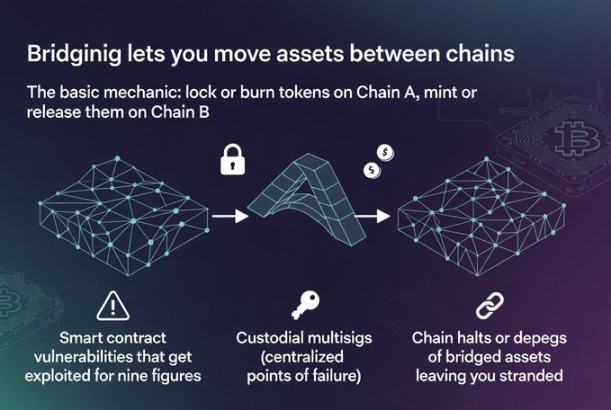
Cross-Chain Bridges: How Funds Move Across Chains and Where the Risks Lie

Cross-chain bridges enable the transfer of assets between different blockchains. The basic principle is: lock or burn tokens on Chain A, mint or release an equivalent amount on Chain B. The concept is simple, but the risks are complex.

Main Risks:

  • Smart Contract Vulnerabilities: Can lead to huge financial losses.

  • Custodial Multi-Sigs: Represent centralized points of failure.

  • Chain Outages or Asset De-pegging: Can result in assets being trapped.

Trader's Perspective:

Avoid storing large amounts of funds long-term on higher-risk cross-chain bridges. However, monitor the trading volume of bridges as a leading indicator of capital flow. For example, funds moving from Ethereum to an L2, or migrating between different ecosystems, signal changes that may present trading opportunities.
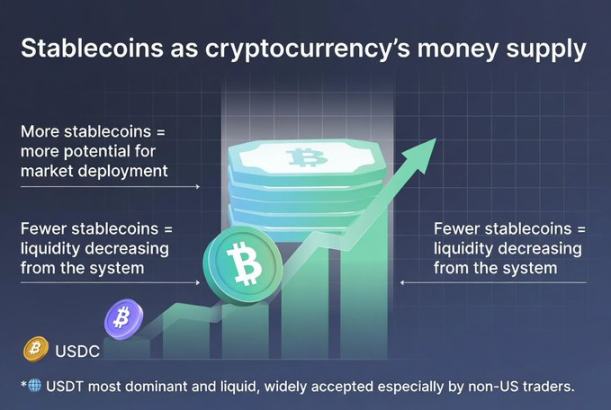
Stablecoins: The Money Supply of the Crypto World

Stablecoin supply is equivalent to the broad money supply (M2) of the crypto world.

  • Supply Increase: Means more "ammunition" waiting to enter the market.

  • Supply Decrease: Indicates liquidity is withdrawing.

Market Status:

USDT dominates due to its high liquidity and wide acceptance (especially favored by non-US traders). USDC is more transparent and compliant but has a slightly narrower usage.

Trader's Perspective:

A rising total stablecoin supply generally supports larger market trends; a shrinking supply means tightening liquidity, which can curb rallies. This is a crucial reference indicator for macro positioning.
Token Unlocks & Emissions: Future Selling Pressure

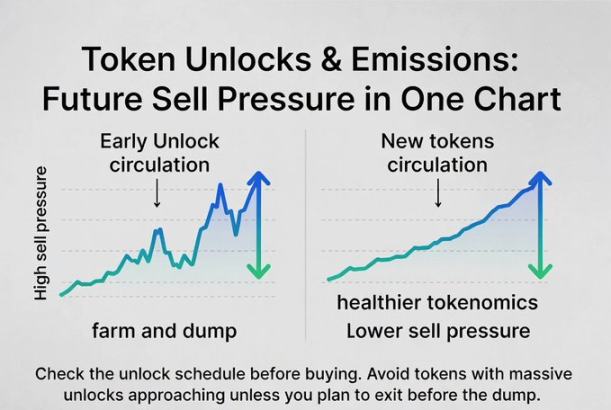
Unlocks and emissions mean new tokens entering the circulating market. Large-scale unlocks are often accompanied by automatic selling: teams cashing out, VCs reducing holdings, reward releases causing a supply surge.

Simple Judgment:

  • Early, High Unlocks: Often indicate a "farm-and-dump" model.

  • Long-term, Gradual Unlocks + Real Demand: Typically represent healthier tokenomics.

Trader's Perspective:

Always check the unlock schedule before buying. Avoid tokens nearing large unlocks, unless you are trading short-term and plan to exit before the selling pressure hits.
On-Chain Volume vs. TVL: Is the Capital Active or Dormant?

  • TVL: How much capital is deposited.

  • Volume: How frequently the capital moves.

A pool with a TVL of $100 million but a daily volume of only $5,000 is essentially "dead capital".

Key Ratio: Volume / TVL Ratio.

  • High Ratio: Capital is active, usage is high.

  • Low Ratio: Could be "ghost liquidity" or idle funds.

Trader's Perspective:

Look for protocols with solid TVL and strong trading volume. You need real usage, not fake prosperity.

Summary

On-chain metrics are not magic, but they are the closest thing to "financial statements" in the crypto world. Use them as analytical tools, not absolute truths. Always cross-verify multiple signals and constantly think about the real meaning behind the data.


Twitter:https://twitter.com/BitpushNewsCN

Bitpush TG Discussion Group:https://t.me/BitPushCommunity

Bitpush TG Subscription: https://t.me/bitpush

Original link:https://www.bitpush.news/articles/7598316

İlgili Sorular

QWhat is the key difference between 'fees' and 'revenue' in the context, and why is it important for traders?

AFees are what users pay to conduct transactions, while revenue is the portion that the protocol or validators ultimately keep. The key point is that high fees do not equal success; the true focus should be on sustainable revenue. This is crucial for traders because a model that drives users away with high fees (e.g., $50) is not sustainable in the long run.

QWhat are the three main 'lies' or misleading aspects of Total Value Locked (TVL) as discussed in the guide?

AThe three main misleading aspects of TVL are: 1. Double-counting, where the same capital is collateralized across different protocols, inflating the total. 2. Incentive-driven TVL, where 'mercenary capital' arrives for short-term rewards and leaves quickly afterward. 3. Idle stablecoins, where large amounts of capital are held in wallets, counted in TVL, but never actually used.

QWhy should traders be cautious about relying solely on Daily Active Addresses (DAA) as a metric?

ATraders should be cautious because DAA can be easily manipulated by bots performing bulk operations, airdrop farmers creating massive numbers of addresses, and internal protocol transfers inflating the data. DAA is only meaningful when it grows in sync with other fundamentals like fees, transaction volume, and real activity. It should be used as a secondary confirmation signal, not a primary buy indicator.

QAccording to the guide, what does the stablecoin supply represent in the crypto ecosystem, and how should traders interpret changes in it?

AThe stablecoin supply represents the broad money supply (M2) of the crypto world. An increase in supply means there is more 'ammunition' waiting to enter the market, typically supporting larger market trends. A decrease indicates that liquidity is being withdrawn, which can suppress price increases. This is an important macro indicator for traders to consider for overall market positioning.

QWhat is the significance of the 'Volume/TVL Ratio' for a protocol, and what does it indicate to a trader?

AThe Volume/TVL Ratio measures how actively the locked capital is being used. A high ratio indicates that the capital is active and being used efficiently. A low ratio suggests the presence of 'ghost liquidity' or idle funds, like a pool with high TVL but very low daily volume. Traders should look for protocols with solid TVL and strong transaction volume, as this indicates real usage rather than false prosperity.

İlgili Okumalar

Raising Interest Rates Is Not a Tech Killer, EPS Is: A Strategy for Discarding the Weak and Retaining the Strong After the AI Theme's Sharp Decline

**Summary: Rising Interest Rates Are Not the Killer of Tech; EPS Is: The "Keep the Strong, Ditch the Weak" Strategy After the AI Theme Plunge** The author argues that the sharp sell-off in tech and AI-related stocks, triggered by a strong US jobs report that heightened Fed rate hike fears, represents a "pullback to pick up passengers" rather than a "car crash." The true end of a tech bull market is not determined by an extra 25 basis point hike, but by industry overcapacity and the disproval of earnings per share (EPS) expectations. Historical analysis shows that during past rate hike cycles, the Nasdaq-100 often outperformed, provided EPS growth remained strong. The current phase is seen as a shift from a "broad narrative-driven rally" to a "focused verification stage" for AI. The investment strategy should be to "keep the strong, ditch the weak." * **Retain exposure** to high-conviction AI infrastructure leaders with clear order visibility, stable margins, strong cash flow, and upward EPS revisions (e.g., AI servers, advanced packaging, optical modules, key cloud suppliers). * **Reduce exposure** to high-beta, narrative-driven stocks with unclear profit paths (e.g., some quantum computing, space, or speculative chip stocks), especially on rebounds. Valuation concerns should focus on whether earnings can catch up to high multiples, not on high P/E alone. Crowded positioning signals a concentration into quality assets, not necessarily a market top. The upcoming Q2 earnings season will be a key validation point. The core principle is to hold stocks with proven EPS, while using macro events (CPI data, central bank meetings) to manage timing and risk.

marsbit35 dk önce

Raising Interest Rates Is Not a Tech Killer, EPS Is: A Strategy for Discarding the Weak and Retaining the Strong After the AI Theme's Sharp Decline

marsbit35 dk önce

The Largest IPO in History Ignites Heated Debate: Is SpaceX Worth $1.77 Trillion?

SpaceX's potential IPO is priced at $135 per share, aiming to raise $75 billion and valuing the company at approximately $1.77 trillion, which would make it the largest IPO in history. This valuation has sparked intense debate among investors. Bullish analysts, including major underwriters Goldman Sachs and Morgan Stanley, argue the valuation is justified by SpaceX's long-term potential. They see it not just as a rocket company but as a future leader in space infrastructure, with key growth drivers being Starlink satellite internet, low-cost rocket launches, and future AI-related ventures. They project revenues reaching hundreds of billions to trillions of dollars by 2030-2040. ARK Invest's model suggests a 2030 enterprise value could reach $2.5 trillion. Bearish analysts from independent research firms like Morningstar, PitchBook, and New Constructs contend the IPO price is excessively high, already pricing in unrealistic future growth. Using DCF and sum-of-the-parts models, they estimate fair value between $780 billion and $1.7 trillion, significantly below the IPO target. They highlight risks such as the speculative nature of AI projections, over-dependence on Elon Musk, high growth expectations, and corporate governance concerns. Trefis set a target price of just $79 per share. While both sides acknowledge SpaceX's unique position in commercial space, the core disagreement centers on whether the $135 share price offers a reasonable margin of safety or is overly optimistic. Despite the valuation controversy, reported strong demand for the IPO indicates significant market interest.

marsbit2 saat önce

The Largest IPO in History Ignites Heated Debate: Is SpaceX Worth $1.77 Trillion?

marsbit2 saat önce

After the Passage of the GENIUS Act and the CLARITY Act, What Is the Correct Architecture for On-Chain Yield?

The article discusses the evolution of on-chain credit, distinguishing three markets: overcollateralized crypto lending, unsecured lending (largely unsuccessful), and asset-backed credit (ABC). ABC, backed by identifiable real-world collateral with legal recourse, is identified as the fastest-growing category and the only one credibly addressing adverse selection—the core problem in credit where the riskiest borrowers self-select. Current growth in on-chain Real World Assets (RWAs), particularly tokenized private credit funds (e.g., Maple Finance, Centrifuge), is substantial but often merely "wraps" existing fund structures, inheriting their risks rather than solving adverse selection at the protocol level. The regulatory landscape is a key driver, with the US GENIUS Act (prohibiting stablecoin issuers from paying yield) and the proposed CLARITY Act (closing loopholes on indirect yield) set to redefine permissible yield-bearing products. This makes vaults (like ERC-4626) the critical architecture—they become the primary compliant vehicle for delivering yield, functioning as issuance, disclosure, distribution, and recovery mechanisms. The author's thesis is that the correct post-GENIUS/CLARITY architecture involves building ABC solutions where credit assessment, structure, and recovery are encoded directly into the smart contract vault layer, moving beyond mere tokenized fund wrappers to solve adverse selection fundamentally and ensure regulatory compliance.

Foresight News3 saat önce

After the Passage of the GENIUS Act and the CLARITY Act, What Is the Correct Architecture for On-Chain Yield?

Foresight News3 saat önce

İşlemler

Spot
Futures

Popüler Makaleler

BILL Nasıl Satın Alınır

HTX.com’a hoş geldiniz! Billions Network (BILL) satın alma işlemlerini basit ve kullanışlı bir hâle getirdik. Adım adım açıkladığımız rehberimizi takip ederek kripto yolculuğunuza başlayın. 1. Adım: HTX Hesabınızı OluşturunHTX'te ücretsiz bir hesap açmak için e-posta adresinizi veya telefon numaranızı kullanın. Sorunsuzca kaydolun ve tüm özelliklerin kilidini açın. Hesabımı Aç2. Adım: Kripto Satın Al Bölümüne Gidin ve Ödeme Yönteminizi SeçinKredi/Banka Kartı: Visa veya Mastercard'ınızı kullanarak anında Billions Network (BILL) satın alın.Bakiye: Sorunsuz bir şekilde işlem yapmak için HTX hesap bakiyenizdeki fonları kullanın.Üçüncü Taraflar: Kullanımı kolaylaştırmak için Google Pay ve Apple Pay gibi popüler ödeme yöntemlerini ekledik.P2P: HTX'teki diğer kullanıcılarla doğrudan işlem yapın.Borsa Dışı (OTC): Yatırımcılar için kişiye özel hizmetler ve rekabetçi döviz kurları sunuyoruz.3. Adım: Billions Network (BILL) Varlıklarınızı SaklayınBillions Network (BILL) satın aldıktan sonra HTX hesabınızda saklayın. Alternatif olarak, blok zinciri transferi yoluyla başka bir yere gönderebilir veya diğer kripto para birimlerini takas etmek için kullanabilirsiniz.4. Adım: Billions Network (BILL) Varlıklarınızla İşlem YapınHTX'in spot piyasasında Billions Network (BILL) ile kolayca işlemler yapın.Hesabınıza erişin, işlem çiftinizi seçin, işlemlerinizi gerçekleştirin ve gerçek zamanlı olarak izleyin. Hem yeni başlayanlar hem de deneyimli yatırımcılar için kullanıcı dostu bir deneyim sunuyoruz.

269 Toplam GörüntülenmeYayınlanma 2026.05.07Güncellenme 2026.06.02

BILL Nasıl Satın Alınır

ATWO Nedir

I. Proje TanıtımıArena Two, hayranların gerçek zamanlı etkinlik sonuçlarında aktif, tokenleştirilmiş bir rol oynamasına olanak tanıyan merkeziyetsiz bir etkileşimli platformdur. Hayranları pasif izleyicilere indirgeyen geleneksel yayıncılık modellerinin aksine, Arena Two, hayranların doğrudan gerçek zamanlı oy kullanmalarını ve sahadaki sonuçları etkilemelerini sağlamak için blok zinciri teknolojisini kullanır.II. Token BilgileriToken adı: ATWO(Arena Two)III. İlgili BağlantılarWeb sitesi:https://arenatwo.com/Keşif araçları:https://basescan.org/token/0x499D35eBE6cEe9B2Ac35Fd003fcBbeeB9CFc7B32Twitter:https://x.com/arenatwoXNot: Proje tanıtımı, resmi proje ekibi tarafından yayınlanan veya sağlanan materyallerden gelmektedir ve yalnızca referans amaçlıdır, yatırım tavsiyesi niteliği taşımaz. HTX, ortaya çıkan doğrudan veya dolaylı kayıplardan sorumluluk kabul etmez.

241 Toplam GörüntülenmeYayınlanma 2026.05.18Güncellenme 2026.06.02

ATWO Nedir

ATWO Nasıl Satın Alınır

HTX.com’a hoş geldiniz! Arena Two (ATWO) satın alma işlemlerini basit ve kullanışlı bir hâle getirdik. Adım adım açıkladığımız rehberimizi takip ederek kripto yolculuğunuza başlayın. 1. Adım: HTX Hesabınızı OluşturunHTX'te ücretsiz bir hesap açmak için e-posta adresinizi veya telefon numaranızı kullanın. Sorunsuzca kaydolun ve tüm özelliklerin kilidini açın. Hesabımı Aç2. Adım: Kripto Satın Al Bölümüne Gidin ve Ödeme Yönteminizi SeçinKredi/Banka Kartı: Visa veya Mastercard'ınızı kullanarak anında Arena Two (ATWO) satın alın.Bakiye: Sorunsuz bir şekilde işlem yapmak için HTX hesap bakiyenizdeki fonları kullanın.Üçüncü Taraflar: Kullanımı kolaylaştırmak için Google Pay ve Apple Pay gibi popüler ödeme yöntemlerini ekledik.P2P: HTX'teki diğer kullanıcılarla doğrudan işlem yapın.Borsa Dışı (OTC): Yatırımcılar için kişiye özel hizmetler ve rekabetçi döviz kurları sunuyoruz.3. Adım: Arena Two (ATWO) Varlıklarınızı SaklayınArena Two (ATWO) satın aldıktan sonra HTX hesabınızda saklayın. Alternatif olarak, blok zinciri transferi yoluyla başka bir yere gönderebilir veya diğer kripto para birimlerini takas etmek için kullanabilirsiniz.4. Adım: Arena Two (ATWO) Varlıklarınızla İşlem YapınHTX'in spot piyasasında Arena Two (ATWO) ile kolayca işlemler yapın.Hesabınıza erişin, işlem çiftinizi seçin, işlemlerinizi gerçekleştirin ve gerçek zamanlı olarak izleyin. Hem yeni başlayanlar hem de deneyimli yatırımcılar için kullanıcı dostu bir deneyim sunuyoruz.

166 Toplam GörüntülenmeYayınlanma 2026.05.18Güncellenme 2026.06.02

ATWO Nasıl Satın Alınır

Tartışmalar

HTX Topluluğuna hoş geldiniz. Burada, en son platform gelişmeleri hakkında bilgi sahibi olabilir ve profesyonel piyasa görüşlerine erişebilirsiniz. Kullanıcıların A (A) fiyatı hakkındaki görüşleri aşağıda sunulmaktadır.

活动图片