Off-Court "Financing" of $65 Million: Is World Brewing a Big Move in the Deep Bear Market?

marsbit2026-03-30 tarihinde yayınlandı2026-03-30 tarihinde güncellendi

Özet

World Foundation announced the completion of a $65 million WLD token OTC sale at an average price of $0.2719. The transaction involved four counterparties, with $25 million worth of tokens subject to a 6-month lock-up. Proceeds will support core operations, R&D, Orb hardware manufacturing, and ecosystem growth. WLD’s price has declined over 97% from its all-time high of $11.8 in March 2024, currently trading around $0.27. The token has faced pressure from market conditions, regulatory scrutiny, and ongoing token unlocks—approximately $14.79 million worth of WLD is unlocked daily. Amid the downturn, World published a research paper highlighting its privacy-preserving human identity system, combining iris-scanning Orb hardware with SMPC and ZKP to create a "Proof of Human" infrastructure. The project also introduced AgentKit, which uses World ID to verify human agents in AI applications. On April 17, World will host the "Lift Off" global launch event in San Francisco, featuring Sam Altman and CEO Alex Blania, focusing on World ID advancements and AI-era use cases.

Original Author: Ma He, Foresight News

On March 28, the World Foundation announced that it had completed an over-the-counter (OTC) sale of WLD tokens totaling $65 million, with an average transaction price of $0.2719. This transaction involved four counterparties, with the first settlement completed on March 20, 2026. Among these, $25 million worth of WLD tokens are subject to a 6-month lock-up period. The official statement indicated that the proceeds will be directly used for the project's core operations, research and development, Orb hardware manufacturing, and ecosystem development. All settlements were executed through the multi-signature address 0xE797 of World Assets.

In the current deep bear market environment, completing a token transaction of tens of millions of dollars is quite rare. The last major token financing by the World Foundation dates back to May 2025, when its subsidiary World Assets sold $135 million worth of WLD tokens to early supporters a16z and Bain Capital Crypto at market prices.
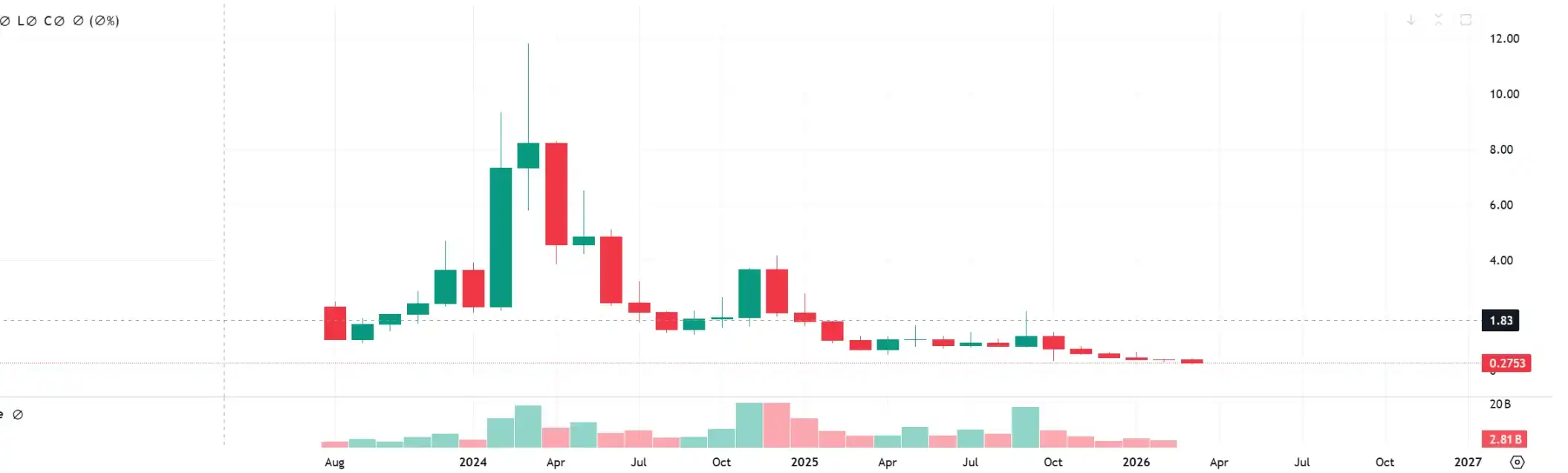
Looking back at the complete price trajectory of WLD in this cycle, it can be described as a textbook case from frenzy to reality. In July 2023, Worldcoin (now renamed World) officially launched WLD. With Sam Altman's personal endorsement, the AI large model boom, and the unique narrative of "Proof of Human Uniqueness," it quickly became a market focus.

In March 2024, driven by the Bitcoin halving cycle and the resonance of AI concepts, the price of WLD surged within a single month, reaching an all-time high of approximately $11.8. Its market capitalization once approached $10 billion. That year, global users showed unprecedented enthusiasm for registering World ID through Orb iris scanning, and the project was regarded as the top contender for Web3 identity infrastructure.

However, after the peak, it soon fell into silence. In the second half of 2024, with the overall crypto market correction, strict scrutiny from regulatory bodies like the EU on biometric data, and the emergence of the project's own large-scale unlocking pressure, the price of WLD began to plummet.

Throughout 2025, the price of WLD fluctuated repeatedly in the range of $0.5 to $1.5. Although the adoption rate of iris scanning steadily advanced, it fell far short of early expectations, and user growth significantly decoupled from narrative hype. Entering 2026, WLD continued to bottom out, recently hitting a new low of $0.2433 and currently hovering around $0.27, with a cumulative decline of over 97% from its all-time high.

In this cycle, the price trend of WLD resembles the trilogy of most altcoins: concept-driven → supply pressure →落地考验 (landing test). Early premiums were mainly driven by Altman's IP and the AI trend, while later stages were suppressed by continuous unlocking and macro tightening.

Interestingly, just before announcing the large OTC sale, on March 25, World's official website released a research report titled "Private Proof of Human: Critical Infrastructure for Humanity in a World with Advanced AI." The article directly addresses the core pain point of the AI agent era: how to establish a reliable and privacy-protecting "Proof of Human" infrastructure in a digital world flooded with machines.

The paper elaborates on the technical solution combining Orb iris scanning hardware with Secure Multi-Party Computation (SMPC) and Zero-Knowledge Proofs (ZKP). This approach not only efficiently verifies human uniqueness but also completely avoids the leakage of personal biometric data, making it more forward-looking and secure than traditional facial recognition or passport verification. This solution is positioned as the future foundation of internet trust, effectively countering deepfakes and AI bot attacks.

On March 26, Marc Andreessen, co-founder of a16z, shared this paper on platform X with a brief yet highly significant comment: It's time to prove human.
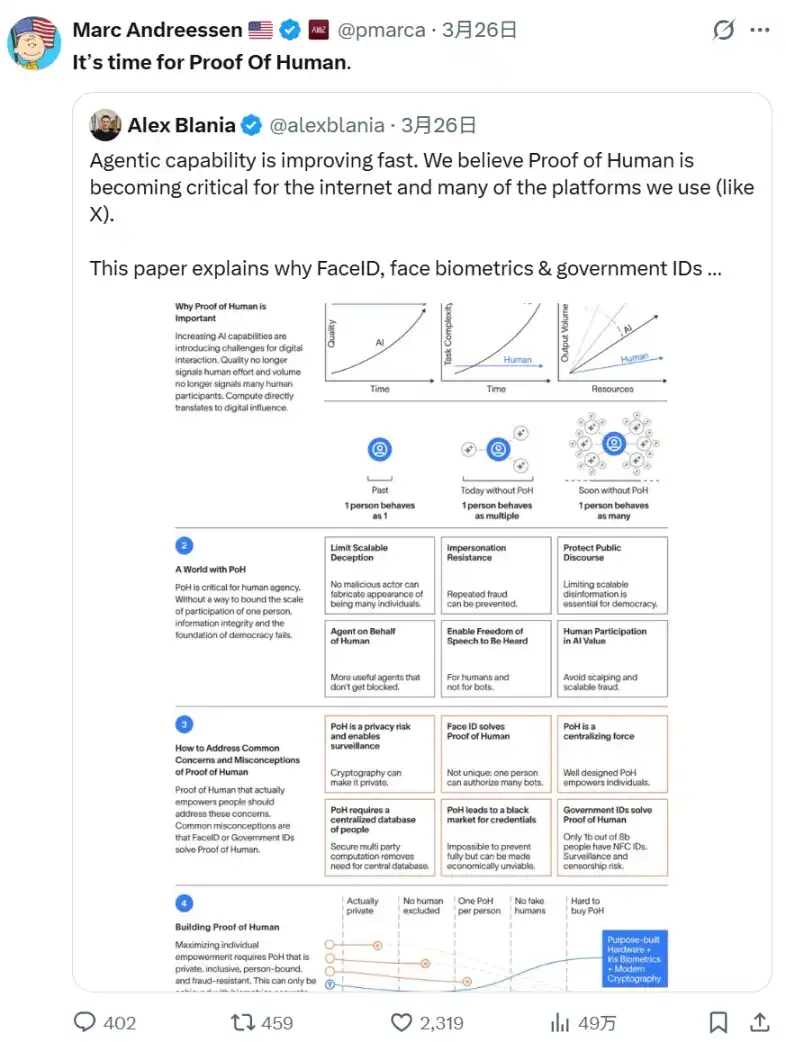
In the current era where AI is reshaping productivity, PoH (Proof of Human) will become a necessity to distinguish humans from machines and rebuild the trust layer of the digital economy.

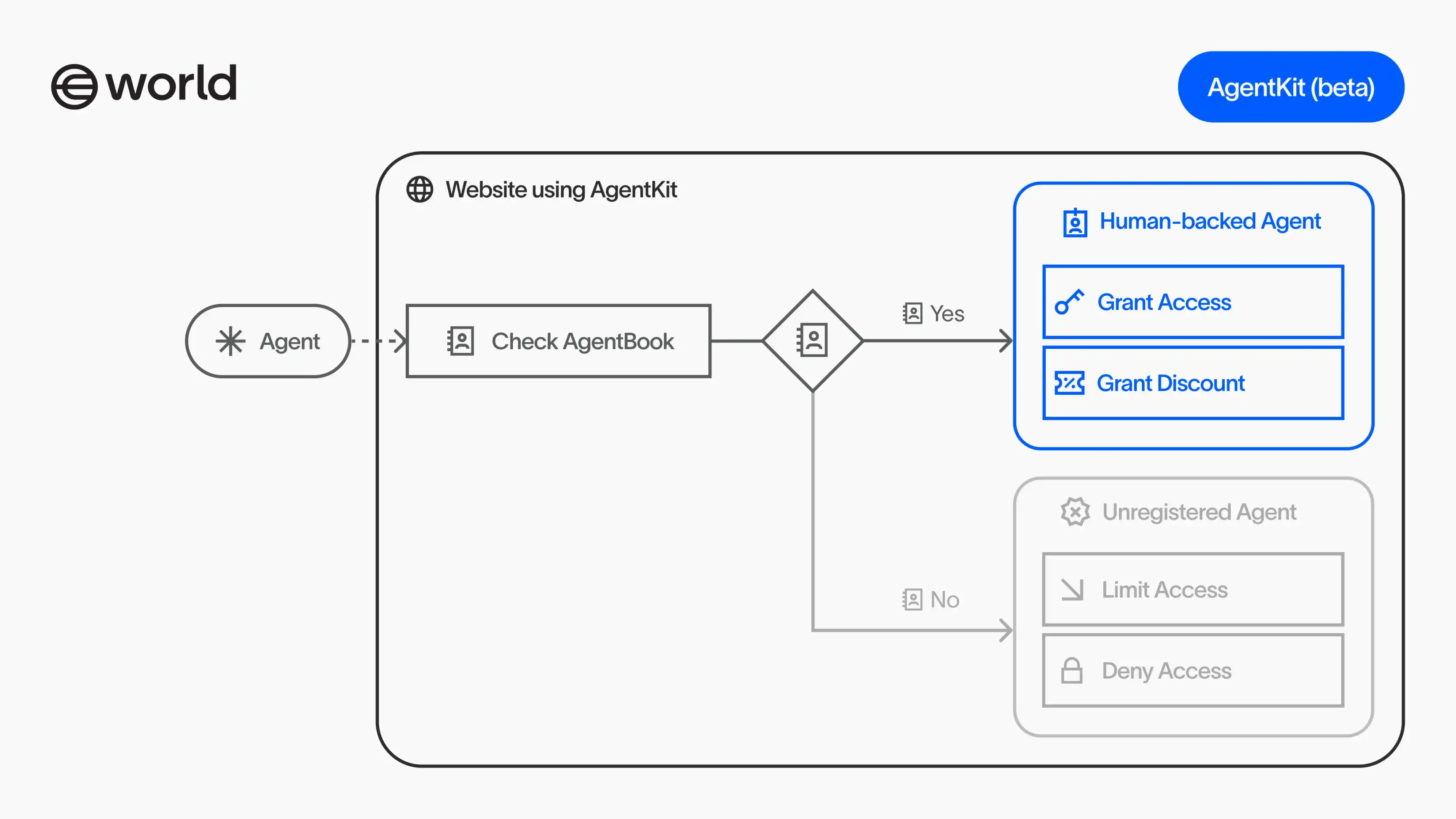
On March 17, World launched AgentKit. Its working principle involves Agents completing registration through World ID proof, linking wallets with anonymous human identities. The agent signs a standard identity verification challenge at a protected endpoint, and the agent's signature is matched with its associated human identity. Access is authorized upon successful matching. The official application scenarios state that AgentKit agents can also be applied to privacy protection, ticketing systems, access frequency limiting, and preventing Sybil attacks.
On April 17, World will host the "Lift Off" World ID global launch event in San Francisco, with Sam Altman personally attending and co-hosting alongside World CEO Alex.
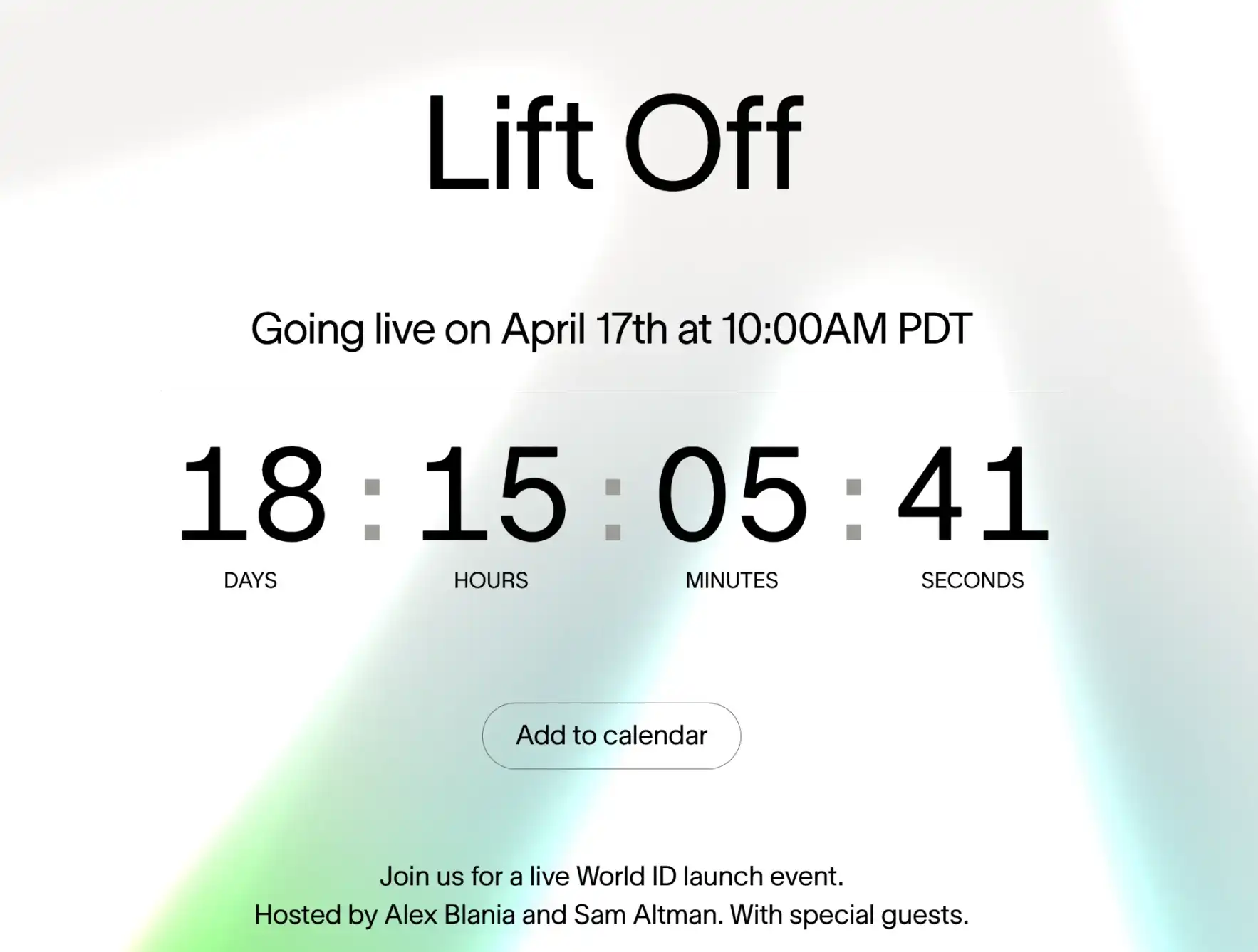
The conference theme focuses on the latest progress of World ID, Orb hardware iterations, and application scenarios for human verification in the AI era. Altman's presence itself symbolizes top-tier influence and confidence and may signal potential synergy between OpenAI and World—AI agents need authentic human identity endorsement, and World ID正好 (just) provides a decentralized solution.

Currently, WLD's market capitalization is $1.346 billion, with an FDV (Fully Diluted Valuation) of $2.758 billion. The proportion of unlocked tokens is 48.80%.
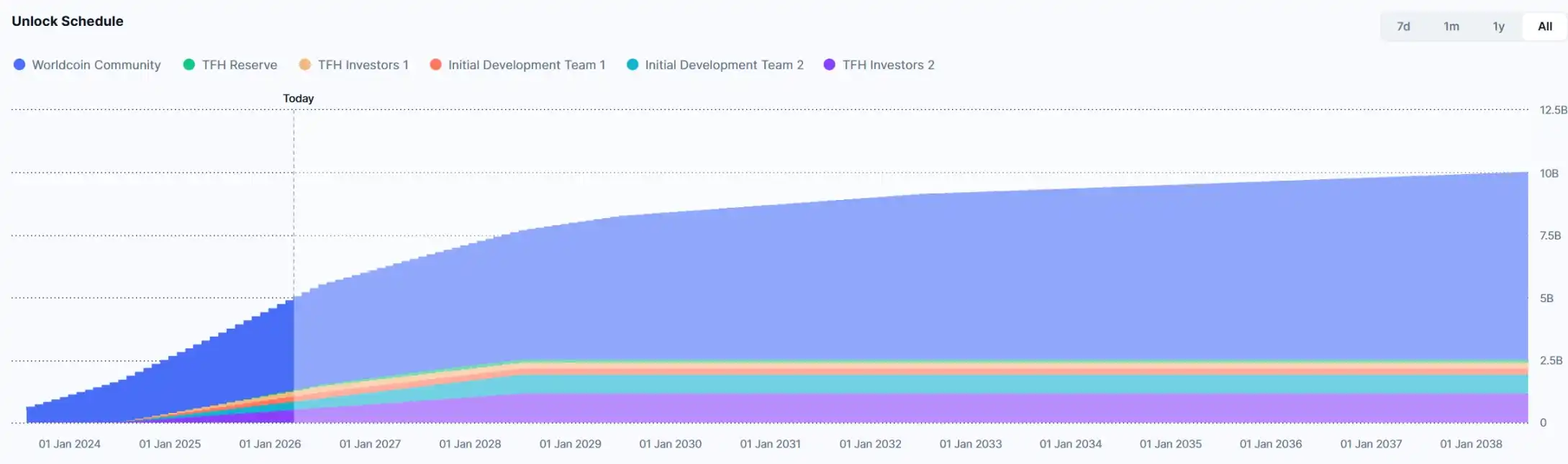
Additionally, WLD continues to unlock 0.05% of the maximum supply daily, approximately 5.32 million tokens, valued at about $1.479 million. Calculated at this rate, the value of tokens unlocked monthly is approximately $44.369 million, which is expected to continue exerting significant selling pressure on the market.


Trend Kriptolar

İlgili Sorular

QWhat was the total amount raised by the World Foundation through the OTC sale of WLD tokens, and at what average price?

AThe World Foundation raised a total of $65 million through the OTC sale of WLD tokens at an average price of $0.2719 per token.

QWhat are the primary uses of the funds raised from the WLD token sale, as stated by the official announcement?

AThe funds will be used for the project's core operations, research and development, Orb hardware manufacturing, and ecosystem growth.

QWhat significant event is scheduled for April 17th in San Francisco, and who are the key figures expected to attend?

AOn April 17th, World will host the 'Lift Off' global launch event for World ID in San Francisco, which will be co-hosted by Sam Altman and World CEO Alex Blania.

QWhat technological solution does World's research paper propose to verify human uniqueness while protecting biometric data?

AThe research paper proposes a solution that combines Orb iris-scanning hardware with Secure Multi-Party Computation (SMPC) and Zero-Knowledge Proofs (ZKP) to verify human uniqueness without storing or leaking raw biometric data.

QWhat is the current fully diluted valuation (FDV) of WLD, and what percentage of the total token supply has been unlocked so far?

AThe current fully diluted valuation (FDV) of WLD is $2.758 billion, and 48.80% of the total token supply has been unlocked to date.

İlgili Okumalar

Dialogue with Jia Hang | Looking Back at Two Decades of Chinese Payment Going Global

**Summary: A Conversation with Jia Hang on Two Decades of China's Payment Globalization** Jia Hang, a veteran with over twenty years in payments, reflects on China's attempts to build a global payment network through three key phases: UnionPay (card networks), Alipay+ (digital wallets), and now, stablecoins. His journey began at UnionPay International, aiming to establish China's card network abroad. While successful in following Chinese tourists ("where Chinese go, UnionPay goes"), it struggled to achieve true global scale. The core lesson: card networks like Visa/Mastercard's unassailable advantage isn't just technical standards, but their deeply entrenched **governance and profit-sharing models** that create powerful network effects. Competing as the "same species" is nearly impossible. At Ant Group, he led Alipay+, a strategy to bypass card networks by interconnecting local e-wallets worldwide. While innovative, it faced a similar ceiling. Mobile QR payments and card swipes were essentially **the same species competing for the same pie**, lacking a disruptive value proposition for users or a sustainable new incentive model to replace the card networks' established flywheel. Today, at Singapore's DCS, Jia focuses on stablecoin-based payments. He argues stablecoins represent a fundamental shift. They are not competing with Visa for consumer payments but challenging the **traditional banking and account system for value movement**. Products like "U Cards" (stablecoin-linked payment cards) are transitional, leveraging existing card networks for acceptance while building new rails. The real potential lies in stablecoins enabling seamless, low-cost global value transfer, potentially reorganizing the financial infrastructure around **accounts rather than cards**. Jia believes stablecoin adoption for local retail payments, cross-border transactions, and as high-yield savings vehicles is becoming irreversible. This could gradually reduce reliance on traditional fiat channels, especially in regions with weak currencies or capital controls. The quest for the "next global payment network" continues, now centered on whether stablecoins can successfully bridge Web2 and Web3, establish new governance, and create compelling user value beyond mere cost reduction.

marsbit10 dk önce

Dialogue with Jia Hang | Looking Back at Two Decades of Chinese Payment Going Global

marsbit10 dk önce

Circle's Stock Price Plunges 76%, Hong Kong Dollar Stablecoin Set to Launch Within Two Weeks

Circle's stock price has plunged approximately 76% from its 2023 peak, reflecting a major market revaluation. Despite this, Circle President Heath Tarbert emphasized the company's focus on long-term execution and its dominant position with USDC's $73 billion circulation across 34 blockchains. The competitive landscape is intensifying. A new consortium-backed stablecoin, Open USD, is attempting to challenge incumbents by sharing reserve yields with partners. More significantly, Visa's new stablecoin platform, initially supporting Open USD while also being compatible with USDC, could erode Circle's network effects. In response, Circle is expanding into real-world payments through partnerships like the one with Japan's JCB. Separately, Tether (USDT) faces a two-year compliance window under new U.S. regulations, requiring it to adjust its reserve composition away from assets like Bitcoin and loans towards cash and U.S. Treasuries. Meanwhile, in Hong Kong, Standard Chartered-backed fintech firm Dian Dian is poised to launch a licensed HKD-pegged stablecoin (HKDAP), moving the industry into a phase where the real test is integrating licensed stablecoins into actual payment flows and corporate treasury systems. The sharp decline in Circle's stock underscores a broader shift: the stablecoin market is moving from a winner-takes-all dynamic to a multi-player competitive arena where execution, compliance, and real-world utility are becoming paramount.

marsbit10 dk önce

Circle's Stock Price Plunges 76%, Hong Kong Dollar Stablecoin Set to Launch Within Two Weeks

marsbit10 dk önce

Amidst Capital's Encirclement, Decentralization is the Sole Defense for Public Blockchains

In a landscape dominated by power and profit motives, the author argues that decentralization is not merely one desirable feature among many in blockchain design—it is the singular, non-negotiable defense against corporate and capital capture. The article adopts a Machiavellian, realist perspective on human institutions, positing that businesses will inevitably attempt to co-opt any valuable network to protect their profits and dominance. While external attacks like 51% forks are often discussed, the greater existential risk is internal capture—the gradual erosion of a protocol’s neutrality by vested interests, as seen historically with platforms like Visa and Google. The piece critiques permissioned chains, highly centralized “permissionless” layer-1s, and layer-2s without sufficient decentralization (e.g., single sequencers) as inherently vulnerable. These compromised systems, promoted by established financial players, are framed as delaying tactics to stifle truly open networks that threaten existing high-fee, inefficient business models. Real-world examples, such as closed enterprise consortiums that exclude competitors, illustrate how such systems cement oligopolies rather than foster innovation. The author concludes that while decentralized protocols like Ethereum are imperfect and costly to operate, they represent the only viable long-term equilibrium. In a market where value naturally flows to the most secure and neutral settlement layer, only maximally decentralized public blockchains can resist being subsumed by capital and powerful incumbents.

Foresight News20 dk önce

Amidst Capital's Encirclement, Decentralization is the Sole Defense for Public Blockchains

Foresight News20 dk önce

Who Decides the Rules of Bitcoin? BIP-110 Ignites Governance Debate

Bitcoin's governance is once again at the center of a heated debate, this time ignited by BIP-110, the "Reduced Data Temporary Softfork." This proposal aims to curb non-monetary data (like inscriptions and Runes) by introducing seven new consensus-layer restrictions over a year, such as limiting new output scripts to 34 bytes and restoring the OP_RETURN cap to 83 bytes. The controversy stems from BIP-110's fundamental shift: it moves the battle against "spam" from node relay and miner policies to the consensus layer, rendering currently valid transactions invalid. Supporters, arguing that default policy governance has failed (highlighted by Bitcoin Core v30's relaxation of OP_RETURN limits), see this as necessary to protect node resources and Bitcoin's monetary focus. Opponents, led by figures like Michael Saylor and Adam Back, warn it dangerously centralizes governance. Saylor listed 110 reasons against it, criticizing its low 55% miner activation threshold and potential for chain splits. Back emphasized Bitcoin's "permissionless" ethos, arguing no single group should impose value judgments via consensus rules. Further complicating matters, technical critiques suggest BIP-110 may be technically circumventable, and a "BlockSlop" vulnerability in its upgrade path poses a consensus risk. The debate has drawn in diverse stakeholders: miners (with pools like Ocean signaling support and Foundry polling clients), node operators (like Bitcoin Knots), and new players like corporate treasury holder MicroStrategy (Saylor), whose market influence adds a novel dimension. Ultimately, BIP-110 acts as a governance stress test, exposing the unresolved question: who decides Bitcoin's rules? It pits the authority of miners, node operators, developers, and capital holders against each other, with each side claiming to defend Bitcoin's core principles of neutrality and security.

marsbit37 dk önce

Who Decides the Rules of Bitcoin? BIP-110 Ignites Governance Debate

marsbit37 dk önce

İşlemler

Spot

Popüler Makaleler

MOVE Nasıl Satın Alınır

HTX.com’a hoş geldiniz! Movement (MOVE) satın alma işlemlerini basit ve kullanışlı bir hâle getirdik. Adım adım açıkladığımız rehberimizi takip ederek kripto yolculuğunuza başlayın. 1. Adım: HTX Hesabınızı OluşturunHTX'te ücretsiz bir hesap açmak için e-posta adresinizi veya telefon numaranızı kullanın. Sorunsuzca kaydolun ve tüm özelliklerin kilidini açın. Hesabımı Aç2. Adım: Kripto Satın Al Bölümüne Gidin ve Ödeme Yönteminizi SeçinKredi/Banka Kartı: Visa veya Mastercard'ınızı kullanarak anında Movement (MOVE) satın alın.Bakiye: Sorunsuz bir şekilde işlem yapmak için HTX hesap bakiyenizdeki fonları kullanın.Üçüncü Taraflar: Kullanımı kolaylaştırmak için Google Pay ve Apple Pay gibi popüler ödeme yöntemlerini ekledik.P2P: HTX'teki diğer kullanıcılarla doğrudan işlem yapın.Borsa Dışı (OTC): Yatırımcılar için kişiye özel hizmetler ve rekabetçi döviz kurları sunuyoruz.3. Adım: Movement (MOVE) Varlıklarınızı SaklayınMovement (MOVE) satın aldıktan sonra HTX hesabınızda saklayın. Alternatif olarak, blok zinciri transferi yoluyla başka bir yere gönderebilir veya diğer kripto para birimlerini takas etmek için kullanabilirsiniz.4. Adım: Movement (MOVE) Varlıklarınızla İşlem YapınHTX'in spot piyasasında Movement (MOVE) ile kolayca işlemler yapın.Hesabınıza erişin, işlem çiftinizi seçin, işlemlerinizi gerçekleştirin ve gerçek zamanlı olarak izleyin. Hem yeni başlayanlar hem de deneyimli yatırımcılar için kullanıcı dostu bir deneyim sunuyoruz.

332 Toplam GörüntülenmeYayınlanma 2024.12.13Güncellenme 2026.06.02

MOVE Nasıl Satın Alınır

Tartışmalar

HTX Topluluğuna hoş geldiniz. Burada, en son platform gelişmeleri hakkında bilgi sahibi olabilir ve profesyonel piyasa görüşlerine erişebilirsiniz. Kullanıcıların MOVE (MOVE) fiyatı hakkındaki görüşleri aşağıda sunulmaktadır.

活动图片