NYSE Can't Sit Still, Plans to Launch 24/7 Tokenized Trading

比推2026-01-19 tarihinde yayınlandı2026-01-19 tarihinde güncellendi

Özet

The New York Stock Exchange (NYSE) is reportedly planning to launch a tokenized securities trading and on-chain settlement platform that would enable 7x24 hour trading of stocks and ETFs. This move, seen as a response to competitor Nasdaq's own application for tokenized stock trading submitted last year, represents a significant step by traditional finance into the digital asset space. The proposed "on-chain stock tokenization solution" includes features such as fractional share trading, stablecoin-based fund settlement, instant settlement, and plans to grant tokenized stocks equal dividend and governance rights as traditional securities. NYSE's parent company, ICE, is also collaborating with major banks to explore supporting infrastructure. Market reactions are mixed. Proponents view it as an inevitable fusion of traditional and crypto finance, bringing enhanced liquidity and modernized infrastructure like atomic settlement. Critics, however, express concerns that it primarily benefits exchanges and could negatively impact younger investors by creating a relentless trading environment. The approval process by the SEC is expected to take time, potentially not until late 2026, leaving a window of opportunity for existing crypto platforms that offer features like non-KYC trading and high leverage, which the NYSE platform is unlikely to provide. The core driver for traditional exchanges remains trading volume and fees, and their success is not guaranteed in this new competitiv...

Source: Odaily Planet Daily

Author: Wenser

Original Title: NYSE Plans to Launch 24/7 Tokenized Stock Trading, Leaving "Competitors" Stunned


As "Flash Crash Monday" continues, the crypto market has just been hit with another bombshell—according to multiple media sources, the New York Stock Exchange plans to launch a tokenized securities trading and on-chain settlement platform supporting 24/7 trading. After investing $2 billion in Polymarket last year, the ICE Group is once again leveraging its stock exchange to join the century-defining wave of cryptocurrency transformation.

It is worth noting that as early as last September, the "competitor" Nasdaq had already submitted an application to the SEC for tokenized stock trading. NYSE's move is also interpreted by the outside world as a response to competition among stock exchanges.

This article will briefly summarize market views related to this event and explore its potential impact.

NYSE Can't Sit Still: A More Aggressive "On-Chain Tokenization Solution for Stocks" Compared to Nasdaq

After Trump took office, the U.S. cryptocurrency regulatory environment underwent a significant shift. As a result, crypto IPOs, stablecoins, PayFi, and DeFi have developed rapidly, sweeping away the policy gloom of the Biden era. According to statistics, stablecoin trading volume reached $33 trillion last year, a sharp increase of 72% year-on-year. Behind this lies the substantial profits earned by stablecoin issuers Tether and Circle, as well as the massive liquidity that can be directed to the stock securities market.

Moreover, unlike Nasdaq's application to the SEC for tokenized stock trading last September, nearly half a year later, NYSE's moves related to "tokenized stock trading" are not just an application to regulators but a comprehensive "on-chain solution."

Specifically, NYSE's "on-chain tokenization solution for stocks" includes the following three aspects:

  • This is a tokenized securities trading and on-chain settlement platform, planning to support 24/7 trading of U.S. stocks and ETF funds, fractional share trading, stablecoin-based fund settlement, and instant delivery, while integrating NYSE's existing matching engine with a blockchain settlement system.

  • According to NYSE's plan, tokenized stocks will have the same dividends and governance rights as traditional securities.

  • NYSE's parent company, ICE, is also collaborating with banking giants such as BNY Mellon and Citigroup to explore tokenized deposits and clearing infrastructure to support cross-time zone, round-the-clock fund and margin management.
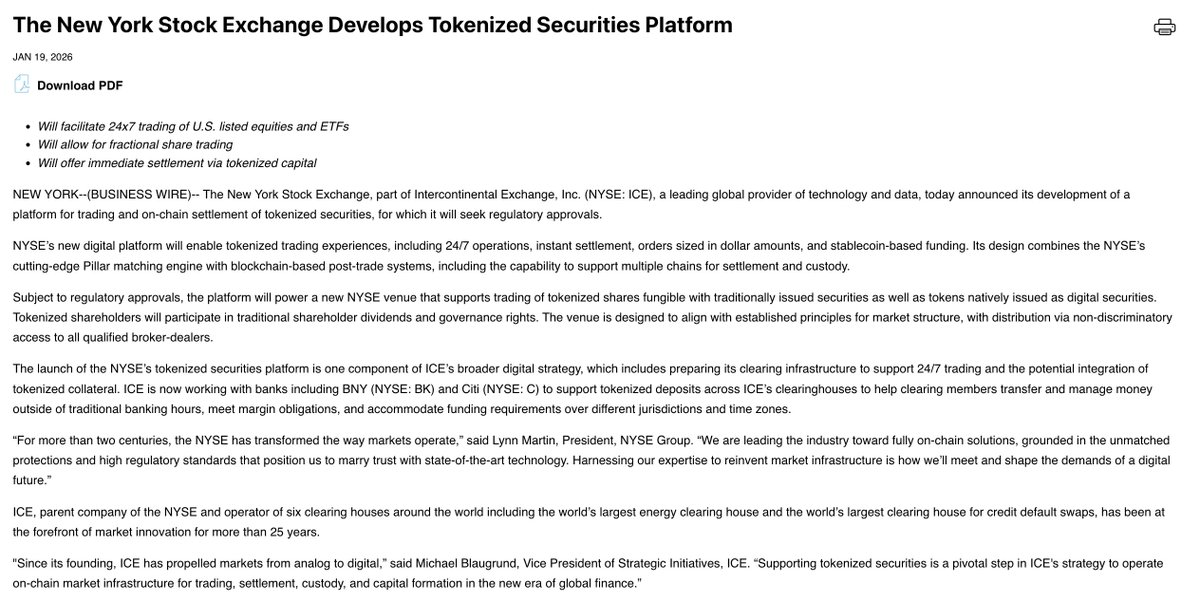
In comparison, if Nasdaq's tokenized stock application seems like a "new bottle for old wine" move in response to policy, NYSE's plan appears to be a "new retail trading platform" that integrates all aspects of "production-packaging-distribution-recycling."

Most importantly, NYSE's "tokenized stock" trading platform supports 24/7 trading, which was originally one of the advantages of various cryptocurrencies over securities and stocks. Now, this advantage becomes a joke in the face of the massive asset targets and liquidity of the world's largest stock exchange, NYSE.

As a result, there are some pessimistic views in the crypto market: "The RWA sector of the crypto market and its increasingly tight liquidity will face the strictest 'father.' Compared to NYSE's annual trading volume of over a hundred trillion dollars, crypto RWA projects can almost be said to not exist."

What Crypto Practitioners Think: Mixed Impacts, the Past Is the Past, the Present Is the Present

In 1792, 24 securities brokers signed the Buttonwood Agreement under a buttonwood tree outside 68 Wall Street in New York, marking the birth of the predecessor of the New York Stock Exchange. At that time, due to limited investment targets and market activity, stock trading hours were relatively flexible, with no strict continuous trading sessions. Brokers primarily conducted transactions through auctions or informal methods.

On March 8, 1817, the organization drafted a charter and officially changed its name to the New York Stock and Exchange Board.

In May 1887, NYSE standardized stock trading hours to "Monday to Friday: 10:00 AM to 3:00 PM; Saturday: 10:00 AM to 12:00 PM."

In 1952, Saturday trading was officially canceled.

In 1985, stock trading opening time was moved forward to 9:30 AM, and closing time extended to 4:00 PM, forming the current 9:30–16:00 session, which has lasted for about 41 years.

If NYSE's application for 24/7 tokenized stock trading is approved, it would mean that this decades- or even centuries-old "limited-time trading model" will become history. From this perspective, the crypto market has gained high recognition from mainstream finance.

Pro Views: The Era's Momentum Is Unstoppable

BTC OG and BankToTheFuture founder Simon Dixon posted, "Nothing can stop this (era's) train. Tokens are IOUs for actual assets held by custodians, supplementing DTCC claims. All-day trading is achievable without tokens. This is an upgraded version of the surveillance state. You will own nothing and be happy." The accompanying image showed BlackRock CEO Larry Fink and Coinbase CEO Brain Armstrong embracing.

Indian crypto KOL Open4profit posted, "(This will) allow the market to react immediately to global news; AI and algorithms will play a greater role in pricing and risk management; this is a significant change for the stock market—keep a close eye on liquidity changes."

Redstone DeFi co-founder Marcin saw a "startup opportunity," saying, "This is a good start and aligns with what we are going to do next."

Wintermute OTC head Jake O also highly affirmed the move: "Traditional infrastructure can extend trading hours but cannot solve T+1/2 friction or eliminate rent-seeking behaviors that increase costs and delays. Ironically, crypto solved this years ago: 24/7 trading, instant settlement, global access, no gatekeepers or (traditional banks') 'data fees.' Convergence is inevitable: equity trading on-chain, atomic settlement, the line between 'crypto' assets and 'traditional' assets will completely disappear. Welcome to the 21st century..."

Of course, some see it as an opportunity, while others see it as a threat.

Con Views: Exchanges Reap the Benefits, the Younger Generation Suffers

Unlike those in the industry who believe NYSE's move will stimulate the crypto market and promote cryptocurrency adoption, some insiders also see potential problems.

L1D partner LouisT posted: "The entire global financial system is moving on-chain, but somehow, they don’t seem to be bidding for our 'bear-drug-like' tokens." In other words, traditional financial market does not buy into the so-called RWA assets of cryptocurrencies.

MoonRock Capital founder expressed concern about the living conditions of the younger generation: "This is not good news for the baby boomers; your lives have become more difficult." He likely meant that compared to previous generations with more increments, baby boomers face a more complex investment environment and a round-the-clock "liquidity gaming stage."

BingX advisor Nebraskangooner also raised doubts: "Why make the stock market trade 24 hours? No one wants this except the exchanges. The only benefit is that without after-hours trading interference, stop-loss and take-profit points can truly function. Not sure what impact this will have on stock price movements after earnings reports?" This view focuses more on information impact and exchange profits.

Summary: A Gap Still Exists Between Traditional Finance and Crypto Natives, Opportunities for Users and Entrepreneurs Remain

Finally, I would like to share some personal views based on the above information:

First, based on current information, NYSE's related application may be approved as early as the end of 2026, with the main approval authority still being the U.S. SEC. For crypto platforms, this is an important time gap.

Second, NYSE's tokenized stock trading and on-chain settlement platform will likely primarily serve conventional investment institutions and compliant investors. For crypto-native groups and global investors, what they need is not just functional satisfaction but also the ability to achieve "KYC-free registered trading, global asset liquidity allocation, and riskier high-leverage" through tokenized stocks and RWA platforms. This may be the advantage of crypto RWA projects.

Finally, the core purpose of NYSE, Nasdaq, and others in promoting stock tokenization remains trading volume and fees. Like CEXs continuously listing new token projects, in the short term, they may still need to learn from CEXs, DEXs, and even on-chain Perp DEXs. This is also the basis for existing mature platforms to potentially counterattack. By then, it is not impossible for U.S. stock exchanges like NYSE and Nasdaq to fall from grace. The focus is still on where the liquidity is, where the attention is, and where the user base is.


Twitter:https://twitter.com/BitpushNewsCN

Bitpush TG Discussion Group:https://t.me/BitPushCommunity

Bitpush TG Subscription: https://t.me/bitpush

Original link:https://www.bitpush.news/articles/7603876

İlgili Sorular

QWhat is the New York Stock Exchange (NYSE) planning to launch according to the article?

AThe NYSE is planning to launch a tokenized securities trading and on-chain settlement platform that supports 7x24 hour trading, fractional share trading, stablecoin-based fund settlement, and instant settlement for U.S. stocks and ETF funds.

QHow does the NYSE's tokenized stock trading plan differ from Nasdaq's application submitted last year?

AUnlike Nasdaq's application, which was seen as a superficial response to policy changes, the NYSE's plan is a comprehensive 'on-chain solution' that integrates trading, settlement, and banking infrastructure, offering full-chain functionality rather than just a tokenized representation of existing stocks.

QWhat are some potential positive impacts of the NYSE's 7x24 hour tokenized trading platform as viewed by crypto industry insiders?

APositive impacts include immediate market reaction to global news, greater role of AI and algorithms in pricing and risk management, elimination of traditional settlement delays and friction, and the blurring of boundaries between crypto and traditional assets, marking a significant step into modern financial infrastructure.

QWhat concerns do critics have about the NYSE's proposed 24/7 trading platform?

ACritics worry that it primarily benefits exchanges by increasing trading fees, complicates risk management for retail investors (especially younger generations), and may negatively impact post-earnings price movements due to constant trading availability, with little actual demand for such extended hours from most market participants.

QWhat advantages might crypto-native RWA projects still hold over traditional exchanges like the NYSE entering tokenized trading?

ACrypto RWA projects can offer advantages like non-KYC registration, global liquidity allocation, higher leverage options, and riskier trading environments, which may appeal to crypto-native users and global investors seeking more flexible and permissionless access compared to the NYSE's likely focus on institutional and compliant investors.

İlgili Okumalar

Weekly Editor's Picks (0725-0731)

Weekly Editor's Picks (0725-0731) provides a curated selection of deep analysis, filtering out market noise. Key themes from this week include: **Macro & Policy:** The Federal Reserve's upcoming meeting is marked by high uncertainty, balancing cooling inflation data against persistent price pressures. Meanwhile, the U.S. crypto regulatory Clarity Act faces critical political hurdles, with its 2026 passage probability seen as low. **Investing & Crypto:** Analysis suggests long-term crypto success depends on conviction through volatile cycles, focusing on assets like Bitcoin and core smart contract platforms. A trend noted is the increasing similarity between global equity markets (especially tech) and crypto, driven by narrative and leverage. Several major crypto protocols show strong revenue growth, but this isn't always translating to token price appreciation due to sell pressure and structural factors. **AI & Semiconductors:** Nvidia's rising credit default swap rates signal market concern over AI infrastructure financing risks. The storage sector experienced volatility as markets began pricing in potential 2027 oversupply. Despite a record profitable quarter, SK Hynix's results were deemed "below expectations," reflecting heightened investor demands for future growth visibility. **Markets & DeFi:** TradeXYZ demonstrated remarkable accuracy in pre-market pricing for a major A股 listing. The token ONDO saw gains, linked to its growing role in the on-chain tokenized stock ecosystem. **Ethereum:** Post-Pectra upgrade, a major structural shift is underway as Lido begins migrating millions of ETH to new validator architectures designed for capital efficiency. **Also Highlighted:** Butian's bullish stock market move; OpenAI's Altman promising major advances; Samsung and SK Hynix securing large AI chip deals; Apple reaching a $5T market cap; and ongoing discussions around exchange security following Poolin's bankruptcy case.

marsbit28 dk önce

Weekly Editor's Picks (0725-0731)

marsbit28 dk önce

Low Investment Isn't Apple's Immunity Pass

While Meta and Google face investor scrutiny over ballooning AI capital expenditures, Apple's minimal AI investment has paradoxically become a strength. Its market cap recently reclaimed the global top spot, surpassing $5 trillion. The irony is deep: Apple's own AI efforts have lagged, with "Apple Intelligence" delayed and core talent lost, forcing reliance on partners like Google Gemini and Alibaba's Qianwen. Its Q3 FY2026 (Q2 CY) earnings initially seemed stellar. Revenue hit $109.4B (up 16% YoY), with iPhone and Mac sales, growing 22% and 29% respectively, driving most of the growth. However, the stock fell over 8% post-earnings. The primary concern was a weaker Q4 revenue growth forecast of 9-11%, below expectations, due to looming supply chain constraints. Apple is feeling the indirect cost of the AI boom. Soaring memory and chip prices, fueled by massive data center investments from Microsoft, Amazon, and others, are forcing Apple to raise Mac and iPad prices significantly. The upcoming iPhone launch is also expected to see substantial price hikes. Despite avoiding heavy AI infrastructure spending—its capital expenditures are actually down 28%—Apple cannot escape the industry-wide supply and cost pressures. While Apple's operating cash flow remains robust, its substantial R&D spending (up 32% YoY) has yet to yield major AI breakthroughs. As Tim Cook prepares to step down as CEO, Apple faces a challenging transition: balancing its premium hardware success against the strategic and cost pressures of the AI era it has so far cautiously navigated.

marsbit1 saat önce

Low Investment Isn't Apple's Immunity Pass

marsbit1 saat önce

PA Graphics Explanation | One Chart to Understand the Major Web3 Events in August 2026

**PANews Crypto Calendar: Key Web3 Events in August 2026** PANews introduces its revamped crypto calendar, featuring comprehensive coverage, flexible filtering, and easy export options. The market in August will be shaped by multiple key events across macroeconomics, regulation, tokenomics, and project developments: * **Macro & Policy:** Key US economic data releases (July Non-Farm Payrolls, CPI), the Federal Reserve meeting minutes, and the Jackson Hole Economic Symposium will be in focus. On the regulatory front, the US Senate plans to release a new draft of the *CLARITY Act*, while the EU's expanded crypto ban against Belarus comes into effect. * **Token Unlocks:** Significant token unlocks are scheduled for assets including ENA, AVAX, CONX, ZRO, and KAITO, which may influence market volatility. * **Project Updates & Shutdowns:** Several services, including Exchange Art, Ctrl Wallet, Zapper, NFTfi, and Summer.fi, are set to cease operations or undergo major adjustments. Users are advised to manage their assets accordingly. * **Corporate Activity:** Q2 earnings reports from companies like SpaceX, Circle, and Nvidia are due. Unitree Robotics will initiate its IPO subscription on the STAR Market, and Moonshot AI plans to begin a Pre-IPO financing round. * **Industry Events:** Major conferences such as Bitcoin Asia 2026 and the 2026 Digital Expo will take place. The overarching market narrative for August will revolve around macroeconomic expectations, regulatory developments, token unlock schedules, and ongoing industry consolidation.

marsbit1 saat önce

PA Graphics Explanation | One Chart to Understand the Major Web3 Events in August 2026

marsbit1 saat önce

Wall Street's Most Famous 'Cassandra' Now Has His Sights Set on Nvidia

Michael Burry, the famed "Big Short" investor, has once again captured Wall Street's attention with a series of short positions against major tech and semiconductor stocks, most notably Nvidia. In late June and July, through his "Cassandra Unchained" newsletter, Burry disclosed short bets against Nvidia, Tesla, Applied Materials, Caterpillar, the SOXX semiconductor ETF, and later, Micron Technology. His core thesis revolves around potential distortions in the AI infrastructure boom, specifically questioning whether extended depreciation schedules (e.g., 6 years vs. a realistic 2-3 years for AI chips) by cloud giants like Microsoft and Google artificially inflate profits. He also raises concerns about possible "off-balance-sheet circular financing," where chip demand might be propped up by vendor-backed funding to clients. Nvidia's stock experienced volatility following these disclosures, briefly dipping but largely holding near Burry's reported entry points, leaving his positions roughly flat or slightly underwater as of late July. This move is part of a pattern for Burry, whose track record since his legendary 2008 bet is mixed. He has faced notable losses, such as on Tesla in 2021, while scoring on broader market turns like the 2020 pandemic crash. His methodology focuses intensely on free cash flow and scrutinizing original financial documents to spot overvaluation and structural risks, but it often struggles with timing the market. The article contrasts Burry's stance with other prominent investors. Steve Eisman, another "Big Short" figure, is not shorting Nvidia, citing strong fundamentals but expressing nervousness about sustainability. Jim Chanos agrees with the broad "accounting mismatch" concern—comparing it to the dot-com bubble—but targets financial leverage in private equity firms rather than the chip stocks themselves. While Nvidia's short interest remains relatively low at 1.3-1.4% of float, the massive stock size means absolute short losses have been significant, exceeding $5 billion earlier this year. The piece concludes that for ordinary investors, the key takeaway is not replicating specific short bets but learning from the critical frameworks these investors use: questioning rosy accounting, identifying structural vulnerabilities, and maintaining skepticism during market euphoria, even if pinpointing the exact catalyst for a downturn remains elusive.

marsbit1 saat önce

Wall Street's Most Famous 'Cassandra' Now Has His Sights Set on Nvidia

marsbit1 saat önce

İşlemler

Spot
活动图片