NVIDIA Q4 Revenue Surges 73%, Q1 Guidance 'Explosive' Hits New High, Jensen Huang Raises 500 Billion Revenue Forecast

marsbit2026-02-26 tarihinde yayınlandı2026-02-26 tarihinde güncellendi

Özet

NVIDIA reported record-breaking Q4 FY2026 results, with revenue surging 73% year-over-year to $68.13 billion, significantly exceeding analyst expectations. Non-GAAP EPS grew over 80%, and gross margin reached a new high of 75.2%. The Data Center segment was the primary growth driver, with revenue up 75% to $62.31 billion, fueled by strong demand for AI computing and a 263% surge in Networking revenue. Gaming and Professional Visualization also saw robust growth. For Q1 FY2027, NVIDIA provided strong guidance, forecasting revenue of approximately $78 billion (up nearly 77% YoY), again surpassing consensus estimates. The company noted this outlook excludes Data Center compute revenue from China. CEO Jensen Huang raised the company's chip revenue target, stating they will exceed the previously stated $500 billion goal for orders through 2026, driven by next-generation Rubin chips and sustained AI demand. However, the stock experienced volatility post-earnings as investors weighed concerns over AI economic overheating and a change in non-GAAP accounting to include stock-based compensation.

Author:Li Dan

Amid recent investor panic fueled by a series of product releases from Anthropic and Citrini's "doomsday report," the AI boom has withstood a direct test. NVIDIA delivered "explosive" earnings, proving that the demand generated by AI remains strong.

On Wednesday, February 25th, US Eastern Time, NVIDIA announced that for the company's fiscal fourth quarter ("Q4") ended January 31, 2026, revenue reached a record $681 billion, a surge of approximately seventy percent year-over-year. The core data center business, contributing over ninety percent of revenue, also set a new quarterly revenue record, both exceeding analyst expectations by over 3%.

NVIDIA's profitability in QQ4 was equally robust. On a non-GAAP basis, adjusted earnings per share (EPS) increased by over eighty percent year-over-year, approximately 5.9% higher than analyst expectations. The gross margin also climbed beyond expectations to 75.2%, reaching a new high in a year and a half.

Even more encouraging for investors was NVIDIA's guidance for the first quarter of fiscal year 2027 (Q1), which was stronger than expected. Revenue is expected to set another record high, with the midpoint of the guidance range being 7.1% higher than the analyst consensus midpoint and even 4% higher than the optimistic expectations of buy-side analysts. The year-over-year growth rate accelerated compared to QQ4 to nearly 77%. NVIDIA noted that this guidance excludes data center computing revenue from the China market.
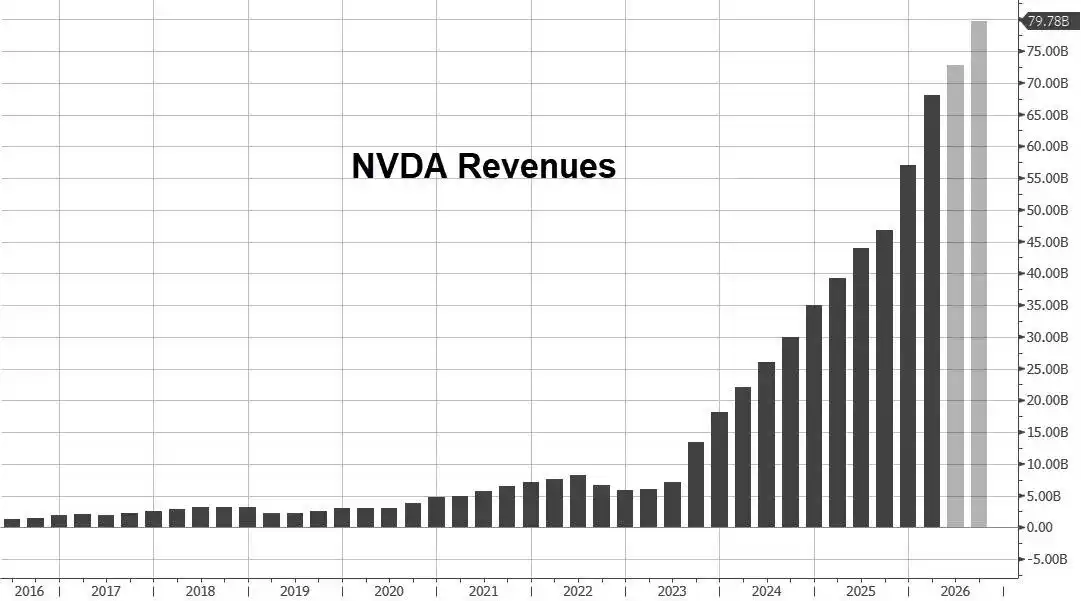
During the earnings call this Wednesday, NVIDIA CEO Jensen Huang also raised the chip revenue forecast he had previously provided, stating, "We will exceed the $500 billion target. Supply will meet demand through next year and beyond." At the GTC conference last October, Huang revealed that NVIDIA had collectively received chip orders worth $500 billion for the calendar years 2025 and 2026, including the next-generation Rubin chip, which will begin mass production this year.

Huang stated that customers are racing to invest in AI computing. Computing demand is growing迅猛ly. The use of agents by enterprises is surging. He mentioned "space data centers," saying the current economics of space data centers are still "barren," but the situation will change over time.

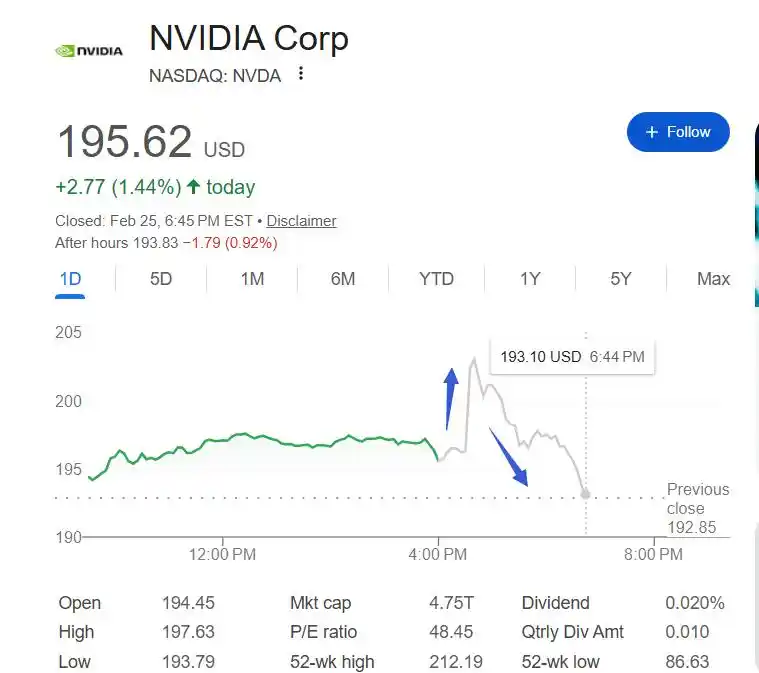
After the earnings release, NVIDIA's stock price, which had already closed up over 1% on Wednesday, surged in after-hours trading, with gains rapidly widening to over 4%. Analysis suggests the key reasons the market bought into it were: Data center revenue and total revenue both exceeded expectations; the gross margin continues to improve as production of the new Blackwell architecture chips ramps up; and the guidance for the current fiscal quarter is even stronger despite excluding some China market revenue, reinforcing the narrative of resilient AI computing demand.

However, during the conference call, NVIDIA's stock price continued to give up its gains, turning negative in after-hours trading and falling over 1%. Some commentary noted that the stock's turn lower indicates investors were not impressed by the latest guidance, suggesting that market concerns about an overheated AI economy will continue to haunt NVIDIA. Other analysis pointed out that operating expenses continue to grow rapidly, and the inclusion of stock-based compensation (SBC) in non-GAAP metrics starting in Q1 may temporarily alter investors' perception of "profit growth."
Q4 Revenue Hits Quarterly Record, Gross Margin Reaches 1.5-Year High

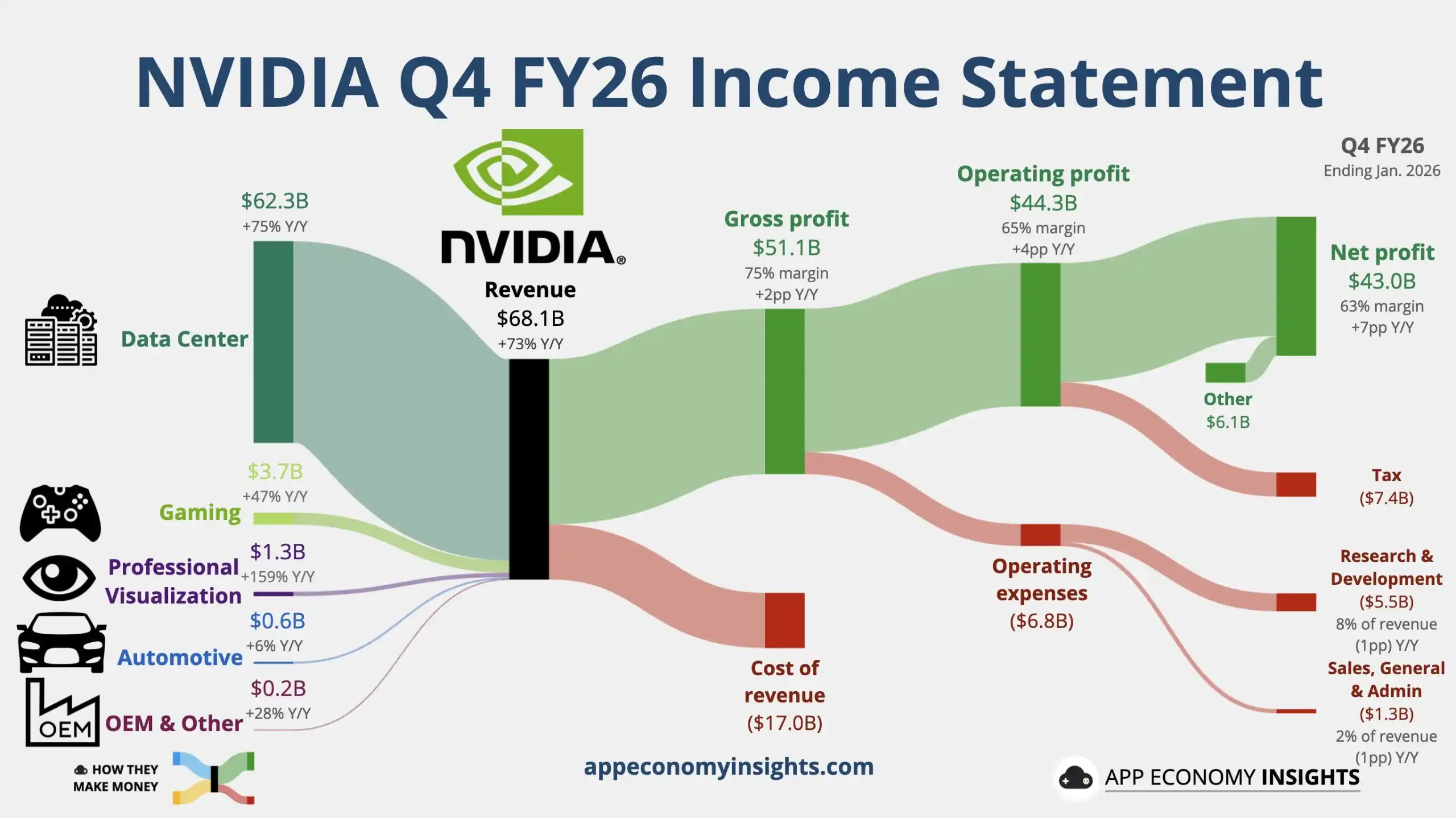
NVIDIA's QQ4 revenue grew 73% year-over-year to $681.27 billion, a growth rate significantly higher than the previous quarter's 62% and exceeding NVIDIA's own guidance midpoint of $650 billion. Analysts had expected revenue of $659.1 billion, representing approximately 68% year-over-year growth. For the full fiscal year, NVIDIA's revenue also set an annual record, reaching $2,159.38 billion, a 65% increase compared to the previous year.

Gross margin was another highlight in QQ4: the non-GAAP gross margin was 75.2%, up 1.7 percentage points year-over-year and 1.6 percentage points sequentially, reaching the highest level since Q2 of fiscal year 2025. This exceeded the analyst consensus expectation of 74.7% and the optimistic expectation of 75.0%.

NVIDIA CFO Colette Kress interpreted this, stating that the year-over-year improvement in gross margin came from "reduced inventory charges," while the sequential improvement was related to the "improved product mix and cost structure" brought by the continued volume ramp of Blackwell chips.

However, for the entire 2026 fiscal year, the non-GAAP gross margin declined, falling from 75.5% in the previous fiscal year to 71.3%, a decrease of 4.2 percentage points year-over-year, indicating that full-year profit margins were still subject to structural disruptions during the platform transition and supply ramp phase.
Data Center: Compute Growth Stabilizes, Networking Accelerates

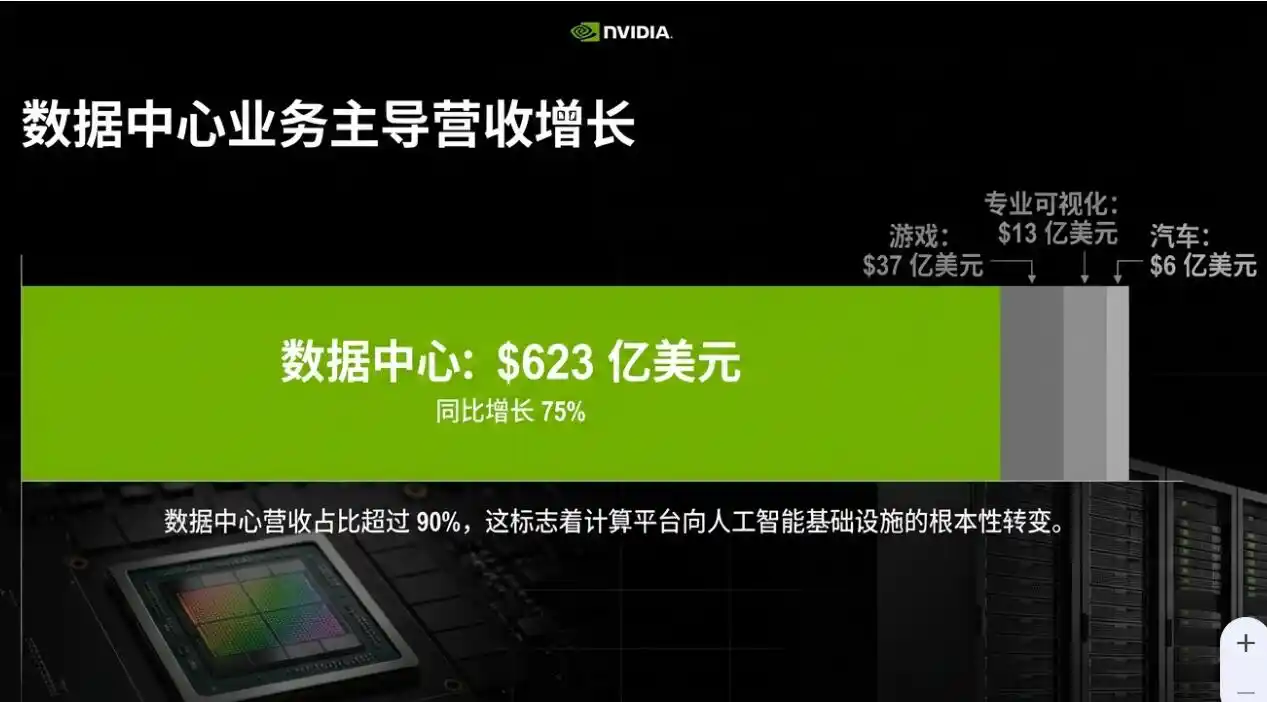
In QQ4, NVIDIA's Data Center business recorded revenue of $623.14 billion, a 75% increase year-over-year, with growth higher than the 66% in the previous quarter. Analysts had expected a near 70% year-over-year increase to $603.6 billion.
Within the Data Center segment, NVIDIA provided two sets of numbers that are even more noteworthy:

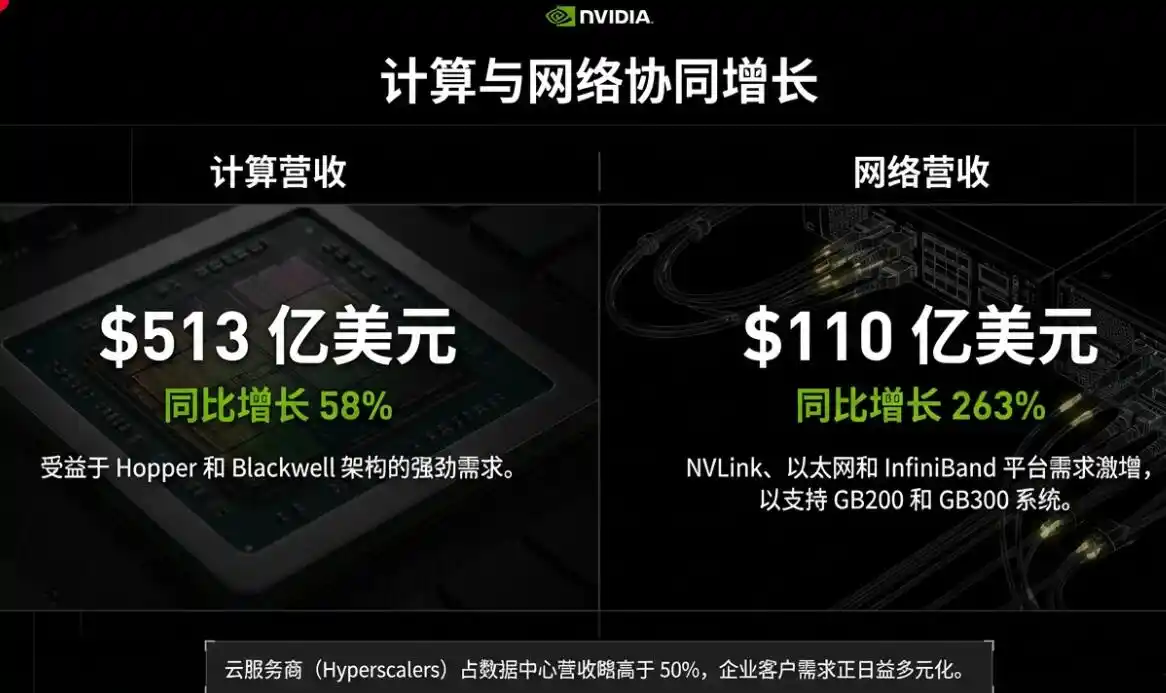
  • Data Center Compute revenue was $513.34 billion, up 58% year-over-year, with growth slightly higher than the 56% in Q3.
  • Data Center Networking revenue was $109.80 billion, up 263% year-over-year, far exceeding the 162% growth in Q3.

NVIDIA attributed the explosion in Networking revenue to: the launch and continued ramp of the NVLink compute fabric for GB200 and GB300 systems, coupled with continued growth in Ethernet and InfiniBand platforms.

In other words, the market should not only focus on the shipment pace of the GPUs themselves but also see that NVIDIA is packaging "computing power, interconnect, and systems" into an overall solution that is harder to replace. The high growth rate of Networking revenue is the financial reflection of this strategy.

Regarding customer structure, the company disclosed: In QQ4, revenue from hyperscale cloud providers accounted for slightly over 50% of the total Data Center business revenue, remaining the largest customer category. However, growth in the quarter came more from other data center customers, indicating a diffusion of revenue sources and a marginal mitigation of concentration risk.
Blackwell Drives Gaming Demand, Short-Term Disruptions from Supply and Channels

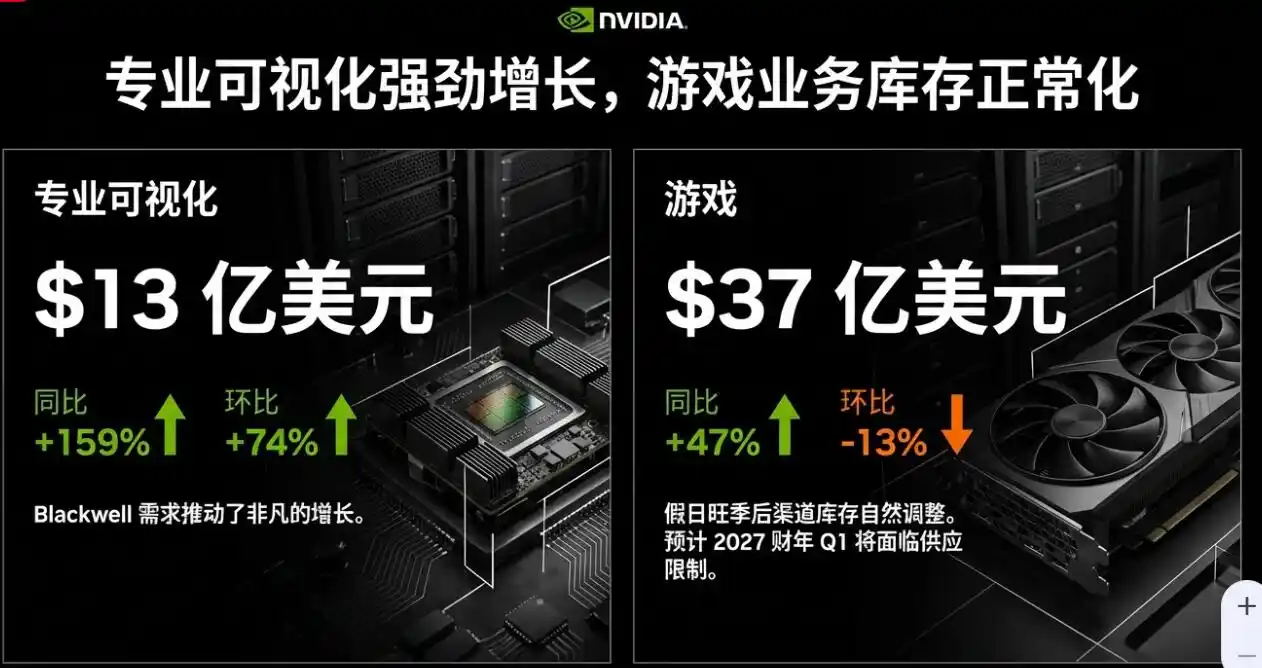
NVIDIA's Gaming business revenue in QQ4 was $37.27 billion, a 47% increase year-over-year. Analysts had expected $40.1 billion. The previous quarter saw 30% year-over-year growth.

The accelerated year-over-year growth in the Gaming business in QQ4 was explained by NVIDIA as primarily driven by strong demand for Blackwell chips. However, revenue for this segment decreased 13% sequentially due to a "natural post-holiday season channel inventory drawdown." Notably, NVIDIA explicitly warned: Supply constraints are expected to be a headwind for the Gaming business in Q1 and beyond.

Professional Visualization revenue in QQ4 was $13.21 billion, a 159% increase year-over-year. Analysts had expected $7.707 billion. The previous quarter saw 56% year-over-year growth.

Professional Visualization also saw revenue more than double year-over-year and grow 74% sequentially, driven by Blackwell, becoming one of the brightest incremental businesses besides Data Center. However, the scale of this business is far smaller than Data Center.
Q1 Revenue Guidance Midpoint Indicates ~77% YoY Growth, Excludes China Data Center Compute Revenue

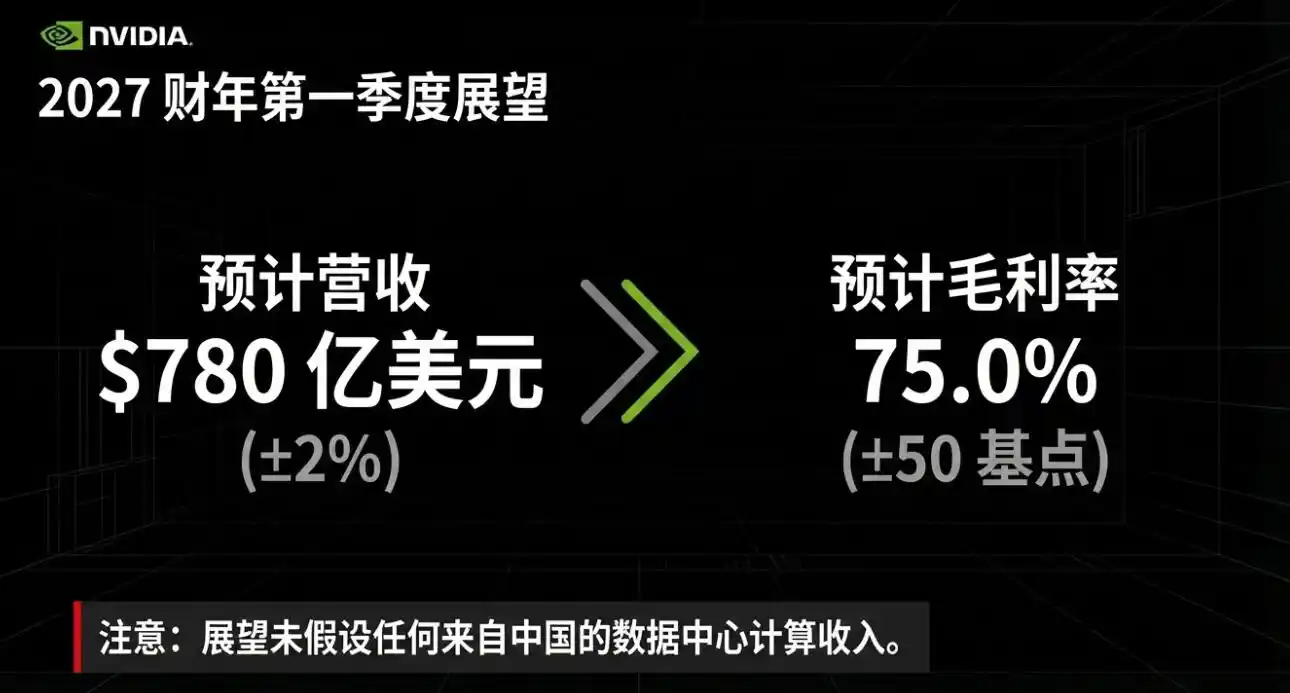
Regarding performance guidance, NVIDIA announced that Q1 revenue is expected to be $780 billion, plus or minus 2%, i.e., $764.4 billion to $795.6 billion. This range implies that NVIDIA's revenue this fiscal quarter will refresh the record high set in QQ4.

Calculated using the revenue guidance midpoint, this means NVIDIA expects Q1 revenue to grow 76.9% year-over-year, further accelerating from the 73% growth rate in QQ4.

NVIDIA's revenue guidance midpoint is not only higher than the analyst consensus midpoint of $727.8 billion but also exceeds the buy-side's optimistic expectations of $740 to $750 billion.

NVIDIA's Q1 gross margin guidance is consistent with the optimistic expectations of Wall Street buy-side analysts, expected to reach a new high since Q2 of fiscal year 2025.

The Q1 non-GAAP adjusted gross margin is expected to be 75%, plus or minus 50 basis points, i.e., 74.5% to 75.5%. The buy-side optimistic expectation was 75%, and the sell-side consensus expectation was 74.7%.
Stock-Based Compensation Included in Non-GAAP Starting Q1

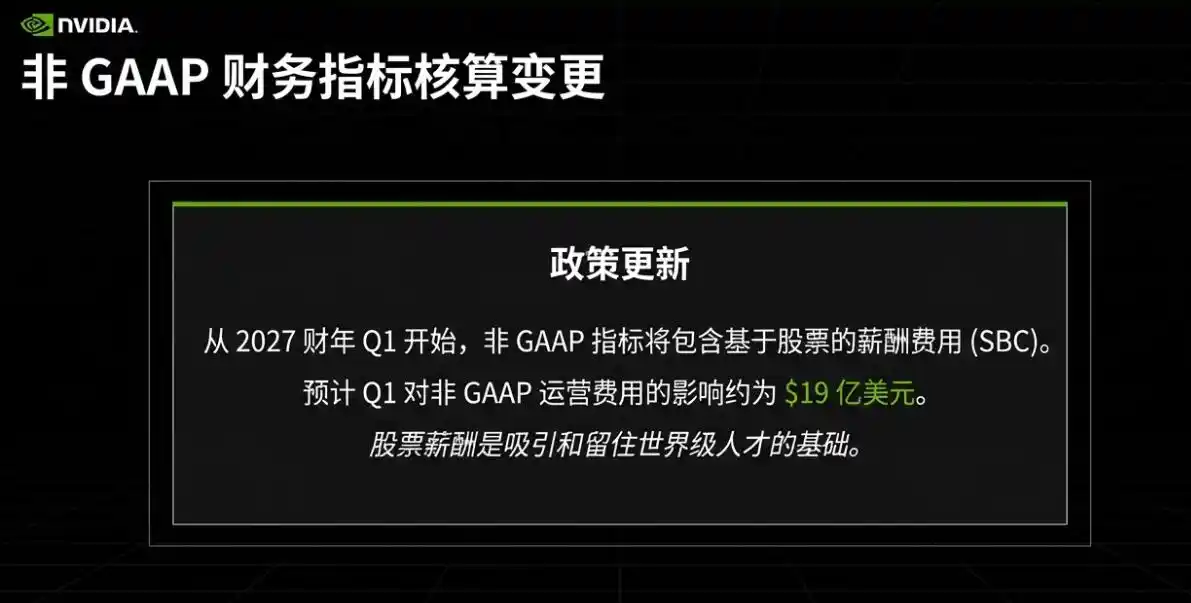
Along with the earnings release, NVIDIA announced that starting in Q1, non-GAAP financial metrics will no longer exclude stock-based compensation (SBC). Due to this adjustment, NVIDIA estimates the impact on Q1 non-GAAP operating expenses will be approximately $19 billion.

This change will directly alter the "customary口径" that the market has long used for横向 comparing profit margins and expense ratios. In the short term, it may lead to a recalibration of consensus expectation models and will also allow investors to see more clearly the真实 cost NVIDIA incurs to maintain talent and R&D leadership.
İlgili Sorular

QWhat was NVIDIA's Q4 revenue growth rate and how did it exceed expectations?

ANVIDIA's Q4 revenue grew by 73% year-over-year to $68.127 billion, exceeding analyst expectations of approximately 68% growth and $65.91 billion in revenue.

QWhat is NVIDIA's Q1 revenue guidance and how does it compare to market expectations?

ANVIDIA provided Q1 revenue guidance of $78 billion, plus or minus 2%, which represents approximately 76.9% year-over-year growth. This exceeded both the analyst consensus midpoint of $72.78 billion and buyer optimistic expectations of $74-75 billion.

QHow did NVIDIA's data center business perform in Q4 and what were the key growth drivers?

ANVIDIA's data center business revenue reached $62.314 billion in Q4, growing 75% year-over-year. The networking segment was particularly strong with 263% growth, driven by NVLink compute fabric for GB200/GB300 systems and growth in Ethernet and InfiniBand platforms.

QWhat changes did NVIDIA announce regarding non-GAAP financial reporting starting Q1?

ANVIDIA announced that starting Q1, non-GAAP financial metrics will no longer exclude stock-based compensation (SBC). This change is expected to impact non-GAAP operating expenses by approximately $1.9 billion in Q1.

QHow did CEO Jensen Huang update NVIDIA's chip revenue expectations?

ACEO Jensen Huang raised NVIDIA's chip revenue expectations, stating that the company will exceed the previously stated $500 billion target for chip orders received for 2025 and 2026 calendar years, which includes the next-generation Rubin chips beginning mass production this year.

İlgili Okumalar

Has Hook Summer Really Arrived? sato, Lo0p, FLOOD Ignite the New Narrative of Uniswap v4

"Hook Summer" Arrives? Sato, Lo0p, FLOOD Ignite Uniswap v4 Narrative Amidst a slight market recovery, attention within the Ethereum ecosystem has shifted to Meme coins built on Uniswap v4's Hook protocol. Following ASTEROID, tokens like sato, sat1, Lo0p, and FLOOD have become market focal points, with market caps ranging from millions to tens of millions, bringing concentrated liquidity to a narrative-dry market. Uniswap v4 Hooks are "plugin smart contracts" that allow developers to inject custom logic at key points in a liquidity pool's lifecycle (initialization, adding/removing liquidity, swaps, etc.), making the AMM programmable. Recent representative projects include: * **sato**: Market cap peaked over $38M; uses a v4 curve mechanism for minting/burning, locking ETH as reserve. * **sat1**: Market cap briefly exceeded $10M, positioning as an "optimized sato," but later declined significantly. * **Lo0p**: Market cap neared $6.6M; a "lending AMM protocol" allowing users to borrow ETH against deposited LO0P tokens without immediate selling pressure. * **FLOOD**: Market cap approached $6M; channels trading reserves into Aave v3 to generate yield, which is retained in the pool. The emergence of these Hook-based tokens could drive long-term growth for the Uniswap ecosystem by attracting users and liquidity to v4 pools. Combined with Uniswap's activated fee switch (partially used to burn UNI), the long-term outlook for UNI appears positive. However, short-term UNI price appreciation is not directly guaranteed. Factors include the sustainability and lifecycle of these new tokens, their price volatility, overall market conditions, and regulatory pressures. Currently, Uniswap v4's TVL ($595M) lags behind v3 and v2, indicating Hook adoption still requires time to mature. In summary, the Hook ecosystem serves as "long-term nourishment" for UNI, but acts more as a "catalyst" than a direct "booster" in the short term. Note: These are early-stage experimental tokens and may carry unknown risks.

marsbit3 dk önce

Has Hook Summer Really Arrived? sato, Lo0p, FLOOD Ignite the New Narrative of Uniswap v4

marsbit3 dk önce

Has Hook Summer Truly Arrived? sato, Lo0p, FLOOD Ignite the New Uniswap v4 Narrative

With the broader market showing signs of recovery, a new wave of interest has emerged around Ethereum-based meme coins. Following ASTEROID, tokens like sato, sat1, Lo0p, and FLOOD, built upon the Uniswap v4 Hook protocol, are capturing market attention. Their market capitalizations range from millions to tens of millions of dollars, injecting much-needed focused liquidity into a market lacking narratives. This article explores whether this trend signifies an incoming "Hook Summer" and its potential impact on UNI's price. Hooks are essentially plug-in smart contracts for Uniswap v4 liquidity pools, allowing developers to inject custom logic at key points in a pool's lifecycle (like initialization, adding/removing liquidity, swaps). This transforms the AMM into programmable building blocks. Key highlighted projects include: * **sato**: Peaked over $38M market cap. It utilizes a v4 curve for minting/burning; buying locks ETH as reserve to mint new tokens, while selling redeems ETH from the reserve and burns tokens. * **sat1**: Market cap briefly exceeded $10M, promoted as an "optimized sato," but later declined significantly. * **Lo0p**: Reached nearly $6.6M. It's a lending AMM protocol where buying LO0P tokens locks them as collateral, allowing users to borrow ETH from the pool reserve at 40% LTV, aiming to improve capital efficiency for idle ETH in LPs. * **FLOOD**: Peaked near $6M. Its mechanism directs asset reserves from buys into Aave v3 to generate yield, with fees and interest retained in the pool to potentially influence the token's price long-term. In the long term, the development of the Hook ecosystem can attract users and liquidity to Uniswap v4, benefiting UNI's fundamentals—especially combined with the recent activation of the protocol fee switch, where a portion of fees is used to burn UNI. However, in the short term, these Hook-based tokens are unlikely to directly drive significant UNI price appreciation. Their impact is moderated by factors like token sustainability, price volatility, and broader market and regulatory conditions. Currently, Uniswap v4's TVL ($595M) still trails behind v2 and v3, indicating adoption and growth will take time. The article concludes that while the Hook ecosystem provides long-term "nourishment" for UNI, its short-term role is more of a "catalyst" than a "booster." Readers are cautioned that these are early-stage experimental tokens and may carry unknown risks.

Odaily星球日报15 dk önce

Has Hook Summer Truly Arrived? sato, Lo0p, FLOOD Ignite the New Uniswap v4 Narrative

Odaily星球日报15 dk önce

Interview with Michael Saylor: I Did Say I Would Sell Bitcoin, But Never a Net Sale

Interview with Michael Saylor: I Said We'd Sell Bitcoin, But Never Be a Net Seller In a recent podcast, MicroStrategy Executive Chairman Michael Saylor clarified the company's stance on potentially selling Bitcoin. Following MicroStrategy's earnings call statement about being prepared to sell BTC to fund dividends for its STRC (Strategic) credit product, Saylor emphasized the distinction between selling and being a "net seller." Saylor explained the core business model: MicroStrategy sells credit instruments like STRC and uses the proceeds to buy Bitcoin, which is viewed as "digital capital" expected to appreciate around 30-40% annually. A portion of these capital gains can then be used to pay the dividends on the credit products. He stressed that even if the company sells some Bitcoin for dividends, it simultaneously buys much more with new credit issuance. For example, after raising $3.2 billion from STRC sales in April, the dividend obligation was only $80-90 million, making the company a net buyer. The clarification aims to counter market narratives questioning the value of Bitcoin on MicroStrategy's balance sheet if it were never sold, and to dismiss claims of a "Ponzi scheme." Saylor reiterated his personal philosophy for investors: "Don't be a net seller of bitcoin" and ensure your Bitcoin holdings increase each year. Saylor also discussed Bitcoin's role as the foundation for "digital credit," noting that STRC has become the largest and most liquid preferred stock issue in the U.S., offering high risk-adjusted returns (Sharpe ratio). He highlighted Bitcoin's deep liquidity, stating that even large purchases by MicroStrategy do not move the market significantly, which is driven by macro factors, geopolitical tensions, and capital flows from ETFs and credit products. Finally, Saylor reflected on his early inspiration from sci-fi books, which motivated his path to MIT, and maintained his fundamental thesis on Bitcoin remains unchanged: it is superior digital capital enabling superior digital credit.

链捕手20 dk önce

Interview with Michael Saylor: I Did Say I Would Sell Bitcoin, But Never a Net Sale

链捕手20 dk önce

Beaten SK Hynix Employees in China: Year-end Bonus Less Than 5% of Korean Staff's

"SK Hynix Chinese Staff Hit Hard: Bonuses Less Than 5% of Korean Counterparts" Driven by the AI boom, South Korea's SK Hynix is experiencing record performance, with media reports predicting massive year-end bonuses for its employees, making them highly desirable in the matchmaking market. However, this prosperity starkly contrasts with the situation for the company's Chinese employees. According to reports, SK Hynix operates under a rule allocating 10% of operating profit for employee bonuses. While projections suggest Korean employees could receive bonuses reaching millions of RMB, a Chinese employee with over a decade of technical experience revealed the disparity: "If they get 3 million, Chinese staff get less than 5% of that." After adjustments based on KPI ratings, this employee's highest bonus was slightly over 100,000 RMB. Bonuses are paid annually in Korea but semi-annually in China. During the industry downturn in 2023-2024, Chinese employees received no bonus at all. The gap extends beyond bonuses. Recruitment posts for SK Hynix's Chinese factories (in Wuxi, Dalian, Chongqing) show engineer monthly salaries ranging from 10,000 to 35,000 RMB, with a 13th-month salary promised. Chinese employees also receive standard benefits like annual leave but lack stock incentives, which are reportedly unavailable to them. Furthermore, management positions in China are predominantly held by Korean personnel, though industry observers note a gradual increase in local middle managers over time. SK Hynix has confirmed the 10% bonus rule but cautioned that specific future bonus amounts remain unpredictable. The company forecasts strong demand for HBM and other high-value enterprise products for the next 2-3 years, driven by AI infrastructure investment. This focus on business-to-business markets may continue to constrain supply for consumer products, potentially prolonging price increases for components like memory.

链捕手33 dk önce

Beaten SK Hynix Employees in China: Year-end Bonus Less Than 5% of Korean Staff's

链捕手33 dk önce

İşlemler

Spot
Futures
活动图片





